
Speaking and Listening is its own row on a Victorian school report, scored on the same half-level scale as reading and writing. In the Victorian Curriculum it covers two kinds of talk at every level: talking with others (taking turns, listening, building on what someone said) and speaking to an audience (from Prep news to a Year 6 presentation). Prep to Year 3 give short talks; from Year 4 they are expected to be structured. Turn-taking is a Year 1 skill, paraphrasing and questioning is Year 5, and adjusting for a formal audience is Year 6. There is no statewide test: the score is the teacher’s judgement, from class assessments and from watching your child talk.
So when the report says “English: Speaking and Listening” with a number beside it, that number is about how your child talks in class discussions and how they present, not how much they talk. This page sets out what each year asks for, in Victoria and the rest of Australia, two pieces of fine print that change how you read the row, five patterns that show where your child is, a two-minute check at the dinner table, and a twenty-minute routine.
Two kinds of talk, on every level
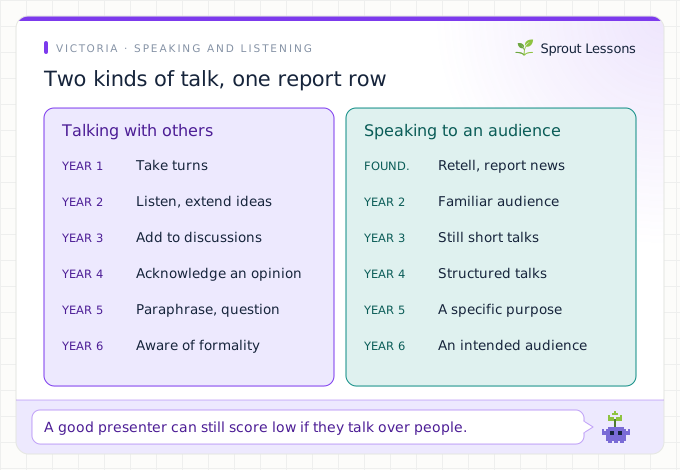
The Victorian Curriculum’s English achievement standards are written in three modes, which are the three English rows on the Department’s model report: Speaking and Listening, Reading and Viewing, and Writing. At every level from Foundation to 10, the Speaking and Listening standard has two halves (paraphrased here from the VCAA):
- When interacting with others: the vocabulary your child uses, how they change their language for the situation, and how they take part in a conversation or discussion. Turn-taking is named at Level 1, actively listening and extending ideas at Level 2, and strategies such as paraphrasing and questioning by Level 6.
- When speaking to an audience: delivering a spoken text, from retelling a story at Foundation to a structured talk with digital elements by Level 5, using “features of voice” (volume, pace, tone and pitch) to suit it.
A child can be strong in one half and weak in the other. The confident presenter who interrupts every discussion and the quiet child who listens well and freezes at the front of the room both end up with a middling score for opposite reasons. If the number surprises you, ask which half it came from.
What the curriculum asks for, year by year
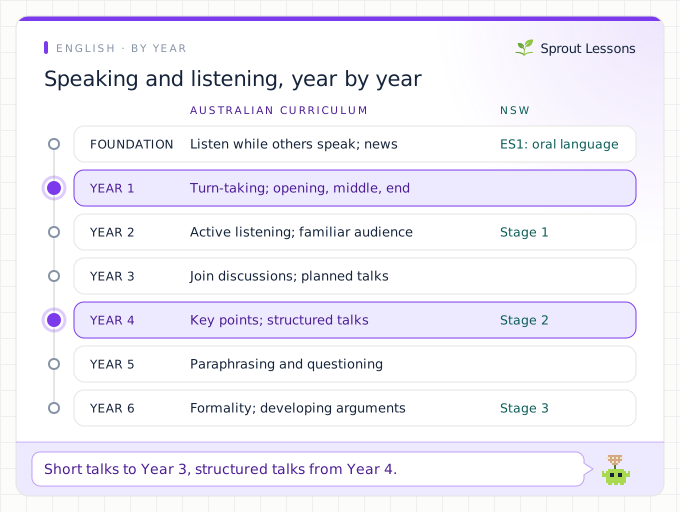
In the Australian Curriculum the same two kinds of talk sit in the Literacy strand, one descriptor for interacting and one for presenting in each year. The interacting descriptors, quoted from ACARA, with the presenting step beside each:
- Foundation, AC9EFLY02: “interact in informal and structured situations by listening while others speak and using features of voice including volume levels”. Presenting (AC9EFLY07) is short spoken reports of ideas and events to classmates: news, or show and tell.
- Year 1, AC9E1LY02: “use interaction skills including turn-taking, speaking clearly, using active listening behaviours and responding to the contributions of others, and contributing ideas and questions”. Presentations (AC9E1LY07) now have “an opening, middle and concluding statement”.
- Year 2, AC9E2LY02: “use interaction skills when engaging with topics, actively listening to others, receiving instructions and extending own ideas, speaking appropriately, expressing and responding to opinions, making statements, and giving instructions”. Presentations (AC9E2LY07) are rehearsed for “familiar audiences and purposes”.
- Year 3, AC9E3LY02: “use interaction skills to contribute to conversations and discussions to share information and ideas”. Presentations (AC9E3LY07) are planned for the first time, to inform, give an opinion or tell a story.
- Year 4, AC9E4LY02: “listen for key points and information to carry out tasks and contribute to discussions, acknowledging another opinion, linking a response to the topic, and sharing and extending ideas and information”. Presentations (AC9E4LY07) become “structured”, and can present an argument.
- Year 5, AC9E5LY02: “use appropriate interaction skills including paraphrasing and questioning to clarify meaning, make connections to own experience, and present and justify an opinion or idea”. Presentations (AC9E5LY07) add visual and digital features.
- Year 6, AC9E6LY02: “use interaction skills and awareness of formality when paraphrasing, questioning, clarifying and interrogating ideas, developing and supporting arguments, and sharing and evaluating information, experiences and opinions”. Presentations (AC9E6LY07) develop a theme or idea.
- Year 7, AC9E7LY02: “use interaction skills when discussing and presenting ideas and information including evaluations of the features of spoken texts”. Secondary students start judging talk, not just giving it.
Where Victoria differs (the VCAA wording is paraphrased here, not quoted). The interacting descriptors match the national ones level by level, but sit one number earlier: turn-taking is VC2E1LY01, paraphrasing is VC2E5LY01. Presenting is split in two. Victoria has a short descriptor about delivering a spoken text to an audience using features of voice (VC2EFLY02 at Foundation through VC2E7LY02 at Level 7), and puts the creating of a talk, its structure and content, into the descriptors for creating texts, which cover written and spoken texts together (for example VC2E3LY11). The Victorian achievement standard expects short talks up to Level 3 and structured talks from Level 4.
Where NSW differs (the NESA outcomes are paraphrased). The NSW English K–10 syllabus has one oral language and communication outcome per stage. Kindergarten communicates with familiar peers and adults using the conventions of conversation (ENE-OLC-01). Stage 1, Years 1 and 2, extends and elaborates ideas in social and learning talk (EN1-OLC-01). Stage 2 communicates with familiar audiences by interacting, understanding and presenting (EN2-OLC-01). Stage 3 communicates with wide audiences, with social and cultural awareness, and analyses and evaluates for understanding (EN3-OLC-01). Our Stage 1 English codes page covers EN1-OLC-01 in detail.
Two pieces of fine print on the Victorian report
Listening to a story is Reading and Viewing, not Speaking and Listening. At Foundation and Level 1, the Victorian Reading and Viewing standard begins with listening alongside reading and viewing. Understanding a book read aloud counts towards that row. The listening in Speaking and Listening is listening in conversation: waiting, following what someone said, and responding to it.
Planning a talk can count towards Writing. From Level 1 the Writing standard covers creating spoken texts as well as written ones. A child whose talk is well organised but mumbled may get credit for the organisation in Writing and lose marks for the delivery in Speaking and Listening. That is why a talk at home is worth practising out loud, not just writing out.
Five patterns that tell you where your child is
1. Talking over people (Foundation to Year 1)
A five-year-old who blurts out the answer, or starts telling you about their day while you are mid-sentence, is not being rude. Turn-taking is a Year 1 skill (AC9E1LY02), which means Foundation children are still learning it. The fix is a visible turn: a talking object at the dinner table (a spoon will do), passed on when you finish. Two weeks of it usually does more than any number of reminders.
2. “And another thing” instead of a reply (Years 2 to 4)
Listen to a group of eight-year-olds and each one is often having their own conversation. They wait their turn, then say what they were already going to say. The curriculum asks for more from Year 2: “extending own ideas”, and in Year 4 “linking a response to the topic” and “acknowledging another opinion”. The fix is one sentence starter: “You said ..., and I think ...”. Use it yourself at dinner, then ask your child to use it once. In Years 5 and 6 the same move becomes paraphrasing (“So you mean ...?”), which is exactly the skill AC9E5LY02 names.
3. A talk that is a list (Foundation to Year 3)
“On the weekend we went to the park and then we got ice cream and then we went home and then ...”. Prep teachers hear this at news time all the time, and it is fine at Foundation. From Year 1 the curriculum expects an opening, middle and concluding statement (AC9E1LY07). The fix is three fingers: one for “what this is about”, one for “the best bit”, one for “how it ended”. Ask your child to tell you something in three fingers, then hold up a fourth and say no more.
4. Reading the cue card word for word (Years 4 to 6)
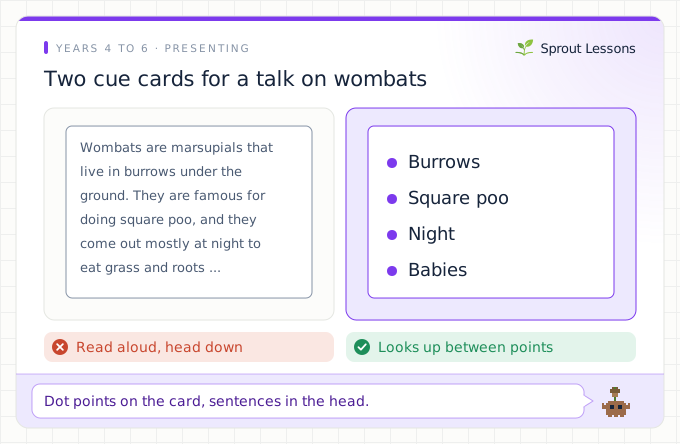
From Year 4 a presentation is planned and rehearsed (AC9E4LY07), and many children write the whole talk out and then read it with their head down. The content may be good; the delivery, which is what “features of voice” describes, disappears. The fix is to move the sentences off the card. Write the talk out once if that helps, then make a cue card with four dot points and practise from that, out loud, three times. Record the third go on a phone and watch it back together: most children fix their own pace once they hear it.
5. A quiet child with a low score (any year)
Quiet is not the same as below level. The standard describes skills, not how often a child speaks up, but a teacher can only score what they see, and a child who never speaks in a whole-class discussion leaves little evidence. If your quiet child’s score is low, ask the teacher what the score was based on, and whether they have seen your child talk in a small group or one to one. Many quiet children do much better with a partner first, then a small group, then the class. Practising a talk at home to one adult, then to the whole family, is the same ladder.
A two-minute check at the dinner table
Each question maps to a year. Stop at the first one that is hard.
- Foundation: Tell me one thing that happened today. Then wait while I tell you mine.
- Year 1: Tell me about your day with a start, a middle and an end.
- Year 2: Give me instructions to make a sandwich, step by step, while I do exactly what you say.
- Years 3 and 4: I think dogs are better than cats. Tell me what you think, and start with what I said.
- Year 5: I will tell you something for thirty seconds. Then tell me back what I meant in your own words, and ask me one question about it.
- Year 6: Explain the same thing twice: once to your friend, once to the principal. What did you change?
Want practice set in their world? Sprout writes English lessons on the exact Victorian code your child is working on, around what they love, from footy to horses. Try it free.
Twenty minutes a week, most of it at dinner
- Five minutes: one topic, everyone talks. Pick a question (best animal, worst chore). Each person answers, starting with what the last person said.
- Five minutes: you are the teacher. Your child teaches you something they know well, a game rule or a footy tactic, while you ask real questions.
- Five minutes: instructions game. Back to back, one of you describes a simple drawing and the other draws it without looking. Then swap. It is listening for key points, the Year 4 skill, with a result you can both see.
- Five minutes: the one-minute talk. From Year 3, your child gives a one-minute talk on anything, from dot points, and you record it. Watch it back and pick one thing to change next week.
What is not the problem
- An accent, or English as an additional language. Students learning English as an additional language are reported on a separate EAL scale in Victoria, not the age-expected one, so the Speaking and Listening row means something different for them. Ask which scale the report uses.
- A speech sound difference, such as a lisp. That is a question for a speech pathologist, not this row. The curriculum is about using talk, not pronouncing every sound.
- Being shy at home. Plenty of children talk more at school than at home, and the reverse. Ask the teacher what they see before deciding there is a problem.
Where this sits
For the whole report, including how the half-level scores and ratings work, see the Victorian school report explained, and for Levels and codes, the Victorian Curriculum explained. Speaking and listening feed straight into reading comprehension and persuasive writing, which use the same opinion and evidence skills on paper. The teacher-facing Level 3 English codes and Level 5 English codes list every Victorian descriptor.
The short version
- On a Victorian report, Speaking and Listening is its own English row, scored on the half-level scale.
- It covers two kinds of talk: talking with others and speaking to an audience. Ask which half a low score came from.
- Turn-taking is Year 1, building on what others say is Years 2 to 4, paraphrasing is Year 5, formality is Year 6.
- Talks are short to Year 3 and structured from Year 4.
- Listening to stories counts under Reading and Viewing at Foundation and Level 1.
- There is no statewide test. A quiet child may simply have left the teacher too little to score.
Sprout makes English lessons on the exact code your child is working on, set around what they love. Start free.
How this page was checked
The report rows are from the Department of Education’s model reports: the primary model report has separate rows for English: Speaking and Listening, Reading and Viewing, and Writing, and its explainer says alternative scales must be used for EAL students. The Victorian achievement standards and their two halves are from the Victorian Curriculum F–10 version 2.0 English curriculum, read for every level from Foundation to 10. The Australian Curriculum descriptors are quoted from our copy of version 9.0, and the NSW outcomes are from the NSW English K–10 Syllabus outcomes. Victorian and NSW wording is paraphrased. Checked 5 November 2026.
Australian Curriculum content descriptions are © Australian Curriculum, Assessment and Reporting Authority (ACARA) 2010 to present, licensed under CC BY 4.0, and quoted here unmodified. ACARA does not endorse any product that uses the Australian Curriculum. Victorian Curriculum codes reference the Victorian Curriculum F–10 Version 2.0 © VCAA, paraphrased; the VCAA does not endorse this product. NSW outcome codes reference the NSW syllabuses © NSW Education Standards Authority (NESA) for and on behalf of the Crown in right of the State of New South Wales, paraphrased, available at curriculum.nsw.edu.au; NESA does not endorse this product.
FAQ
What does Speaking and Listening mean on a Victorian school report?
It is one of three English rows on the Department of Education model report, alongside Reading and Viewing and Writing, scored on the same half-level scale. In the Victorian Curriculum it covers two kinds of talk at every level: talking with others (taking turns, listening, building on what someone said) and speaking to an audience (from Prep news to a structured presentation).
How is Speaking and Listening assessed?
There is no statewide test. Teachers judge it from class assessments and from what they observe in discussions, group work and presentations, against the Victorian Curriculum achievement standard. A quiet child may leave the teacher too little to score, so if a score surprises you, ask what it was based on and which half, conversation or presenting, it came from.
What should a Year 3 oral presentation include?
In the Australian Curriculum, Year 3 presentations are planned, created and rehearsed to inform, express an opinion or tell a story, with a clear structure, details, precise vocabulary, visual features and appropriate tone, pace, pitch and volume (AC9E3LY07). In Victoria the talks are still expected to be short at Level 3; structured talks are expected from Level 4.
When do children learn turn-taking in the curriculum?
Year 1. AC9E1LY02 names turn-taking, speaking clearly, active listening and responding to others. In Victoria the same skills are VC2E1LY01. Foundation children are still learning to listen while others speak, so blurting out is normal at that age.
Does listening to stories count towards Speaking and Listening?
Not in Victoria at the early levels. At Foundation and Level 1 the Victorian Reading and Viewing standard includes listening, so understanding a story read aloud counts towards Reading and Viewing. The listening in Speaking and Listening is listening in conversation.