
In the Australian Curriculum, children write an opinion in Year 1 and a short persuasive text in Year 2. Year 3 groups the ideas into paragraphs and learns how modal verbs make a claim stronger or softer. Year 4 links the reasons and separates opinion from fact, and Year 5 is told to move beyond bare assertions by taking account of other views and authoritative sources. NAPLAN can set a persuasive task in Years 3, 5, 7 and 9, and nobody knows until the day.
So persuasive writing is not a NAPLAN trick. It is in the curriculum every year from Year 1, and what changes from year to year is not the shape (opinion, reasons, conclusion) but what counts as a good reason. This page sets out what each year asks for, how the NAPLAN persuasive task is actually marked, the five mistakes that tell you where your child is, a two-minute spoken check and a twenty-minute routine that does not need a pen.
What the curriculum asks for, year by year
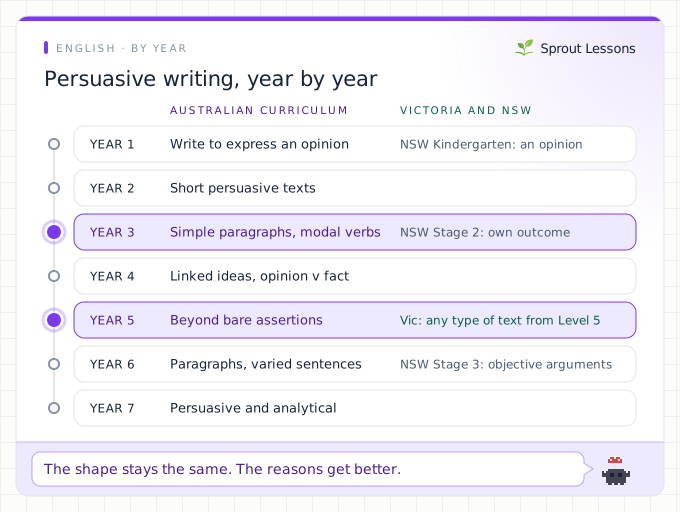
The Australian Curriculum descriptors, quoted from ACARA:
- Year 1, AC9E1LY06: “create and re-read to edit short written and/or multimodal texts to report on a topic, express an opinion or recount a real or imagined event”. AC9E1LY03 adds telling the difference between imaginative, informative and persuasive texts.
- Year 2, AC9E2LY06: “create and edit short imaginative, informative and persuasive written and/or multimodal texts for familiar audiences, using text structure appropriate to purpose, simple and compound sentences”. The word persuasive first appears in a writing descriptor here.
- Year 3, AC9E3LY06 and AC9E3LA02: persuasive texts “with ideas grouped in simple paragraphs”, and “understand how the language of evaluation and emotion, such as modal verbs, can be varied to be more or less forceful”. Should, must, might and could arrive in Year 3.
- Year 4, AC9E4LY06 and AC9E4LA02: “relevant linked ideas, complex sentences”, and “identify the subjective language of opinion and feeling, and the objective language of factual reporting”. AC9E4LY07 asks for a spoken argument using both kinds of language.
- Year 5, AC9E5LA02 and AC9E5LY06: “understand how to move beyond making bare assertions by taking account of differing ideas or opinions and authoritative sources”, and writing that develops ideas using “text structure appropriate to the topic and purpose, text connectives”. This is the biggest single step in the sequence.
- Year 6, AC9E6LY06: “using paragraphs, a variety of complex sentences, expanded verb groups”, with AC9E6LY02 adding “developing and supporting arguments” in discussion.
- Year 7, AC9E7LY06: texts that convey “information, ideas and opinions in ways that may be imaginative, reflective, informative, persuasive and/or analytical”. Analytical writing, the essay, starts to take over from here.
Where Victoria differs (the VCAA wording is paraphrased here, not quoted). The Victorian descriptors for creating texts cover written and spoken texts together, and they name persuasive texts at Levels 2, 3 and 4 (VC2E2LY11, VC2E3LY11, VC2E4LY10). At Levels 5 and 6 they switch to creating different types of texts with elaborated, then developed and organised, ideas (VC2E5LY10, VC2E6LY09), and the next one to name opinions directly is Level 8 (VC2E8LY08). The Level 3 modal verbs descriptor is about what modals mean (obligation, probability, possibility) rather than how forceful they are (VC2E3LA09). And Victoria adds editing against agreed criteria at Levels 5 and 6 (VC2E5LY11, VC2E6LY10), which is exactly what a NAPLAN marking guide is.
Where NSW differs (the NESA wording is paraphrased). The NSW English K–10 Syllabus has children give an opinion in writing from Kindergarten, and in Stage 1 they use what they know about persuasive texts when planning. Stage 2 (Years 3 and 4) gives persuasive writing its own outcome, EN2-CWT-03, and its content asks for a statement of position, sequenced paragraphs that begin with a topic sentence, facts or opinions to back the viewpoint, rhetorical devices and modality. Stage 3 (Years 5 and 6) folds the purposes back into one outcome (EN3-CWT-01) and asks for objective, impersonal arguments, personal and objective arguments combined, more than one viewpoint, and a rhetorically effective conclusion.
How the NAPLAN persuasive task is marked
The NAPLAN writing test sets either a narrative or a persuasive task, and the text type is only revealed on the day (our narrative writing by year page covers the other one). Years 3 and 5 get different prompts from Years 7 and 9, and Year 3 sits the test on paper. Students have 5 minutes to plan, 30 to write and 5 to edit. The persuasive marking guide scores ten criteria, 48 marks in all:
- Audience, 0 to 6: does the writing engage and persuade a reader?
- Text structure, 0 to 4: an introduction, a body and a conclusion.
- Ideas, 0 to 5: how well the reasons are chosen and elaborated.
- Persuasive devices, 0 to 4: the techniques used to win the reader over.
- Vocabulary, 0 to 5; cohesion, 0 to 4; paragraphing, 0 to 3.
- Sentence structure, 0 to 6; punctuation, 0 to 5; spelling, 0 to 6.
Two details from the guide are worth knowing at home. Under Ideas, four or more reasons that are never explained sit in the same band as one reason explained properly, so more reasons is not the way up. And under Text structure, the higher bands look for a conclusion that is more than a restatement of the main points: it reflects on the issue or recommends action. Spelling, punctuation and sentences are 17 of the 48 marks; the other 31 are about the argument.
Five mistakes that tell you where your child is
1. “I like dogs because they are cute.” (Years 1 and 2)
An opinion and a reason, which is exactly the Year 1 target. The step to Year 2 is noticing the reader: persuading someone is different from saying what you like. Ask “who are you trying to convince, and what would make them agree?” A Year 2 child who writes “Our class should get a dog because it would teach us to look after animals” has made the jump.
2. The argument turns into a story (Years 2 and 3)
Asked whether children should be allowed pets at school, the child writes about the day their dog got into the classroom. It is a good story, and under Text structure the marking guide counts it as the wrong text type. This mistake is common in Year 3 because recounts and narratives are what young children write most. The fix is the frame: first sentence says what you think, each paragraph gives one reason, the last paragraph says it again in a new way. A story can stay, as an example inside a reason.
3. “Everyone knows zoos are cruel!!!” (Years 3 to 5)
Loud, certain and unsupported. Everyone, always and never are the most forceful words a child knows, and the exclamation marks do the rest. This is the bare assertion that AC9E5LA02 asks children to move beyond, and the Year 3 modal verbs descriptor is where the tools start. Ask: is it true that everyone knows? Would “many people think” or “zoos can be cruel when” be harder to argue with? A claim the reader cannot immediately disagree with persuades better than a loud one.
4. Five reasons, none of them explained (Years 3 to 6)
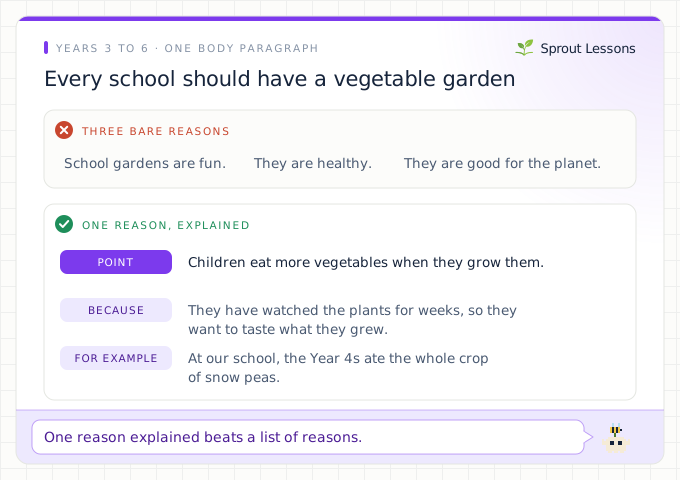
“School gardens are fun. They are healthy. They are good for the planet.” Three reasons in three short sentences, each one a bare assertion. This is the most common persuasive mistake from Year 3 to Year 6, and it survives because it looks like hard work: lots of reasons, a sentence each. The fix is a paragraph shape: one point, then because, then for example. Year 4 asks for linked ideas and complex sentences, and “because” is the word that builds both. Have your child pick their best reason and say three sentences about it before writing anything.
5. A conclusion that copies the introduction (Years 5 and 6)
“In conclusion, every school should have a vegetable garden”, the same words as the first line. It is a structure the child has been taught, so it is not wrong, but it rarely reaches the top of the Text structure scale, which looks for a conclusion that does something: says what should happen next, or why it matters beyond this school. “If every school in our state planted one garden bed this year, thousands of children would know where their food comes from” is a Year 6 conclusion. NSW Stage 3 calls this a rhetorically effective conclusion.
A two-minute spoken check
Persuading out loud uses the same thinking without the handwriting, so you can see the argument on its own. Ask: “Should kids your age get pocket money?” Let them talk, then listen for these, in order:
- Year 1: did they say what they think? (“Yes, they should.”)
- Year 2: did they give a reason with because?
- Year 3: did they pick a word for how sure they are, such as should, must or might?
- Year 4: did they explain the reason, or give an example, rather than just add another reason?
- Year 5: did they mention what someone on the other side would say, and answer it? (“Some parents think kids will waste it, but…”)
- Year 6: did they finish with something more than a repeat?
The first one that is missing is the place to start. Most children can do more out loud than on paper, so if the spoken version reaches Year 5 and the written one stops at mistake 4, the gap is the writing, not the thinking.
Want practice set in their own world? Sprout writes an English lesson on AC9E4LY06 or VC2E4LY10 around what your child loves, so they argue about something they actually care about. Try it free.
Twenty minutes, mostly talking
- Five minutes: pick a side. Choose a topic your child cares about (screen time, school uniforms, a later bedtime). They pick a side and say their opinion in one sentence.
- Five minutes: one reason, three sentences. They choose their best reason and say it as a point, a because and a for example. Then write just that paragraph.
- Five minutes: the other side. You argue the other side for one minute. They answer it in one sentence starting “Some people think… but…”.
- Five minutes: the strength dial. Read their paragraph back and find one word to make stronger or softer: must, should, might, always, often. Talk about which one a reader would believe.
What is not the problem
- A short text in Year 2 or 3. Length is not one of the ten NAPLAN criteria. A short piece with one reason explained beats a long list.
- A formula. Introduction, body, conclusion is what the marking guide describes, and topic sentences are named in the NSW Stage 2 content. A formula is the scaffold; it becomes a problem only if the reasons inside it never improve.
- Spelling in a draft. Spelling is 6 marks of 48. Get the argument down first and fix the spelling at the edit stage, which NAPLAN gives five minutes for.
- Choosing the side they do not believe. Arguing a side is a skill in itself, and Year 5 and NSW Stage 3 both ask for awareness of more than one viewpoint.
Where this sits
Persuasive writing leans on the rest of the English set, and its opposite number, factual writing with no opinions in it, is on our informative writing by year page. Complex sentences and “because” clauses are on our grammar by year page, and the exclamation marks of mistake 3 on punctuation by year. If NAPLAN is the worry, see what Year 3 NAPLAN actually tests and NAPLAN preparation without the stress. For every English code in one year, the teacher-facing Year 5 English codes page lists them, and if you are not sure which curriculum applies, start with which curriculum your state uses.
The short version
- Year 1: an opinion. Year 2: a short persuasive text. Year 3: paragraphs and modal verbs.
- Year 4: linked reasons, opinion versus fact. Year 5: beyond bare assertions, other views and sources.
- Year 6: paragraphs, varied complex sentences, supported arguments. Year 7: analytical writing begins.
- NSW gives persuasive writing its own outcome in Stage 2. Victoria names it to Level 4, then says different types of texts.
- NAPLAN marks ten criteria, 48 marks, and explained reasons count for more than many reasons.
- Practise out loud: one reason, because, for example.
Sprout makes a lesson on the exact code your child is working on, with topics from their own interests. Start free.
How this page was checked
The Australian Curriculum descriptors are quoted from our copy of version 9.0, which matches AC9E5LA02 on the Australian Curriculum website; we searched every Year 1 to 8 English descriptor for persuasive, opinion, argument and modal. The NAPLAN facts come from the NAPLAN writing page and the 2026 NAPLAN Writing Persuasive Marking Guide linked from it (criteria, score ranges and timing), summarised in our own words. The Victorian codes are from the Victorian Curriculum F–10 version 2.0, and the NSW findings from the Creating written texts pages of the NSW English K–10 syllabus content for Early Stage 1 to Stage 3, read on 25 October 2026. Checked 25 October 2026.
Australian Curriculum content descriptions are © Australian Curriculum, Assessment and Reporting Authority (ACARA) 2010 to present, licensed under CC BY 4.0, and quoted here unmodified. ACARA does not endorse any product that uses the Australian Curriculum. Victorian Curriculum codes reference the Victorian Curriculum F–10 Version 2.0 © VCAA, paraphrased; the VCAA does not endorse this product. NSW outcome codes reference the NSW syllabuses © NSW Education Standards Authority (NESA) for and on behalf of the Crown in right of the State of New South Wales, paraphrased, available at curriculum.nsw.edu.au; NESA does not endorse this product. NAPLAN is administered by ACARA, which does not endorse this product.
FAQ
When do kids start persuasive writing in Australia?
In Year 1, children write to express an opinion (AC9E1LY06), and in Year 2 they create short persuasive texts (AC9E2LY06). Paragraphs and modal verbs follow in Year 3. In NSW, children give an opinion in writing from Kindergarten, and persuasive writing gets its own outcome in Stage 2 (EN2-CWT-03).
How is NAPLAN persuasive writing marked?
With a marking guide of ten criteria worth 48 marks: audience (6), text structure (4), ideas (5), persuasive devices (4), vocabulary (5), cohesion (4), paragraphing (3), sentence structure (6), punctuation (5) and spelling (6). Students have 5 minutes to plan, 30 to write and 5 to edit, and the text type, persuasive or narrative, is revealed on the day.
Will my child get a persuasive or a narrative task in NAPLAN?
Nobody knows until the day. NAPLAN sets either a narrative or a persuasive task, the same text type for every year level, and there is no choice. Years 3 and 5 get different prompts from Years 7 and 9, so practise both kinds of writing.
How many reasons should a persuasive text have?
Fewer than most children think. The NAPLAN marking guide puts four or more reasons that are never explained in the same band as one reason with developed elaboration. Two or three reasons, each with a because and an example, is a better target than a long list.
What is a bare assertion?
A claim with nothing behind it, such as "everyone knows zoos are cruel". AC9E5LA02 asks Year 5 students to move beyond bare assertions by taking account of differing ideas or opinions and authoritative sources. Softer words such as can or many people, a reason and an example all help.