
In the Australian Curriculum, children learn nouns, verbs, adjectives and adverbs and the simple sentence in Year 1, compound sentences joined by “and”, “but” or “so” in Year 2, clauses, subject–verb agreement and tense in Year 3, and complex sentences with “because” or “when” in Year 4. Expanded noun groups follow in Year 5, embedded clauses in Year 6 and compound-complex sentences in Year 7. Victoria follows the same order. NSW runs about a year ahead: nouns, verbs and adjectives are Kindergarten content there, and complex sentences start in Stage 1.
So a Year 1 child who cannot yet say what an adverb is has not fallen behind, and a Year 3 child who writes “Because it was raining.” as a whole sentence is making a Year 4 mistake a year early. The other thing worth knowing before you read your child’s worksheets is that Australian schools teach grammar in different words from the ones most parents learnt: noun groups, verb groups and processes. This page translates them, sets out what each year teaches, lists the five mistakes that tell you where your child is, and finishes with a two-minute check and a twenty-minute routine built on their own writing.
What the curriculum asks for, year by year
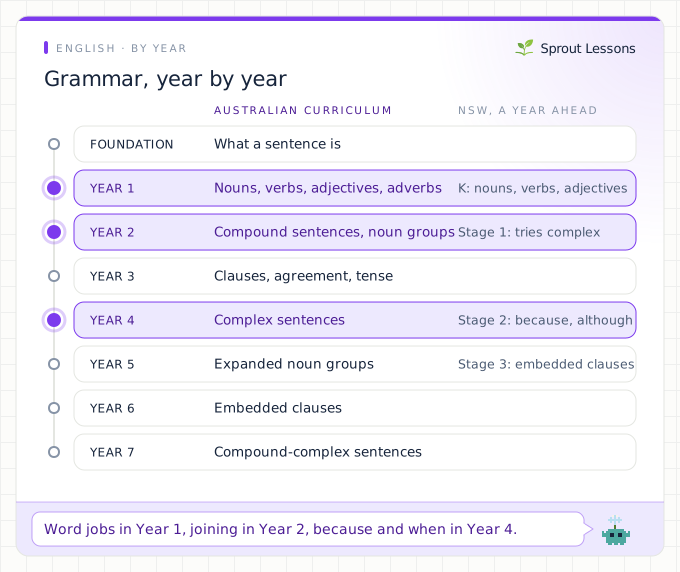
The Australian Curriculum descriptors, quoted from ACARA:
- Foundation, AC9EFLA05 and AC9EFLA06: “recognise that sentences are key units for expressing ideas” and “recognise that sentences are made up of groups of words that work together in particular ways to make meaning”. No word classes yet: the Foundation job is knowing what a sentence is.
- Year 1, AC9E1LA07: “understand that words can represent people, places and things (nouns, including pronouns), happenings and states (verbs), qualities (adjectives) and details such as when, where and how (adverbs)”. Alongside it, AC9E1LA06: “understand that a simple sentence consists of a single independent clause representing a single event or idea”.
- Year 2, AC9E2LA06: “understand that connections can be made between ideas by using a compound sentence with 2 or more independent clauses usually linked by a coordinating conjunction”. And AC9E2LA07: nouns “may be extended into noun groups using articles and adjectives, and verbs may be expressed as verb groups”.
- Year 3, AC9E3LA06 and AC9E3LA08: “understand that a clause is a unit of grammar usually containing a subject and a verb that need to agree” and “understand that verbs are anchored in time through tense”. AC9E3LA07 sorts verbs by what they represent: “doing, feeling, thinking, saying and relating”.
- Year 4, AC9E4LA06: “understand that complex sentences contain one independent clause and at least one dependent clause typically joined by a subordinating conjunction to create relationships, such as time and causality”. Year 4 also asks for past, present and future tenses and their impact on meaning (AC9E4LA09).
- Year 5, AC9E5LA06: “understand how noun groups can be expanded in a variety of ways to provide a fuller description of a person, place, thing or idea”.
- Year 6, AC9E6LA05: “understand how embedded clauses can expand the variety of complex sentences to elaborate, extend and explain ideas”. “The boy who lives next door” is an embedded clause.
- Year 7, AC9E7LA05 and AC9E7LA06: compound-complex sentences, and “consistency of tense through verbs and verb groups” for clarity. Year 8 (AC9E8LA05) examines a variety of clause structures.
Where Victoria differs (the VCAA wording is paraphrased here, not quoted). The Language descriptors match level by level, with two additions. At Level 1 (VC2E1LA07) Victoria adds prepositions, the words for relationships in time and space such as “under”, “after” and “behind”, to the list of word classes. At Level 3 it gives modal verbs their own descriptor (VC2E3LA09), naming obligation, probability and possibility (“must”, “might”, “could”), where the Australian Curriculum mentions modal verbs only inside a descriptor about forceful and less forceful language (AC9E3LA02).
Where NSW differs (the NESA wording is paraphrased). The NSW English K–10 Syllabus puts grammar inside its Creating written texts outcomes, under the headings sentence-level grammar and word-level language, and the content runs ahead of the national order. In Kindergarten (Early Stage 1), children identify and use nouns and verbs, explain what a noun, a verb and an adjective do in their own writing, write a simple sentence with a subject, verb and object, and already experiment with compound sentences. Stage 1 (Years 1 and 2) writes compound sentences with coordinating conjunctions, uses noun groups and action, saying, relating and sensing verbs, and experiments with complex sentences. Stage 2 (Years 3 and 4) uses subordinating conjunctions for sequence, cause and contrast and adds adjectival clauses to noun groups. Stage 3 (Years 5 and 6) experiments with embedded adjectival clauses, the placement of adverbial clauses and appositives.
The words on the worksheet
Australian school grammar comes from functional grammar, which describes words by the job they do in a sentence. Most of the terms map onto the ones you learnt, with a new name:
- Noun group is what you may know as a noun phrase: the noun and everything attached to it. “The hungry dog next door” is one noun group.
- Verb group is the verb with its helpers: “was running”, “might have eaten”.
- Processes are verbs sorted by meaning. Doing (ran), feeling (loved), thinking (knew), saying (whispered) and relating (is, has). NSW calls the same idea action, sensing, saying and relating verbs.
- Dependent clause is a subordinate clause: a clause that cannot stand on its own, such as “because it was raining”. The clause that can stand alone is the independent or main clause.
- Circumstances are the when, where, how and why details, usually adverbs, adverb groups or prepositional phrases: “after lunch”, “under the table”.
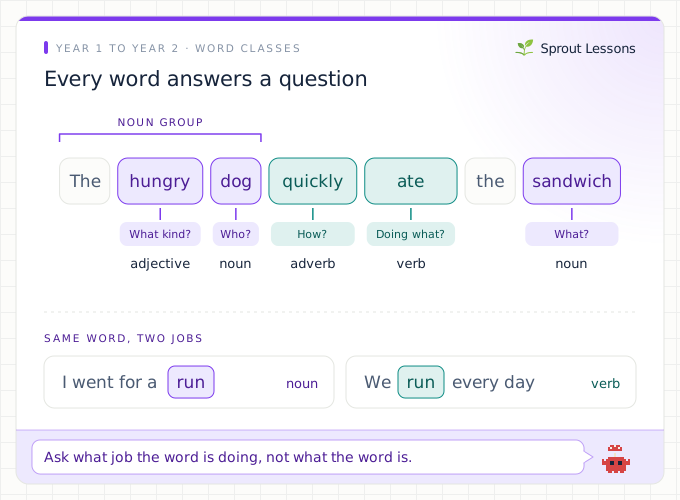
You do not need the new names to help. You need the question each one answers, which is the next figure.
Five mistakes that tell you where your child is
1. “A noun is a thing you can touch” (Year 1 and 2)
Children often learn “a noun is a person, place or thing” and take “thing” to mean an object. Ask them to find the nouns in “On Tuesday our team felt real happiness” and they will miss all three. Tuesday, team and happiness are nouns because of the job they do: each one is what the sentence is about or what is being named. The quick test is whether you can put “the” or “a” in front of it, or make it plural. The same habit sorts the trick words that change class: “a run” is a noun, “we run” is a verb.
2. “The dogs runs to the park” (Year 3)
Subject–verb agreement is Year 3 content (AC9E3LA06), and the mistake usually shows up in writing rather than speech, because the child is concentrating on the idea. The fix is to find the subject first: who is doing it? “The dogs”, more than one, so “run”. The harder version comes when a noun group sits between the subject and the verb: “The box of toys are heavy”. The subject is the box, so “is”. Cover the middle words with a finger and the right verb is usually obvious.
3. A story that slides between now and then (Year 3 to Year 7)
“We go to the beach and we swam and then Dad says it’s time to leave.” Tense arrives in Year 3 (AC9E3LA08), the three tenses and their effect in Year 4 (AC9E4LA09), and keeping tense consistent through a whole piece is a named Year 7 skill (AC9E7LA06). So this mistake is normal for longer than most parents expect. Ask your child to decide before writing whether the story is happening now or already happened, then to underline every verb and check each one against that choice.
4. “Because it was raining.” (Year 4)
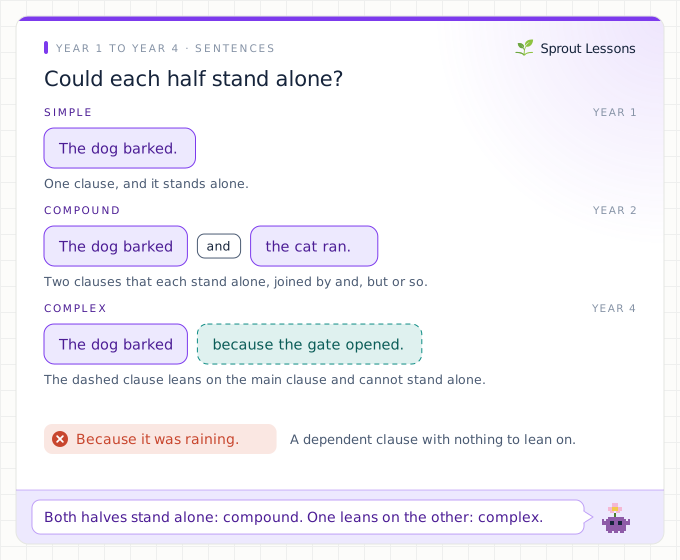
A dependent clause written as a whole sentence. It turns up in the year complex sentences are taught (AC9E4LA06), often because a child has been told not to start a sentence with “because” and has then been told that they can. Both are half true: a sentence can start with “because”, as long as the main clause follows. “Because it was raining, we stayed inside.” The test is the one in the figure: read the clause aloud on its own and ask whether it leaves you waiting for more. If it does, it needs the rest of its sentence.
5. “The big, scary, dark, old house” (Year 5)
By Year 4 most children have been told to add adjectives, and some add them in a pile. Year 5 asks for something more useful: noun groups expanded “in a variety of ways” (AC9E5LA06), which mostly means adding detail after the noun as well as before it. “The old house at the end of our street, the one with the broken gate” tells the reader more than four adjectives do. A good exercise is to take one noun from their writing and grow it three ways: one adjective before it, one phrase after it (“with the broken gate”), and one clause after it (“that nobody visits”). The clause version is the Year 6 embedded clause, arriving on time.
A two-minute grammar check
Do these out loud or on paper, in order, and stop when one goes wrong. Each one maps to a year.
- Year 1: “Sam kicked the ball over the fence.” Point to the doing word, then to two naming words. (Kicked; Sam and ball, or fence.)
- Year 2: Join “I was tired.” and “I kept reading.” into one sentence. (“I was tired but I kept reading.”)
- Year 3: Fix “Yesterday the dogs runs to the park.” (Two errors: the verb must agree with “dogs” and match “yesterday”, so “ran”.)
- Year 4: Add a “because”, “when” or “although” part to “We stayed inside.”, then say which half could stand alone.
- Year 5 and 6: Grow “the dog” with detail after the noun, then with a “who” or “that” clause. (“The dog with the muddy paws that lives next door.”)
The first one that goes wrong is where to start. A Year 2 child who manages 1 and 2 is on track outside NSW; a Year 4 child who stumbles on 3 needs agreement and tense before complex sentences will make sense.
Want practice set in their own world? Sprout writes an English lesson on AC9E4LA06 or VC2E2LA06 around what your child loves, from horses to Minecraft. Try it free.
Twenty minutes with their own writing
Grammar exercises on made-up sentences help less than the same moves on your child’s own writing. You need one piece of their writing, about half a page, and two coloured pencils.
- Five minutes: find the verbs. Your child underlines every verb in one colour. Then check each one: does it agree with who is doing it, and is it in the same time as the rest of the story? That covers mistakes 2 and 3.
- Five minutes: the stand-alone test. For every sentence with a joining word (and, but, so, because, when), read each half aloud on its own. If a half leaves you waiting, check it is attached to a main clause. That is mistake 4.
- Five minutes: join two. Find two short sentences next to each other and join them twice, once with “and” or “but” (Year 2) and once with “because”, “when” or “although” (Year 4). Read both versions and pick the better one together.
- Five minutes: grow one noun. Pick one plain noun and grow it with detail after it, as in mistake 5. Year 5 and up; younger children can add one adjective instead.
What is not the problem
- Not knowing the names in Foundation. Word classes are Year 1 content in the Australian and Victorian curricula. A Foundation child only needs to know what a sentence is. In NSW, nouns and verbs start in Kindergarten.
- Talking in better sentences than they write. Almost every child speaks in complex sentences years before they write them. Writing is slower and the grammar is the first thing to slip when the ideas get harder, which is why the routine above uses their own writing.
- Starting a sentence with “and” or “because”. Both are allowed. What matters is that a “because” clause has a main clause to lean on.
Where this sits
Grammar sits in the Language strand of the English curriculum, next to punctuation and spelling. Our pages on punctuation by year, spelling by year and handwriting by year cover the other things a parent notices first in a piece of writing. For the whole picture of a year level, see what a Year 4 student should know, and for every English code in that year, the teacher-facing Year 4 English codes page. If you are not sure which curriculum applies, start with which curriculum your state uses.
The short version
- Foundation: what a sentence is. Year 1: nouns, verbs, adjectives, adverbs and the simple sentence.
- Year 2: compound sentences and noun groups. Year 3: clauses, agreement and tense.
- Year 4: complex sentences. Year 5: expanded noun groups. Year 6: embedded clauses.
- Year 7: compound-complex sentences and consistent tense.
- Victoria adds prepositions in Level 1 and modal verbs in Level 3. NSW runs about a year ahead.
- Ask what job a word is doing, and whether each half of a sentence could stand alone.
Sprout makes a lesson on the exact code your child is working on, with examples in their own interests. Start free.
How this page was checked
The Australian Curriculum descriptors are quoted from our copy of version 9.0, which matches AC9E4LA06 on the Australian Curriculum website; we searched every Foundation to Year 8 English descriptor for nouns, verbs, adjectives, clauses, conjunctions, tense and sentences. The Victorian codes are from the Victorian Curriculum F–10 version 2.0. The NSW findings come from the NSW English K–10 content pages for Creating written texts in Early Stage 1 to Stage 3, read on 24 October 2026. Victorian and NSW wording is paraphrased. Checked 24 October 2026.
Australian Curriculum content descriptions are © Australian Curriculum, Assessment and Reporting Authority (ACARA) 2010 to present, licensed under CC BY 4.0, and quoted here unmodified. ACARA does not endorse any product that uses the Australian Curriculum. Victorian Curriculum codes reference the Victorian Curriculum F–10 Version 2.0 © VCAA, paraphrased; the VCAA does not endorse this product. NSW outcome codes reference the NSW syllabuses © NSW Education Standards Authority (NESA) for and on behalf of the Crown in right of the State of New South Wales, paraphrased, available at curriculum.nsw.edu.au; NESA does not endorse this product.
FAQ
What year do kids learn nouns and verbs in Australia?
Year 1. AC9E1LA07 names nouns (including pronouns), verbs, adjectives and adverbs, and Victoria adds prepositions at Level 1 (VC2E1LA07). Foundation only asks children to recognise what a sentence is. In NSW, nouns, verbs and adjectives are Kindergarten content.
When do kids learn compound and complex sentences?
Compound sentences, two clauses joined by and, but or so, are Year 2 (AC9E2LA06). Complex sentences, a main clause with a dependent clause joined by a word such as because, when or although, are Year 4 (AC9E4LA06). NSW experiments with compound sentences in Kindergarten and with complex sentences in Stage 1 (Years 1 and 2).
What is a noun group?
A noun with everything attached to it, what many parents learnt as a noun phrase. The hungry dog next door is one noun group. Australian schools use the term from Year 2 (AC9E2LA07), and Year 5 asks children to expand noun groups with detail after the noun as well as before it.
Is it wrong to start a sentence with because?
No. A sentence can start with because as long as a main clause follows: Because it was raining, we stayed inside. The mistake is writing the because part on its own, which is a dependent clause with nothing to lean on. It is common in Year 4, the year complex sentences are taught.
Why does my child mix up past and present tense in stories?
Because keeping tense consistent through a whole piece is a skill the curriculum spreads over years: tense arrives in Year 3 (AC9E3LA08), its effect on meaning in Year 4, and consistency through verbs and verb groups is named again in Year 7 (AC9E7LA06). Ask your child to decide first whether the story is now or already happened, then check every verb against that.