
VCE has four maths subjects. Foundation Mathematics is practical maths for everyday life and work. General Mathematics is statistics, finance, matrices and networks, with no calculus. Mathematical Methods is functions, calculus and probability, and it is the one most university prerequisites name. Specialist Mathematics extends Methods and is taken alongside it. Maths is not compulsory for the VCE, but the Year 11 choice decides which Year 12 subjects stay open, and some courses require Methods.
If your child is finishing Year 10 in Victoria, the choice is being settled now, and it usually gets made on one question: “which one is easier?” That is the wrong question, because the subjects are not easier and harder versions of one thing. They teach different mathematics for different futures. This page sets out what each subject is, what the exams look like, which doors each choice keeps open, a five-question check against the Year 10 curriculum, and what to do if the school’s advice and your child’s plans do not match.
The four subjects, side by side
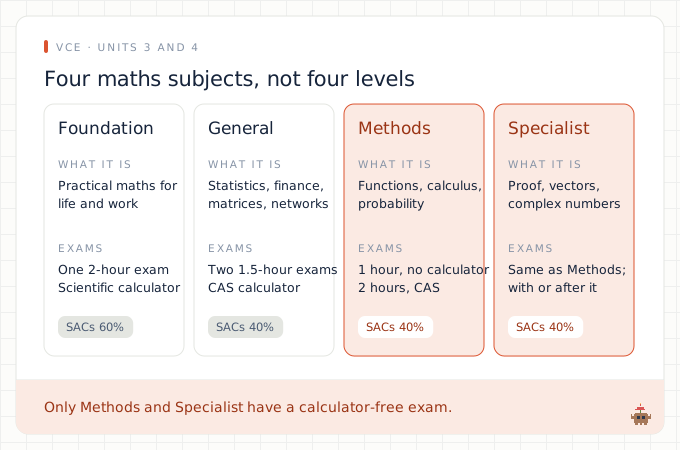
All four come from one VCAA study design, accredited from 2023. In the VCAA’s own descriptions (paraphrased here):
- Foundation Mathematics is maths for practical contexts at home, at work, in the community and in further study: budgets, measurement, plans, data in the news. The Year 12 study score is 60% coursework (SACs) and 40% one two-hour exam with a scientific calculator.
- General Mathematics is non-calculus maths: data analysis, recursion and financial modelling, matrices and networks. The VCAA describes it as widely accessible and as preparation for employment, business and further study. Year 12 is 40% coursework and two 1.5-hour exams worth 30% each, one multiple choice and one written, with a CAS calculator and a bound book of notes allowed in both.
- Mathematical Methods is functions, transformations, algebra, calculus, probability and statistics. The VCAA names it as background for STEM, economics, medicine and the humanities. Year 12 is 40% coursework, a one-hour exam worth 20% with no calculator and no notes (a formula sheet is provided), and a two-hour exam worth 40% with a calculator and notes.
- Specialist Mathematics is mathematical structure, reasoning and proof: logic, complex numbers, vectors, differential equations, kinematics and statistical inference. Year 12 Specialist assumes your child is doing Year 12 Methods at the same time or has already done it. The exams follow the Methods pattern, including the calculator-free paper.
That calculator-free paper is the difference most families miss. A child who is quick with a CAS calculator but slow with algebra by hand can do well in General and struggle in Methods, because a fifth of the Methods study score is an hour of algebra, calculus and probability with only a pen.
The Year 11 choice decides Year 12
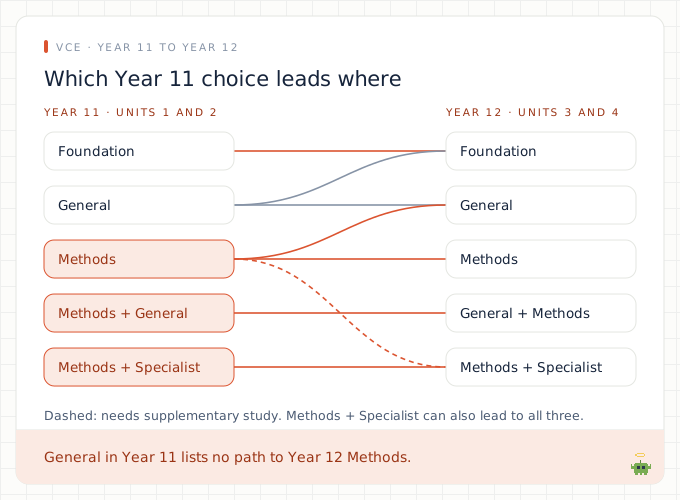
The study design lists which Year 11 units (Units 1 and 2) lead to which Year 12 units (Units 3 and 4). Read it as a one-way street:
- Methods in Year 11 keeps every Year 12 option open. It leads on to Methods, to General (with some catch-up), or to Methods and Specialist together (with supplementary study, the study design notes).
- General in Year 11 leads to General or Foundation in Year 12. The study design lists no path from General Units 1 and 2 into Methods Units 3 and 4. A child who picks General in Year 11 and changes their mind in Year 12 has a real gap to close.
- Two maths subjects are common. Methods with General, or Methods with Specialist, are both listed combinations. Some students take three in Year 12.
- No maths at all is allowed. The VCE needs 16 units, including three from the English group, and has no maths requirement. The VCE Vocational Major is different: it needs two units of VCE VM Numeracy or VCE Mathematics.
Bendigo families, whose children change schools between Year 10 and Year 11, will find this handover in more detail on our page about choosing between Level 10 and 10A.
What the choice decides after school
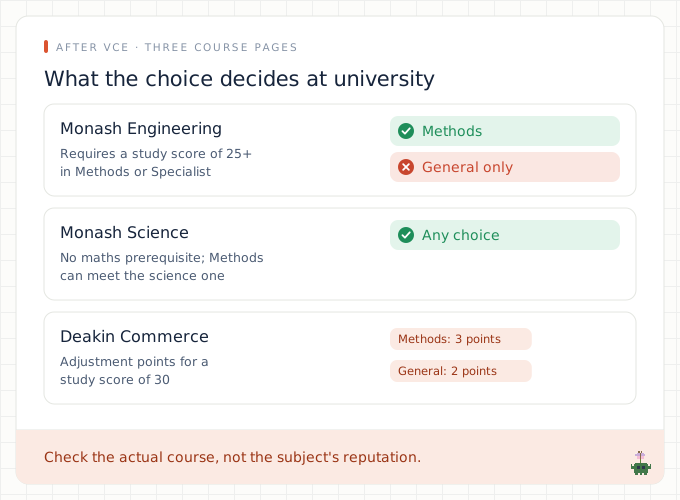
Prerequisites are set course by course, and they vary more than most families expect. Three examples from the course pages we read on 22 October 2026:
- Monash Engineering requires a study score of at least 25 in Mathematical Methods or Specialist Mathematics, alongside English and a science. General Mathematics does not meet it.
- Monash Science has no maths prerequisite. Its science prerequisite can be met by one of several subjects, and Methods and Specialist are on that list.
- Deakin Commerce adds subject adjustment points towards selection: a study score of 30 in Methods or Specialist is worth three points, and a 30 in General is worth two.
So the honest rule is: if any course your child might want names Methods, take Methods in Year 11, because Year 12 Methods cannot be reached from Year 11 General. If none does, the choice should follow what your child is good at and what they will enjoy for two years, not a reputation. Every course’s prerequisites are on its own page and in VTAC’s course search; check the actual courses, not a list from a friend.
What about scaling? VTAC adjusts study scores across subjects when it calculates the ATAR, and maths subjects are often discussed for how they scale. We could not check the current scaling report (VTAC’s site was in maintenance when this page was written), so we give no numbers. Scaling depends on how strong each subject’s cohort is across all their subjects, and it changes every year; a subject your child does badly in rarely helps their ATAR, however it scales. An ATAR needs at least four study scores including one from the English group, so maths is one of several; our page on routes to university sets out the ATAR rules.
Is your child ready for Methods? Five questions
Methods assumes a sound background in number, algebra, functions, geometry, probability and statistics, which in practice means Year 10 algebra done by hand. Ask your child to try these without a calculator. The code after each one is the Victorian Curriculum descriptor it checks.
- Factorise x² + 5x + 6. Right: (x + 2)(x + 3). This is Level 10 (VC2M10A04). A child who cannot start is not ready for Methods yet.
- Solve x² − 4x − 12 = 0. Right: x = 6 or x = −2, by factorising and the null factor law (VC2M10A13). Answering only 6 is a common slip: two brackets, two answers.
- Solve y = 2x + 1 and y = x + 4 together. Right: x = 3, y = 7 (VC2M10A09). Methods leans on this every week.
- Factorise 2x² + 7x + 3. Right: (2x + 1)(x + 3). This is a non-monic quadratic, which is 10A content (VC2M10AA07). A child who managed 1 to 3 but not this one is the most common Methods starter, and the gap is closeable over a summer.
- If f(x) = x² − 3, what is f(4)? Right: 13. Function notation is 10A too (VC2M10AA08), and it is how every Methods question is written.
Questions 1 to 3 are the floor: a child who cannot do them by hand will find the calculator-free exam hard, whatever their marks in Year 10. Questions 4 and 5 are the 10A material the Methods teacher will assume in the first weeks. If your child did not do 10A, that is not a closed door; it is a summer of work, and it is better known in November than in March.
Want practice set in their own world? Sprout writes a lesson on VC2M10AA07 or any Level 10 code around what your child loves, from AFL statistics to game design. Try it free.
When the school and your child disagree
Schools often recommend a Year 11 maths subject from Year 10 results, and some set a minimum result or ask for 10A before Methods. That is a school decision: the study design itself says there are no prerequisites for Units 1, 2 or 3. If the school’s advice does not match your child’s plans, three questions help:
- What is the advice based on? Ask which topics your child found hardest. If the answer is the algebra in the five questions above, that is real and fixable. If it is effort, homework or one bad test, it is a different conversation.
- What would change your view? Ask whether a summer of work would, and whether your child could start Methods and move to General if it is not working. The study design allows that move (Methods Units 1 and 2 can lead to General Units 3 and 4); it lists no move the other way.
- Can my child take General as well? Methods with General is a listed combination, and it gives a safety net if Methods goes badly in Year 12.
If your child does need to change level in one subject only, our page on working at a different level explains how Victorian schools handle it below VCE.
What is not the problem
- Choosing General. For many careers it is the more useful subject: statistics and financial maths are what most adults actually use. It is a problem only if a course your child wants needs Methods.
- Not doing Specialist. Specialist is for students who love maths or are heading for maths-heavy degrees. Most courses that need maths need Methods, not Specialist.
- Not knowing the career yet. That is normal at 15 or 16, and it is the best argument for Methods in Year 11 if your child can manage it: it keeps the most doors open for one more year.
Where this sits
Year 11 in Victoria starts in late January, on Thursday 28 January 2027 in government schools. For the Year 10 maths that Methods builds on, see the Year 10 maths codes page, and for the algebra jump that arrives in Year 10, our page on the Year 10 algebra step. If you are weighing a tutor for Year 12, our page on what a high-ATAR tutor buys sets out the costs, and the Victorian Curriculum explained page covers the years before VCE.
The short version
- Four subjects: Foundation, General, Methods and Specialist. They are different maths, not four levels of one.
- Methods and Specialist have a one-hour exam with no calculator; General and Foundation do not.
- Methods in Year 11 keeps every Year 12 option open. General in Year 11 does not lead to Year 12 Methods.
- Maths is not compulsory for the VCE. Some courses, such as Monash Engineering, require Methods.
- Check readiness with Year 10 algebra by hand: factorising, quadratics and simultaneous equations.
Sprout makes a lesson on the exact Year 10 code your child needs before Methods starts, with questions in their own interests. Start free.
How this page was checked
The subject descriptions, combinations, entry rules and assessment weightings are from the VCAA VCE Mathematics Study Design (accredited from 2023), read in full. The VCE and VCE Vocational Major program rules are from the VCAA current students FAQ. University examples are from the Monash Engineering course page, the Monash Science course page and the Deakin Commerce course page, read on 22 October 2026. The Victorian Curriculum codes are from version 2.0, paraphrased. VTAC’s scaling report could not be checked. Checked 22 October 2026.
VCE study design content is © Victorian Curriculum and Assessment Authority (VCAA), paraphrased; the VCAA does not endorse this product. Victorian Curriculum codes reference the Victorian Curriculum F–10 Version 2.0 © VCAA. The Victorian Curriculum F–10 and related content can be accessed directly at the VCAA website. The VCAA does not endorse this product.
FAQ
What is the difference between General Maths and Methods in VCE?
They are different mathematics, not easier and harder versions of one subject. General Mathematics is statistics, financial modelling, matrices and networks, with no calculus, and both of its exams allow a CAS calculator. Mathematical Methods is functions, calculus and probability, and one of its two exams is an hour with no calculator. Methods is the subject most university maths prerequisites name.
Is maths compulsory for the VCE?
No. The VCE needs at least 16 units, including three from the English group, and has no maths requirement. The VCE Vocational Major is different: it needs two units of VCE VM Numeracy or VCE Mathematics. Some university courses do require Methods, so check the courses your child might want before dropping maths.
Can my child do General Maths in Year 11 and Methods in Year 12?
The VCE Mathematics study design lists no path from General Mathematics Units 1 and 2 into Mathematical Methods Units 3 and 4. Methods in Year 11 keeps every Year 12 option open, including General, so a child who might need Methods should take it in Year 11, alone or together with General.
Do you need Methods to do Specialist Maths?
Yes. Year 12 Specialist Mathematics assumes your child is studying Year 12 Methods at the same time or has already completed it. In Year 11, the study design calls Methods and Specialist Units 1 and 2 taken together the comprehensive preparation; Methods alone in Year 11 can lead to both in Year 12 with supplementary study.
How do I know if my child is ready for Methods?
Check Year 10 algebra by hand: factorising a quadratic such as x² + 5x + 6, solving a quadratic equation, and solving two linear equations together. A child who can do those without a calculator has the floor Methods needs. Factorising non-monic quadratics and function notation are Level 10A content that Methods assumes early, and both can be learnt over a summer.