
In the Australian Curriculum, children learn capital letters and full stops in Foundation, question and exclamation marks in Year 1, commas in lists in Year 2, apostrophes in Year 3 and quotation marks for dialogue in Year 4. Commas for phrases and clauses follow in Years 5 and 6, colons and brackets in Year 7, and semicolons in Year 8. Victoria follows the same order. NSW runs ahead: possessive apostrophes and quotation marks are already in Stage 1 (Years 1 and 2).
So a Year 2 child who writes “the dogs bone” is not behind outside NSW, and a Year 5 child who has never used a semicolon is exactly where the curriculum expects. What matters more than the year is the pattern of the mistake, because each common error points to one idea the child has not yet got. This page sets out what each year teaches, the five mistakes that turn up most often, a two-minute editing check, and twenty minutes of practice that uses your child’s own writing.
What the curriculum asks for, year by year
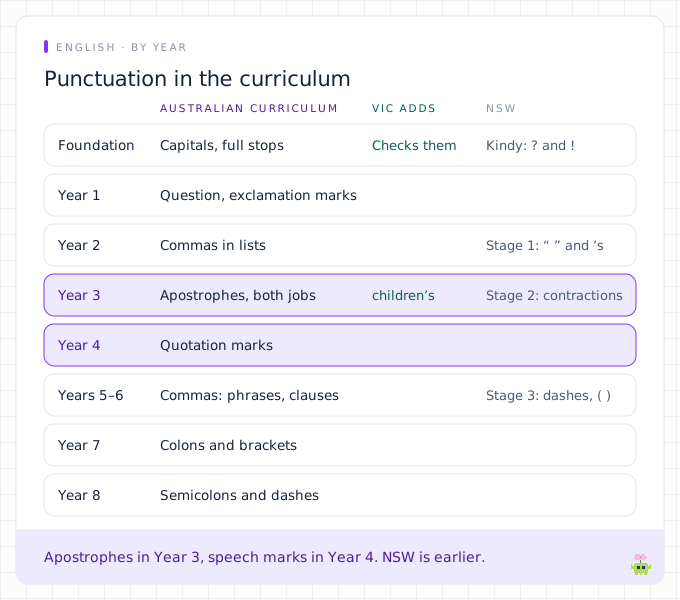
The Australian Curriculum descriptors, quoted from ACARA:
- Foundation, AC9EFLA09: “identify punctuation as a feature of written text different from letters; recognise that capital letters are used for names, and that capital letters also signal the beginning of sentences while punctuation marks signal the end”.
- Year 1, AC9E1LA10: “understand that written language uses punctuation such as full stops, question marks and exclamation marks, and uses capital letters for familiar proper nouns”.
- Year 2, AC9E2LA10: “recognise that capital letters are used in titles and commas are used to separate items in lists”.
- Year 3, AC9E3LA11: “understand that apostrophes signal missing letters in contractions, and apostrophes are used to show singular and plural possession”. Both jobs of the apostrophe arrive in the same year, which is the root of mistakes 2 and 3 below.
- Year 4, AC9E4LA12: “understand that punctuation signals dialogue through quotation marks and that dialogue follows conventions for the use of capital letters, commas and boundary punctuation”.
- Year 5, AC9E5LA09: “use commas to indicate prepositional phrases, and apostrophes where there is multiple possession”. A comma after “At the end of the day”, and “Mia and Sam’s house”.
- Year 6, AC9E6LA09: “understand how to use the comma for lists, to separate a dependent clause from an independent clause, and in dialogue”.
- Year 7, AC9E7LA09: “understand the use of punctuation including colons and brackets to support meaning”.
- Year 8, AC9E8LA09: “understand and use punctuation conventions including semicolons and dashes to extend ideas and support meaning”. Year 9 adds punctuation for referencing and citing (AC9E9LA09).
Where Victoria differs (the VCAA wording is paraphrased here, not quoted). The Language descriptors match level by level, with three changes worth knowing. Level 3 (VC2E3LA12) names possession for irregular nouns as well as regular ones, so a Victorian Year 3 is expected to manage “the children’s bags” and not only “the girls’ bags”. Level 6 (VC2E6LA09) keeps only the clause comma, because lists and dialogue were covered earlier. And Victoria adds checking punctuation in their own writing as a separate expectation from the first year: shared editing for capitals and full stops in Foundation (VC2EFLY14), re-reading for punctuation at Level 1 (VC2E1LY14), editing for sentence boundary punctuation at Level 2 (VC2E2LY12) and for punctuation generally at Level 3 (VC2E3LY12). A Victorian child is expected to find their own missing full stops, not only to know where they go.
Where NSW differs (the NESA wording is paraphrased). The NSW English K–10 Syllabus puts punctuation inside its Creating written texts outcomes, and the content runs ahead of the national order. Kindergarten (Early Stage 1) already uses question and exclamation marks alongside capitals and full stops. Stage 1 (Years 1 and 2) asks for commas to separate ideas, lists and dependent clauses, quotation marks for simple dialogue, and possessive apostrophes in their own writing. Stage 2 (Years 3 and 4) adds apostrophes for contractions and for singular and plural possession, a comma after a dependent clause, capitals for headings and acronyms, and bullet points. Stage 3 (Years 5 and 6) uses quotation marks consistently, including for other people’s words, and experiments with dashes and brackets, which the national curriculum leaves to Years 7 and 8.
Five mistakes that tell you where your child is
1. One long sentence joined with “and then” (Foundation to Year 2)
“We went to the beach and then we got an ice cream and then Sam fell over and then we went home.” The child knows a sentence ends with a full stop but has not yet decided where a sentence ends. That is the real Foundation and Year 1 skill, and it is about meaning, not marks. The fix is to have them read it aloud and stop each time their voice drops and they take a breath: that is a full stop, and the next word gets a capital. Ask “how many things happened?” Four things, four sentences.
2. “The dog’s are barking” (Year 3)
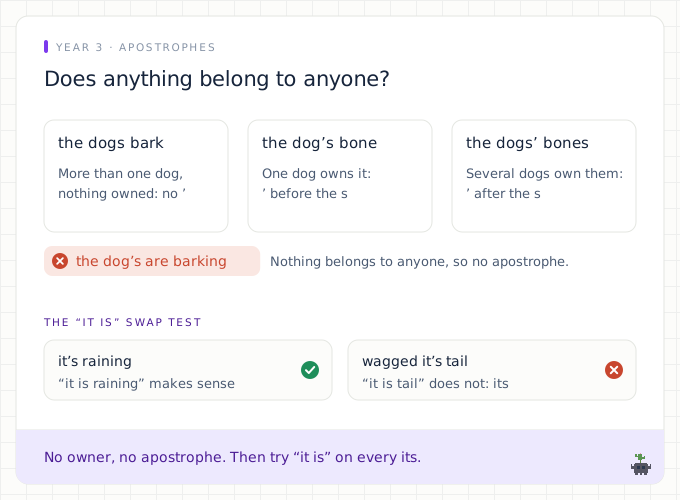
The child has learnt that an s at the end sometimes needs an apostrophe and now adds one to every plural. It is the most common apostrophe error in adult writing too. The test is one question: does anything belong to anyone? “The dogs are barking” owns nothing, so no apostrophe. “The dog’s bone” does, so the apostrophe goes before the s for one dog and after it for several (“the dogs’ bones”).
3. “The dog wagged it’s tail” (Year 3 onwards)
This one is the curriculum’s fault, a little. Year 3 teaches apostrophes for missing letters and apostrophes for owning in the same descriptor, and “its” is the one word where the two rules collide: the owning form has no apostrophe at all. The fix is a swap test. Say the sentence with “it is” in place of the word. “It is raining” works, so it’s. “The dog wagged it is tail” does not, so its. The same test sorts “you’re” and “your”, and our spelling by year page has the matching trap with “there” and “their”.
4. “Can we go now”? asked Mia. (Year 4)
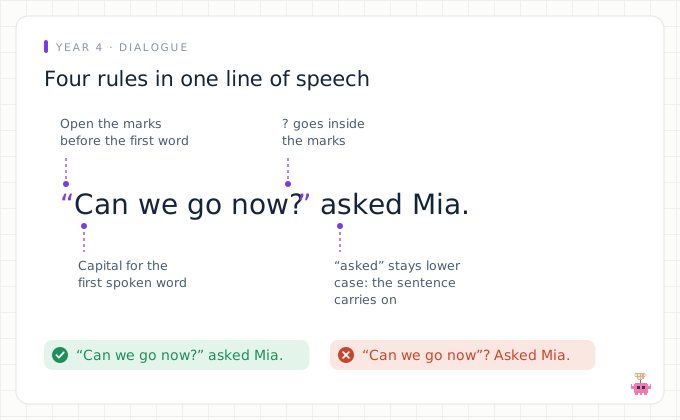
Dialogue is four conventions at once, which is why AC9E4LA12 names capital letters, commas and boundary punctuation alongside the quotation marks. The usual slip is the closing mark in the wrong place: the question mark belongs to what Mia said, so it goes inside. The second is a capital on “Asked”, because the child thinks the question mark ended the sentence. It did not: the sentence is not finished until we know who spoke. A comic is the quickest fix. Have your child turn three speech bubbles into sentences, and check each one against the four labels in the picture. In NSW, simple dialogue starts in Stage 1, so a Year 2 child there may already be doing this.
5. “It was raining, we stayed inside.” (Year 6 onwards)
Two complete sentences joined by a comma. Teachers call it a comma splice, and it appears in exactly the year the curriculum teaches the comma that separates a dependent clause from an independent one (AC9E6LA09). The child has learnt that commas go where you pause and applies it everywhere. The test: can each half stand alone as a sentence? “It was raining” can, and so can “we stayed inside”, so the comma is not enough. Use a full stop, add a joining word (“It was raining, so we stayed inside”), or make one half depend on the other (“Because it was raining, we stayed inside”). The semicolon is a fourth fix, but that is Year 8.
A two-minute editing check
Write this out with no punctuation and no capitals, and ask your child to fix it. Do not read it aloud for them.
on saturday sam and his dad went to the shops they bought milk bread and eggs sams dad said lets get a treat its your birthday tomorrow
Then mark each fix against the year it belongs to:
- Foundation and Year 1: a capital for On, Saturday, Sam and They, and a full stop after “shops”.
- Year 2: commas in “milk, bread and eggs”.
- Year 3: “Sam’s dad”, then “let’s” and “it’s”: one apostrophe for owning, two for missing letters.
- Year 4: the dialogue: Sam’s dad said, “Let’s get a treat. It’s your birthday tomorrow.”
The first number that goes wrong is the place to start. A Year 2 child who manages 1 and 2 but not 3 is on track outside NSW; a Year 4 child who misses the apostrophes needs mistakes 2 and 3 above before the dialogue.
Want practice set in their own world? Sprout writes an English lesson on AC9E3LA11 or VC2E4LA11 around what your child loves, from dinosaurs to netball. Try it free.
Twenty minutes with their own writing
Exercises on someone else’s sentences help less than you would think, because the habit you want is checking their own. You need one piece of your child’s writing, about a page, and a coloured pencil.
- Five minutes: read it aloud. Your child reads their writing aloud while you listen for where their voice drops. Each drop without a full stop gets one in the coloured pencil. This is the Victorian re-reading expectation, and it fixes mistake 1.
- Five minutes: hunt the apostrophes. Circle every word ending in s. For each one, ask “does anything belong to anyone?”, then run the “it is” test on every its and it’s.
- Five minutes: one line of dialogue. Add one thing a character says, or rewrite one reported line (“Mum said we could go”) as speech, checking it against the four labels in the dialogue picture. Year 4 and up, or Stage 1 and up in NSW.
- Five minutes: the stand-alone test (Year 6 and up). Find every comma that sits between two halves and check whether each half could stand alone. If both can, the comma needs help.
What is not the problem
- No apostrophes in Year 2. Outside NSW, apostrophes are Year 3 content. In NSW, possessive apostrophes start in Stage 1, so a Year 2 child there is meeting them now.
- No semicolons in primary school. Semicolons and dashes are Year 8 in the national and Victorian curricula. NSW Stage 3 experiments with dashes and brackets, but not semicolons.
- Punctuation that comes and goes. A child who punctuates a dictation perfectly and then drops every full stop in a story is normal: when the ideas get harder, the punctuation is the first thing to go. That is why the practice above uses their own writing.
Where this sits
Punctuation sits in the Language strand of the English curriculum, next to grammar, and shows up in writing. Our pages on spelling by year and handwriting by year cover the other two things a parent notices first in a piece of writing. For the whole picture of a year level, see what a Year 3 student should know, and for every English code in that year, the teacher-facing Year 3 English codes page. If you are not sure which curriculum applies, start with which curriculum your state uses.
The short version
- Foundation: capitals and full stops. Year 1: question and exclamation marks. Year 2: commas in lists.
- Year 3: apostrophes, for missing letters and for owning, in the same year.
- Year 4: quotation marks for dialogue. Years 5 and 6: commas for phrases and clauses.
- Year 7: colons and brackets. Year 8: semicolons and dashes.
- NSW runs ahead: quotation marks and possessive apostrophes in Stage 1, dashes and brackets in Stage 3.
- The best practice is their own writing, read aloud.
Sprout makes a lesson on the exact code your child is working on, with examples in their own interests. Start free.
How this page was checked
The Australian Curriculum descriptors are quoted from our copy of version 9.0, which matches AC9E3LA11 on the Australian Curriculum website; we searched every Foundation to Year 10 English descriptor for punctuation. The Victorian codes are from the Victorian Curriculum F–10 version 2.0. The NSW findings come from the NSW English K–10 content pages for Creating written texts in Early Stage 1 to Stage 3 and the Early Stage 1 Print conventions page, read on 22 October 2026. Victorian and NSW wording is paraphrased. Checked 22 October 2026.
Australian Curriculum content descriptions are © Australian Curriculum, Assessment and Reporting Authority (ACARA) 2010 to present, licensed under CC BY 4.0, and quoted here unmodified. ACARA does not endorse any product that uses the Australian Curriculum. Victorian Curriculum codes reference the Victorian Curriculum F–10 Version 2.0 © VCAA, paraphrased; the VCAA does not endorse this product. NSW outcome codes reference the NSW syllabuses © NSW Education Standards Authority (NESA) for and on behalf of the Crown in right of the State of New South Wales, paraphrased, available at curriculum.nsw.edu.au; NESA does not endorse this product.
FAQ
What year do kids learn apostrophes in Australia?
Year 3. AC9E3LA11 teaches apostrophes for missing letters in contractions and for singular and plural possession in the same year; Victoria adds irregular nouns such as children's at Level 3. Multiple possession (Mia and Sam's house) follows in Year 5. In NSW, possessive apostrophes start in Stage 1 (Years 1 and 2) and contractions follow in Stage 2.
When do kids learn quotation marks for dialogue?
Year 4 in the Australian Curriculum and the Victorian Curriculum (AC9E4LA12, VC2E4LA11), together with the capital letters, commas and end punctuation that go with them. NSW asks for quotation marks for simple dialogue in Stage 1, so a Year 1 or Year 2 child there may already be using them.
When do kids learn semicolons?
Year 8. AC9E8LA09 introduces semicolons and dashes; colons and brackets come a year earlier, in Year 7. NSW Stage 3 (Years 5 and 6) experiments with dashes and brackets, but no curriculum expects semicolons in primary school.
Why does my child put an apostrophe in every plural?
Because they have learnt that a word ending in s sometimes needs an apostrophe and now add one to every plural, as in the dog's are barking. The fix is one question before any apostrophe goes in: does anything belong to anyone? If nothing is owned, there is no apostrophe.
How do I help my child with its and it's?
Use the swap test: say the sentence with it is in place of the word. It is raining makes sense, so it's. The dog wagged it is tail does not, so its. The owning form of it has no apostrophe, which is why Year 3 children who have just learnt both jobs of the apostrophe trip over it.