
Most Point Cook children go to a government school that ends at Year 9, then move to a senior secondary college for Years 10 to 12. The trouble is timing: the move lands on the year the Victorian Curriculum’s algebra more than doubles, from 7 content descriptions at Level 9 to 16 at Level 10. A new school, new teachers and the biggest algebra step in the curriculum all arrive in the same February.
This page covers how the P-9 model works in Point Cook, what changes in maths between Level 9 and Level 10, the one Year 9 code that decides how Year 10 goes, the questions worth asking before the move, and where practice at home fits.
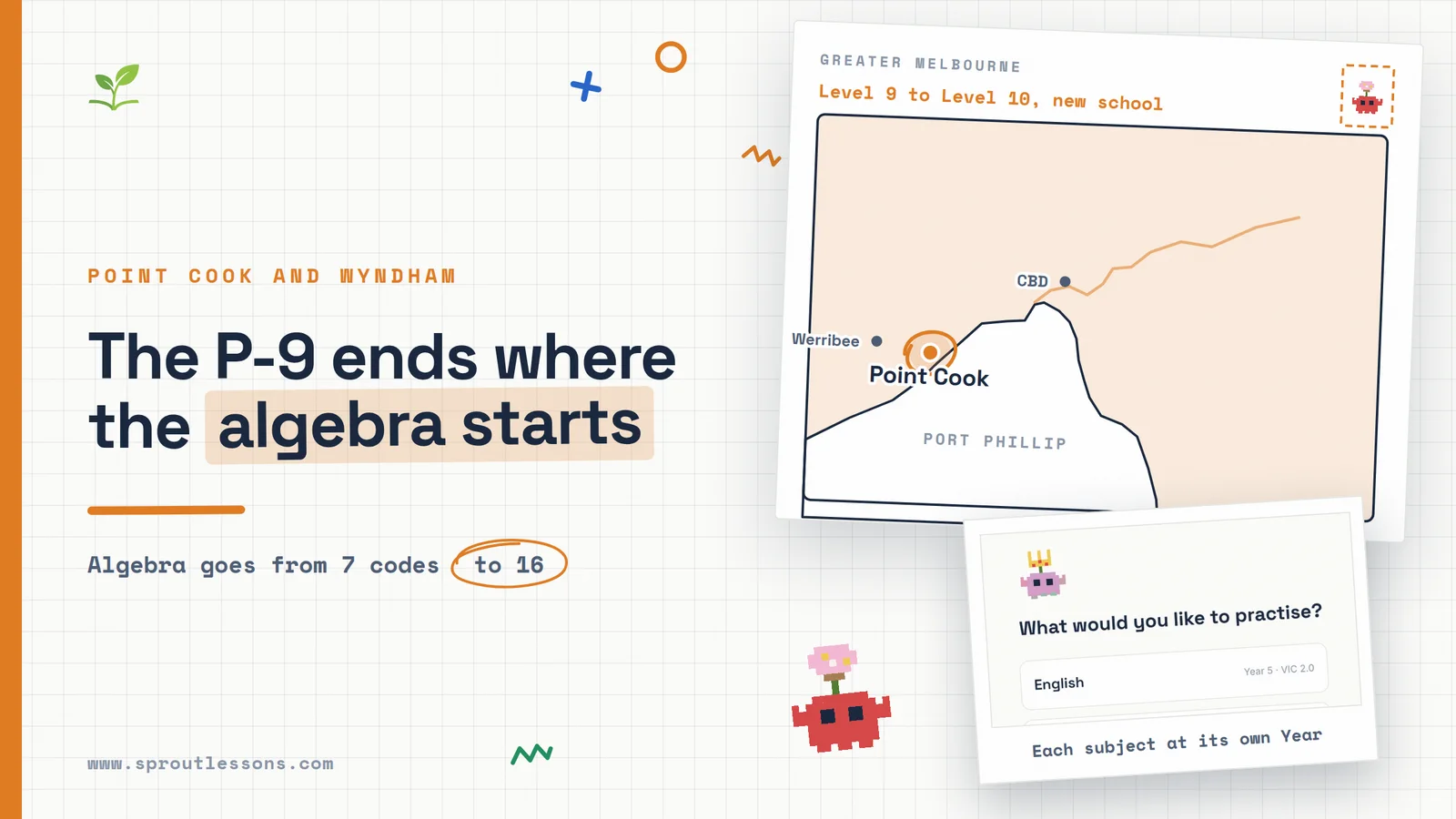
How school is split in Point Cook
The government schools that grew with Point Cook were built as Prep to Year 9 colleges. Carranballac P-9 College, for example, describes itself as a Foundation to Year 9 school taking students mainly from Point Cook, Altona Meadows and Sanctuary Lakes, with about 800 students across two campuses at the start of 2026. Featherbrook, Saltwater and Point Cook P-9 Colleges follow the same model, and Alamanda runs from kindergarten to Year 9.
For Years 10 to 12, students move to a senior secondary college: Point Cook Senior Secondary College, which opened in 2008 and has about 800 students, or Homestead Senior Secondary College, which opened in 2020. Point Cook Senior Secondary College names Carranballac, Saltwater, Featherbrook and Point Cook P-9 as its usual feeder schools.
The model has real strengths. A child stays with one school, one set of teachers and one set of friends for ten years, and the Year 7 transition that unsettles so many children elsewhere mostly does not happen. The cost is that the move happens later, at 15, and it coincides with the maths year that matters most for what a student can choose in VCE.
What changes in maths between Level 9 and Level 10
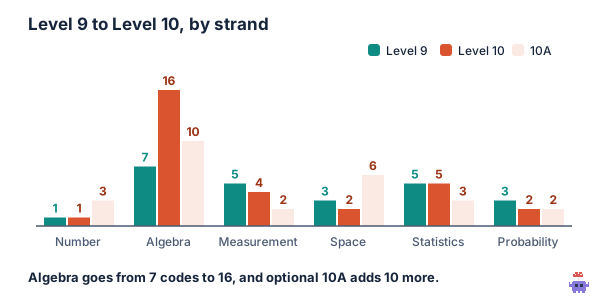
In the Victorian Curriculum 2.0, Level 9 maths has 24 content descriptions and Level 10 has 30. That alone is a step. The shape of it is the real story:
- Algebra goes from 7 to 16. Level 10 itemises algebra in a way Level 9 does not: algebraic fractions, rearranging formulas, linear inequalities, simultaneous equations, parallel and perpendicular gradients, quadratic equations by the null factor law, and exponential equations each get a code of their own.
- Number is already down to one. Level 9 keeps a single Number description, the real number system, and Level 10 keeps one too. By this point almost everything a student calls “maths” is algebra, measurement, space or statistics.
- Level 10A sits on top. Victoria has an optional Level 10A with 26 more descriptions, 10 of them algebra: polynomials and the factor theorem, logarithms, non-monic quadratics, and the unit circle. Schools commonly use 10A, or a class built from it, as the preparation for VCE Mathematical Methods.
The full lists are in every Year 9 maths code and every Year 10 maths code. The point for a Point Cook family is simpler: Year 10 maths is usually where classes split, into a group heading for Methods and groups heading for General or Foundation maths, and the evidence used to place a student is often their Year 9 work. With a P-9, that evidence is written at one school and read at another.
The Year 9 code that decides how Year 10 goes
If you check one thing in Year 9, check VC2M9A02: simplifying algebraic expressions, expanding with the distributive law including binomial products, and factorising monic quadratics. Level 10 builds straight on it. Factorising monic quadratics again (VC2M10A04), solving quadratics by the null factor law (VC2M10A13), and in 10A, factorising non-monic quadratics (VC2M10AA07) all assume a student can expand and factorise without thinking about it.
Two wrong answers tell you it is not secure yet:
- (x + 3)² written as x² + 9. The student has squared each term and lost the middle one. Test it with a number: if x is 2, (2 + 3)² is 25, but 2² + 9 is 13. The correct expansion is x² + 6x + 9. The reteach is the area model: draw a square of side x + 3, split it into four rectangles, and the two 3x pieces are impossible to miss.
- x² + 5x + 6 factorised as (x + 1)(x + 6). The student found two numbers that multiply to 6 and stopped. They also have to add to 5, which gives (x + 2)(x + 3). The reteach is to expand the answer back every time; (x + 1)(x + 6) expands to x² + 7x + 6, and the student sees the error themselves.
Both checks take two minutes at the kitchen table, and neither needs a parent who remembers how to factorise. Ask your child to expand their answer back and compare.
Sprout builds a lesson on VC2M9A02, or any other Victorian Curriculum code, in about thirty seconds, with the code on the lesson. Start free and have the binomial practice ready before the holidays.
Questions to ask before the move
Ask the P-9 in Term 3 or 4 of Year 9:
- How secure is my child on VC2M9A02, VC2M9A03 (linear equations and graphs) and VC2M9A05 (quadratics and the null factor law)? Three codes, three answers.
- What does the school send to the senior college about maths? A report rating, a teacher recommendation, a test result, or nothing.
Ask the senior college at the transition information session:
- How are Year 10 maths classes set, and when? On Year 9 results, on a test in the first weeks, or by choice.
- Which Year 10 class leads to VCE Mathematical Methods, and can a student move into it during the year? The answer tells you how much the first term matters.
Do not take this page’s word for how either college places students; each sets its own approach, and the answer is a phone call away.
A side note on selective entry
Suzanne Cory High School, one of Victoria’s four selective entry high schools, is in Werribee next door and takes students from Year 9. Entry is by an exam in June of Year 8. One detail matters for P-9 families: the department caps offers to any one school at 4% of its students, but for schools that run only from Prep to Year 9, the cap is 10%. What the exam tests, and what its organisers say about coaching, is covered in our guide to the selective entry exam.
Where Sprout Tutor fits, and where it stops
Straight facts, since this is our product:
- Sprout Tutor is in public beta and follows the Victorian Curriculum for Years 1 to 10, in maths, English and science. That covers a P-9 college, Prep aside, and the first year at the senior college.
- It now covers Year 10. A Year 9 student who masters the hardest tier moves up into Level 10, and a Year 10 pathway includes the Level 10 codes, the Levels 9 to 10 science band and the optional 10A codes. Year 10 was added on 5 October 2026, so if you read this page before then the range has changed.
- Each subject runs at its own Year. A student can be practising Year 9 English and Year 8 maths while one strand catches up, and every change is logged. How it decides what comes next has the rules.
- You see the actual questions, the answer given, and whether a hint was opened or the answer revealed.
- While it is in beta it is free on every plan, including the free one. It is not on the pricing page, so there is no price to quote.
Sprout Lessons, the full lesson builder, does cover Level 10 and 10A codes, built around one of your child’s interests per lesson. Neither replaces a good maths teacher at a new school, and the honest position on software like ours is that the effectiveness of personalised-learning chatbots has not been independently established, and very few rigorous studies of them exist.
A plan for Year 9
- Terms 2 and 3: run the two kitchen-table checks above. If either wrong answer shows up, practise VC2M9A02 for about twenty minutes most nights for three weeks.
- Term 4: ask the P-9 and the senior college the four questions above.
- The summer holidays: a cold check in January, five expansions and five factorisations with no warm-up. What survives the break is what was learned.
- Term 1 of Year 10: ask the new maths teacher what the first unit covers, and practise one step behind the class rather than one step ahead. See what to do between tutoring sessions if a tutor is part of the plan.
The same idea, three years earlier, is the subject of starting Year 7 on Phillip Island: a transition year is easier when the code underneath it is solid before the move.
The short version
Point Cook’s government schools mostly run to Year 9, and Year 10 happens at a senior secondary college. That move coincides with the Victorian Curriculum’s biggest algebra step, from 7 descriptions at Level 9 to 16 at Level 10, with an optional 10A on top that schools commonly use to prepare for Methods. Check VC2M9A02 in Year 9, ask both schools how Year 10 maths is set, and keep the practice one step behind the class.
Sprout builds Victorian Curriculum lessons on the exact code around your child’s interests, and Sprout Tutor is in public beta for Years 1 to 10 and free on every plan while it is in beta. Start free.
Checked 3 October 2026. School structure is from Carranballac P-9 College’s own site and the public listings for Point Cook Senior Secondary College and Homestead Senior Secondary College; the selective entry cap is from the Victorian Government’s selective entry page. Counts are from the Victorian Curriculum F–10 Version 2.0 maths content descriptions, paraphrased; © VCAA, licensed under CC BY-NC 3.0 AU, see f10.vcaa.vic.edu.au. VCAA does not endorse this page. We build competing software and say so above.
FAQ
Where do Point Cook students go for Year 10?
Most Point Cook government schools run from Prep to Year 9, such as Carranballac, Featherbrook, Saltwater and Point Cook P-9 Colleges, with Alamanda running from kindergarten to Year 9. For Years 10 to 12 students move to a senior secondary college: Point Cook Senior Secondary College, opened in 2008, or Homestead Senior Secondary College, opened in 2020.
How much harder is Year 10 maths than Year 9?
In the Victorian Curriculum 2.0, Level 9 maths has 24 content descriptions and Level 10 has 30. Algebra goes from 7 to 16, with algebraic fractions, rearranging formulas, inequalities, simultaneous equations and exponential equations each getting their own code. An optional Level 10A adds 26 more, 10 of them algebra, which schools commonly use as preparation for VCE Mathematical Methods.
What should my child practise in Year 9 before Year 10?
VC2M9A02: expanding binomial products and factorising monic quadratics. Level 10 factorising, solving quadratics by the null factor law and 10A non-monic factorising all build on it. Two wrong answers show it is not secure: writing (x + 3)² as x² + 9 instead of x² + 6x + 9, and factorising x² + 5x + 6 as (x + 1)(x + 6) instead of (x + 2)(x + 3).
Does the selective entry cap apply differently to P-9 schools?
Yes. The department caps standard and principal discretion offers to the selective entry high schools at 4% of students from any one source school, but for schools that run only from Prep to Year 9 the cap is 10%. Suzanne Cory High School in Werribee is the nearest selective entry school to Point Cook, with entry by an exam in June of Year 8.
Does Sprout Tutor cover Year 10?
Yes, since 5 October 2026. Sprout Tutor follows the Victorian Curriculum for Years 1 to 10, in maths, English and science, which covers a P-9 college apart from Prep and the first year at the senior secondary college. A Year 9 student who masters the hardest tier moves on through Year 9, and a Year 10 pathway covers Level 10, the Levels 9 to 10 science band and the 10A codes. Sprout Tutor is in public beta and free on every plan while it is in beta.