
For most Phillip Island families, Year 7 means crossing the bridge. The maths changes more than the bus route does: the Victorian Curriculum goes from 24 maths content descriptions at Level 6 to 31 at Level 7, and Algebra doubles, from 3 to 6. The new campus, the new timetable and the new friendships get the attention in the transition term. This page is about the quieter change, where it bites, and what a Year 6 family can do about it before February.
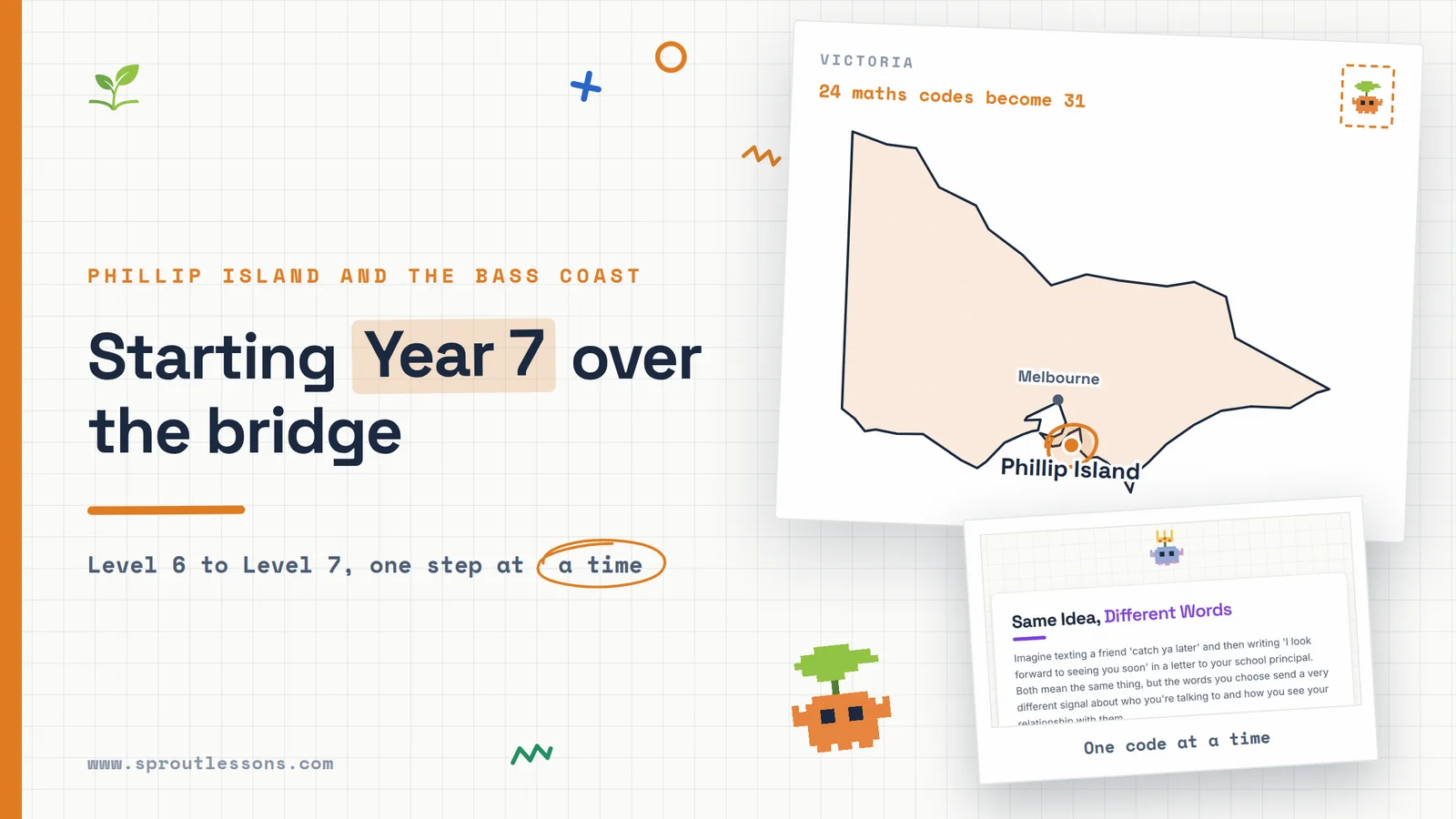
Where Year 7 happens on the Bass Coast
The government secondary option for the island is the San Remo campus of Bass Coast College, just over the bridge. It opened in 2022, takes Years 7 to 9, and serves Phillip Island, San Remo, the Westernport Waterline and Anderson, with room for about 420 students. Years 10 to 12 then move to the senior campus in Wonthaggi. So a child who starts Year 7 at San Remo spends exactly Levels 7, 8 and 9 of the curriculum there.
The island also has Newhaven College, an independent school running Prep to Year 12 on Phillip Island Road, where Year 7 does not mean a change of campus at all. The social transition is gentler there. The jump in content is a property of the curriculum rather than of the buildings, so it is worth preparing for either way.
The step, drawn
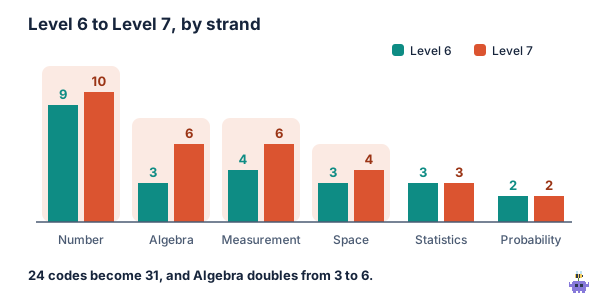
Seven more content descriptions in one year is the largest year-on-year increase anywhere from Foundation to Level 10, and Level 7, at 31, has more maths content descriptions than any other Level. Five of the seven extra land in two strands. Algebra goes from 3 to 6. Measurement goes from 4 to 6. Number barely changes in count, but what it asks for changes a great deal.
Algebra: the letter arrives
At Level 6, algebra is still about numbers: continuing patterns, and finding the missing number in an equation with brackets (VC2M6A02). At Level 7 the unknown becomes a letter, and the strand asks a child to do six things with it: use a variable in an everyday formula and substitute into it (VC2M7A01), write expressions with brackets and the laws of arithmetic (VC2M7A02), solve one-variable linear equations and check the answer by substituting it back (VC2M7A03), read relationships from graphs of real data (VC2M7A04), build tables of values and plot them on the Cartesian plane (VC2M7A05), and rearrange formulas with several variables using digital tools (VC2M7A06).
The single best piece of preparation is the Level 6 code nobody talks about. Finding the box in 3 × (□ + 4) = 27 is the same mathematics as solving 3(x + 4) = 27. A child who can do the first confidently has already done the hard part of the second, and only has to accept that a letter is allowed to stand where the box was. A child who cannot do the first will meet both at once in Term 1.
Two wrong answers are worth knowing, because they tell you exactly what is going on:
- “If x is 5, then 3x is 35.” The child has written the digits side by side, the way 3 and 5 make 35 in a place-value chart. They have not yet learned that a number written against a letter means multiply. The reteach is to write it out as 3 × x for a week before dropping the sign.
- “p stands for penguins.” The letter is being read as a label, an abbreviation for a thing, rather than as a number that has not been found yet. It produces answers like “7p means seven penguins” that are nearly right and then collapse the moment an equation needs solving. The reteach is to ask, every time, “what number could p be?”
Measurement and Number: familiar words, harder demands
Measurement grows from 4 to 6, and the growth is formulas. At Level 6 a child establishes the area of a rectangle (VC2M6M02); at Level 7 they extend it to triangles and parallelograms (VC2M7M01), find the volume of prisms (VC2M7M02), meet the relationship between pi and a circle (VC2M7M03), and work with angles made by parallel lines and the angle sum of a triangle (VC2M7M04, VC2M7M05). The Level 6 angle code, angles on a straight line and at a point (VC2M6M04), is the direct prerequisite for the last two.
Number stays at about the same size and moves up a gear. Level 6 adds and subtracts fractions (VC2M6N05) and places integers on a number line (VC2M6N01). Level 7 multiplies and divides fractions and decimals (VC2M7N05), adds and subtracts integers (VC2M7N08), works with square numbers and square roots (VC2M7N01), writes numbers as products of primes in index notation (VC2M7N02), and brings in ratio (VC2M7N09). The full list, with every Level 7 code, is on Year 7 maths in the Victorian Curriculum, and the Level 6 list is on the Year 6 page.
Sprout builds a lesson on any one of these codes in about thirty seconds, with the code printed on it. VC2M6A02 is the one to start with. Start free.
Personalised to the island
The hardest part of preparing over the last term of Year 6 is not the content. It is getting a child who is excited about everything except maths to sit down with it. This is where personalisation does real work, and it works best when it is specific to the child rather than generic “fun”.
In Sprout Lessons you choose your child’s interests from a curated list that includes penguins, surfing, sailing, ocean animals and footy, and each new lesson is built around one of them, taking turns. The curriculum code does not move. A substitution lesson can have a ranger counting groups of penguins crossing a beach at dusk, where 7p is the number of penguins in seven groups of p, and it is still VC2M7A01 underneath. The reasoning behind one interest at a time is in teaching maths through interests.
Sprout Tutor, our guided practice, does it more lightly: a child picks the flavour of each session from Classic, Footy, Netball or Animals. The Animals theme is written with one rule on purpose, that it never states an animal fact that could be wrong. A maths question is not the place to learn something false about the wildlife your child sees every summer.
Why the tutor fits this transition exactly
Sprout Tutor follows the Victorian Curriculum for Years 1 to 9, in maths, English and science. That range happens to match the San Remo campus exactly: Level 6 for the last year of primary, then Levels 7, 8 and 9. A few specifics, since this is our product:
- A child can practise below their year while a gap closes. A Year 7 who is shaky on VC2M6A02 can work at Level 6 in algebra while staying at Level 7 elsewhere, and the change is recorded rather than hidden. How that works is in working at a different level in the Victorian Curriculum.
- The moves are decided by fixed rules, not a model’s opinion, and every one is logged. See how Sprout Tutor decides what comes next.
- You see what your child actually did: each question as worded, the answer given, and whether a hint was opened or the answer revealed.
- It is in public beta and free on every plan while it is in beta, including the free one.
What it will not do is notice that your child is anxious about the new school rather than about algebra, which a good teacher or tutor will. And the honest state of the evidence is that the effectiveness of personalised-learning chatbots has not been independently established; very few rigorous studies of them exist. Use it for the practice, and keep the people for everything else.
A plan for the last term of Year 6
- Ask the Year 6 teacher three specific questions: how secure is my child on finding unknowns in equations with brackets (VC2M6A02), on adding and subtracting fractions (VC2M6N05), and on integers on a number line (VC2M6N01). Those three feed the biggest Level 7 changes.
- Practise the weakest one for about twenty minutes most nights for three weeks, using the method the school uses.
- Give a cold check in December: five questions, no warm-up. What survives the holidays is what was learned.
- In the first weeks of Year 7, ask the maths teacher which topics Term 1 covers, and practise one step behind the class rather than one step ahead.
For the wider picture of what Year 6 should leave a child able to do, see what a Year 6 student should know, which covers the Australian Curriculum. Victoria’s version differs in its codes, as the comparison of the two explains, but the sequence is broadly the same.
The short version
Year 7 on the Bass Coast usually means the San Remo campus, which runs Years 7 to 9. The maths step is the largest year-on-year increase in the Victorian Curriculum: 24 content descriptions become 31, Algebra doubles and Measurement becomes formulas. The best preparation is one unglamorous Level 6 code, finding the unknown in an equation with brackets, practised a little most nights in the last term of Year 6.
Sprout builds Victorian Curriculum lessons around your child’s interests, penguins included, with the code on every lesson. Sprout Tutor is in public beta for Years 1 to 9 and free on every plan while it is in beta. Start free.
Checked 29 September 2026. Content description counts and codes were read from our copy of the Victorian Curriculum 2.0 mathematics dataset, and the descriptions above are paraphrased rather than quoted. Campus details are from Bass Coast College’s San Remo campus page; the Newhaven College details are from public listings, since the school’s own site does not allow automated checks. Victorian Curriculum F–10 Version 2.0 © VCAA, which does not endorse this product; the curriculum is available at f10.vcaa.vic.edu.au.
FAQ
Where do Phillip Island students go for Year 7?
The government option is the San Remo campus of Bass Coast College, just over the bridge. It opened in 2022, takes Years 7 to 9, serves Phillip Island, San Remo, the Westernport Waterline and Anderson, and has room for about 420 students; Years 10 to 12 then move to the senior campus in Wonthaggi. Newhaven College, an independent Prep to Year 12 school on Phillip Island Road, is the other option on the island.
How much harder is Year 7 maths than Year 6?
In the Victorian Curriculum 2.0, Level 6 maths has 24 content descriptions and Level 7 has 31, the largest year-on-year increase from Foundation to Level 10. Algebra doubles from 3 to 6 and Measurement grows from 4 to 6. Number stays at about the same size but moves up a gear, into multiplying and dividing fractions, operations with negative numbers, square roots, prime factorisation and ratio.
What should my child practise before Year 7?
Finding the unknown in an equation with brackets, the Level 6 code VC2M6A02. Finding the box in 3 × (□ + 4) = 27 is the same mathematics as solving 3(x + 4) = 27 at Level 7. A child who can do the first has already done the hard part of the second. Adding and subtracting fractions (VC2M6N05) and integers on a number line (VC2M6N01) are the other two worth checking.
Why does my child say 3x is 35 when x is 5?
They are writing the digits side by side, the way 3 and 5 make 35 in place value, and have not yet learned that a number written against a letter means multiply. The reteach is to write it as 3 × x for a week before dropping the sign. A related mistake is reading a letter as a label, so that 7p means seven penguins rather than seven times an unknown number.
Does Sprout Tutor cover Year 7?
Yes. Sprout Tutor follows the Victorian Curriculum for Years 1 to 9, in maths, English and science, which covers the last year of primary and all three years at the San Remo campus. A child can work below their year in one strand while a gap closes, and the change is recorded. It is in public beta and free on every plan, including the free one, while it is in beta.