
Year 6 Maths in the Victorian Curriculum F–10 Version 2.0, officially Level 6, is 24 content descriptions, VC2M6A01 through VC2M6ST03, the same count as the national Year 6 curriculum and the same strand distribution. Level 5 tracked the national curriculum almost word for word. Level 6 does not. Six descriptors carry Victorian wording changes, and two of them add content a teacher working from a national-curriculum scope and sequence would never cover: triangular numbers, and elapsed time.
This guide covers all 24 codes, the six places Victoria genuinely diverges, the three descriptors that decide whether Level 7 goes well, a term-by-term order, five checks before moving on, and where Level 6 Maths overlaps the Capabilities.
What Victoria does differently at Level 6
The code numbering matches: VC2M6N01 is AC9M6N01, VC2M6SP02 is AC9M6SP02, all the way down. What changes is what six of those descriptors ask for.
- VC2M6N02 adds triangular numbers. Victoria asks for the properties of prime, composite, square and triangular numbers. The national descriptor stops at square. This is the largest single content difference in the level and the one most likely to be missed, because triangular numbers do not appear in most national-curriculum-aligned Year 6 resources.
- VC2M6M03 keeps elapsed time as an explicit requirement. Victoria asks students to measure, calculate and compare elapsed time before going on to timetables and itineraries. The national descriptor covers timetables and durations without naming elapsed time as its own skill. In practice Victoria is protecting a step that is easy to skip: calculating the gap between 9:45 am and 2:20 pm is a different task from reading a timetable that has already done the arithmetic.
- VC2M6N07 says with and without digital tools. The national version says “using digital tools where appropriate” for percentage and discount problems. Victoria explicitly requires both, which means a Level 6 program that only ever teaches discounts on a calculator has not met the descriptor.
- VC2M6N09 names mental and written strategies. Victoria’s modelling descriptor asks for efficient mental and written calculation strategies by name. It also scopes to rational numbers and percentages, where the national version adds natural numbers.
- VC2M6P01 leads with describing probabilities. Victoria opens the descriptor with describing probabilities using fractions, decimals and percentages, then moves to the 0 to 1 and 0% to 100% scales. The national version starts at the scale. The order matters for teaching: Victoria is saying the representation comes first and the scale gives it meaning, not the other way round.
- VC2M6ST03 names the collection methods. Victoria asks for questions refined to collect categorical or numerical data by observation or survey. The national version leaves the method open. If you are building an assessment task, Victoria has effectively told you what it should look like.
VC2M6N08 also drops the national version’s “including financial contexts” from estimation, though financial contexts remain in VC2M6N01 and VC2M6N09, so nothing is genuinely lost. For the wider comparison of where the two frameworks agree and diverge, see the Victorian Curriculum versus the Australian Curriculum, and for the national coverage of this exact year level, see Year 6 Maths under the Australian Curriculum.
The level at a glance
| Strand | Codes | What it covers |
|---|---|---|
| Number | 9 (VC2M6N01–09) | Integers on a number line and the Cartesian plane, prime, composite, square and triangular numbers, comparing common fractions on one number line, adding and subtracting decimals, adding and subtracting fractions with equivalence, multiplying and dividing decimals by powers of 10, fractions and percentages of quantities including discounts, estimation, and modelling with mental and written strategies |
| Algebra | 3 (VC2M6A01–03) | Rules generating visually growing and number patterns with rational numbers, unknown values in equations with brackets and mixed operations, and designing algorithms that generate sets of numbers and reveal patterns |
| Measurement | 4 (VC2M6M01–04) | Converting between metric units with decimal representations, establishing the area formula for a rectangle, elapsed time with timetables and itineraries, and angles on a straight line, at a point and vertically opposite |
| Probability | 2 (VC2M6P01–02) | Describing probabilities as fractions, decimals and percentages on a 0 to 1 or 0% to 100% scale, and repeated experiments and simulations where more trials reduce variation |
| Space | 3 (VC2M6SP01–03) | Parallel cross-sections and their relationship to right prisms, points in all four quadrants of the Cartesian plane, and combinations of transformations creating tessellations |
| Statistics | 3 (VC2M6ST01–03) | Comparing data sets across variable types using mode, range and shape, critiquing statistically informed arguments in the media, and investigations collecting categorical or numerical data by observation or survey |
Number drops from Level 5’s ten descriptors to nine while Algebra rises from two to three, because the algorithm descriptor moves out of Number (VC2M5N10) and into Algebra as VC2M6A03. The content is continuous; only the strand label changes.
Reading the codes
Victorian Maths codes run VC2 + M + level + strand + number, so VC2M6N01 is Level 6 Number, position 1. In primary school the level number matches the year number, so Level 6 is the same cohort as Year 6. Strand letters are N Number, A Algebra, M Measurement, P Probability, SP Space, ST Statistics. Level 6 Number stops at nine descriptors, so the Level 5 numbering difference, where Victoria writes VC2M5N10 and the national curriculum writes AC9M5N010, does not recur here.
Strand by strand
Number (VC2M6N01 to VC2M6N09)
VC2M6N01 introduces integers, recognising situations including financial contexts that use them, and locating them on a number line and as coordinates on the Cartesian plane. VC2M6N02 covers prime, composite, square and triangular numbers, including the Victorian addition. VC2M6N03 applies equivalence to compare, order and represent halves, thirds and quarters on the same number line and justify the order. VC2M6N04 applies place value to add and subtract decimals with estimation and rounding as the reasonableness check. VC2M6N05 solves addition and subtraction problems with fractions using knowledge of equivalent fractions, the level’s hardest computational descriptor. VC2M6N06 multiplies and divides decimals by multiples of powers of 10 without a calculator. VC2M6N07 finds fractions, decimals and percentages of quantities including discounts, with and without digital tools. VC2M6N08 approximates solutions involving rational numbers and percentages using estimation. VC2M6N09 is the applied descriptor, modelling practical problems including financial contexts using efficient mental and written strategies, interpreting and communicating the solution in terms of the situation.
Algebra (VC2M6A01 to VC2M6A03)
VC2M6A01 recognises and uses rules that generate visually growing patterns and number patterns involving rational numbers. Pair it with VC2M6N02: triangular numbers are the cleanest visually growing pattern in the level, and teaching the two descriptors in the same unit turns a Victorian addition into a saving rather than an extra. VC2M6A02 finds unknown values in numerical equations involving brackets and combinations of arithmetic operations, which is where the order of operations formally lives and is load-bearing for Level 7 algebra. VC2M6A03 designs and uses algorithms involving a sequence of steps and decisions to generate sets of numbers, then identifies and explains emerging patterns. Victoria says “design” where the national curriculum says “create”, which lines up with the Digital Literacy Capability’s design language.
Measurement (VC2M6M01 to VC2M6M04)
VC2M6M01 converts between common metric units of length, mass and capacity and chooses decimal representations appropriate to the context, so teach it after VC2M6N06’s powers-of-ten work rather than before. VC2M6M02 establishes the formula for the area of a rectangle and uses it to solve practical problems. The verb is “establish”: a student handed length times width has not met the descriptor. VC2M6M03 measures, calculates and compares elapsed time, then interprets and uses timetables and itineraries, the Victorian expansion described above. VC2M6M04 identifies the relationships between angles on a straight line, angles at a point and vertically opposite angles and uses them to determine unknown angles with reasoning communicated, the first genuinely deductive descriptor in primary Measurement.
Probability (VC2M6P01 to VC2M6P02)
VC2M6P01 describes probabilities using fractions, decimals and percentages, recognises that probabilities lie on scales of 0 to 1 or 0% to 100%, and uses estimation to assign them in context. Because Victoria puts the representation clause first, this descriptor depends directly on VC2M6N07 and should never be scheduled before it. VC2M6P02 conducts repeated chance experiments and runs simulations with an increasing number of trials using digital tools, comparing observations with expected results and discussing the effect on variation. The digital-tool clause is doing real work: a thousand simulated trials behave differently from twenty physical ones, and that is hard to demonstrate by hand.
Space (VC2M6SP01 to VC2M6SP03)
VC2M6SP01 compares the parallel cross-sections of objects and recognises their relationship to right prisms, which turns “a prism has the same cross-section all the way through” into a definition rather than a slogan. VC2M6SP02 locates points in all four quadrants of the Cartesian plane and describes how the coordinates change when a point moves, the geometric half of VC2M6N01. VC2M6SP03 recognises and uses combinations of transformations to create tessellations and other geometric patterns using dynamic geometry software, extending Level 5’s single translations, reflections and rotations into compositions.
Statistics (VC2M6ST01 to VC2M6ST03)
VC2M6ST01 interprets and compares data sets for ordinal and nominal categorical, discrete and continuous numerical variables, comparing distributions in terms of mode, range and shape. That variable-type vocabulary is new and is assumed from Level 7 onward. VC2M6ST02 identifies statistically informed arguments in traditional and digital media and critiques the methods, representations and conclusions. VC2M6ST03 plans and conducts statistical investigations, with Victoria naming observation or survey as the collection methods and categorical or numerical as the data types, which effectively specifies the shape of the assessment task.
The three codes that decide Level 7
VC2M6N01: a negative number is a position, not a subtraction
The misconception: that the minus sign in −5 is the same symbol doing the same job as the minus in 8 − 5, so a negative number is read as an instruction rather than a location. Its close cousin is ordering by magnitude, where −5 is judged larger than −3 because 5 is larger than 3.
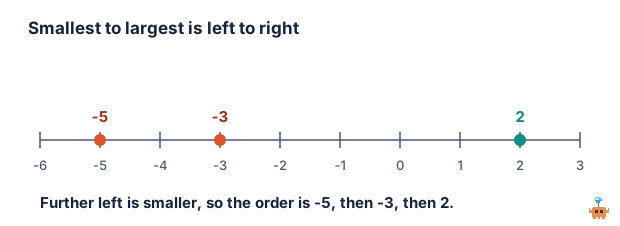
What you will see: asked to order −5, 2 and −3 from smallest to largest, a student writes 2, −3, −5, or puts −5 last. Asked which is colder, −5 degrees or −3 degrees, the same student usually gets it right, because the context supplied the reasoning the symbol did not.
The fix: build the extended number line physically before any symbol is written, using a thermometer or a lift panel, and ask ordering questions only in context until “further left is smaller” is automatic. Then introduce the Cartesian plane in the same unit so VC2M6SP02’s four quadrants reinforce the direction rather than arriving a term later as an unrelated topic. Read the symbol aloud as “negative five”, never “minus five”, while the idea is new.
VC2M6N02: triangular numbers are a growth rule, not a list to memorise
The misconception: that the Victorian addition to this descriptor is a vocabulary item, so 1, 3, 6, 10, 15 gets learned as a sequence to recall rather than as a pattern whose rule can be stated and extended. The same student who can recite the list cannot tell you the eleventh triangular number.
What you will see: asked what comes after 15, a student either guesses 20 by adding 5 again or falls back to counting a drawn triangle dot by dot. Asked how triangular numbers relate to square numbers, they see no connection at all, even though two consecutive triangular numbers always sum to a square.
The fix: build them as a visually growing pattern under VC2M6A01, with counters, so each new triangle is the previous one plus a new row, and the growth rule (add 2, then 3, then 4) is something the student sees themselves adding. Then put two consecutive triangles together to form a square, which connects the Victorian addition back to the square numbers the national curriculum stops at, and makes VC2M6N02 one idea instead of two.
VC2M6N07: the discount is not the answer, and the calculator is not the method
The misconception: that finding a percentage of a quantity finishes the problem, so the discount amount gets reported as the sale price. Alongside it sits the chained-discount error, where 20% off and then a further 10% off is treated as 30% off. Victoria’s “with and without digital tools” wording exists partly because a calculator hides both errors: the arithmetic is right, the reasoning is not.
What you will see: a $68 jacket at 25% off answered as $17, which is the discount rather than the price. Or a $100 item at 20% then 10% off answered as $70 instead of $72, because the second percentage was applied to the original price rather than the reduced one.
The fix: make the last step explicit and non-optional: after every percentage calculation, say out loud what the number represents and whether the question asked for it. For chained discounts, insist the intermediate price is written down before the second percentage is applied. Then do the mental version of every problem first and the calculator version second, which is what the Victorian wording is asking for and which catches a wrong method before the calculator makes it look authoritative.
What students need to arrive with
Level 6 leans on three Level 5 codes directly. VC2M5N04 (percentages as fractions of 100) is the prerequisite for VC2M6N07; a child who cannot say that 25% is a quarter should not start discount problems. VC2M5N03 (comparing and ordering common unit fractions with related denominators) is the prerequisite for VC2M6N03 and then VC2M6N05, because a student who cannot order 2/3 and 3/4 cannot estimate their sum. VC2M5SP02 (constructing a grid coordinate system) is the prerequisite for VC2M6SP02’s four quadrants. Where any of these is shaky, the fix is a short return to Level 5’s percentage and fraction work rather than starting integers and discounts on an unstable base.
What this level sets up
- VC2M6N01 (integers as positions) becomes Level 7’s comparing, ordering and operating with integers, where they stop being positions and start being added and subtracted.
- VC2M6N02 (prime, composite, square and triangular numbers) becomes Level 7’s square roots and representing natural numbers as products of powers of primes.
- VC2M6N05 and VC2M6N07 (fraction operations and percentages of quantities) become Level 7’s four operations with positive rational numbers including fractions, decimals and percentages.
- VC2M6A02 (equations with brackets and mixed operations) becomes Level 7’s algebraic expressions using constants, variables, operations and brackets.
- VC2M6P01 (probability as a fraction, decimal or percentage) becomes Level 7’s sample spaces for single-stage events and assigning probabilities to outcomes.
NSW families should note Stage 3 bundles this Level 6 content with Level 5 into one set of 21 outcomes, see Stage 3 Maths under the NSW syllabus. Our guide to which curriculum your state uses is worth checking if you are unsure whether VC2, AC9 or a NSW syllabus applies to your child.
A term-by-term order
- Term 1: number properties and patterns, together. VC2M6N02 prime, composite, square and triangular numbers taught alongside VC2M6A01 visually growing patterns, then VC2M6N03 comparing halves, thirds and quarters on one number line and VC2M6N04 adding and subtracting decimals.
- Term 2: integers and the plane, taught together. VC2M6N01 integers on a number line and as coordinates alongside VC2M6SP02 the four quadrants, so the negative direction is met twice in the same fortnight. Add VC2M6N06 multiplying and dividing decimals by powers of 10, then VC2M6M01 metric conversions, which depends on it.
- Term 3: fraction and percentage operations. VC2M6N05 adding and subtracting fractions using equivalence, VC2M6N07 percentages and discounts taught first mentally and then with digital tools, VC2M6N08 estimation, and then VC2M6P01 and VC2M6P02 describing probabilities and running simulations with increasing trials.
- Term 4: apply, deduce and investigate. VC2M6A02 equations with brackets and mixed operations, VC2M6A03 designing algorithms, VC2M6N09 modelling with mental and written strategies, VC2M6M02 to VC2M6M04 the rectangle area formula, elapsed time and timetables, and angle relationships, VC2M6SP01 and VC2M6SP03 cross-sections and tessellations, and VC2M6ST01 to VC2M6ST03 comparing data sets, critiquing media claims and running an observation or survey investigation.
Three orderings matter more than the rest. VC2M6N02 sits with VC2M6A01 because triangular numbers are a visually growing pattern and teaching them apart doubles the work. VC2M6N03 sits before VC2M6N05 because comparing halves, thirds and quarters on one number line is the picture that makes a common denominator obvious rather than procedural. And VC2M6N07 sits before VC2M6P01, because Victoria’s probability descriptor opens by asking for probabilities described as percentages, which is meaningless to a student still shaky on what a percentage of a quantity is.
Five checks before Level 7
- Number: ask the child to order −5, 2 and −3 from smallest to largest. The order −5, −3, 2 confirms VC2M6N01; anything ranking −5 above −3 means rebuild the extended number line in context before symbols return.
- Number: ask for the eleventh triangular number, or simply for the next two after 15. An answer built from the growth rule confirms VC2M6N02; a guess or dot-by-dot counting means reteach it as a visually growing pattern with counters rather than a list.
- Number: ask for 1/2 + 1/3, and ask for an estimate first. An estimate of “a bit more than a half” followed by 5/6 confirms VC2M6N05; an answer of 2/5 means reteach the common denominator as physically recutting both fractions into sixths.
- Number: ask for the sale price of a $68 jacket at 25% off, without a calculator. An answer of $51 confirms VC2M6N07; an answer of $17 means the discount is being reported as the price, so make the final subtraction and the estimate explicit every time.
- Measurement: ask how long it is from 9:45 am to 2:20 pm. An answer of 4 hours 35 minutes confirms VC2M6M03’s elapsed time clause; an answer that subtracts the digits as if they were decimals means reteach elapsed time by bridging to the hour before timetables reappear.
Capabilities and record keeping
Victoria assesses four Capabilities alongside the learning areas, and Level 6 Maths overlaps two of them cleanly. VC2M6A03, designing algorithms involving a sequence of steps and decisions, sits directly against the Digital Literacy Capability’s work on designing algorithms with control structures. VC2M6ST02, critiquing statistically informed arguments in the media, sits against Critical and Creative Thinking’s work on evaluating claims and the reasoning behind them. A single lesson that has a child pull apart a graph in a news story can legitimately evidence both a Mathematics and a Capabilities code. Our guide to the four Victorian Capabilities covers how they are structured and assessed.
Whether you are programming for a class or building a VRQA home education portfolio, record the code on the activity as you go. “Maths worksheet” tells a reviewer nothing; “VC2M6N02, triangular numbers built with counters and linked to squares, 12 May” answers the question before it is asked. Our guide to state-by-state registration requirements covers what reviewers actually ask for, and teaching maths through interests covers how to wrap these codes around whatever your child is currently into.
Sprout Lessons builds a full interactive lesson from any of these codes, pitched at Level 6 and wrapped in whatever your student is into, with self-checking practice that hints rather than just marking wrong, and the exact VC2 code recorded in the lesson footer. Try it free and generate a Level 6 Maths lesson in about a minute. You can also browse ready-made Year 6 lessons against these codes directly.
Curriculum codes reference the Victorian Curriculum F–10 Version 2.0 © VCAA. The curriculum can be accessed directly at f10.vcaa.vic.edu.au. The VCAA does not endorse this product. Always verify against the current content descriptions and achievement standards.
FAQ
How many maths codes are there in Year 6 (Level 6) of the Victorian Curriculum?
Twenty-four: nine in Number (VC2M6N01 to VC2M6N09), three in Algebra (VC2M6A01 to VC2M6A03), four in Measurement (VC2M6M01 to VC2M6M04), two in Probability (VC2M6P01 and VC2M6P02), three in Space (VC2M6SP01 to VC2M6SP03) and three in Statistics (VC2M6ST01 to VC2M6ST03).
How is Year 6 Maths in the Victorian Curriculum different from the Australian Curriculum?
The code numbering matches one for one, but six descriptors differ in wording and two of those add content. VC2M6N02 includes triangular numbers, which the national descriptor stops short of. VC2M6M03 keeps elapsed time as an explicit requirement before timetables. VC2M6N07 requires percentage and discount work with and without digital tools, VC2M6N09 names mental and written strategies, VC2M6P01 leads with describing probabilities as fractions, decimals and percentages, and VC2M6ST03 names observation or survey as the collection methods.
What are triangular numbers and why does Victoria include them in Year 6?
They are the counts of dots that form successive triangles: 1, 3, 6, 10, 15 and so on, each one the previous plus a new row. VC2M6N02 lists them alongside prime, composite and square numbers, and they belong with VC2M6A01 visually growing patterns because the growth rule, add 2 then 3 then 4, is what makes them useful rather than the list itself. Two consecutive triangular numbers always sum to a square, which ties them back to the square numbers already in the descriptor.
Why does my child think negative 5 is bigger than negative 3?
This is the standard VC2M6N01 misconception: the minus sign is being read as an instruction rather than a direction, so the numbers are ordered by size alone. Build the extended number line physically first, with a thermometer or a lift panel, ask ordering questions only in context until "further left is smaller" is automatic, and read the symbol aloud as "negative five" rather than "minus five" while the idea is new.
How do I check if my child is ready to move from Level 6 to Level 7 maths?
Ask for the sale price of a $68 jacket at 25% off, without a calculator. An answer of $51 confirms VC2M6N07 and the estimation habit underneath it; an answer of $17 means the discount is being reported as the price, and Level 7 will assume that step is automatic. Follow it with the time from 9:45 am to 2:20 pm, which tests the elapsed-time clause Victoria keeps in VC2M6M03.