
Stage 3 Mathematics in NSW is 21 outcomes, MA3-2DS-01 through MA3-RQF-02, covering Year 5 and Year 6 in one syllabus stage. The outcome count is identical to Stage 2, which makes it easy to assume the workload is too. It is not. Stage 3 is where number stops being about counting structures and starts being about proportion: percentages arrive, probability becomes a number rather than a description, and area stops being something you count and becomes something you calculate.
This guide covers all 21 outcomes by focus area, how the Year A and Year B split works and why it exists, the three outcomes that decide whether Stage 4 goes well, a term-by-term order across both years, and five checks before high school.
What changes from Stage 2
Three focus areas grow or change shape, and the pattern in all three is the same move from description to quantity.
Representing numbers goes from two outcomes to three. Stage 2 had place value and decimals to two places. Stage 3 keeps both, pushes decimals to three places (MA3-RN-02), and adds MA3-RN-03, which asks students to determine percentages of quantities and find equivalent fractions and decimals for benchmark percentage values. That third outcome is the biggest single arrival in the stage and it is the one Stage 4 assumes without reteaching.
Chance stops being descriptive. MA2-CHAN-01 asked students to record and compare the results of chance experiments. MA3-CHAN-01 asks them to conduct experiments and quantify the probability. Probability turns into a value on a scale, expressed as a fraction, decimal or percentage, which is why it depends directly on MA3-RN-03 and should never be taught before it.
Additive relations shrinks, multiplicative relations takes on order of operations. Stage 2 carried two additive outcomes; Stage 3 carries one, MA3-AR-01, on selecting and applying strategies for addition and subtraction problems. The missing-value number-sentence work that was MA2-AR-02 is absorbed into MA3-MR-02, which now also carries the order of operations. That is a genuinely new topic, not an extension, and it is the one most likely to be taught as a mnemonic and then quietly misapplied for the rest of the stage.
Year A and Year B: what the split actually promises
NSW publishes Stage 3 content in two cycles, Year A and Year B, within each focus area. This is a scheduling device for schools running composite or multi-stage classes: a school can run Year A content this year and Year B next year, and a student who joins mid-cycle still meets everything across the two years without repeating a term of work.
It is not a claim that Year A is Year 5 and Year B is Year 6, and it is not an achievement split. The outcome itself, the thing a student is assessed against, describes what they can do by the end of Year 6. A parent looking at a Stage 3 outcome and asking “should my Year 5 child be able to do this yet?” is asking a question the syllabus deliberately does not answer. If you are homeschooling or tutoring, you choose the pacing, and the term-by-term order below is one defensible way to choose it. See the NSW syllabuses explained for the wider structure, and Year 5 Maths and Year 6 Maths under the Australian Curriculum for how the same two years look when the framework splits them by year instead.
The stage at a glance
| Focus area | Outcomes | What it covers |
|---|---|---|
| Representing numbers using place value | MA3-RN-01, MA3-RN-02, MA3-RN-03 | Place value and the role of zero to describe the properties of numbers; comparing and ordering decimals to three places; percentages of quantities and benchmark percentage-fraction-decimal equivalents |
| Representing quantity fractions | MA3-RQF-01 | Comparing and ordering fractions with denominators of 2, 3, 4, 5, 6, 8 and 10 |
| Representing quantity fractions | MA3-RQF-02 | Determining a half, a quarter, a fifth and a tenth of measures and quantities |
| Additive relations | MA3-AR-01 | Selecting and applying appropriate strategies for addition and subtraction problems |
| Multiplicative relations | MA3-MR-01, MA3-MR-02 | Strategies for multiplication and division problems; constructing and completing number sentences and applying the order of operations |
| Geometric measure | MA3-GM-01, MA3-GM-02, MA3-GM-03 | Locating and describing points on a coordinate plane; length, distance and perimeter; measuring and constructing angles, and angle relationships on a straight line and at a point |
| Non-spatial measure | MA3-NSM-01, MA3-NSM-02 | Mass with an appropriate unit and device; duration in 12- and 24-hour time with am and pm notation |
| 2D spatial structure | MA3-2DS-01, MA3-2DS-02, MA3-2DS-03 | Classifying triangles and quadrilaterals by their properties; area units and the area of rectangles; area of parallelograms and triangles by combining, splitting and rearranging |
| 3D spatial structure | MA3-3DS-01, MA3-3DS-02 | Visualising, sketching and constructing prisms and pyramids and connecting them to two-dimensional representations; volume and capacity |
| Chance | MA3-CHAN-01 | Conducting chance experiments and quantifying the probability |
| Data | MA3-DATA-01, MA3-DATA-02 | Constructing graphs with many-to-one scales; interpreting displays including timelines and line graphs |
Twenty-one outcomes across ten focus areas, one more than Stage 2, and three of them (MA3-RN-03, MA3-MR-02’s order of operations, MA3-2DS-03) carry content with no Stage 2 ancestor at all.
Reading the codes
NSW outcome codes run learning area, stage, focus area, number: MA3-RN-03 is Mathematics, Stage 3, Representing numbers using place value, outcome 3. One focus area code changes at this stage. Stage 2’s PF, Partitioned fractions, becomes RQF, Representing quantity fractions, at Stage 3. The rename is not cosmetic: Stage 2 built fractions by partitioning a length, Stage 3 treats a fraction as a quantity to be compared and ordered against other quantities, which is the reasoning percentages then sit on top of.
Focus area by focus area
Representing numbers using place value (MA3-RN-01 to MA3-RN-03)
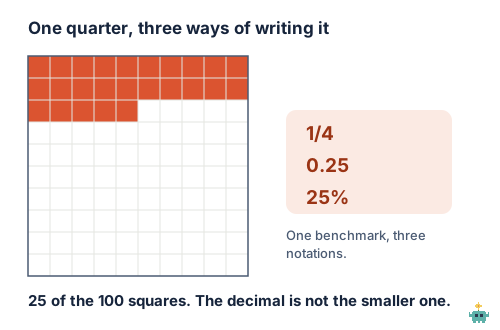
MA3-RN-01 applies place value and the role of zero to represent the properties of numbers, the whole-number backbone of the stage. MA3-RN-02 compares and orders decimals up to three decimal places, one place further than Stage 2. MA3-RN-03 is the load-bearing outcome for the entire stage: determining percentages of quantities, and finding equivalent fractions and decimals for benchmark percentage values. Read that last part carefully, because it names benchmark values. NSW is not asking for 37% of 84 by algorithm at Stage 3, it is asking for the equivalences a student should be able to reason with instantly: 50% is 1/2 is 0.5, 25% is 1/4 is 0.25, 10% is 1/10 is 0.1.
Representing quantity fractions (MA3-RQF-01, MA3-RQF-02)
MA3-RQF-01 names its denominators explicitly: 2, 3, 4, 5, 6, 8 and 10. That list is a planning gift, because it tells you exactly where the ceiling sits. Sevenths, ninths and twelfths are not Stage 3 work, and a student struggling to order 5/6 and 7/8 is inside the outcome, while a student being drilled on 7/12 versus 5/9 is being pushed past it. The denominators chosen are the ones that relate cleanly to halving, thirding and the benchmark percentages in MA3-RN-03, which is not a coincidence.
MA3-RQF-02 is the operator half, and it narrows the list further: determining a half, a quarter, a fifth and a tenth of measures and quantities. Those four are exactly the fractions that convert cleanly to the benchmark percentages, so this outcome and MA3-RN-03 are the same idea approached from two directions, and they belong in one unit. The distinction to hold onto is that MA3-RQF-01 treats a fraction as a number to be placed and compared, and MA3-RQF-02 treats it as an operation performed on a quantity. Students who are fluent at ordering fractions and stall on “a fifth of 60” have met the first outcome and not the second, and that gap is invisible unless you ask both questions.
Additive and multiplicative relations (MA3-AR-01, MA3-MR-01, MA3-MR-02)
MA3-AR-01 covers selecting and applying appropriate strategies to solve addition and subtraction problems, and MA3-MR-01 does the same for multiplication and division. Both are written as strategy-selection outcomes rather than procedure outcomes, which is a NSW pattern worth noticing: the assessment target is choosing a sensible method, not executing one taught method correctly. MA3-MR-02 constructs and completes number sentences involving multiplicative relations and applies the order of operations to calculations, the outcome that carries the new content and the one covered in detail below.
Geometric measure (MA3-GM-01 to MA3-GM-03)
MA3-GM-01 locates and describes points on a coordinate plane, the direct successor to Stage 2’s grid maps and directional language and the first time a position is given by an ordered pair rather than a grid square. MA3-GM-02 selects the appropriate unit and device to measure lengths and distances including perimeters. MA3-GM-03 measures and constructs angles with a protractor and identifies the relationships between angles on a straight line and angles at a point, moving from comparing an angle to a right angle (Stage 2) to reasoning about angles that must sum to 180 or 360 degrees.
Non-spatial measure (MA3-NSM-01, MA3-NSM-02)
MA3-NSM-01 selects the appropriate unit and device to measure the mass of objects. MA3-NSM-02 measures and compares duration using 12- and 24-hour time with am and pm notation. The word doing the work in MA3-NSM-02 is duration: Stage 2 read a clock, Stage 3 calculates elapsed time across formats, which is why it belongs near timetable and line-graph work rather than in its own isolated week.
Spatial structure (MA3-2DS, MA3-3DS)
MA3-2DS-01 investigates and classifies two-dimensional shapes, including triangles and quadrilaterals, based on their properties, a step up from Stage 2’s comparing and describing of features into formal classification. MA3-2DS-02 selects and uses the appropriate unit to calculate areas, including areas of rectangles. MA3-2DS-03 combines, splits and rearranges shapes to determine the area of parallelograms and triangles, the stage’s most conceptually demanding outcome and the one most often taught as a formula instead. MA3-3DS-01 visualises, sketches and constructs three-dimensional objects including prisms and pyramids, making connections to two-dimensional representations. MA3-3DS-02 selects and uses the appropriate unit to estimate, measure and calculate volumes and capacities.
Chance and Data (MA3-CHAN-01, MA3-DATA-01, MA3-DATA-02)
MA3-CHAN-01 conducts chance experiments and quantifies the probability, the move from recorded frequencies to a number. MA3-DATA-01 constructs graphs using many-to-one scales, where one symbol or one axis interval represents more than one data value. MA3-DATA-02 interprets data displays including timelines and line graphs, both of which are continuous displays rather than the categorical column graphs of Stage 2, and both of which reward a student who has already done MA3-NSM-02’s duration work.
The three outcomes that decide Stage 4
MA3-RN-03: a percentage is a fraction whose denominator is already chosen for you
The misconception: that percentages are a third number system alongside fractions and decimals, with their own procedures to memorise, rather than the same quantity written with a denominator fixed at 100.
What you will see: a student answers 50% of 40 correctly by halving, then stalls completely on 25% of 40 because no separate rule was memorised for quarters. Asked whether 0.25, 25% and 1/4 are the same amount, they hesitate, or say the decimal is “smaller” because it looks smaller.
The fix: build a three-column benchmark table (fraction, decimal, percentage) once, with the student, and then require all three forms to be written for every percentage question for a full term. NSW names benchmark values in the outcome for a reason: fluency with a small set beats a procedure applied to an unbounded set. Only once the table is automatic should you introduce 10% as a unit for building other percentages (30% is three lots of 10%).
MA3-MR-02: the order of operations is a convention, not a mnemonic
The misconception: that a memorised letter sequence is a strict priority ladder, so division always happens before multiplication and addition always happens before subtraction, because that is the order the letters appear in.
What you will see: given 12 ÷ 2 × 3, a student answers 2, having done 2 × 3 first because the letter for multiplication came earlier in the mnemonic. Given 10 - 4 + 1, they answer 5. Both are the same error, and both are invisible in a normal set of practice questions because most textbook examples happen to give the same answer either way.
The fix: teach it as two tiers, not four or six steps. Multiplication and division sit on one tier and are worked left to right; addition and subtraction sit on a lower tier and are also worked left to right; brackets override both. Then deliberately practise on the cases where left-to-right matters, which means specifically choosing expressions like 12 ÷ 2 × 3 and 10 - 4 + 1 rather than the ones a mnemonic survives.
MA3-2DS-03: the height of a triangle is not one of its sides
The misconception: that the “height” in an area calculation is whichever slanted side is available, rather than the perpendicular distance from the base to the opposite vertex. This is the direct cost of teaching the formula before the rearrangement the outcome actually asks for.
What you will see: given a triangle with a base of 6 cm, a perpendicular height of 4 cm and a slanted side marked 5 cm, a student computes half of 6 × 5 and answers 15. On an obtuse triangle where the height falls outside the shape, the same student declares the question impossible.
The fix: do the rearrangement physically before any formula appears. Cut a parallelogram, slide the triangular end across, and watch it become a rectangle with the same area, so the height is visibly the rectangle’s side rather than the parallelogram’s. Then cut a rectangle diagonally into two identical triangles, so “half of base times height” is something the student has seen happen rather than something they were told. The outcome literally says combine, split and rearrange, and a class that only ever substitutes into a formula has not met it.
What students need to arrive with
Stage 3 leans on three Stage 2 outcomes directly. MA2-RN-02 (decimals to two places) is the prerequisite for both MA3-RN-02’s third decimal place and MA3-RN-03’s percentage-decimal equivalences; a student who still reads 0.45 as larger than 0.5 cannot start percentages. MA2-MR-01 (multiplicative structure to 10 × 10) is the prerequisite for MA3-MR-01 and MA3-MR-02, both of which assume fact recall is automatic rather than derived. MA2-PF-01 (fractions as lengths on a number line) is the prerequisite for MA3-RQF-01’s comparing and ordering. Where any of these is shaky, the fix is a short return to Stage 2’s place value and fraction work rather than pushing ahead, and the full guide to MA2-MR-01 covers the structure-before-recall order if multiplication is the gap.
What this stage sets up
- MA3-RN-03 (percentages of quantities) becomes Stage 4’s work on ratios, rates and percentage increase and decrease, all of which assume benchmark equivalences are automatic.
- MA3-MR-02 (order of operations) becomes Stage 4’s algebraic expressions, where the same convention is applied to letters and a misremembered mnemonic produces wrong answers that are much harder to spot.
- MA3-2DS-03 (area by rearrangement) becomes Stage 4’s area formulas for trapeziums, kites and rhombuses, every one of which is derived by exactly the rearrangement argument used here.
- MA3-CHAN-01 (quantified probability) becomes Stage 4’s theoretical probability and sample spaces, where a probability is a number from the outset.
- MA3-GM-01 (points on a coordinate plane) becomes Stage 4’s linear relationships plotted on the number plane.
If you are unsure whether NSW syllabus outcomes, AC9 or the Victorian codes apply to your child, our guide to which curriculum your state uses sorts it out in a page.
A term-by-term order across two years
- Year 5, Terms 1–2: rebuild number, then extend it. MA3-RN-01 place value and the properties of numbers, MA3-RN-02 decimals to three places, MA3-RQF-01 comparing and ordering fractions, and MA3-AR-01 addition and subtraction strategies. Nothing new conceptually, everything the rest of the stage stands on.
- Year 5, Terms 3–4: measurement and space. MA3-GM-02 length and perimeter, MA3-2DS-01 classifying triangles and quadrilaterals, MA3-2DS-02 area of rectangles, MA3-3DS-01 prisms and pyramids, and MA3-NSM-01 mass. Perimeter before area, and area of rectangles well before MA3-2DS-03 needs it.
- Year 6, Terms 1–2: percentages, then everything that needs them. MA3-RN-03 percentages as the centrepiece, then MA3-CHAN-01 quantifying probability, which is unteachable without it, and MA3-MR-01 multiplication and division strategies alongside.
- Year 6, Terms 3–4: convention, derivation and data. MA3-MR-02 order of operations, MA3-2DS-03 area of parallelograms and triangles by rearrangement, MA3-GM-01 the coordinate plane, MA3-GM-03 angle relationships, MA3-3DS-02 volume and capacity, MA3-NSM-02 duration in 12- and 24-hour time, and MA3-DATA-01 and MA3-DATA-02 many-to-one scales, timelines and line graphs.
This is a suggested split, not a NSW requirement, since the syllabus deliberately does not assign outcomes to a specific year within the stage. Two orderings are non-negotiable whichever cycle you run: MA3-RN-03 comes before MA3-CHAN-01, because quantifying a probability means writing it as a fraction, decimal or percentage; and MA3-2DS-02 comes before MA3-2DS-03, because the rearrangement argument turns a parallelogram into a rectangle whose area the student must already be able to find.
Five checks before Stage 4
- Representing numbers: ask for 25% of 40 and how they worked it out. An answer reasoning from the quarter confirms MA3-RN-03; a correct answer with no explanation, or a stall after 50% was fine, means rebuild the benchmark table before Stage 4 assumes it.
- Multiplicative relations: ask for 12 ÷ 2 × 3. An answer of 18, worked left to right, confirms MA3-MR-02; an answer of 2 means reteach the two tiers and drill specifically on expressions where left-to-right changes the result.
- 2D spatial structure: hand over a triangle labelled with a 6 cm base, a 4 cm perpendicular height and a 5 cm slanted side, and ask for the area. An answer of 12 confirms MA3-2DS-03; an answer of 15 means go back to physically cutting and rearranging before the formula returns.
- Chance: after 20 coin tosses, ask for the probability of heads as a number. A fraction, decimal or percentage confirms MA3-CHAN-01; “likely” or “even chance” means the outcome is still being answered at Stage 2 level and the percentage work underneath it needs checking first.
- Data: show a picture graph where one symbol represents 5 items and ask how many a row of four and a half symbols represents. An answer of 22 or 23 with reasoning confirms MA3-DATA-01; counting the symbols and answering 4 or 5 means reteach many-to-one scale explicitly, including part symbols.
Recording the alignment
Whether you are programming for a class or building evidence for a NESA home education review, record the outcome code on the activity as you go, and note where in the two-year stage the student sits, because the outcome itself will not tell a reviewer that. “Maths worksheet” answers nothing; “MA3-RN-03, benchmark percentage equivalents with a fraction-decimal-percentage table, Year 6 Term 1” answers the question before it is asked. Our guides to state-by-state registration requirements and which curriculum your state uses cover what NSW reviewers ask for and which code set applies if you have moved states, and teaching maths through interests covers wrapping these outcomes around whatever your child is currently into.
Sprout Lessons builds a full interactive lesson from any of these outcomes, pitched at Stage 3 and wrapped in whatever your student is into, with self-checking practice that hints rather than just marking wrong, and the exact NSW outcome code recorded in the lesson footer. Try it free and generate a Stage 3 Maths lesson in about a minute.
Outcome codes reference NSW syllabuses © NSW Education Standards Authority (NESA) for and on behalf of the Crown in right of the State of New South Wales, accessed viacurriculum.nsw.edu.au. NESA does not endorse this product. Always verify against the current syllabus outcomes and content.
FAQ
How many maths outcomes are there in Stage 3 of the NSW syllabus?
Twenty-one, across ten focus areas: three in Representing numbers using place value (MA3-RN-01 to MA3-RN-03), two in Representing quantity fractions (MA3-RQF-01 and MA3-RQF-02), one in Additive relations (MA3-AR-01), two in Multiplicative relations (MA3-MR-01 and MA3-MR-02), three in Geometric measure (MA3-GM-01 to MA3-GM-03), two in Non-spatial measure (MA3-NSM-01 and MA3-NSM-02), three in 2D spatial structure (MA3-2DS-01 to MA3-2DS-03), two in 3D spatial structure (MA3-3DS-01 and MA3-3DS-02), one in Chance (MA3-CHAN-01) and two in Data (MA3-DATA-01 and MA3-DATA-02).
What do Year A and Year B mean in NSW Stage 3 Maths?
They are two content cycles published within each focus area so that schools running composite or multi-stage classes can teach Year A one year and Year B the next without a student repeating or missing content. They are not a claim that Year A is Year 5 and Year B is Year 6, and they are not an achievement split: the outcome describes what a student can do by the end of Year 6.
Which NSW Stage 3 maths outcomes are genuinely new rather than extensions of Stage 2?
Three. MA3-RN-03 brings in percentages of quantities and benchmark fraction-decimal-percentage equivalents. MA3-MR-02 adds the order of operations, which has no Stage 2 ancestor. MA3-2DS-03 asks for the area of parallelograms and triangles found by combining, splitting and rearranging shapes rather than by counting units.
Why does my child get 12 divided by 2 times 3 wrong?
An answer of 2 instead of 18 means the order of operations is being applied as a strict letter ladder, with multiplication placed above division because its letter comes first in the mnemonic. Teach it as two tiers instead: multiplication and division share one tier and are worked left to right, addition and subtraction share a lower tier and are also worked left to right, and brackets override both. Then practise specifically on expressions where the left-to-right rule changes the answer.
Why does my child use the slanted side when finding the area of a triangle?
This is the standard MA3-2DS-03 error and it comes from meeting the formula before the rearrangement. Cut a parallelogram and slide its triangular end across to make a rectangle, then cut a rectangle diagonally into two identical triangles, so the perpendicular height is something the child has watched appear rather than a label they were told to look for.