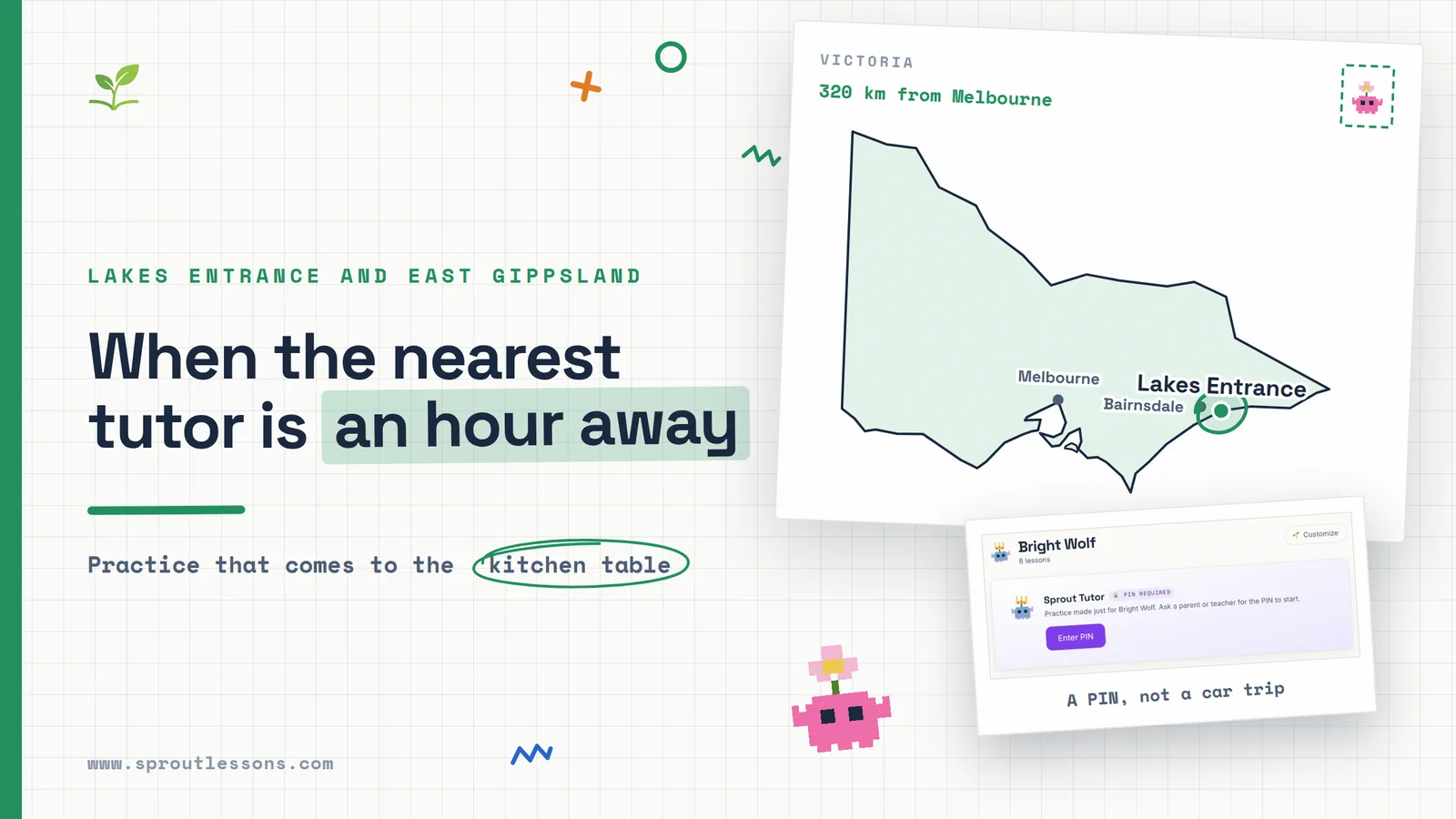
In Lakes Entrance the tutoring question is usually not which tutor, but whether there is one within a drive you can make every week. Bairnsdale is about 36 km up the highway and Melbourne is roughly 320 km away, so for most East Gippsland families the realistic options are the school, a tutor on a screen, and practice at home. This page takes each one seriously, including the one that is often mistaken for tutoring and is not.
Start with the school, because it is the local option
Lakes Entrance Secondary College is a small school: about 300 students from Year 7 to Year 12, drawn from the primary schools at Swan Reach, Nungurner, Lakes Entrance, Toorloo Arm and Metung. In a region where the nearest paid tutor may be half an hour away, the classroom teacher is the only educator who sees your child every week, and that makes them the most useful person to ask before you spend anything.
Two questions, for a primary or a secondary teacher alike:
- Which part of maths or English is the difficulty in? A strand, and a Victorian Curriculum code if they have one. “Fractions” is a start; “adding fractions with different denominators” is something you can actually practise.
- Does the school still run small-group tutoring this year? The state program that funded a tutor in every government school was only guaranteed to the end of 2025, and in 2026 it has been cut or reduced at many schools. We set out what changed, and why to ask how many sessions your child actually attended, in the Geelong version of this question. None of that is specific to Geelong.
Virtual School Victoria is not a tutoring service
It is worth clearing this up, because it comes up whenever regional families ask about learning online. Virtual School Victoria is a government school that teaches remotely, and students already enrolled at another Victorian school can take a subject with it. The rules, from its own enrolment page:
- Students in Years 7 to 10 can take at most one subject with it each semester.
- Students in Years 11 and 12 can take at most two.
- The principal of the home school has to approve it, and a staff member there is nominated as the student’s supervisor.
- It exists for a subject the home school does not offer, or one that clashes on the timetable. For a non-government school the upfront cost is $960 a subject.
So it is a real option for a Year 10 who wants a subject the local school cannot run, and no option at all for a Year 5 who is stuck on fractions. Extra help with a subject your child already takes is a different job, and the rest of this page is about that job.
A tutor on a screen: what changes, and what to ask
For a family this far from the nearest centre, a tutor on a video call is usually the realistic way to get a person. It needs two adjustments that a tutor in your kitchen would not.
- Ask how they will see the working. Maths on a video call fails quietly when the tutor can only see the answer. A shared whiteboard, or a phone propped over the page, fixes it. Ask before you book, not after the third session.
- Ask which curriculum they teach to. An online service may teach children in every state. Your child’s school runs the Victorian Curriculum, so a tutor who can name the Victorian code for this week’s topic is working from the same page as the classroom. One who talks about “Year 5 maths” in general may not be.
And ask for the same checks you would ask of anyone tutoring your child in person: a current Working with Children Check, or registration as a teacher. The Victorian Institute of Teaching’s public register is searchable in a minute.
Once the teacher has named the topic, Sprout builds a Victorian Curriculum lesson on that exact code in about thirty seconds. No drive, no booking. Start free.
Practice that comes to the kitchen table
Distance changes the arithmetic of tutoring more than people expect. A weekly session in Bairnsdale is not one hour; with the drive both ways it is closer to two, every week, and it usually lands in the only after-school slot a family has. The thing that actually moves a child forward, short practice on the right topic most nights, is the one part of tutoring that never needed a car. What it needs is the right topic and someone checking the answers, which is exactly what a busy household is short of.
That is the gap Sprout Tutor is built for, and here is how it works for a family at a distance:
- Your child opens their own page and types a four-digit PIN. You hold the PIN and can change it. There is no open text box, so it is a bounded practice surface rather than a chatbot.
- You can check it from anywhere. The parent dashboard shows each question as it was worded, the answer given, and whether a hint was opened or the answer revealed. A parent on shift work, or away for work during the week, sees the same record as the one at home. Every number on the dashboard, explained.
- It works at your child’s actual level. A child assigned to Year 5 can be practising Year 4 content while a gap closes, and the change is recorded. The rules for that are in working at a different level in the Victorian Curriculum.
- It follows the Victorian Curriculum, Years 1 to 9, in maths, English and science. It is in public beta, and while it is in beta it is free on every plan, including the free one.
Personalised to the lakes, not to a textbook
The tutor lets a child choose each session’s flavour (Classic, Footy, Netball or Animals) without changing the curriculum code underneath. Sprout Lessons, the full lesson builder, goes further: you pick interests from a curated list that includes fishing, sailing, surfing, whales and dolphins, and ocean animals, and each new lesson is built around one of them, taking turns. A child who spends weekends on the jetty gets a ratio lesson about bait and catch, and the ratio is still the Level 7 ratio code, VC2M7N09. The reasoning behind one interest at a time is in teaching maths through interests.
What a person still does better
None of this replaces a good tutor, and we build the software, so we will say it plainly. A person notices when a child is guessing to get it over with, or is fine with the maths and frightened of being wrong. A person can abandon the plan and teach the thing underneath. And for a child who has decided they are “no good at maths”, a relationship with one adult who thinks otherwise can be the whole intervention. The honest state of the evidence is also that the effectiveness of personalised-learning chatbots has not been independently established, and very few rigorous studies of them exist.
The practical answer for a regional family is often both: a human tutor online, less often than you would book one in person, and short practice at home on the topic that tutor named. How to make the days between sessions count is in what to do between tutoring sessions.
If distance is part of why you are thinking about home education
Some East Gippsland families get here from the other direction: the school run is long, a child is unhappy, and home education starts to look practical. In Victoria that means registering with the VRQA and keeping a learning plan that, taken as a whole, substantially addresses eight learning areas. The steps, forms and timeframes are in homeschool registration in Victoria. The Victorian Curriculum is a sensible spine for that plan even though it is not required, because it is the same sequence your child would meet if they return to school.
A plan for this term
- Ask the teacher for the topic, as precisely as they can give it.
- Ask the school what small-group support still runs, and whether your child is in it.
- Practise that one topic at home for about twenty minutes most nights, for three weeks, then give a short cold check with no warm-up.
- If it did not stick, or nobody could name the topic, book a person. Online is fine; ask how they will see the working and which curriculum they teach to.
- Skip Virtual School Victoria for this problem. Keep it in mind for Year 10 and beyond, when a subject the local school cannot offer becomes the problem instead.
The short version
Around Lakes Entrance the nearest paid tutor may be a drive you cannot make every week, so the school, an online tutor and practice at home do most of the work. Virtual School Victoria is for taking a subject your school does not offer, not for extra help. The part that moves a child forward, short practice on the right topic most nights, never needed a car.
Sprout builds Victorian Curriculum lessons around your child’s interests, with the code on every lesson, and Sprout Tutor is in public beta for Years 1 to 9 and free on every plan while it is in beta. Start free.
Checked 29 September 2026. School numbers and feeder schools are from Lakes Entrance Secondary College’s own site. Virtual School Victoria’s limits, approval rules and fee are from its page for students enrolled in other schools. Distances are approximate road distances. The home education requirements are summarised from the VRQA guidance cited on our Victorian registration page. We build competing software and say so above.
FAQ
Are there tutors in Lakes Entrance?
Paid tutoring close to Lakes Entrance is thin, and Bairnsdale, the nearest larger centre, is about 36 km by road. For most families the realistic options are the school’s own support, a human tutor online, and short practice at home on the topic the teacher names. Online national services teach anywhere in Victoria, so ask any of them which Victorian Curriculum code they are working on.
Can Virtual School Victoria help my child catch up?
Not in the way tutoring does. Virtual School Victoria lets a student enrolled at another Victorian school take a subject remotely, at most one a semester in Years 7 to 10 and two in Years 11 and 12, with the principal’s approval and a supervising staff member. It exists for subjects the home school does not offer or timetable clashes; for a non-government school it costs $960 a subject. It does not provide extra help with a subject your child already takes.
Does online tutoring work for primary school maths?
It can, with two adjustments. Make sure the tutor can see the working, through a shared whiteboard or a phone over the page, because a video call that only shows the answer hides the mistake. And ask which curriculum they teach to, because a Victorian school runs the Victorian Curriculum and an online service may teach every state. Check a Working with Children Check or teacher registration as you would in person.
What is Sprout Tutor, and does it cost anything?
Sprout Tutor is guided practice for the Victorian Curriculum, Years 1 to 9, in maths, English and science. A child opens their own page and enters a PIN the parent holds; there is no open chat box. The parent dashboard shows each question, the answer given, and any hint or reveal. It is in public beta and free on every plan, including the free one, while it is in beta.
Can practice be about fishing or the ocean?
In Sprout Lessons, yes: you choose interests from a curated list that includes fishing, sailing, surfing, whales and dolphins and ocean animals, and each new lesson is built around one of them while the curriculum code stays fixed. In Sprout Tutor a child picks a flavour for each session from Classic, Footy, Netball or Animals.