
You are buying one hour. The tutoring works or fails in the other 167, and almost nobody sells you a plan for those. This is the single most common reason a family spends three thousand dollars across a year and cannot say afterwards whether it helped.
The fix is not more tutoring. It is about twenty minutes a night doing the specific thing the tutor worked on, and a two-minute conversation at pickup that most parents never have.
The week, drawn
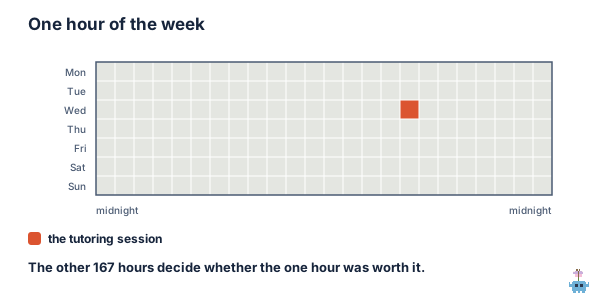
A good tutor spends their hour finding the gap and teaching into it. That is the expensive, skilled part and it is worth paying for. What it produces is a fragile new idea, one exposure old, in a child who will not meet it again for seven days.
Forgetting over those seven days is not a failure of the tutor or of your child. It is the default behaviour of memory, and the evidence on what beats it is unusually clear: in a 2013 review of ten study techniques, Dunlosky and colleagues rated only two as high utility, and both of them are things that have to happen between sessions rather than during one.
- Practice testing. Being asked, rather than being shown.
- Distributed practice. Meeting the same material across several days instead of in one block.
A weekly session is, structurally, a single block with six empty days after it. The longer version of why that loses is its own page.
The two-minute conversation
Do this at pickup, or by message afterwards. It is the highest-value thing in this article and it costs nothing.
- “What did you work on today?” You want a topic, not a subject. “Equivalent fractions with related denominators”, not “fractions”. If your tutor can give you the Victorian Curriculum code, better again.
- “What method did you use?” This is the one people skip and it matters more than the topic. If the tutor taught a bar model and you teach the algorithm you remember from school, your child now has two competing methods and trusts neither.
- “What should we practise before next week?” A good tutor has an answer ready. A tutor who says “just keep it up” is not planning for the six days, and you can ask them to.
What to actually do on the six days
- Twenty minutes, most nights, same time. Not an hour on Sunday. The spacing is doing more work than the duration, and a habit survives a bad mood in a way a decision does not.
- Practise the thing the tutor named, and nothing else. The temptation is to cover more ground because you are paying for progress. Resist it. One topic, revisited, beats four topics met once.
- Ask questions rather than explaining. You are not the second tutor and you should not try to be. Your job between sessions is retrieval: pose the problem, wait, and let them produce the answer. Waiting is most of the skill.
- Use the tutor’s method, even if yours is faster. Especially if yours is faster. Consistency across the week is worth more than efficiency on any one night.
- Keep a two-line record. Date, topic, and whether it went well. Hand it to the tutor next week. This turns their first ten minutes from reorientation into teaching, which is real money.
- Do the cold check before the session, not after. One problem from last week, no help, on the morning of the next session. If it survives seven days it has landed. If it does not, the tutor now knows before they start.
What not to do
- Do not set extra work as a punishment, or as a response to a bad session. It teaches exactly one thing and it is not maths.
- Do not re-teach a different way on the same night. If your child is stuck on the tutor’s method, note it and send it back to the tutor. Two methods in twelve hours produces a child who thinks maths is arbitrary.
- Do not let a chatbot fill the gap unsupervised. The clearest experiment in this area found that unrestricted access to a strong model left students worse on a later unassisted exam than students who never had AI, because they used it as a crutch. The full result is here. Between sessions is exactly the unsupervised window where that happens.
- Do not double the sessions instead. Two hours a week is still two hours in 168, at twice the price. If one hour is not landing, the problem is usually the other six days rather than the quantity of tutoring.
How to tell it is working
Set this up in the first fortnight, because otherwise you will be six months in and guessing.
- The cold check survives a week. Same problem type, no help, seven days later. This is the only test that matters and it takes two minutes.
- The topic list is moving. If your two-line record shows the same topic in week two, week five and week nine, something is wrong and it is worth raising.
- School work is changing, not just tutoring work. Transfer to the classroom is the actual goal. Improvement that only shows up in the session is improvement at the session.
- Your child can explain a step. Not the whole method, one step, and why. A child who can reproduce a procedure and cannot say why any step follows the last has been shown rather than taught.
Where we sit, declared
We build lesson software, so weigh this as the interest it is. Sprout Tutor is in public beta as of 22 September 2026, covers the Victorian Curriculum only, Years 1 to 9, and is free on every tier while in beta.
It is built for exactly the six-day problem and not for the hour: ten questions on one curriculum code per sitting, the VC2 code on every question, and a record of what was answered, where a hint was taken and where the answer was revealed, so you have something concrete to hand your tutor. It does not do the thing you are paying the tutor for. It cannot notice your child is having a bad week, and it cannot abandon the plan to teach the thing underneath. What tutoring actually costs in Melbourne, and when it is the wrong purchase, is the companion page to this one.
The short version
One hour of 168. The tutor’s job is finding the gap and teaching into it; keeping it alive for the next seven days is yours, and nobody sells you a plan for that.
Have the two-minute conversation at pickup. What topic, what method, what should we practise. The method question is the one people skip, and teaching a competing method at home is the fastest way to waste the hour you just paid for.
Then twenty minutes most nights on that one topic, asking rather than explaining, using the tutor’s method, with a two-line record to hand back. Do the cold check on the morning of the next session rather than after it, so the tutor starts informed.
Sprout Lessons builds curriculum-aligned lessons for Foundation to Year 10, with the code on every lesson. Start free. If you are in Victoria, Sprout Tutor is in public beta for Years 1 to 9 and free on every tier while it is in beta.
Checked 26 September 2026. The learning-technique ratings are from Dunlosky et al., Improving Students’ Learning With Effective Learning Techniques, Psychological Science in the Public Interest, 2013, which rated practice testing and distributed practice as the only two high-utility techniques of the ten reviewed; the publisher blocks automated fetches from our tooling, so PubMed is linked. The finding on unrestricted AI access is Bastani et al., PNAS, 2025, covered with its caveats on our own page. We build competing software and say so above.
FAQ
What should my child do between tutoring sessions?
Twenty minutes most nights on the single topic the tutor named, at the same time each day, using the tutor’s method rather than yours. Ask questions rather than explaining, since your job between sessions is retrieval rather than teaching. Keep a two-line record of date, topic and how it went, and hand it to the tutor next week. Then do one cold problem on the morning of the next session.
Why is my child forgetting what the tutor taught?
Because a weekly session is structurally a single block of teaching with six empty days after it, and forgetting after one exposure is the default behaviour of memory. In a 2013 review of ten study techniques, Dunlosky and colleagues rated only two as high utility: practice testing and distributed practice. Both of those are things that have to happen between sessions rather than during one.
Should I teach my child a different method from the tutor?
No, and this is the most common expensive mistake. If the tutor taught a bar model and you teach the algorithm you remember from school, your child has two competing methods within twelve hours and trusts neither. If they are stuck on the tutor’s method, note it and send it back to the tutor rather than substituting your own.
Should I book more tutoring sessions instead?
Usually not. Two hours a week is still two hours in 168, at twice the price. If one hour is not landing, the constraint is generally the other six days rather than the quantity of tutoring. Fix the between-sessions plan before buying more sessions.
Can my child use an AI chatbot for homework between sessions?
Be careful with it unsupervised, because between sessions is exactly the unsupervised window where it goes wrong. The clearest field experiment in this area found that unrestricted access to a strong model left high school students 17% worse on a later unassisted exam than students who never had AI at all, because they used it as a crutch by asking for and copying solutions.
How do I know if the tutoring is working?
Set up four checks in the first fortnight. Does a cold problem of the same type survive seven days. Is the topic list moving, or is week two the same as week nine. Is school work changing rather than only tutoring work, since transfer to the classroom is the actual goal. And can your child explain one step and why it follows the last, because a child who reproduces a procedure without that has been shown rather than taught.