
Year 7 Maths in the Victorian Curriculum F–10 Version 2.0, officially Level 7, is 31 content descriptions, VC2M7A01 through VC2M7ST03. The national Year 7 curriculum has 30. That one extra code is not a rounding difference: Victoria splits the Number strand along different lines, and the split moves two of the hardest topics in the year out of a shared descriptor and into descriptors of their own.
This guide covers all 31 codes, the places Victoria genuinely diverges from the national curriculum (there are more of them at Level 7 than at any primary level), the four descriptors that decide whether Level 8 goes well, a term-by-term order, six checks before moving on, and where Level 7 Maths overlaps the Capabilities.
What Victoria does differently at Level 7
The Algebra, Measurement, Probability, Space and Statistics codes line up one for one with the national numbering: VC2M7A03 is AC9M7A03, VC2M7SP02 is AC9M7SP02. Number does not. Victoria has ten Number descriptors where the national curriculum has nine, and after VC2M7N02 the numbers no longer match, so a scope and sequence that maps VC2M7N05 to AC9M7N05 will be mapping fraction multiplication onto rounding. That mismatch is the single most practical thing to know about Level 7 in Victoria.
Six differences matter for planning. The rest are wording.
- Multiplying and dividing fractions and decimals gets its own descriptor (VC2M7N05). Nationally, this sits inside the general four-operations descriptor alongside everything else. Victoria pulls it out and names it, with mental, written and digital strategies all required. This is the hardest computational content in the year and the change is a planning gift: it makes the topic impossible to under-schedule, because it is a line item rather than a clause.
- Percentages get their own descriptor too (VC2M7N07), and it names a skill the national curriculum does not. Victoria asks students to find percentages of quantities and to express one quantity as a percentage of another, with and without digital tools. That second half is a genuinely different task, and it is not named anywhere in the national Year 7 Number strand. A student who can find 15% of 80 often has no idea how to answer “12 out of 80 is what percentage?”, and Victoria makes that a Level 7 requirement rather than an assumed by-product.
- VC2M7M01 asks students to establish the area formulas, not just use them.The national descriptor permits established formulas for triangles and parallelograms. Victoria asks for the formulas to be established, and includes rectangles in the list even though the rectangle formula was already established at Level 6 (VC2M6M02). The verb is the whole difference: a Level 7 program that hands over half base times height has not met VC2M7M01, and the rearrangement argument it wants is the same one that makes trapezium and kite areas derivable in later levels rather than memorised.
- VC2M7A02 pulls the number laws forward a year. Victoria attaches the associative, commutative and distributive laws, applied to mental and written computation, to the expression-building descriptor. Nationally those properties are named in Year 8, in the expand-and-factorise descriptor. Teaching them at Level 7 alongside expression building is the better order, because the distributive law is what makes expanding brackets in Level 8 look obvious rather than arbitrary.
- VC2M7N03 names negatives and mixed numbers explicitly. Where the national descriptor asks for rational numbers on a number line, Victoria specifies positive and negative rational numbers and mixed numbers. Practically, this means the number line work has to run below zero and past one in the same lesson, which is where the interesting errors live.
- VC2M7SP03 restricts rotations to the origin. The national descriptor asks for rotations about a given point. Victoria asks for rotations about the origin. That is a narrowing, and it is one of the few places where the Victorian requirement is smaller than the national one.
Four smaller differences are still worth a line in a program. VC2M7A05 asks for visually changing patterns rather than growing ones, so a shrinking pattern is fair game. VC2M7M06 scopes its ratio modelling to ratios of lengths, areas and volumes, which is narrower and more geometric than the national version. VC2M7P02 adds the effect of sample size on outcomes to the simulation descriptor. VC2M7ST02 names dot plots alongside stem-and-leaf plots, and VC2M7ST03 brings primary and secondary sources into Level 7, where nationally that distinction waits until Year 8. Our side-by-side comparison of the Victorian and Australian curriculums covers the structural differences behind all of this, and the Victorian Curriculum explained covers levels, bands and how VCAA publishes them.
What changes this year
Level 6 ended with integers as positions on a number line and equations with brackets. Level 7 makes both abstract, and it does it with letters. Algebra doubles from three descriptors to six, and every one of the six uses variables rather than the number patterns and missing-value sentences that carried the primary years. VC2M7A01 starts from everyday formulas and asks for substitution; VC2M7A02 reverses it and asks students to build expressions from a situation, now with the number laws attached; VC2M7A03 solves one-variable linear equations of increasing complexity and verifies the answer by substituting it back. Between those three, a letter stops being a placeholder in a puzzle and becomes a number whose value has not been fixed yet.
Two things arrive with no Level 6 ancestor at all. Ratios appear twice, in VC2M7N09 and again in VC2M7M06, and nothing in the primary curriculum builds them, because Level 6 stopped at fractions, decimals and percentages of a quantity. And integers become operable in VC2M7N08 rather than merely locatable, which is where the two jobs of the minus sign collide in one expression for the first time.
The level at a glance
| Strand | Codes | What it covers |
|---|---|---|
| Number | 10 (VC2M7N01–10) | Square numbers and square roots; expanded notation with powers of 10 and prime factorisation in one descriptor; equivalent representations of positive and negative rational numbers and mixed numbers on a number line; rounding and estimation; multiplying and dividing fractions and decimals; the four operations with positive rational numbers; percentages of quantities and one quantity as a percentage of another; adding and subtracting integers; ratios; and modelling in financial contexts including best buys |
| Algebra | 6 (VC2M7A01–06) | Variables in everyday formulas and substitution; the associative, commutative and distributive laws applied to computation and to building expressions; one-variable linear equations of increasing complexity verified by substitution; investigating relationships between variables in graphs from authentic data; tables of values from visually changing patterns plotted on the Cartesian plane; and manipulating multi-variable formulas with digital tools |
| Measurement | 6 (VC2M7M01–06) | Establishing the area formulas for rectangles, triangles and parallelograms; volume of right prisms; the relationship between π, circumference, radius and diameter; corresponding, alternate and co-interior angles on parallel lines; the interior angle sum of a triangle and other shapes; and modelling with ratios of lengths, areas and volumes |
| Probability | 2 (VC2M7P01–02) | Sample spaces for single-stage experiments with probabilities assigned and relative frequencies predicted, and repeated experiments and simulations with many trials including the effect of sample size on the outcomes |
| Space | 4 (VC2M7SP01–04) | Representing three-dimensional objects in two dimensions and reasoning about the trade-offs; classifying triangles, quadrilaterals and other polygons by side and angle properties; translations, reflections in an axis and rotations about the origin described with coordinates; and algorithms that sort and classify shapes by attribute |
| Statistics | 3 (VC2M7ST01–03) | Acquiring data for discrete and continuous numerical variables and calculating range, median, mean and mode with a justified choice of measure; dot plots and stem-and-leaf plots described by shape, centre and spread; and statistical investigations using data from primary and secondary sources |
Ten of the 31 descriptors are Number, and both of the extra Number descriptors relative to the national curriculum are computational rather than conceptual. That is worth reading as an instruction: Victoria is telling you that Level 7 fluency work is not optional and cannot be folded into an applications unit at the end of the year.
Reading the codes
Victorian codes run VC2M + level + strand + number, so VC2M7N05 is Level 7 Number, position 5. Strand letters are N Number, A Algebra, M Measurement, P Probability, SP Space, ST Statistics, the same set as the national curriculum. The Mathematics codes are level-by-level from Foundation to Level 10, unlike Science and the Humanities, which VCAA publishes in two-level bands. If you are used to reading VC2 Science in bands, Level 7 Maths being a single year is the exception, not the rule.
Strand by strand
Number (VC2M7N01 to VC2M7N10)
VC2M7N01 covers the relationship between perfect squares and square roots and using both to solve problems, the descriptor that introduces two inverse operations at once when students have only ever met one inverse pair. VC2M7N02 is the merged descriptor: expanded notation with powers of 10 and prime factorisation in exponent notation, which the national curriculum splits across two codes. Teaching them together is defensible, because both are place value and factor structure written with exponents, but it does mean one descriptor carries two distinct assessable skills.
VC2M7N03 puts equivalent representations of rational numbers, including negatives and mixed numbers, on a number line. VC2M7N04 is the rounding and estimation habit descriptor, which works better as a standing requirement across the year than as a fortnight in isolation. VC2M7N05 multiplies and divides fractions and decimals, and VC2M7N06 covers the four operations with positive rational numbers, so the two overlap deliberately: VC2M7N05 builds the procedures and VC2M7N06 asks for them to be selected and combined in problems.
VC2M7N07 is the percentage descriptor covered above, and it is the one most likely to be half-taught. VC2M7N08 compares, orders, adds and subtracts integers. VC2M7N09 covers ratios, the level’s genuinely new topic. VC2M7N10 is the applied descriptor: modelling with rational numbers and percentages in financial contexts, and Victoria names best buys and designing algorithms inside it, which makes it a natural place to end the year with something that looks like a project rather than a test.
Algebra (VC2M7A01 to VC2M7A06)
The publication order is very close to the right teaching order. VC2M7A01 substitutes into everyday formulas, which is the gentlest possible entry because the letter arrives already attached to a meaning the student has. VC2M7A02 reverses it into building expressions, with the associative, commutative and distributive laws attached. VC2M7A03 solves one-variable linear equations of increasing complexity and verifies by substitution, which closes the loop back to VC2M7A01.
The other three are graphical. VC2M7A04 investigates, interprets and describes relationships between variables shown in graphs developed from authentic data. Note the extra verbs against the national version: Victoria wants investigation, not just description, which in practice means the data set has to be one students can interrogate rather than a printed graph. VC2M7A05 generates tables of values from visually changing patterns or a function rule and plots them. VC2M7A06 varies the values in a multi-variable formula using digital tools and describes the effect, the descriptor most often skipped and the one that does most for intuition, because a student who has watched an answer move as a variable changes has stopped reading a formula as a fixed recipe.
Measurement (VC2M7M01 to VC2M7M06)
VC2M7M01 establishes the area formulas for rectangles, triangles and parallelograms and uses them in problem solving, discussed above. VC2M7M02 solves volume problems for right prisms including rectangular and triangular prisms. VC2M7M03 covers the relationship between π and a circle’s circumference, radius and diameter. Note what is absent: the area of a circle is Level 8 work in VC2M8M03, and so is the circumference formula applied to problems. Level 7 is about the relationship, not the calculation.
VC2M7M04 covers corresponding, alternate and co-interior angles on parallel lines cut by a transversal, with reasons explained. VC2M7M05 demonstrates that a triangle’s interior angles sum to 180 degrees and applies it to other shapes and unknown angles. Those two are the deductive core of the level and belong in the same unit. VC2M7M06 models with ratios of lengths, areas and volumes, which is why ratio belongs in Number first and here second.
Probability and Space (VC2M7P01 to VC2M7SP04)
VC2M7P01 identifies the sample space for single-stage experiments, assigns probabilities to the possible outcomes and predicts relative frequencies. The phrase carrying the level is sample space: Level 6 described probabilities on a scale, Level 7 lists what can happen and counts it. VC2M7P02 runs repeated experiments and digital simulations with many trials and explains both the differences from prediction and the effect of sample size.
VC2M7SP01 represents three-dimensional objects in two dimensions and argues about which representation suits a purpose, covering nets, plans and elevations, and isometric drawing. VC2M7SP02 classifies triangles, quadrilaterals and other polygons by side and angle properties, the descriptor that makes “a square is a rectangle” something a student can justify rather than resent. VC2M7SP03 describes the effect of translations, reflections in an axis and rotations about the origin using coordinates. VC2M7SP04 designs sorting algorithms for shapes, which pairs with VC2M7SP02 rather than standing alone.
Statistics (VC2M7ST01 to VC2M7ST03)
VC2M7ST01 acquires data for discrete and continuous numerical variables, calculates range, median, mean and mode, and requires a justified decision about which measure of centre gives useful insight. The justification is the assessable part and it is routinely reduced to arithmetic. VC2M7ST02 creates numerical displays including dot plots and stem-and-leaf plots and compares distributions by shape, centre and spread including outliers. VC2M7ST03 plans and conducts investigations into issues, using data collected from both primary and secondary sources, and reports in terms of shape and summary statistics.
The four codes that decide Level 8
VC2M7A02: the letter is a number, not a label
The misconception: that a variable abbreviates an object rather than standing for a quantity, so a means apples and 3a means three apples. Alongside it sits reading juxtaposition as concatenation, so 3a with a = 4 is answered as 34.
What you will see: asked to write an expression for “5 more than a number n”, a student writes 5n. Asked to write “there are 6 times as many students as teachers”, they write 6s = t, parking the 6 next to the thing there is more of.
The fix: teach VC2M7A01 before VC2M7A02, always. Substitution forces the letter to hold a number before the student is asked to invent one. Use formulas the student can already say in words, and substitute three or four different values into the same formula inside a minute, so the letter is visibly a slot rather than a fixed thing. When you move to building expressions, require a written sentence such as “n is the number of students” before any expression is accepted. That sentence alone kills the label reading. Victoria’s addition of the number laws to this descriptor helps here too: checking that 3(n + 2) and 3n + 6 agree for several values of n is a substitution exercise that also delivers the distributive law.
VC2M7N05: multiplying a fraction usually makes it smaller
The misconception: that multiplication always makes numbers bigger and division always makes them smaller, a rule that held for every whole number a student met before Level 7 and stops holding here. Victoria gives this content its own descriptor, which is a signal about how much time it needs.
What you will see: asked whether 12 × 0.4 is more or less than 12, a student says more, without calculating. Asked for 6 ÷ 1/2, they answer 3, because dividing must shrink it. The division error is the more damaging of the two, because it survives into Level 8 rates and Level 9 algebraic fractions unnoticed.
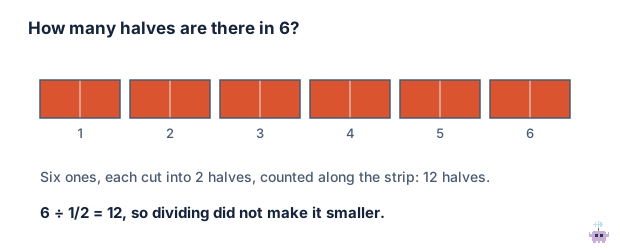
The fix: ask for a prediction and a reason before every calculation, and make the reason the assessable part. For division, replace “how many times does it go in” with the question the operation actually asks: how many halves are there in 6? Count them physically on a strip of paper. Once a student has counted 12 halves in 6, the answer of 3 is unavailable to them. Delay the invert-and-multiply rule until after the counting, not before, because the rule is what makes the meaning inaccessible.
VC2M7N07: 12 out of 80 is a different question from 15% of 80
The misconception: that the two halves of the descriptor are one skill. They share the word percentage and nothing else: one starts from a rate and finds a part, the other starts from two quantities and finds the rate. Nationally the second is not named at all, so it is easy to teach only the first without noticing.
What you will see: a student who answers 15% of 80 confidently and then, for “12 out of 80 is what percentage?”, either stalls or multiplies 12 by 80. A common near-miss is answering 12/80 and stopping, which is right but unfinished, and it tells you the fraction-to-percentage step is the gap rather than the set-up.
The fix: teach the second half as a fraction question that ends in a conversion, not as a new procedure: 12 out of 80 is the fraction 12/80, and a percentage is that fraction with the denominator changed to 100. Ask both question types about the same numbers in the same lesson, deliberately alternating, so the student has to decide which one is being asked rather than applying whichever was taught most recently. Test scores are the best context because every student already knows that 12 out of 80 is bad news, which supplies the reasonableness check for free.
VC2M7N08: the minus sign is doing two jobs in the same expression
The misconception: that the sign in −3 and the operation in 8 − 3 are the same symbol doing the same job. Level 6 built negatives as positions in VC2M6N01 but never asked for an operation on them, so the collision happens for the first time here.
What you will see: −3 − 5 answered as −2, by subtracting the magnitudes, or as 2, by treating the two minus signs as a cancellation. The same student usually gets “the temperature was −3 and dropped 5 degrees” right, which is the diagnostic: the context supplies the reasoning the bare symbols do not.
The fix: keep every integer calculation attached to a number line for longer than feels necessary, and read the operation as movement: subtracting is going left, adding is going right, and the sign in front tells you where you started. Say “negative three” and “take away five” aloud so the two roles sound different even when they look identical. Money and temperature are where students self-correct, so build the rules there and then strip the context deliberately, one step at a time, rather than starting bare and hoping.
What students need to arrive with
Level 7 leans on four Level 6 codes hard enough that a gap will surface within a fortnight. VC2M6N02 (prime, composite, square and triangular numbers) is the prerequisite for VC2M7N01 and VC2M7N02. VC2M6N01 (integers as positions) is the prerequisite for VC2M7N08, and it is the most common gap of the four, because it is the last topic of a primary year and often gets a week where it needed a month. VC2M6N05 and VC2M6N07 (adding and subtracting fractions, and percentages of quantities including discounts) are the prerequisites for VC2M7N05, VC2M7N06 and VC2M7N07, all three of which assume both are fluent. VC2M6A02 (equations with brackets and mixed operations) is the prerequisite for VC2M7A02 and VC2M7A03, because the order of operations is not retaught once letters arrive.
Where any of these is shaky, the honest fix is a deliberate return to Level 6’s integer, fraction and percentage work in the first three weeks, rather than starting algebra on an unstable base and rebuilding under pressure in Term 3. For support at home, helping with maths at home without a tutor covers how to do that without turning every evening into a lesson.
What this level sets up
- VC2M7A02 and VC2M7A03 become VC2M8A01, creating, expanding, factorising, rearranging and simplifying linear expressions. Victoria’s decision to teach the number laws at Level 7 pays off directly here.
- VC2M7N01 and VC2M7N02 become VC2M8N02, the exponent laws with positive integer exponents and the zero exponent, and VC2M8N01, irrational numbers including π and non-perfect square roots.
- VC2M7N05 and VC2M7N06 become VC2M8N03, converting between fractions and terminating or recurring decimals, and VC2M8N04, the four operations with integers and rational numbers.
- VC2M7N07 becomes VC2M8N05, percentage increases and decreases and percentage error, which assumes both halves of the Level 7 descriptor are automatic.
- VC2M7N09 and VC2M7M06 (ratios) become VC2M8M05 rates and VC2M8M07 modelling with ratios and rates including distance-time problems at constant speed.
- VC2M7A05 becomes VC2M8A02, graphing linear relations and solving linear equations and one-variable inequalities.
- VC2M7M03 becomes VC2M8M03, the circumference and area of a circle using formulas.
Families following the national curriculum should note that Year 7 covers the same territory in 30 descriptors with the Number strand cut differently, see Year 7 Maths under the Australian Curriculum. NSW families should note that Stage 4 bundles Years 7 and 8 into 16 outcomes, see Stage 4 Maths under the NSW syllabus. If you have moved states recently, which curriculum your state uses sorts out which code set applies.
A term-by-term order
- Term 1: rebuild number for secondary. VC2M7N01 squares and square roots, VC2M7N02 expanded notation and prime factorisation, VC2M7N08 comparing, ordering, adding and subtracting integers, VC2M7N03 rational numbers including negatives and mixed numbers on a number line, and VC2M7N04 rounding and estimation started here and required all year. Unglamorous by design: every fluency Algebra assumes is built in this term.
- Term 2: fraction and percentage fluency, then variables. VC2M7N05 multiplying and dividing fractions and decimals, VC2M7N06 the four operations with positive rational numbers, VC2M7N07 percentages both ways round, then the algebra sequence in publication order: VC2M7A01 substitution, VC2M7A02 building expressions with the number laws, VC2M7A03 one-variable equations verified by substitution, and VC2M7A06 varying formulas with digital tools.
- Term 3: the Cartesian plane and deductive geometry. VC2M7A05 tables of values plotted on the plane and VC2M7A04 investigating relationships in graphs from authentic data, then VC2M7SP03 transformations about the origin while the plane is still fresh. Follow with VC2M7M04 parallel lines and transversals, VC2M7M05 the interior angle sum, VC2M7SP02 classifying polygons and VC2M7SP04 sorting algorithms.
- Term 4: proportion, derived formulas and data. VC2M7N09 ratios, then VC2M7M06 modelling with ratios of lengths, areas and volumes, VC2M7M01 establishing the area formulas, VC2M7M02 volume of right prisms, VC2M7M03 π and the circle, VC2M7SP01 representing three-dimensional objects, VC2M7N10 financial modelling and best buys, VC2M7P01 sample spaces, VC2M7P02 simulations and sample size, and VC2M7ST01 to VC2M7ST03 to finish with a full investigation.
Four orderings matter more than the rest. VC2M7N01 comes before VC2M7N02, because exponent notation is introduced by squares and generalised by prime factorisation. VC2M7N08 comes before all of Algebra, because substituting a negative value turns up in the first week of VC2M7A01 and a student still shaky on −3 − 5 will read that as an algebra failure rather than a number one. VC2M7A01 comes before VC2M7A02. And VC2M7M01 belongs late rather than early: establishing the triangle and parallelogram formulas is a rearrangement argument, and it is far easier once VC2M7SP02’s classification work has given students the vocabulary to describe what they cut and slid.
Assessment checkpoints
- Number: ask for 7 squared, then the square root of 36. Answers of 49 and 6 confirm VC2M7N01; 14 and 18 mean the small 2 is being read as an instruction to double, and the array work needs redoing before VC2M7N02 goes anywhere.
- Number: ask whether 12 × 0.4 is bigger or smaller than 12, and ask for the reason before the answer. Smaller, with a reason about taking less than one lot, confirms VC2M7N05; bigger means the whole-number rule is still running and division of fractions will fail the same way.
- Number: ask for 15% of 80, then ask what percentage 12 out of 80 is. Both correct confirms VC2M7N07; the first right and the second stalled means only one half of the descriptor has been taught, which is the most common Level 7 gap in Victoria.
- Algebra: ask them to write an expression for “5 more than a number n”, then find its value when n = 4. Answers of n + 5 and 9 confirm VC2M7A01 and VC2M7A02; 5n and 54 mean the letter is still a label, so go back to substitution-only work for a fortnight.
- Measurement: draw two parallel lines cut by a transversal, mark one angle 65 degrees, and ask for a co-interior angle with a reason. 115 degrees with “co-interior angles on parallel lines add to 180” confirms VC2M7M04; a correct number with no reason, or 65 for every angle, means the relationships have not been separated from each other.
- Statistics: give the data set 2, 3, 3, 4, 40 and ask which measure of centre best describes it and why. Median, with a reason naming the outlier, confirms VC2M7ST01; “the mean, because that is the average” means the justification clause was dropped and only the calculation was taught.
Where Level 7 Maths meets the Capabilities
Two of the four Victorian Capabilities attach to Level 7 Maths cleanly enough to evidence in the same lesson. VC2M7A06, varying the values in a formula with digital tools and describing the effect, and VC2M7P02, running simulations and explaining how sample size changes the result, both sit against Critical and Creative Thinking’s work on testing ideas and drawing conclusions from evidence. VC2M7N10, modelling financial problems including best buys, sits against Personal and Social Capability where the context is a real decision with a cost attached. A single lesson that has a student compare two supermarket unit prices and justify the choice can legitimately evidence both a Mathematics and a Capabilities code. Our guide to the four Victorian Capabilities covers how they are structured and assessed.
Recording the alignment
Whether you are programming for a class or building a VRQA home education portfolio, record the code on the activity as you go. “Algebra worksheet” tells a reviewer nothing; “VC2M7A01, substituting into the cost and perimeter formulas, 3 March” answers the question before it is asked. At Level 7 there is a second reason to be precise: because Victoria’s Number numbering diverges from the national curriculum after VC2M7N02, a record that only says “N05” is genuinely ambiguous to anyone reading it against the wrong framework. Write the full code. Our guide to state-by-state registration requirements covers what Victorian reviewers ask for, and teaching maths through interests covers wrapping these codes around whatever your student is currently into, which matters more at Level 7 than it did at Level 5.
Sprout Lessons builds a full interactive lesson from any of these 31 codes, pitched at Level 7 and wrapped in whatever your student is into, with self-checking practice that hints rather than just marking wrong, and the exact VC2 code recorded in the lesson footer. That matters most for VC2M7N05 and VC2M7N07, the two descriptors Victoria breaks out on its own and where national-curriculum resources will not have a matching lesson. Try it free and generate a Level 7 Maths lesson in about a minute.
Curriculum codes reference the Victorian Curriculum F–10 Version 2.0 © VCAA. The curriculum can be accessed directly at f10.vcaa.vic.edu.au. The VCAA does not endorse this product. Always verify against the current content descriptions and achievement standards.
FAQ
How many maths codes are there in Year 7 (Level 7) of the Victorian Curriculum?
Thirty-one: ten in Number (VC2M7N01 to VC2M7N10), six in Algebra (VC2M7A01 to VC2M7A06), six in Measurement (VC2M7M01 to VC2M7M06), two in Probability (VC2M7P01 and VC2M7P02), four in Space (VC2M7SP01 to VC2M7SP04) and three in Statistics (VC2M7ST01 to VC2M7ST03). The national Year 7 curriculum has 30, and the extra one is in Number.
How is Year 7 Maths in the Victorian Curriculum different from the Australian Curriculum?
Algebra, Measurement, Probability, Space and Statistics line up one for one, but Number does not, and after VC2M7N02 the code numbers stop matching. Victoria gives multiplying and dividing fractions and decimals its own descriptor (VC2M7N05) and percentages their own descriptor (VC2M7N07), including expressing one quantity as a percentage of another, which the national curriculum never names at Year 7. VC2M7M01 asks students to establish the area formulas rather than use established ones, VC2M7A02 pulls the associative, commutative and distributive laws forward from Year 8, VC2M7N03 names negatives and mixed numbers explicitly, and VC2M7SP03 restricts rotations to the origin.
Why do the Victorian and national Year 7 Number codes stop matching?
Because VC2M7N02 merges two national descriptors, expanded notation with powers of 10 and prime factorisation, into one, and Victoria then adds two descriptors the national curriculum does not have. From VC2M7N03 onward the numbers are offset, so mapping VC2M7N05 to AC9M7N05 maps fraction multiplication onto rounding. Always write the full code in a program or portfolio at Level 7, because the bare number is genuinely ambiguous.
Why does my child think multiplying always makes a number bigger?
Because it did for every whole number they met before Level 7, and VC2M7N05 is where the rule stops holding. Ask for a prediction and a reason before every calculation and make the reason the assessable part. For division, replace "how many times does it go in" with the question the operation actually asks: how many halves are there in 6? Count them on a paper strip. Once a student has counted 12 halves in 6, an answer of 3 is unavailable to them.
How do I check if my child is ready to move from Level 7 to Level 8 maths?
Ask for 15% of 80, then ask what percentage 12 out of 80 is. Both correct confirms VC2M7N07, the descriptor Victoria breaks out on its own; the first right and the second stalled means only half of it has been taught, and VC2M8N05 percentage increase, decrease and error assumes both. Follow it with an expression for "5 more than a number n" and its value at n = 4: n + 5 and 9 confirms the algebra, 5n and 54 means the letter is still being read as a label.