
A 99 ATAR tells you the tutor ranked at the top of their own VCE year. It does not tell you whether they can find out why a Year 5 child gets equivalent fractions wrong, and the best recent study of tutor traits found that degrees and teaching experience did not predict results either. What did was structure. So if you are hiring a high-ATAR university student in Kew, Camberwell or Hawthorn, and plenty of families are, the question is not “how high was the score?” It is “what will they work from?” This page is about giving them something.
We build Sprout Tutor, which is free while it is in beta, so this is an interested comparison. Every agency figure below is from the agency’s own page, read on 9 October 2026, and every Sprout Tutor claim is a rule we checked in our own code the same day.
What the agencies sell: the ATAR
Search for a tutor in Kew or Camberwell and the headline on nearly every page is a number, and it is not a price. Here is what the main services say about themselves:
- KIS Academics says its “average tutor ATAR is 99.50” and that “every tutor is a top-scoring graduate who sat your child’s exact exam”. Its Gold tier, “top 3% graduates”, is $70 an hour for Years 7 to 10, online or in person, Prep to 12, with a free 30-minute trial. Platinum is $90 for Years 11 and 12.
- Tutero runs online one-to-one lessons for Melbourne students “from A$65 an hour”, or from $75 for a qualified teacher, with tutors from “the top 2% of applicants”, each with a Working with Children Check and Tutero’s own training.
- Learnmate is a marketplace rather than an agency: tutors set their own rates. Its page title promises “99+ ATARs”, and it publishes the most useful price data we found. Its 2025 averages were $41 an hour for primary, $54 for Years 7 to 10 and $65 for Years 11 and 12. It takes a 23% to 30% commission from the tutor.
Weekly for a 40-week school year, that is about $1,640 at Learnmate’s primary average and $2,800 at KIS Gold. Those are advertised rates, not quotes. What Melbourne tutoring costs has the wider ranges, including the centres.
Two things worth noticing. First, the ATAR claims are a little loose: KIS’s own pages carry both 99.50 and 96.04 as its average, and Learnmate says both “97+” and “99+”. Second, look at who is listed. On KIS’s Melbourne primary maths page, the $70 tutors we saw were studying commerce, biomedicine and medicine, and the one teaching qualification listed was a Master of Primary Teaching due to start in 2027. These are clever, motivated people. Most of them have never been taught how to teach.
What an ATAR actually measures
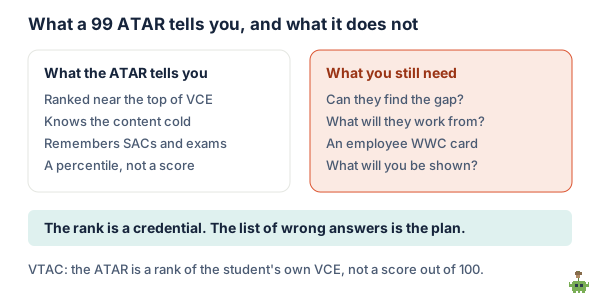
VTAC, which calculates it, is blunt about this: the ATAR is “not a score out of 100”, it is a rank, a percentile showing how a student performed relative to everyone else in their VCE year. The top value is 99.95.
It is a rare thing. Kew High School, one of the strongest government schools in the area, reports on its own homepage that in 2025 five students scored 99 or above and its median ATAR was 77. A 99 is genuinely impressive. It is evidence of the tutor’s own learning: that they know Year 10 algebra cold and remember exactly what a Methods SAC rewards.
What it does not measure is the other half of tutoring, which is noticing what a different person does not understand. Those are different skills. Many top students never had to struggle with fractions, which is exactly why they can find it hard to see where someone else is stuck.
What the evidence says about who tutors
This is where it gets interesting, because the research does not say “hire a teacher instead”. It says something more useful.
- The Teaching and Learning Toolkit, published in Australia by Evidence for Learning, puts one-to-one tuition at about five months of additional progress. It says tuition by people who are not trained teachers “may be less effective”, and that for them “training and the use of a structured program is advisable”.
- A 2026 randomised study from Stanford’s National Student Support Accelerator randomly assigned tutors to primary school children and found that “neither bachelor’s degrees nor classroom teaching experience predicts superior gains”. What did predict them was experience inside the same structured program. It was a US study of online reading tutoring, so it is not the last word on Year 5 maths in Kew, but the direction is clear.
- University of Sydney and Wollongong researchers reported in September 2025 that private tutoring is mainstream for at least one in seven Australian students, with up to 80,000 tutors in 2024, “many without formal teaching credentials”, in an industry with no regulation at any level of government.
Put those together and the conclusion for a Boroondara parent is practical. The student tutor is not the problem. A student tutor with no structure is, because the structure is what the evidence says makes a non-teacher effective, and nobody sells it to you with the ATAR.
What a structure looks like, and where Sprout Tutor fits
A structured program, in the research sense, has three parts: it knows what the child should be learning next, it finds out where they are actually stuck, and it keeps a record so the next session starts where the last one stopped. Sprout Tutor is built to do exactly those three things, every day, between the weekly hours:
- It knows the sequence. Practice follows the Victorian Curriculum 2.0 for Years 1 to 10, one content description at a time, which is what Kew High, Camberwell High and the government primaries feeding them report against.
- It finds the gap. Ten questions a topic, across ten question types (ordering, matching, spot-the-error, estimate-in-range and more), marked on the spot. Three right in a row moves your child up a tier and five wrong moves them down. A needs-a-hand list ranks up to eight curriculum codes by wrong answers.
- It keeps the record. The parent dashboard shows the literal question, the options, the answer your child gave, and whether a hint was opened or the answer revealed. What the dashboard shows walks through it.
That record is the brief a student tutor has never been given. Send it to them the night before. Instead of spending the first twenty minutes of a $70 hour working out what went wrong this week, they start on the code your child failed four times on Tuesday. That is the “structured program” the toolkit recommends, and you supply it.
Set up a PIN, give your child ten questions a day for a fortnight, and hand the tutor the needs-a-hand list before the next session. Start free. Sprout Tutor is free on every plan while it is in beta.
Student tutor vs Sprout Tutor, side by side
| High-ATAR student tutor, $41 to $70 an hour | Sprout Tutor | |
|---|---|---|
| Knows the content | Yes, and recently. A strong VCE student knows Year 10 maths and what a SAC rewards. | Victorian Curriculum Years 1 to 10, by code. No VCE. |
| Finds where your child is stuck | Depends on the tutor. Most have no training in it. | Every answer updates per-code counts; a needs-a-hand list ranks up to eight codes by wrong answers. |
| Explains it a different way | Yes. A person can reword, draw, and follow the child’s confusion. | An eight-slide mini-lesson with two interactive tools opens each new code. The same for every child. |
| How often | An hour a week, usually. | Daily, ten questions a topic, sessions of up to four hours. |
| What you see | What the tutor tells you, or a session note. | The literal question and answer, hints and reveals, and every Year change, dated. |
| Who is with your child | A young adult, in your home or online. Needs a paid (employee) Working with Children Clearance. | Nobody. A 4-digit PIN you hold, six wrong guesses locks it, no open text box. |
| A year, weekly | About $1,640 to $2,800. | Free on every plan while in beta. Not on the pricing page. |
What the student tutor does better
Said plainly, because a comparison that cannot do this is not worth reading.
- They are a near-peer. A 19-year-old who sat in a Year 9 maths class five years ago, and now loves the subject, can shift how a teenager feels about it. No app does that.
- They know VCE. Subject choices in Year 10, what Methods assumes, how SACs are marked: a student who just did it knows. Sprout Tutor stops at Year 10.
- They respond. Tears, boredom, a misunderstanding hiding in how the child explains something, this week’s assignment. A person sees and adapts. Our record shows the wrong answer and nothing about why.
- They are an appointment. A weekly session with someone your child does not want to let down gets work done. An app relies on the household to make the daily habit happen, and that is not always easy.
And the limit on our side: the effectiveness of personalised-learning software like ours has not been independently established, and very few rigorous studies of it exist. The five months belongs to tutoring by a person.
Four questions to ask before the first lesson
- “Which card do you hold?” Victoria lists “coaching or private tuition services of any kind specifically for children” as child-related work. Anyone paid needs an employee Clearance ($139.20 from 1 July 2026, valid five years). A free volunteer card from uni clubs or sport does not cover paid tutoring. You can check a card’s status online.
- “Have you taught this year level before?” The study above found experience within a structured program mattered. Teaching Year 5 and acing Year 12 are different experience.
- “Will you read a list of wrong answers before each session?” A tutor who says yes is one who will use a structure when given one.
- “Which Victorian Curriculum Level is my child working at?” Ask after three sessions. “She’s doing really well” is not an answer; a Level is.
The short version
In Kew, Camberwell and Hawthorn the tutor market sells the ATAR: KIS at $70 an hour with an average of 99.50, Tutero from $65, Learnmate’s primary tutors averaging $41. An ATAR is a rank of the tutor’s own VCE, not a measure of teaching, and the evidence says what makes a non-teacher effective is a structured program. Sprout Tutor supplies that structure daily, for free while in beta: the Victorian Curriculum sequence, ten marked questions a topic, a needs-a-hand list and the literal record. The student tutor supplies the near-peer, the VCE knowledge and the explaining.
Hire the clever student if your child will work for them. Then hand them the list. Start free; Sprout Tutor is in public beta for Years 1 to 10 on the Victorian Curriculum. For the hour itself, see what a $100 tutoring hour buys, and for the days between, what to do between sessions.
Checked 9 October 2026. Agency claims and prices are from KIS Academics’ home, pricing and Melbourne primary maths pages, Tutero’s pricing, Melbourne and our-tutors pages, and Learnmate’s home, pricing and commission pages; they are advertised figures, not quotes. ATAR facts are from VTAC. Kew High School figures are from its own website. The toolkit quotes are from Evidence for Learning; the tutor-traits study is Huffaker, Markel, Robinson and Loeb (2026), as published by the National Student Support Accelerator; the industry figures are from the University of Sydney’s release of 30 September 2025. Working with Children Check facts are from vic.gov.au, fees for 1 July 2026 to 30 June 2027. Sprout Tutor claims were checked against our own code the same day. We build competing software and say so above.
FAQ
How much does a high-ATAR tutor cost in Kew or Camberwell?
From the agencies' own pages on 9 October 2026: KIS Academics' Gold tier is $70 an hour for Years 7 to 10 and Platinum $90 for Years 11 and 12. Tutero is online from $65 an hour, or $75 for a qualified teacher. Learnmate tutors set their own rates; its 2025 averages were $41 an hour for primary, $54 for Years 7 to 10 and $65 for Years 11 and 12. Weekly for 40 weeks that is roughly $1,640 to $2,800.
Does a high ATAR make someone a good tutor?
Not on its own. VTAC says the ATAR is not a score out of 100 but a percentile rank of the student's own VCE results. It shows the tutor knows the content, not that they can find where a child is stuck. The Teaching and Learning Toolkit says tuition by non-teachers may be less effective and recommends training and a structured program, and a 2026 randomised study from Stanford's National Student Support Accelerator found degrees and teaching experience did not predict gains while experience within a structured program did.
Does a university student tutor need a Working with Children Check in Victoria?
Yes. Victoria lists coaching or private tuition services of any kind specifically for children as child-related work, and anyone paid for it must hold an employee Clearance, $139.20 from 1 July 2026 and valid five years. A free volunteer card, for example from uni clubs or sport, does not cover paid tutoring. Parents can check a card's status online.
What does a student tutor do better than a learning app?
A near-peer can change how a teenager feels about a subject, knows VCE and SACs from recent experience, responds in real time to confusion or distress, and is a weekly appointment a child does not want to miss. Sprout Tutor stops at Year 10 and has no person in it.
How can I make a student tutor more effective?
Give them a structure. Sprout Tutor runs daily practice on the Victorian Curriculum 2.0 for Years 1 to 10, ten marked questions a topic, and ranks up to eight curriculum codes by wrong answers on the parent dashboard with the literal questions. Send that list to the tutor before each session so the hour starts on the code your child keeps getting wrong. It is in public beta and free on every plan while in beta.