
Families inside the Balwyn High zone paid a median of $2,550,000 for a house in the year to March 2025, $327,000 more than a kilometre outside it. Then a good many of them pay a private tutor $85 to $150 an hour on top. That hour is the most expensive kind of tutoring there is, and the least examined. This page takes it apart: what a private tutor’s hour is actually made of, which parts of it a free tool now does, and which parts it never will.
We build Sprout Tutor, which is free while it is in beta, so this is an interested comparison. Every number here is from a published source and every Sprout Tutor claim is a rule we checked in our own code on 9 October 2026.
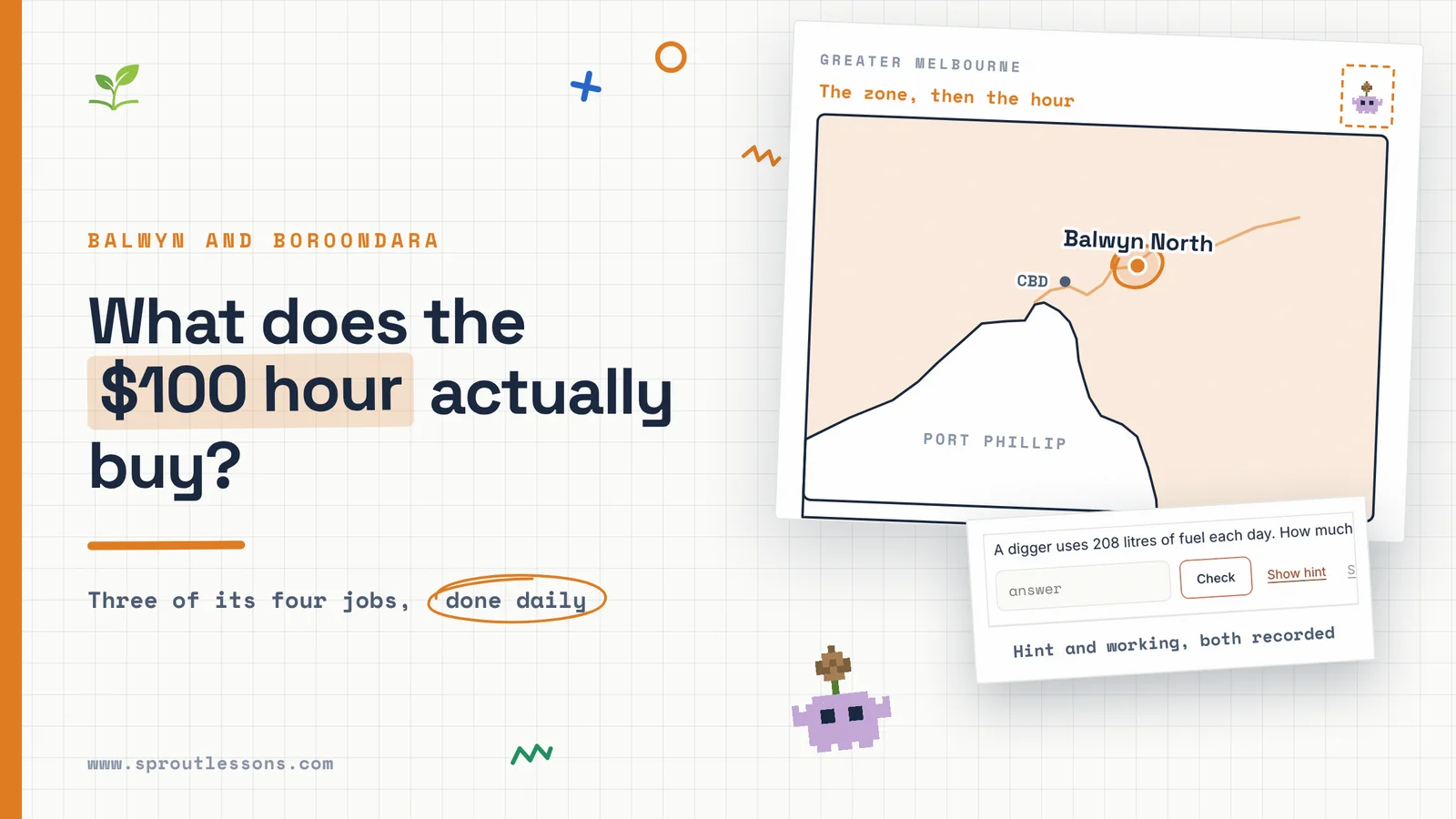
The zone, and what it says about the tutor
Balwyn High School enrols strictly by zone. Its enrolment page says Year 7 entry in 2026 is restricted to students living in the zone, siblings, and compassionate cases, under a restriction the department reviews yearly. The zone runs from the Eastern Freeway down to Whitehorse Road, so part of Balwyn itself sits outside it. The school’s 2025 annual report records 2,207 students, 55% of them with English as an additional language, and 92.9% of its Year 7 to 10 students at or above the expected standard in maths.
The REIV’s 2025 school-zones report, covered by the ABC on 4 July 2025, puts the in-zone house median at $2,550,000 against $2,223,000 a kilometre outside: a 14.7% premium. Units carried a 29.7% premium. Worth knowing: the same body’s figures for 2018 showed no premium at all, so it is a market, not a law.
The point for this page is what that premium reveals. A family that paid six figures for the zone is not buying a tutor because the school is weak. They are buying one because the room is strong, and a child who is at expected level can still be in the bottom half of it. Behind, or just in a strong class? is the check to run before the first invoice.
What an hour costs, and who gets it
No marketplace we could reach publishes an inner-east rate, so these are the national figures each company states on its own page:
- Learnmate, a marketplace, says its tutors average “around $64/hr in 2025” with a median of $62, and that agencies charge “from $85/hr”. Learnmate takes a 23% to 30% commission from the tutor.
- Cluey’s cost guide puts a first-time tutor at $50 to $60 an hour, a qualified maths or English teacher at “upwards of $85” and specialists at “upwards of $150”. Its own service schedule lists $99 a one-hour session, and its tutor jobs page says contractors are paid $25 to $40 an hour of it.
- Tutero’s 2026 guide puts Australian maths tutoring at $55 to $85 an hour, with experienced teachers and ATAR specialists at $95 to $140 and up.
- KIS Academics advertises Balwyn Year 11 and 12 Methods tutors “starting at just $50 per hour”, online.
So a Balwyn family paying $100 an hour for a qualified teacher, weekly across a 40-week school year, is spending about $4,000; at $140, about $5,600. Those are advertised rates and company estimates, not quotes. What Melbourne tutoring costs has the broader ranges.
What the hour is made of
Watch a good private tutor for an hour and you see four different jobs, in roughly this order.
- Finding out. “Show me what you did in class this week.” Ten to twenty minutes of the hour, every week, spent discovering what went wrong since last time.
- Explaining. The thing underneath. A child stuck on equivalent fractions who is actually stuck on division, and a person who notices and goes back two years. This is the skilled part.
- Practising. Worked examples, then questions, with the tutor marking as they go and nudging when the child stalls.
- Reporting. A line to the parent at the door, or a message later: what was covered, what to do before next week.
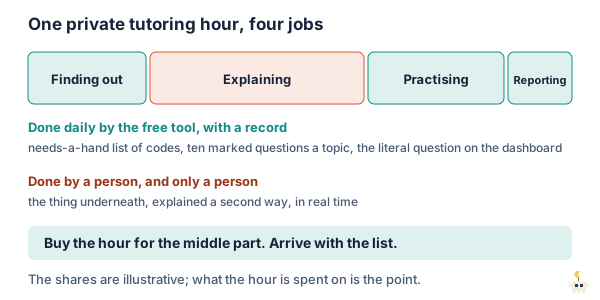
Jobs one, three and four are what Sprout Tutor does, every day, with a record. Job two is what a tutor is for, and nothing we build replaces it. The arithmetic follows from that: if a free tool arrives at the session with the finding-out already done, the paid hour is spent on explaining, which is the only part worth $100.
Private tutor vs Sprout Tutor, side by side
| Private tutor, $85 to $150 an hour | Sprout Tutor | |
|---|---|---|
| Finding out what is wrong | Done live, from the week’s homework and conversation, at the start of each hour. | A needs-a-hand list ranks up to eight Victorian Curriculum codes by wrong answers, from every question your child has answered. |
| Explaining the thing underneath | Yes. A person adapts the explanation to the child, in real time, and can abandon the plan. | An eight-slide mini-lesson with two interactive tools opens each new code. It is the same for every child. No live explanation. |
| Practice, marked | Within the hour, by the tutor. Between sessions, whatever is set and whoever marks it. | Ten questions per topic, ten question types, marked instantly, no partial credit, a reveal counted as wrong. |
| Level | The tutor’s judgement. | Fixed rules: 3 right in a row up a tier, 5 wrong down; 3 right at stretch climbs the working Year, 5 wrong at support drops it. Every move logged with a date. |
| What you see | What the tutor tells you. | The literal question, the options, the answer given, hint and reveal flags, and the log. |
| Safety | A paid tutor needs a Working with Children Check unless they are a VIT-registered teacher. You can verify a card online. | A 4-digit PIN, six wrong guesses locks it, four-hour sessions, no open text box. |
| A year, weekly | About $4,000 at $100 an hour; $5,600 at $140. | Free on every plan while in beta. Not on the pricing page. |
What the private tutor does better
Stated plainly, because a comparison that cannot do this is not worth reading.
- The explanation is the product. The Teaching and Learning Toolkit, published in Australia by Evidence for Learning, puts one-to-one tuition at about five months of additional progress, and that is a person “offering greater levels of interaction and feedback”. Our mini-lesson is a fixed deck.
- They notice. Tiredness, guessing, fear of being wrong. Our record shows the wrong answer and nothing about why.
- They go where VCE goes. A Methods specialist at $140 an hour is a real purchase in Year 11. Sprout Tutor stops at Year 10.
One more thing the toolkit says, which cuts the other way: the optimum shape is “short, regular sessions (about 30 minutes, three to five times a week)”, “additional to and explicitly linked with normal lessons”, and the effect in maths specifically is smaller (about two months) than in literacy (about six). A weekly hour of maths is the shape the research rates lowest. The daily twenty minutes is the shape it rates highest, and that is the one you do not have to pay for.
Where Sprout Tutor is better, mechanism by mechanism
- Finding out is continuous, not weekly. Every answer updates the per-code counts. The tutor arrives with a list instead of a question. What the dashboard shows walks through every number.
- Marking is instant and consistent. One rule per question type, the same for every child, every night. A hint is recorded; a revealed answer is never counted as correct and counts against the streak. Will it just give them the answer? covers the rungs between stuck and told.
- The level is per subject and the move is logged. Maths can be working a Year ahead while English stays at the assigned Year. A tutor’s “she’s about a year ahead” becomes a dated row with a reason. The rules in full.
- It is coded to the school’s curriculum. Balwyn High reports against the Victorian Curriculum 2.0; so does every government primary feeding it. Each question carries the VC2 code, which is what lets you put the record next to the report.
- It costs nothing while in beta, on every plan, which turns the question from “tutor or software” into “what should the paid hour be spent on”.
And the limit, said plainly: the effectiveness of personalised-learning software like ours has not been independently established, and very few rigorous studies of it exist. The five months above belongs to the person.
Give your child a PIN and ten questions on the strand their last report named, then read the needs-a-hand list before you book the hour. Start free. Sprout Tutor is free on every plan while it is in beta.
Three checks on any private tutor in Boroondara
- The card. Victoria’s Working with Children Check page lists “coaching or private tuition services of any kind specifically for children” as child-related work. A paid tutor needs an employee Clearance ($139.20 from 1 July 2026, valid five years); a VIT-registered teacher is exempt but must notify the scheme if they tutor privately. You can check a card’s status online or by scanning the QR code on a digital card in the Service Victoria app. University of Sydney researchers noted in September 2025 that tutors “are not consistently required to undergo background checks”, because nobody regulates the industry. Ask.
- The curriculum. Ask which Victorian Curriculum Level your child is working at and which strand. “Fractions” is not an answer; a Level and a code is.
- The brief. Ask whether they will read a record of your child’s wrong answers before each session. A tutor who says yes is one whose hour you are not paying to spend finding out.
The short version
Balwyn families pay a documented premium for the zone, then $85 to $150 an hour for a tutor, which is roughly $4,000 to $5,600 a year weekly. That hour is four jobs: finding out, explaining, practising, reporting. A private tutor does the second better than anything we will ever build, and the research says that is where the value is. Sprout Tutor does the other three daily, for free while in beta, with the literal questions on a dashboard, a level that moves on fixed rules and is logged, and the Victorian Curriculum code on every question.
Run the free thing first. Buy the hour with the list in hand. Check the card. Start free; Sprout Tutor is in public beta for Years 1 to 10 on the Victorian Curriculum.
Checked 9 October 2026. Balwyn High School facts are from its own enrolment page and 2025 annual report. The zone premium is from the REIV’s 2025 report “Buying into the Classroom”, 12 months to March 2025, as reported by the ABC; the 2018 comparison is from REIV data reported by Smart Property Investment. Rates are from Learnmate’s pricing and commission pages, Cluey’s cost guide, service schedule and tutor jobs page, Tutero’s 2026 cost guide and KIS Academics’ Balwyn page, and are advertised figures or company estimates, not quotes. Working with Children Check facts are from vic.gov.au, fees for 1 July 2026 to 30 June 2027; from 19 October 2026 applicants must also complete child safety training. Toolkit quotes are from Evidence for Learning. Sprout Tutor claims were checked against our own code the same day. We build competing software and say so above.
FAQ
How much does a private tutor cost in Balwyn?
No marketplace publishes an inner-east rate, so the figures are national. Learnmate says its tutors average around $64 an hour in 2025 and that agencies charge from $85. Cluey's guide puts a qualified teacher at upwards of $85 and specialists upwards of $150; Cluey itself charges $99 a one-hour session. Tutero puts maths tutoring at $55 to $85 with specialists at $95 to $140 and up. Weekly across a 40-week year, $100 an hour is about $4,000. These are advertised rates and estimates, not quotes.
Does a private tutor in Victoria need a Working with Children Check?
Victoria's Working with Children Check page lists coaching or private tuition services of any kind specifically for children as child-related work, so a paid tutor needs an employee Clearance ($139.20 from 1 July 2026, valid five years). A teacher registered with the Victorian Institute of Teaching is exempt but must notify the scheme if they tutor privately. Parents can check a card's status online or scan a digital card's QR code in the Service Victoria app.
How much more does a house in the Balwyn High zone cost?
The REIV's 2025 school-zones report, using median sale prices for the 12 months to March 2025, put the in-zone house median at $2,550,000 against $2,223,000 a kilometre outside, a 14.7% premium of $327,000. Units carried a 29.7% premium. REIV figures for 2018 showed no premium at all, so it varies with the market.
What does a private tutor do that Sprout Tutor cannot?
Explain in real time and adapt the explanation to the child, including going back two years to the thing underneath. The Teaching and Learning Toolkit puts one-to-one tuition at about five months of additional progress, and that is a person. A tutor also notices tiredness and guessing, and can cover VCE, which Sprout Tutor does not. Sprout Tutor opens each code with the same eight-slide mini-lesson for every child.
What does Sprout Tutor do that a private tutor cannot?
Find out, practise and report every day with a record. Every answer updates per-code counts, a needs-a-hand view ranks up to eight Victorian Curriculum codes by wrong answers, ten questions a topic are marked instantly with a reveal counted as wrong, and every change to the working Year is logged with a date. It follows the Victorian Curriculum for Years 1 to 10, is in public beta and is free on every plan while in beta.