
A Year 5 place at St Leonard’s College costs $34,726 in 2026. A weekly hour with Cluey, at its published $99, adds about $3,960 across a school year. Before you pay the second number, it is worth knowing what the first one already bought. In Brighton nearly one in five people at school are at a non-government secondary, four times the Victorian rate, and the tutoring that gets bought on top is increasingly an online service rather than a person at the kitchen table.
This page is for Bayside families thinking about tutoring on top of fees. It covers what the schools say they already provide, what an online tutoring service actually publishes, what the evidence says about one-to-one versus daily practice, and a straight comparison between Cluey and Sprout Tutor, which we build and which is free while it is in beta.
What the fees already include
The first question is not which tutor. It is what is already inside the fee, because every independent school in Bayside runs some form of learning support, and most parents have never asked to use it.
- Haileybury, with a campus in Brighton, described its learning support team on 1 September 2026 as “38-strong”, supporting Prep to Year 12 students “with a wide range of additional learning needs” across its Melbourne campuses, under a Director of Individual Learning Needs.
- Star of the Sea College in Brighton has a Learning Diversity Team that says it “assesses students who may be at risk in literacy and numeracy”, “provides small class and small group support” and works with teachers on individual learning plans.
- St Leonard’s College and Brighton Grammar both run academic support programs; their pages would not load for us on 9 October 2026, so we quote nothing from them. Ask the school directly.
Small-group support run by the school is, in the research, the same intervention a tutoring centre sells. The school version is already paid for, is linked to what the classroom is teaching, and comes with the teacher’s own assessment. So the first email is to the year-level coordinator: “what support is my child eligible for, and what did the last assessment show?”
What a year of each actually costs
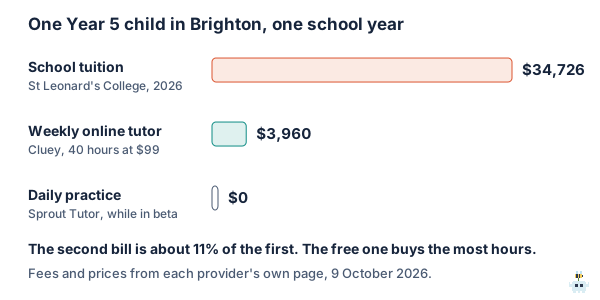
Published figures, each from the provider’s own page:
- St Leonard’s College, 2026 annual tuition from its fee schedule: Year 4 $32,086, Year 5 $34,726, Year 9 $41,113, Year 10 $41,152.
- Brighton Grammar, 2027 local tuition per boy: Years 3 and 4 $35,572, Year 5 $39,312, Years 7 to 12 $43,636, plus a consolidated charge of $1,900 to $3,400 for camps and excursions. Its page now shows only 2027.
- Haileybury, 2027 annual tuition, all Melbourne campuses: Years 3 and 4 $33,595, Years 5 and 6 $37,745, Years 9 to 12 $43,980.
- Star of the Sea, 2026: Year 7 $13,380 rising to Year 12 $16,760, fully inclusive of camps and the laptop, with a $2,500 per-family capital fee. A Catholic college sits at a different price point from the three above.
- Cluey Learning: its pricing page publishes no figure, but its service schedule does. From 1 July 2026 a one-hour one-to-one session is $99 on the Standard plan (two sessions paid in advance) or $86 on the Value Max plan (four in advance). Cluey recommends once a week to start. Forty weeks at $99 is $3,960; at $86 it is $3,440.
- Kip McGrath online: RRP $78 a session, “60 minute weekly sessions” with a qualified teacher over video, prices varying by location.
- Learnmate, a marketplace: tutors set their own rate, “starting from $30/hr and averaging around $64/hr in 2025”.
- Sprout Tutor: free on every plan while in beta, not on the pricing page, nothing to buy.
For the wider market, what Melbourne tutoring costs has the private-tutor ranges and the annual arithmetic.
Cluey vs Sprout Tutor, side by side
Cluey is the comparison because it is the one Bayside families name most, it is the one that publishes its format in detail, and it now publishes a price. Everything in the Cluey column is from its own how-it-works, FAQ and service schedule pages, read on 9 October 2026.
| Cluey Learning | Sprout Tutor | |
|---|---|---|
| Who teaches | A matched human tutor, live, one-to-one, “100% online”. | Nobody. An eight-slide mini-lesson opens each new topic, then adaptive questions. |
| Session | One hour, recommended weekly. Years 2 to 12 one-to-one; small groups Years 3 to 10. | Ten questions finishes a topic. Daily if you like. Years 1 to 10. |
| Curriculum | “Mapped to the Australian Curriculum in each state.” Victoria’s own curriculum is not named. | Victorian Curriculum 2.0, with the VC2 code on every question. |
| What you get after | A tutor’s report “highlighting topics covered” and areas of strength and difficulty, plus a session recording. | Every question in full: the options, the correct one, the answer given, whether a hint was opened or the answer revealed. Per-code counts and a dated log of every level change. |
| How the level is set | By the tutor, in the session. | By fixed rules: 3 right in a row up a tier, 5 wrong down; 3 right at the hardest tier climbs the working Year, 5 wrong at the easiest drops it. A reveal counts as wrong. |
| What the child can type | Anything, to a person, in a live session. | Answers only. No open text box, no chat. |
| Published price | $99 an hour Standard, $86 Value Max, from 1 July 2026. | Free on every plan while in beta. |
What Cluey does better
We build the other column, so take this as from an interested party. It is still true.
- A person explains in real time. When a child does not understand the explanation, a tutor tries a different one. Our mini-lesson is the same eight slides for every child meeting that code. The evidence for one-to-one tuition, below, is evidence for a person.
- It covers VCE. Cluey takes students to Year 12. Sprout Tutor stops at Year 10, because the Victorian Curriculum does. A Year 11 Methods student is not our customer.
- The recording. A child can replay the exact moment a concept clicked. We keep the answers, not the conversation, because there is no conversation.
What the evidence says about an hour a week versus twenty minutes a night
The Teaching and Learning Toolkit, published in Australia by Evidence for Learning, is the most cited summary there is, and it is specific in a way that matters for this decision.
- One-to-one tuition: about five months of additional progress, but the optimum shape is “short, regular sessions (about 30 minutes, three to five times a week) over a set period of time (up to ten weeks)”, and it should be “additional to and explicitly linked with normal lessons”. A single weekly hour is neither short nor regular.
- Homework: about five months in secondary and three in primary, with two conditions. “Studies that included feedback on homework had higher impacts on learning”, and “the quality of the task set appears to be more important than the quantity”. Studies involving digital technology came in at six months. The evidence base is rated low, so hold it loosely.
Read together: the paid hour is worth most when it is a person explaining a thing the child could not get from the classroom, and the free thing is worth most when it is daily, marked immediately, and on the content the school is teaching. The two conditions do not compete. Daily marked practice is what makes the weekly hour cheaper, because the tutor arrives with a list of what went wrong instead of spending the first twenty minutes finding out.
Where Sprout Tutor is better, and why
Each of these is a rule in the code rather than a claim in a brochure.
- You see the question, not a report about it. A session report tells you “worked on fractions, needs more practice with equivalence”. The dashboard shows you the question that said two fifths, the options, the answer your child chose, and whether they opened the hint first. A needs-a-hand view ranks up to eight curriculum codes by wrong answers. What the dashboard shows covers every number on it.
- The level moves on evidence and the move is logged. You assign Year 5. Three correct at the hardest tier and the working Year becomes 6 for that subject; five wrong at the easiest tier and it becomes 4. Each change writes a dated row that the engine can only add to, so “when did this click?” has an answer. The full rules are here.
- It is the school’s curriculum, coded. Victorian government and Catholic schools are required to use the Victorian Curriculum; the VCAA says independent schools may use it as a model for implementing the Australian Curriculum. Either way the content your child’s report is written against is one of those two, and they are closely related. How the Victorian and Australian curriculums differ has the detail. Sprout Tutor is coded to VC2; Sprout Lessons covers both.
- Marked immediately, every time. Ten question types, one marking rule each, no partial credit, and a revealed answer is never counted as correct. If three or more of a topic’s ten questions go wrong, the tutor offers to build a full Sprout lesson on it, which uses your plan’s credits like any other lesson.
- Bounded, which matters on a shared iPad. A 4-digit PIN you set and can regenerate, a lock after six wrong guesses, a four-hour session with no “remember this device”, and no text box that goes to an AI. The safety page covers what that does and does not protect against.
- Free while in beta. Not on the pricing page. There is nothing to buy, which is also why there is no price for it in the figure above.
The honest limit: the effectiveness of personalised-learning software like ours has not been independently established, and very few rigorous studies of it exist. The toolkit numbers above are for people and for homework, not for us. What we can show you is the record.
Before you book the first paid hour, give your child a PIN and ten questions on the strand the school named. Start free. Sprout Tutor is free on every plan while it is in beta, and the needs-a-hand list is the brief a tutor should be given.
A sensible order for a Bayside family
- Ask the school what the fee already covers. Learning support, small-group sessions, the last assessment, and which strand it named.
- Run three weeks of free daily practice on that strand, at the Level your child is working at, and read the dashboard.
- If one code keeps failing, buy the hour, and send the tutor the needs-a-hand list before the session. A tutor who starts with your child’s actual wrong answers spends the hour teaching.
- Keep the daily practice going between sessions. The other six days are where the hour sticks or does not.
- Stop paying when the record says to. When the code that was failing is sitting at the stretch tier for a fortnight, the tutor has done the job.
The government option exists, and it is not capped
Worth one paragraph, because the question underneath “fees plus a tutor” is sometimes “is this school the right fit”. Brighton Secondary College’s enrolment page says students in its zone “are guaranteed a place” and that it is “not a ‘select entry school’ nor limited by capacity in year 7”. Sandringham College prioritises its zone and may take a limited number from outside it. Government schools report against the Victorian Curriculum on a five-point age-expected scale, which means the same thing in every suburb.
The short version
Bayside fees run from about $13,000 at a Catholic college to over $43,000 at the independents, and every one of those schools has learning support inside the fee that most parents never ask for. Cluey publishes $99 a one-hour session, which is about $3,960 a year weekly. The evidence says a person is worth paying for when they are explaining, and that short daily marked practice linked to the classroom is the shape that works.
Sprout Tutor is the daily marked practice: ten questions a topic, the literal question on the dashboard, a level that moves on fixed rules and is logged, coded to the Victorian Curriculum for Years 1 to 10, and free on every plan while in beta. It does not explain in real time and it does not do VCE. Ask the school first, run the free thing second, and buy the hour with a list in hand.
Start free. Sprout Tutor is in public beta on the Victorian Curriculum.
Checked 9 October 2026. School fees are from St Leonard’s College’s 2026 fee schedule, Brighton Grammar’s 2027 schedule of fees, Haileybury’s 2027 schedule of tuition fees and Star of the Sea College’s 2026 fee schedule; Brighton Grammar and Haileybury no longer show 2026 figures. Cluey facts are from its how-it-works, FAQ, pricing and service schedule pages; Kip McGrath from its pricing and online tutoring pages; Learnmate from its pricing page. The learning support descriptions are from Haileybury’s and Star of the Sea’s own pages. The curriculum requirement is from the VCAA’s Victorian Curriculum overview; the Brighton enrolment figures are from the ABS 2021 Census QuickStats for Brighton (Vic). Prices change, so confirm with the provider. Sprout Tutor claims were checked against our own code the same day. We build competing software and say so above.
FAQ
How much does Cluey Learning cost per session?
Cluey's pricing page publishes no figure, but its service schedule does: from 1 July 2026 a one-hour one-to-one session is $99 on the Standard plan, with two sessions paid in advance, or $86 on the Value Max plan, with four paid in advance. Cluey recommends once a week to start, so forty weeks is about $3,960 or $3,440. Prices change; confirm with Cluey.
Do independent schools in Brighton provide learning support?
Yes. Haileybury described a 38-strong learning support team for Prep to Year 12 in September 2026, and Star of the Sea College's Learning Diversity Team assesses students at risk in literacy and numeracy and provides small-group support. Ask your school's year-level coordinator what your child is eligible for and what the last assessment showed before buying tutoring on top.
What do Brighton private schools cost in 2026 and 2027?
From the schools' own fee schedules: St Leonard's College 2026 tuition is $32,086 for Year 4, $34,726 for Year 5 and $41,113 for Year 9. Brighton Grammar's 2027 local tuition is $39,312 for Year 5 and $43,636 for Years 7 to 12, plus a consolidated charge. Haileybury's 2027 tuition is $37,745 for Years 5 and 6 and $43,980 for Years 9 to 12. Star of the Sea's 2026 fees run from $13,380 in Year 7 to $16,760 in Year 12.
Is an hour a week of tutoring better than daily practice?
The Teaching and Learning Toolkit puts one-to-one tuition at about five months of additional progress, with the best results from short regular sessions of about 30 minutes three to five times a week, linked to normal lessons. Homework with feedback also scores well, and the quality of the task matters more than the quantity. A weekly hour is best spent on explanation; daily marked practice on the school's content is what the evidence describes for the rest of the week.
What does Sprout Tutor show a parent that a tutoring report does not?
The literal question: every option, the correct one marked, the answer the child gave, and whether a hint was opened or the answer revealed. A needs-a-hand view ranks up to eight Victorian Curriculum codes by wrong answers, and every change to the working Year is logged with a date. It follows the Victorian Curriculum for Years 1 to 10, is in public beta and is free on every plan while in beta.