
The coaching colleges around Glen Waverley sell one thing above all else: ahead. One centre’s own page says its “difficulty is set one level above school grade”; Kumon says its students “progress to study topics beyond their school grade level”. Before you pay for ahead, it is worth asking what it is measured against, whether it is ahead for the group or for your child, and what you will be shown to prove it.
This page puts the local options side by side, including ours, which is free while it is in beta. It covers what each centre actually publishes, what the Victorian Curriculum means by a level, what the research says about group size, and where Sprout Tutor is better, where it is worse, and why.
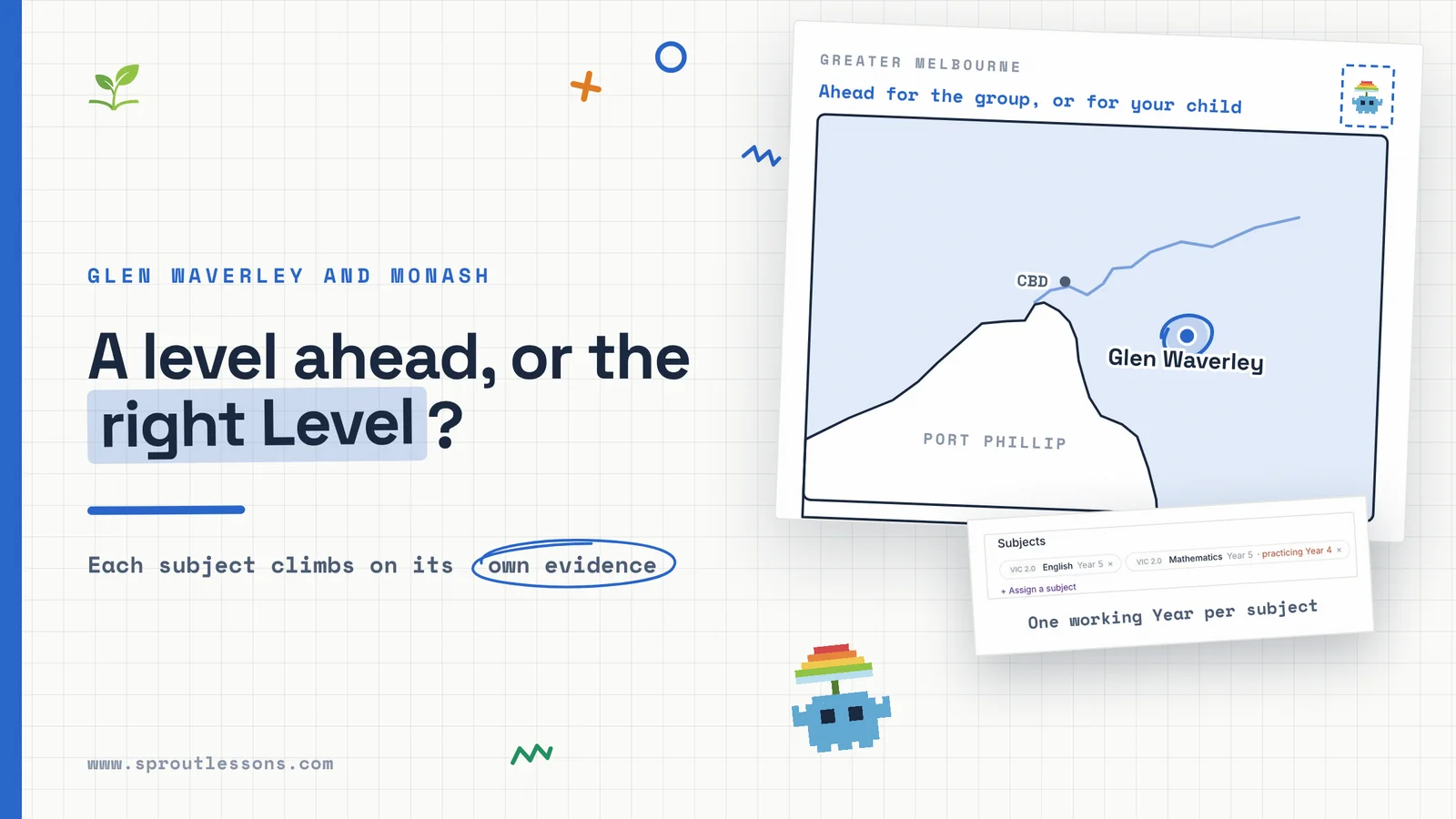
Why the question is sharper in Glen Waverley
Glen Waverley Secondary College enrols by zone. Its enrolment page says students living within the zone “are guaranteed a place”, and the college describes itself as having “a culture of high expectations”, drawing students from “over 40 nationalities” with “more than 50 languages” represented. Glen Waverley Primary manages enrolments under an Enrolment Management Implementation Plan, the department’s tool for a school that may not have room for everyone who applies, and must keep capacity for up to 100 Foundation enrolments a year.
So the school your child attends was decided by your address, not a test. What the coaching colleges offer is a place in the top of the room once they get there. That is a real thing to want. It is also a comparison against the room, and the room is the one ruler that moves when the suburb changes.
One local detail is worth knowing. The college’s Scholars Program for its highest-ability Year 9 and 10 students is by invitation, and the invitation rests on the school’s own data: subject assessment results, progress reports, semester reports and NAPLAN. There is no external entry test. The thing being measured is consistent work at the right level over years, which is a different target from an exam you can be coached for.
What the Glen Waverley centres actually publish
All of this is from each provider’s own pages, checked on 9 October 2026. Where a page does not publish something, that is stated, because a missing number is information too.
- Edu-Kingdom College, Railway Parade. Small-group maths and English for Years 1 to 12, with “difficulty set one level above school grade”. Offers selective-school, scholarship and SEAL preparation with “practice papers that closely reflect the real exam”. Class size, session length and price are not published. Parents get “regular feedback”; no formal report is described.
- Kumon, High Street Road. Individual worksheets, not group teaching. Children are at the centre “30 to 45 minutes per subject” and do worksheets at home daily, “between 15 and 30 minutes each day”. Kumon’s Australian fee page publishes $160 a month per subject, plus a $100 enrolment fee, non-refundable, with a month’s fee due if you have not given notice by the 15th. Instructors “provide regular progress updates”.
- Kip McGrath, Leicester Avenue. In the centre or online, most children once a week on one subject per session. The national pricing page says “RRP $78 per session” and that prices may vary by location. Session length and group size are not published. Parents get “regular progress reports” and a parent portal.
- NumberWorks’nWords, Coleman Parade. One-hour sessions after school that “follow the school curriculum”. Group size, price and reporting are not published.
- Cluey Learning. Online one-to-one with a matched tutor; no centre. Its Glen Waverley page and its pricing page publish no figure and route you to “request pricing”, but its service schedule does: $99 a one-hour session on the standard plan, $86 on the plan that bills four sessions in advance, effective 1 July 2026.
One pattern. Of the five, three publish a price somewhere. The group college promising a level above publishes no price, no class size and no session length. You can still buy from it; you should go in knowing that every one of those numbers has to be asked for in the room. What Melbourne tutoring costs across a year has the arithmetic for a weekly session.
“One level above”: above what, and for whom?
Victorian schools teach the Victorian Curriculum 2.0, which the Department of Education requires in every government school. It is written in Levels, not years, and the VCAA says plainly that the Levels do not represent discrete years of schooling. A Year 5 child in a Glen Waverley classroom is being reported against Level 5 achievement standards, and a strong one may already be working at Level 6 in Number and Level 5 in Measurement at the same time. Which Level is the worksheet? explains how that works inside one classroom.
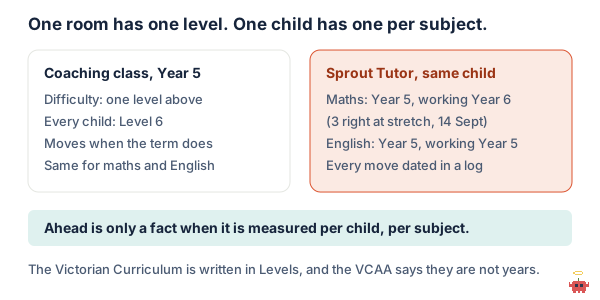
A group class set “one level above” is set there for the group. Your child is in it because of their school year, and the class moves when the term does. Nothing in the published material says the level is set per child, moves on your child’s evidence, or is different for maths and English. Those are exactly the three things to ask.
Coaching college vs Kumon vs Sprout Tutor
| Group coaching college | Kumon | Sprout Tutor | |
|---|---|---|---|
| Who is in the room | A teacher and a small group; size not published. | An instructor, and the child with their own worksheets. | The child, at home, with a PIN. No open chat box. |
| Who sets the level | The centre, one level above the school year, for the class. | The instructor, per child, along Kumon’s own worksheet sequence. | You assign the year; the working Year then moves per subject on fixed rules. |
| How it moves | With the timetable. | At the instructor’s judgement. Kumon says learning is individualised. | Up a tier after 3 right in a row, down after 5 wrong. Up a Year after 3 right at the hardest tier, down a Year after 5 wrong at the easiest. Every move is logged with a date. |
| Curriculum | Its own syllabus, aimed at the school year above. Code alignment not published. | Kumon’s own worksheet sequence, not the Victorian Curriculum. | Victorian Curriculum 2.0, with the code on every question, Years 1 to 10. |
| What you see | “Regular feedback.” No report format published. | Marked worksheets and instructor updates. | The literal question, every option, the answer given, hint and reveal flags, per-code counts and the Year-change log. |
| Exam practice | Yes: selective, scholarship and SEAL papers. | No. | No. Nothing in it resembles an ACER paper. |
| Published price | None. | $160 a month per subject, plus $100 to enrol. | Free on every plan while in beta. Not on the pricing page. |
What the centres do better
We build Sprout Tutor, so weigh this accordingly. A comparison that cannot name what the other side does better is a brochure, and these three are real.
- A teacher in the room notices. Someone sees that your child is guessing, or rushing, or has stopped reading the question. Software records the wrong answer; it does not see the face. That is the single biggest thing you are paying for at a centre.
- Exam format is a skill, and the colleges teach it. If your target is a selective-entry or scholarship exam, timed practice under exam conditions on papers that look like the real one is a thing we do not offer at all. ACER’s own preparation page says “there is no need for your child to practice or revise for the exam”, then adds that it can be a good idea to prepare them for the kinds of questions they will see. Read both sentences. Our Box Hill page covers what ACER says about coaching in more detail.
- A place and a fee make a habit. Kumon’s daily worksheet routine works for many families precisely because someone outside the house is expecting the folder back. A free tool on a tablet has no such hold on anyone.
What the evidence says about the shape of tutoring
The Teaching and Learning Toolkit, maintained in Australia by Evidence for Learning, puts small-group tuition at about four months of additional progress over a year and one-to-one at about five, and it is specific about the conditions. For groups, “as a rule of thumb, the smaller the group the better”, with the effect falling away beyond six or seven students. For one-to-one, tuition “is more likely to make an impact if it is additional to and explicitly linked with normal lessons”, in “short, regular sessions (about 30 minutes, three to five times a week)”.
Hold the Glen Waverley offers up to that. A class of unpublished size, on a syllabus set a year ahead of the one the school is teaching, once a week, is the opposite of linked and the opposite of regular. University of Wollongong and University of Sydney researchers writing in September 2025 estimate that one in six Australian students gets private tutoring at some point, and warn that when tutoring conflicts with what the school is teaching, students can become “confused, frustrated or disengaged”. Thirty minutes most days, on the content the school is actually teaching, is the shape that works. Kumon’s daily worksheets come closest to it locally, at $160 a month per subject and on Kumon’s own sequence rather than the school’s.
Where Sprout Tutor is better, mechanism by mechanism
Each of these is a rule in the code, not a line of marketing copy.
- The level is your child’s, per subject, and it moves on their answers. You assign Year 5. If they answer three in a row correctly at the hardest tier, the working Year becomes 6 for that subject only; five wrong in a row at the easiest tier drops it to 4. Each move writes a dated row to a log the engine can only add to. Maths can sit a Year ahead while English stays put. The full rules are on how Sprout Tutor decides what comes next.
- “Ahead” is defined against the Victorian Curriculum, not a centre’s syllabus. Every question carries the VC2 code, so when the working Year reads 6 you can see which Level 6 descriptions were answered and how. That is the same curriculum the school reports against, which is what makes it comparable to the report card.
- Daily volume, at the frequency the evidence asks for. Ten questions finishes a topic. A new code opens with an eight-slide mini-lesson and two interactive tools before the first question, so a child meeting a topic cold is taught it first. If three or more of the ten go wrong, the tutor offers to build a full Sprout lesson on that topic, which uses your plan’s credits like any other lesson.
- You see the work, not a summary of it. The parent dashboard lists recent questions and opens any one in full: every option, the correct one marked, your child’s pick, whether a hint was opened and whether the answer was revealed. A revealed answer is never counted as correct. A needs-a-hand view ranks up to eight curriculum codes by wrong answers. What the dashboard shows walks through all of it.
- Ten question types, not a drill. Ordering, matching, categorise, spot the error, estimate in a range and multi true-or-false sit alongside multiple choice, so a child cannot pattern-match their way to “ahead”. The ten types has an example of each.
- Bounded. A 4-digit PIN you set and can regenerate, six wrong guesses locks the gate, a session expires after four hours, and the only text boxes are answer boxes inside a question. Nothing to ask the AI.
- Free while in beta, on every plan. It is not on the pricing page and there is nothing to buy, which is also why this page cannot show you a number for it.
And the honest limit, said plainly: the effectiveness of personalised-learning software like ours has not been independently established, and very few rigorous studies of it exist. The evidence above is for tutoring by people. What we can show you is the record.
Want to see where your child actually sits before you pay for ahead? Assign a Victorian Curriculum subject, let them do ten questions, and read the dashboard. Start free. Sprout Tutor is free on every plan while it is in beta.
Five questions to ask any Glen Waverley centre
- “How many children are in the class?” The toolkit’s cut-off is six or seven. If the answer is twelve, you are buying a class, not tuition.
- “Which Level is my child working at, and who decided?” You want a Victorian Curriculum Level and a reason, not “the Year 6 class”.
- “Does the level move for my child, or for the group?” And what evidence moves it.
- “Can I see the actual work?” The marked papers, not a report that says “progressing well”.
- “What happens when it does not stick?” A centre set one level above the school year has a plan for a child who is coping. Ask about the one who is not.
A sensible way to combine them
If your target is a selective or scholarship exam, a college that teaches the format is a reasonable purchase for the months before it, and ACER’s own line on practice is worth reading first. For everything else, run the free thing first: three weeks of daily practice at the Level your child is working at, then read the needs-a-hand list. If it names one strand, that is the brief for a tutor and the thing that makes the first paid hour useful instead of diagnostic. What to do between tutoring sessions covers the other six days if you do go ahead with a centre.
The short version
Glen Waverley’s coaching colleges sell “one level above”, set for a group of unpublished size on an unpublished price. Kumon publishes $160 a month per subject and a daily worksheet habit. Kip McGrath publishes RRP $78 a session. The Victorian Curriculum is written in Levels that are not years, and your child’s report is against those Levels, so “ahead” only means something when it is measured there.
Sprout Tutor sets a working Year per child per subject, moves it on fixed streaks, logs every move, shows you the literal questions, and is free on every plan while in beta. It does not notice a face and it does not teach exam format. Ask the five questions before you sign, and let your child do ten free questions before you decide what ahead means for them.
Start free. Sprout Tutor follows the Victorian Curriculum for Years 1 to 10 and is in public beta.
Checked 9 October 2026. Centre facts are from each provider’s own pages: Edu-Kingdom College’s Glen Waverley and selective pages, Kumon Australia’s monthly fee and enrolment FAQ pages, Kip McGrath’s pricing and Glen Waverley pages, NumberWorks’nWords’ Glen Waverley page and Cluey’s pricing and service schedule pages. School facts are from Glen Waverley Secondary College’s enrolment, principal and Scholars Program pages and Glen Waverley Primary’s prospective families page. The curriculum requirement is from the Department of Education’s Policy and Advisory Library, curriculum programs policy, updated 20 April 2026. Prices change, so confirm with the centre. Sprout Tutor claims were checked against our own code the same day. We build competing software and say so above.
FAQ
What does "one level above school grade" mean at a Glen Waverley coaching college?
It means the group class is pitched a year ahead of the school year the children are in. Edu-Kingdom College publishes that its difficulty is set one level above school grade. It is set for the group, not per child, and the Victorian Curriculum is written in Levels that the VCAA says do not represent discrete years of schooling, so a strong Year 5 child may already be working at Level 6 in one strand and Level 5 in another. Ask which Level your child is working at and who decided.
How much does tutoring in Glen Waverley cost?
Of the centres with a Glen Waverley presence, Kumon publishes $160 a month per subject plus a $100 enrolment fee, and Kip McGrath publishes RRP $78 per session with prices varying by location. Cluey publishes $99 a one-hour session on its service schedule ($86 on its four-session plan). Edu-Kingdom College and NumberWorks'nWords do not publish a price. Figures were read from each provider's own pages on 9 October 2026 and change, so confirm with the centre.
Does small-group tutoring work?
The Teaching and Learning Toolkit, published in Australia by Evidence for Learning, puts small-group tuition at about four months of additional progress over a year and one-to-one at about five. It says the smaller the group the better, with effectiveness falling away beyond six or seven students, and that tuition works best when it is additional to and explicitly linked with normal lessons, in short regular sessions of about 30 minutes three to five times a week.
Does Sprout Tutor prepare children for the selective entry exam?
No. Sprout Tutor is daily practice coded to the Victorian Curriculum, and nothing in it resembles an ACER paper or runs under exam conditions. A coaching college that teaches the exam format does something we do not offer. ACER's own preparation page says there is no need to practise or revise for the exam, then adds that preparing a child for the kinds of questions they will see can be a good idea.
How does Sprout Tutor decide what level my child works at?
You assign a Year for each subject. Three correct answers in a row move the child up a tier and five wrong in a row move them down; three correct at the hardest tier climb the working Year by one and five wrong at the easiest tier drop it by one. Each move is logged with a date, and maths can sit a Year ahead while English stays put. It follows the Victorian Curriculum for Years 1 to 10, is in public beta and is free on every plan while in beta.