
The Ontario math curriculum tells you which multiplication facts belong to which grade, by name. The 2s, 5s and 10s in grade 3. The whole table from 1 × 1 to 10 × 10 in grade 4. Everything from 0 × 0 to 12 × 12 in grade 5. Almost no parent has been shown this list, which is why so many families are drilling the sevens a year before the province expects them.
If your grade 3 child cannot do 7 × 8, they are not behind. In grade 3 Ontario asks them to build 7 × 8 with an array and to recall only the 2s, 5s and 10s. The sevens and eights are grade 4 work, and the 11s and 12s, which American and Australian curricula leave out entirely, are grade 5 work here.
What each grade asks for
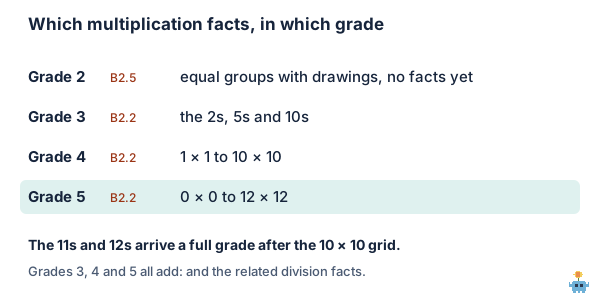
| Grade | Expectation | What it asks for, in plain words |
|---|---|---|
| Grade 2 | Number, B2.5 | Show multiplication as repeated equal groups, with objects and drawings. Nothing to recall. |
| Grade 3 | Number, B2.2 | Recall and show the 2s, 5s and 10s, and the matching division facts |
| Grade 3 | Number, B2.6 | Represent any product up to 10 × 10 with tools such as arrays (represent, not recall) |
| Grade 4 | Number, B2.2 | Recall and show every fact from 1 × 1 to 10 × 10, and the matching division facts |
| Grade 5 | Number, B2.2 | Recall and show every fact from 0 × 0 to 12 × 12, and the matching division facts |
Three things in that table change how practice at home should look, and none of them is obvious from a times tables poster.
Grade 3 says recall for the 2s, 5s and 10s, and represent for the rest
These are two different expectations in the same grade. B2.2 is the short list a grade 3 child should know cold. B2.6 asks them to represent products up to 10 × 10 with arrays and other tools, which means a grade 3 child should be able to build 7 × 8 as seven rows of eight and count it, and is not expected to know it. A parent who hears “they are doing the times tables up to 10” and starts flashcards for the sevens has mixed the two up. The flashcards are a grade 4 job.
The 11s and 12s are in, and so are the zeros
Ontario is the one of the three big English-speaking curricula that goes past 10 × 10. The Australian Curriculum stops at 10 × 10 in Year 4 and the American Common Core stops at one-digit times one-digit by the end of grade 3. Ontario’s grade 5 expectation runs from 0 × 0 to 12 × 12. Two consequences: a child using an imported American or Australian program will arrive in grade 5 without the 11s and 12s, and the zero facts, which many children get wrong (6 × 0 is not 6), are explicitly on the list.
The full grid is a year later than the American timetable
Common Core asks for all one-digit products from memory by the end of grade 3. Ontario asks for the 1 × 1 to 10 × 10 grid in grade 4. So an American grade 3 workbook, app or YouTube channel runs a full year ahead of the Ontario expectation. That is fine if your child is ready, and a source of needless worry if they are not. British Columbia goes the other way: its learning standards do not list multiplication and division facts to 100 until grade 5, and describe fluency there as emerging. If you are not in Ontario, which curriculum your province uses is the place to check.
Every grade says recall and demonstrate, and every grade adds division
The verb pair is the same in grades 3, 4 and 5: recall and demonstrate. A child who can say “56” to 7 × 8 has done the first half. Demonstrating means showing it, with an array, a skip count or a known fact, and it is the half that stops a memorized table from collapsing under pressure. And each of those expectations ends with the related division facts, so 56 ÷ 7 is part of the same expectation as 7 × 8, not a separate topic for later.
The five wrong answers worth knowing
1. 7 × 8 = 54
A near miss from a neighbouring fact: 54 is 6 × 9. The child is reaching into memory and pulling out the wrong card, which is what happens when a table was memorized without the demonstrate half.
The fix: derive it from a fact they do know. 5 × 8 is 40, 2 × 8 is 16, so 7 × 8 is 56. Grade 4’s B2.1 asks children to use the properties of operations to solve and check, and this is that property at work. A child who can rebuild 56 from 40 and 16 never has to trust a guess.
2. 6 × 0 = 6
Six groups of nothing is nothing. A child who answers 6 is applying the rule for 6 × 1 or 6 + 0. The zeros are on Ontario’s grade 5 list by name (0 × 0 to 12 × 12), and they are the facts most tables posters leave off.
The fix: say it as groups. “Six plates with zero cookies on each. How many cookies?” Then 0 × 6, six cookies on zero plates. Ten seconds, once a day for a week.
3. 12 × 7 = 74
An attempt to memorize the twelves as a thirteenth table, with one row misremembered. Nobody needs the twelves as a table.
The fix: 12 × 7 is 10 × 7 plus 2 × 7, which is 70 plus 14, 84. Grade 4 already has multiplying by 10 as a mental math expectation (B2.3) and the 2s from grade 3, so the twelves are two facts the child already owns, added together. The elevens are even easier: 11 × 7 is 70 plus 7.
4. 42 ÷ 6 = ... silence
The child knows 6 × 7 is 42 and cannot answer 42 ÷ 6. The multiplication facts were learned as a list and the division facts never got attached, even though every expectation from grade 3 up names them in the same sentence.
The fix: say both every time. “6 times 7 is 42, so 42 divided by 6 is 7 and 42 divided by 7 is 6.” One breath. A fact family, not a fact.
5. 8 × 7: “8, 16, 24, 32, 40, 48 ... 54?”
Skip counting to the answer and losing the thread near the end. This is demonstrating without recalling. In grade 3 it is exactly right for a fact outside the 2s, 5s and 10s. By grade 5 it is a sign the fact never moved into memory.
The fix: shorten the trip. Start from a landmark: 5 × 7 is 35, then 42, 49, 56. Three steps instead of eight, and the landmark is a fact from the grade 3 list.
Want practice that asks your child to show the fact, not just say it? Sprout builds a lesson against the Ontario grade 3, 4 or 5 Number expectations with the expectation on every page, set around whatever your child is into. Try it free.
The five-minute check
Out loud, with something to make rows of if you have it (Lego, coins, cereal). The grade in brackets is where Ontario places the skill, so you can tell a gap from a not-yet.
- “5 × 6? 2 × 9? 10 × 4?” (grade 3) 30, 18, 40, straight away. These are the whole grade 3 recall list. Hesitation here comes before anything else.
- “Show me 7 × 8 with these.” (grade 3) Seven rows of eight, or eight rows of seven. A child who cannot build it has missed the represent expectation, and no amount of drilling fixes that.
- “7 × 8, and tell me how you know.” (grade 4) 56. 54 is the neighbour fact. A derivation from 5 × 8 is a better answer than a fast guess.
- “42 ÷ 6?” (grade 4) 7. Silence after a correct 6 × 7 means the division half of the expectation is missing.
- “6 × 0? 12 × 7?” (grade 5) 0 and 84. A grade 4 child getting these wrong is on schedule. A grade 6 child getting them wrong is not.
The twenty-minute reteach
- Strip the grid before you drill it. Multiplication is commutative, so 3 × 4 and 4 × 3 are one fact, which halves the grid. The 0s, 1s and 10s are rules. The 2s are doubling, the 5s come off the clock, the 9s have the digit pattern. What is left is a core of facts between 3 × 3 and 8 × 8, and that core is what the two minutes a day are for.
- Build the 11s and 12s, never memorize them. 11 × n is 10n + n. 12 × n is 10n + 2n. Two facts the child already owns, added. This is the grade 5 list done in a week.
- Arrays on the table. Rows of Lego studs or coins. The array is the demonstrate half of recall and demonstrate, and it is the thing that makes 7 × 8 and 8 × 7 visibly the same.
- Say the division in the same breath. Every fact as a family of four. It costs nothing and it is what the expectation literally says.
- Landmarks for the hard ones. 5 × 7 is 35, so 6 × 7 is 42 and 7 × 7 is 49. The grade 3 list is the scaffold for the grade 4 one.
- Two minutes, daily, not twenty, weekly. Facts move into memory by spaced retrieval. A short run before breakfast beats a long one on Sunday.
What is not the problem
- A grade 3 child who cannot recall 7 × 8. Grade 3 recall is 2s, 5s and 10s. Building 7 × 8 with an array is the whole expectation for that fact.
- Using an array or a skip count in grade 4. That is the demonstrate half. The target is to need it less often, not to be forbidden it.
- Not knowing the 12s in grade 4. They are grade 5, and they are built from the 10s and 2s, not learned as a table.
Where this sits
The Ontario guides this page sits beside:
- Grade 4 math in Ontario, all 48 expectations by strand
- Homeschool curriculum in Canada, which province sets what
- Homeschool requirements in Ontario, if you are teaching this at home full time
If the trouble is wider than multiplication facts, the catch-up path is the broader plan.
The short version
Ontario names the facts grade by grade: 2s, 5s and 10s in grade 3, the 10 × 10 grid in grade 4, and 0 × 0 to 12 × 12 in grade 5. Grade 3 also asks children to represent any product up to 10 × 10 with an array, which is a different expectation from recalling it.
That is a year later than the American timetable for the full grid, and it includes the 11s, 12s and 0s that the American and Australian curricula leave out. Every grade says recall and demonstrate, and every grade attaches the division facts.
Strip the grid, build the 11s and 12s from the 10s and 2s, use arrays, say the division in the same breath, and keep it to two minutes a day.
Sprout Lessons builds lessons against the Ontario curriculum with the expectation code on each one, so the record exists as you teach. Start free.
Expectation codes were checked 7 October 2026 against our copy of the Ontario curriculum dataset, accessed 16 July 2026, not written from memory. The expectations are paraphrased here rather than reproduced: read the official wording on the Ontario Ministry of Education’s grade 3, grade 4 and grade 5 mathematics pages. The Ontario Curriculum © King’s Printer for Ontario. This product is not endorsed by the Ontario Ministry of Education.
FAQ
Which times tables should my child know in grade 3 in Ontario?
The 2s, 5s and 10s, with the matching division facts. That is the grade 3 recall expectation (Number, B2.2). A separate grade 3 expectation asks children to represent any product up to 10 x 10 with tools such as arrays, so a grade 3 child should be able to build 7 x 8 as seven rows of eight and is not expected to know it from memory.
When does Ontario expect the whole multiplication table?
Grade 4 for 1 x 1 to 10 x 10, and grade 5 for 0 x 0 to 12 x 12, each with the related division facts. That is a year later than the American Common Core, which asks for all one-digit products by the end of grade 3, so American grade 3 materials run a year ahead of the Ontario expectation.
Does my child need to learn the 11 and 12 times tables?
In Ontario, yes, in grade 5: the expectation runs from 0 x 0 to 12 x 12. The Australian Curriculum stops at 10 x 10 and the Common Core at one-digit by one-digit, so imported programs leave them out. Build them rather than memorize them: 12 x 7 is 10 x 7 plus 2 x 7, which is 84.
What does recall and demonstrate mean?
Both halves are in every Ontario multiplication facts expectation from grade 3 up. Recall is saying 56 to 7 x 8. Demonstrate is showing why, with an array, a skip count or a known fact such as 5 x 8 plus 2 x 8. A child who can only do the first half has a table that collapses under pressure.
How do I help my child with multiplication facts at home?
Strip the grid first: commutativity halves it, the 0s, 1s and 10s are rules, the 2s are doubling, the 5s come off the clock and the 9s have a pattern, leaving a small core between 3 x 3 and 8 x 8. Build arrays with Lego or coins, say the division fact in the same breath as the multiplication, and do two minutes a day rather than twenty once a week.