
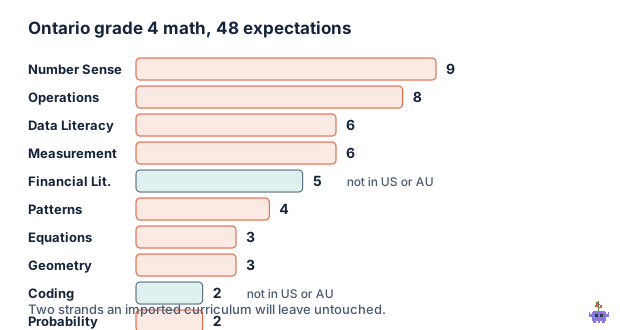
Grade 4 math in Ontario is 48 expectations across six strands, and two of those strands are not the ones a parent expects: Financial Literacy and Coding. Coding sits inside Algebra, and money is a strand of its own with five expectations. Neither appears in the American or Australian curricula at all, so a family using an imported program will finish the year with two Ontario strands untouched.
The other thing to know before planning: 48 is a lot of expectations for one grade and one subject. That is a fact about how Ontario writes its curriculum rather than about how much your child has to learn, and the same year in Alberta is 13 outcomes.
The 48 expectations, by strand
| Strand | Expectations | What it covers |
|---|---|---|
| Number: Number Sense | 9 | Whole numbers to 10 000, fractions to tenths, decimal tenths, equivalence |
| Number: Operations | 8 | The four operations, mental math, multi-digit multiplication and division |
| Data: Data Literacy | 6 | Collecting, displaying and interpreting data |
| Spatial Sense: Measurement | 6 | Length, mass, capacity, area, angles, time |
| Financial Literacy: Money and Finances | 5 | Payment methods, cost and change, spending and saving, value for money |
| Algebra: Patterns and Relationships | 4 | Patterns, and the rules that generate them |
| Algebra: Equations and Inequalities | 3 | Equality, unknowns, inequalities |
| Spatial Sense: Geometric and Spatial Reasoning | 3 | Properties of shapes, location and movement |
| Algebra: Coding | 2 | Writing and altering code, including nested and repeating events |
| Data: Probability | 2 | Likelihood of events |
The two strands nobody plans for
Financial Literacy, five expectations (F1.1 to F1.5)
Ontario is unusual in giving money its own strand from grade 1. In grade 4 the expectations cover methods of payment, estimating and calculating the cost of a multi-item purchase and the change owed, the ideas of spending, saving, earning, investing and donating, how spending and saving behaviour differs between people, and how to judge whether something is reasonably priced.
Why this is the easiest strand to actually teach at home. It is the one place where a homeschooling family has a structural advantage over a classroom: your child can be present for a real grocery shop, compare unit prices on a shelf, handle actual change, and watch a household decision get made. A classroom has to simulate all of that. Do the shopping with them and F1.1, F1.2 and F1.5 are genuinely covered.
The one to plan deliberately is F1.3 and F1.4, because spending, saving, earning, investing and donating are ideas rather than transactions. A jar system, a small allowance with a savings rule, or a family donation decision does more than any worksheet.
Coding, two expectations (C3.1 and C3.2)
Coding is not a computing subject in Ontario. It sits inside the Algebra strand, because the point is representing a mathematical situation as a sequence of instructions.
C3.1 asks the child to solve problems by writing and executing code, including code involving sequential, concurrent, repeating and nested events. C3.2 asks them to read and alter existing code and describe what their changes do.
C3.2 is the one families skip, and it is the more important one. Writing code from scratch is what everyone thinks coding means. Reading somebody else’s code, changing one thing, predicting the effect and then checking is a different and harder skill, and it is the one that transfers to algebra. Scratch is more than adequate for both, and neither expectation requires a text-based language.
A practical route: build one small project, then deliberately hand your child a working project they did not write and ask them to change its behaviour. That second activity is C3.2 and takes twenty minutes.
The three hard ones
Counting to 10 in fractions (B1.6)
Ontario asks children to count to 10 by halves, thirds, fourths, fifths, sixths, eighths and tenths. It looks trivial and it is the most diagnostic expectation in the strand.
The wrong answer it produces: ask a child to count by thirds and you get “one third, two thirds, four thirds”, skipping three thirds because it is a whole number and does not look like a fraction. Or they stop at one whole, because a fraction cannot be bigger than one.
The fix: a number line rather than a list, with the whole numbers marked. Counting past one is the entire point, and it is what makes improper fractions ordinary rather than alarming later.
Fractions and decimal tenths as the same number (B1.9)
Ontario introduces decimal tenths in grade 4 (B1.7) and then, in the same strand, asks children to show the equivalences between fractions and decimal tenths.
The wrong answer it produces: the child treats 0.3 and three tenths as two unrelated things, one belonging to decimals and one to fractions. Ask which is bigger, 0.5 or one half, and you get a pause.
The fix: one number line, both notations written above and below the same marks. If this does not land in grade 4 it becomes the decimal comparison problem in grade 5: see why a child thinks 0.5 is smaller than 0.45.
Rounding, twice (B1.3 and B1.8)
Rounding whole numbers to the nearest ten, hundred or thousand, and separately rounding decimal numbers to the nearest whole number.
The wrong answer it produces: a rule applied without a picture. Ask a child to round 3 462 to the nearest hundred and a rule-follower says 3 500 correctly, then rounds 3 462 to the nearest thousand as 4 000 because they rounded the previous answer rather than the original number.
The fix: a number line every time, with the two candidates marked and the midpoint visible. Rounding is a question about which of two numbers is closer, and a child who sees it that way never chains errors.
How long grade 4 math takes at home
Plan for about 150 to 180 hours, which is roughly 50 minutes a day across four days. Where it goes:
- Number: about half. Seventeen of the 48 expectations are Number Sense and Operations, and fractions and decimals are slow.
- Spatial Sense and Data: about a quarter between them.
- Financial Literacy: less than the five expectations suggest, if it is folded into real life rather than taught as a unit.
- Coding: two expectations, but budget properly, because the setup time is real even though the mathematics is small.
What to compress when it runs long. Probability (2 expectations) is short and enjoyable and can be a single afternoon. Do not compress the fraction work or B1.9, because grade 5 in every jurisdiction builds directly on them.
A sequence for a flexible year
- Whole numbers to 10 000 (B1.1 to B1.3), including rounding on a number line.
- Operations (B2), with multiplication and division built alongside rather than after.
- Fractions (B1.4 to B1.6), finishing with counting past one.
- Decimal tenths and the equivalences (B1.7 to B1.9), on the same number line as the fractions.
- Measurement and geometry (E1, E2), which are practical and a good change of pace mid-year.
- Patterns, equality and coding (C1, C2, C3), taught as one block, because Ontario grouped them for a reason.
- Data and probability (D1, D2), finishing on data the child collected.
- Financial literacy (F1), running across the whole year rather than as a unit.
Records, and what Ontario asks for
Nothing. Ontario requires no reporting, no testing and no curriculum, so you are not obliged to follow these expectations at all. Many families use them anyway, because a free, complete, province-written scope and sequence is a good starting point even if you diverge from it.
Keep dated work anyway. The situations that ask for evidence in Ontario all arrive without notice: a rare reasonable-grounds enquiry, a return to school, or a move to Alberta, where a supervised program means two formal evaluations a year.
The honest summary
Forty-eight expectations, six strands, and about 160 hours. Half the year is number, and fractions plus decimal tenths are where the difficulty sits.
The two strands to put in the plan deliberately are the ones no imported curriculum will cover. Financial Literacy is five expectations and is the easiest thing on this list to teach at home, because you can take your child shopping. Coding is two expectations inside Algebra, and the one that matters is reading and altering somebody else’s code rather than writing your own.
And do not read 48 as a heavy year. It is a granular document, not a big one: the same grade in Alberta is 13 outcomes covering much the same ground.
Sprout Lessons builds lessons against the Ontario curriculum with the expectation code on each one, so the record exists as you teach. Start free.
Expectation counts and codes were taken from our copy of the Ontario curriculum dataset, accessed 16 July 2026, not written from memory. The expectations are paraphrased here rather than reproduced: read the official wording on the Ontario Ministry of Education’s grade 4 mathematics page. The Ontario Curriculum © King’s Printer for Ontario. This product is not endorsed by the Ontario Ministry of Education.
FAQ
What does Ontario grade 4 math cover that other curricula do not?
Two whole strands. Financial Literacy has five expectations of its own covering methods of payment, calculating the cost of a multi-item purchase and the change owed, the ideas of spending, saving, earning, investing and donating, and judging whether something is reasonably priced. Coding sits inside the Algebra strand as two expectations. Neither exists in US Common Core or the Australian Curriculum, so an imported program will leave both untouched.
Why is coding part of the Ontario math curriculum?
Because it is not being taught as a computing subject. Coding sits inside the Algebra strand, since the point is representing a mathematical situation as a sequence of instructions. C3.1 asks for writing and executing code involving sequential, concurrent, repeating and nested events, and C3.2 asks for reading and altering existing code and describing the effect of the change. Scratch covers both and no text-based language is required.
Is 48 expectations a lot for grade 4 math?
It is a lot of expectations and it is not an unusual amount of mathematics. Ontario writes granularly, naming tools, contexts and number ranges in each expectation. The same grade and subject is 34 standards in BC, 28 in US Common Core and 13 outcomes in Alberta, and all four expect a child to end the year able to do much the same things. Plan from what each expectation would take, not from the total.
Why does my child skip three thirds when counting by thirds?
Because three thirds is a whole number and does not look like a fraction, so it gets skipped on the way to four thirds. Some children stop at one entirely, believing a fraction cannot be bigger than one. Ontario expectation B1.6 asks children to count to 10 by halves, thirds, fourths, fifths, sixths, eighths and tenths, and it is the most diagnostic thing in the strand. Use a number line with the whole numbers marked rather than a spoken list, because counting past one is the entire point.
Do I have to follow the Ontario curriculum to homeschool in Ontario?
No. Ontario requires no curriculum, no testing and no reporting, so these expectations are a free resource rather than an obligation. Many families use them anyway, because a complete province-written scope and sequence is a good starting point even if you diverge from it. Keep dated work regardless, since a reasonable-grounds enquiry, a return to school, or a move to a province like Alberta all ask for evidence without notice.
How long does grade 4 math take at home in Ontario?
About 150 to 180 hours, roughly 50 minutes a day across four days. Around half of that is Number, since seventeen of the 48 expectations are Number Sense and Operations and the fraction and decimal work is slow. Financial Literacy takes less time than five expectations suggests if it is folded into real life. Probability is two expectations and can be a single enjoyable afternoon if the year runs long.