
Grade 4 science in British Columbia is 35 learning standards, and 24 of them are things your child does rather than things your child learns about. Only 11 are content. That ratio is the whole curriculum in one number, and it is the opposite of what most families plan for.
The practical consequence is blunt: you cannot cover BC grade 4 science by reading about topics. The content list is short enough to read in an afternoon. The year is the investigation cycle wrapped around it.
The 35 standards, split
| Group | Standards | What it is |
|---|---|---|
| Curricular Competencies: Planning and conducting | 5 | Planning an inquiry, ethics, safe use of tools, observing, collecting data |
| Curricular Competencies: Processing and analyzing | 5 | Interpreting the local environment, sorting and classifying, tables and bar graphs |
| Curricular Competencies: Questioning and predicting | 4 | Curiosity, observing, framing investigable questions, predicting |
| Curricular Competencies: Evaluating | 4 | Inferring, judging a fair test, valuing evidence, environmental implications |
| Curricular Competencies: Applying and innovating | 4 | Contributing to community, designing projects together, transferring learning |
| Curricular Competencies: Communicating | 2 | Representing findings, reflecting on experiences of place |
| Content | 11 | Sensing and responding, biomes, matter and energy, Earth in space |
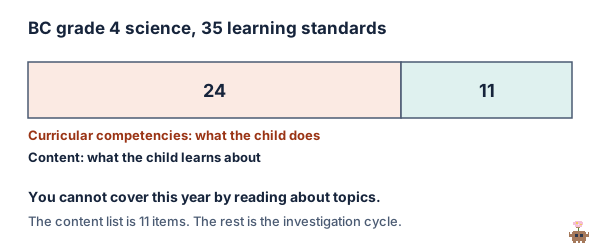
All 11 content standards, which is genuinely the short list
Paraphrased, and it is worth seeing the whole thing at once because most families assume it is longer:
- Sensing and responding: in humans, in other animals, and in plants. Three standards.
- Biomes as large regions with shared environmental features.
- Phases of matter, and the effect of temperature on particle movement. Two standards, and together they are the particle model.
- Energy: that it has various forms, and that it is conserved. Two standards.
- Devices that transform energy.
- Earth in space: local changes caused by Earth’s axis, rotation and orbit, and the effects of the relative positions of the sun, moon and Earth, including local First Peoples perspectives. Two standards.
Eleven items. A curious child could hold a conversation about all of them inside a term. The other 24 standards are what stops that being the whole of grade 4 science.
First Peoples knowledge is in the standards, not beside them
This is the part that most needs planning deliberately, because a family using an imported program will miss it entirely, and it is not an optional enrichment.
It appears twice in grade 4 science, in two different places. One of the processing and analyzing competencies asks children to recognize First Peoples stories, songs and art, including oral and written narratives, as ways of sharing knowledge. And the Earth in space content standard on the sun, moon and Earth explicitly includes local First Peoples perspectives.
Read those two together and the intent is clear: this is about knowledge systems and how knowledge is transmitted, not a themed activity. The word local is doing real work in the second one, because the relevant perspectives are those of the Nations whose territory you live on rather than a generic pan-Indigenous account.
The honest advice for a homeschooling family: start with the Nation whose territory you are on, use resources that Nation has published or endorsed, and expect this to take a few hours of finding rather than a search. Many school districts publish local resources, and the First Nations Education Steering Committee publishes classroom materials that transfer to home use.
What the competencies actually ask for
Twenty-four standards sounds like a lot until you notice they describe one cycle, repeated. A single decent investigation touches most of them:
- Ask something. Curiosity, observing in a familiar context, framing a question that can actually be investigated, and predicting from what you already know.
- Plan and do it. Suggesting how to find out, considering ethical responsibilities, using tools safely including formal measurements, observing living and non-living things locally, collecting simple data.
- Make sense of it. Sorting and classifying with drawings, pictographs and tables, representing with simple bar graphs, and comparing results against the prediction with reasons for any difference.
- Judge it. Inferring from results and prior knowledge, asking whether it was a fair test, showing appreciation of evidence, and identifying environmental implications.
- Apply it. Designing projects co-operatively, transferring the learning to a new situation, refining ideas while problem solving, and contributing to care for self, others and neighbourhood.
- Say it. Representing findings in diagrams and simple reports, and reflecting on personal or shared experience of place.
The planning consequence: four or five real investigations across the year, each fully cycled, covers the competencies better than twenty short activities. Choose investigations that let the same child ask, plan, do, analyze, judge and report, because a demonstration you run for them meets almost none of these.
The three hard ones
Fair testing (standard 16)
BC asks the child to reflect on whether an investigation was a fair test.
The wrong answer it produces: asked whether a test was fair, the child says yes because everyone got a turn, or because they did their best. Fairness is being read as an ethical word rather than a methodological one.
The fix: change two things at once on purpose and let them discover the result is uninterpretable. Water two plants with different amounts of water and also put one in a cupboard. Ask which factor caused the difference. The inability to answer is the lesson, and it takes one demonstration rather than a definition.
Energy is conserved (standard 32)
The wrong answer it produces: ask where the energy went when a toy stopped moving and you get “it got used up”. The same child says a battery runs out of electricity.
The fix: always ask where did it go rather than what went wrong. Rub hands together and feel the heat. Energy that appears to vanish has turned up as heat, sound or light, and at grade 4 the child can usually detect it. Pair it with the devices that transform energy standard, which gives the idea something to be about.
Temperature and particle movement (standard 30)
The wrong answer it produces: temperature is understood as how hot something feels rather than as how fast the particles are moving, so a child cannot explain why a solid melts.
The fix: teach it immediately after phases of matter, never separately. Food colouring dropped into cold and hot water side by side is the whole lesson: same drop, visibly different speed, and the only difference is temperature.
How long grade 4 science takes at home
About 60 to 90 hours, best in two longer blocks a week rather than daily slices, because an investigation does not fit in twenty minutes.
- Investigating: well over half. That follows directly from 24 of 35 standards being competencies.
- Content teaching: about a fifth. Eleven items is not many.
- Recording, graphing and reporting takes the rest, and it is where the data literacy competencies get met.
What to compress: biomes is research-shaped and compresses well. Do not compress the fair-testing work or the investigation cycle, because they are two thirds of the curriculum by count.
Records, and what BC asks for
Nothing. A registered BC homeschooler is not required to meet provincial standards at all, is not inspected and is not supervised, so this curriculum is a resource rather than an obligation.
Two things worth doing anyway. Keep dated photographs of investigations, since science produces very little paper and this is the subject where a portfolio is thinnest. And remember that the school that registered your child must offer free assessment services, which almost nobody claims and which is the only external evidence available to a BC family.
The honest summary
Thirty-five standards, 24 of which are the investigation cycle and 11 of which are content, and about 75 hours. The content genuinely is short: sensing and responding, biomes, phases of matter and particle movement, energy and devices that transform it, and Earth in space.
So plan the year as four or five real investigations rather than as a topic list, because a demonstration you perform meets almost none of the competencies. Teach temperature immediately after phases of matter. Break a fair test on purpose so the word stops meaning kind.
And plan the First Peoples standards deliberately, starting with the Nation whose territory you live on. They appear twice, they are not enrichment, and an imported science program will not contain them.
Sprout Lessons builds lessons against the BC curriculum with the learning standard on each one. Start free.
Standard counts were taken from our copy of the BC curriculum dataset, accessed 16 July 2026, not written from memory. The learning standards are paraphrased here rather than reproduced: read the official wording on the BC Ministry of Education’s grade 4 science page. BC curriculum © Province of British Columbia, used under the Open Government Licence for British Columbia. This product is not endorsed by the Province.
FAQ
What is the difference between curricular competencies and content in BC?
Content is what your child learns about and competencies are what your child does. In grade 4 science there are 11 content standards and 24 competencies, covering questioning and predicting, planning and conducting, processing and analyzing, evaluating, applying and innovating, and communicating. That two to one ratio is the whole curriculum in a number, and it means a year planned as a topic list will miss most of the standards.
What content is actually in BC grade 4 science?
Eleven items. Sensing and responding in humans, other animals and plants; biomes as large regions with similar environmental features; phases of matter; the effect of temperature on particle movement; that energy has various forms and that it is conserved; devices that transform energy; local changes caused by Earth’s axis, rotation and orbit; and the effects of the relative positions of the sun, moon and Earth including local First Peoples perspectives.
How do I teach the First Peoples parts of BC science at home?
Start with the Nation whose territory you live on, and use resources that Nation has published or endorsed rather than a generic pan-Indigenous account, because the curriculum says local. It appears twice in grade 4: once as a competency about recognizing stories, songs and art as ways of sharing knowledge, and once inside the sun, moon and Earth content standard. Expect it to take a few hours of finding. Many school districts publish local resources, and the First Nations Education Steering Committee publishes materials that transfer to home use.
Why does my child think a fair test means everyone got a turn?
Because fair is an ethical word everywhere else in their life and a methodological one only in science. Definitions do not fix it. Run an investigation where you change two variables at once on purpose, then ask which one caused the result. Discovering that the question cannot be answered is what teaches the idea, and BC asks for exactly this reflection in one of its evaluating competencies.
How long does grade 4 science take at home in BC?
About 60 to 90 hours, best in two longer blocks a week rather than daily slices, because an investigation does not fit into twenty minutes. Well over half of that is investigating, which follows directly from 24 of 35 standards being competencies. Content teaching is about a fifth, and recording and graphing takes the rest. Biomes compresses well if the year runs long; the fair-testing work does not.
Do I have to follow the BC curriculum if I am a registered homeschooler?
No. A registered BC homeschooler delivers the entire program themselves, is not required to meet provincial standards, and is not inspected or supervised, so the curriculum is a free resource rather than an obligation. Two things are still worth doing: keep dated photographs, since science produces very little paper, and claim the free assessment service the registering school must offer, because it is the only external evidence available to a BC family.