
British Columbia makes you choose between two completely different legal statuses, and the funding follows the choice rather than the child. Register as a homeschooler and the school receives $250 while you receive nothing. Enrol in an online learning program instead and your child is a student in the system, taught by a certified teacher, with the funding that goes with it.
Almost every confusing conversation about home education in BC comes from these two being called the same thing in casual speech. They are not the same thing, and the difference decides who is responsible for your child’s education.
British Columbia at a glance
| Requirement | Registered homeschooling in BC |
|---|---|
| Registration required | Yes, by September 30 each year |
| Who you register with | A public or independent school, not the Ministry |
| Can you be refused | A public school principal must register any homeschooler in the district. An independent school may choose, and may charge a fee |
| Who delivers the program | You do, entirely. Not a BC-certified teacher |
| Provincial standards | Not required to meet them. The program is not inspected or supervised |
| School’s authority over your program | None. No power to approve or supervise it |
| What the school owes you, free | Assessment and evaluation services, and loans of approved educational resources |
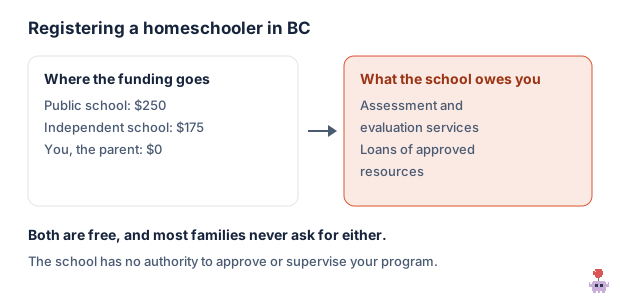
| Funding | $250 to a public school, $175 to an independent school. Nothing to parents |
| Parent qualifications | None |
| Testing or reporting | None required of a registered homeschooler |
The two statuses, and why the distinction decides everything
Registered homeschooling means you deliver the entire educational program yourself. It sits outside the provincial system: not taught by a BC-certified teacher, not required to meet provincial standards, and deliberately not inspected or supervised by the Ministry. You choose the curriculum, you monitor progress, and you are wholly responsible for both.
Online learning, which used to be called distributed learning, is a classroom alternative rather than an alternative to the classroom. Your child enrols in formal courses through an accredited program, is taught and assessed by certified teachers, and remains a student in the education system with the credits and the reporting that implies.
Families often describe both as “homeschooling” because both happen at the kitchen table. Legally they are opposites: one puts you fully in charge and gives you nothing, the other keeps the system in charge and gives your child everything a school student gets. Deciding which you are actually doing is the first real decision in BC, and it is worth making deliberately rather than drifting into.
The free services almost nobody claims
This is the most useful thing on this page and it is buried in the policy, so it is worth stating plainly.
A school that registers your homeschooled child must offer, at no cost:
- Evaluation and assessment services to determine your child’s educational progress.
- Loans of approved educational resources, meaning the textbooks and materials the school already holds.
Both of these are free to you, and both exist because the school received money for registering your child. Very few registered families ask for either, which means the $250 quietly becomes a grant to the school for a form.
Ask. An assessment carried out by the school is the single most useful record a BC homeschooling family can hold, precisely because BC requires no records at all: it is external, dated, and written by someone with no stake in flattering you. It is also exactly the document that helps if your child later returns to school, or if you move to a province that does supervise.
Crucially, asking for it costs you nothing in independence. The school has no authority to approve or supervise your program, and requesting an assessment does not create one.
Registering, and the September 30 date
Register your child by September 30 of each year. It is an annual act, not a one-time one.
You may register with a public school or an independent school, and the two behave differently:
- A public school principal must register any homeschooler living in the district. There is no discretion and no criteria to satisfy. If you want certainty, this is the route.
- An independent school may choose whether to register homeschoolers, and may charge a registration fee. Some offer support, community or materials that justify it. Read what is actually included before paying, because the statutory services above are free either way.
Registration is not approval and it cannot be refused by a public school on the merits of your program, because the school has no authority over your program to begin with.
What BC does not ask for
Setting out the absences plainly, because families arriving from provinces or countries with heavier regimes routinely over-prepare:
- No curriculum requirement, and no obligation to meet provincial standards.
- No inspection, supervision or home visit.
- No portfolio, progress report or annual return.
- No testing. Registered homeschoolers are not required to sit provincial assessments.
- No qualification for the parent.
The trade for all of that is that you carry the whole responsibility, and that the province will not be producing any evidence of what your child learned. If that evidence is ever going to matter, it has to come from you or from the assessment service above.
Records: not required, and worth keeping
BC requires nothing. The three situations where you will wish you had something:
- Returning to school or moving to online learning, where placement decisions are made on age but support is aimed using whatever evidence you can produce.
- Moving provinces. If you move to Alberta, a supervised program means two formal evaluations a year by a certificated teacher, and portfolio reviews. The evidence bar goes from nothing to real in one move.
- Post-secondary admission, where a BC homeschooled student has no Dogwood diploma and needs another route, evidenced.
The cheapest version: dated work samples across subjects, kept monthly, plus an annual assessment from the school that registered you. That second item is free and most people never use it.
How BC compares with the rest of Canada
Across the three provinces we have written up, the same pattern holds: the money and the oversight travel together.
- Ontario gives you nothing and asks nothing. One letter a year, and a policy that tells boards not to investigate without reasonable grounds.
- British Columbia pays the school rather than you, supervises nothing, and leaves two free services on the table that most families never claim.
- Alberta is the only province where funding reaches the parent, and the trade is two formal evaluations a year.
The honest summary
Decide which of the two things you are doing. Registered homeschooling puts you entirely in charge, outside provincial standards, with no supervision and no money. Online learning enrols your child in the system with certified teachers and full funding. Both get described as homeschooling and they are legal opposites.
If you are registering: do it by September 30, with a public school if you want a principal who cannot say no, and understand that the $250 goes to them rather than to you.
Then claim what you paid for. Free assessment services and free loans of educational resources are owed to you, they cost you no independence because the school has no authority over your program anyway, and the assessment is the best record a BC family can hold in a province that asks for none.
Sprout Lessons builds standards-aligned lessons for kindergarten to grade 12, with the curriculum reference on each one, so you have records even where BC never asks. Start free.
Checked against the BC Ministry of Education and Child Care’s current homeschooling guidance as at 3 September 2026. Registered homeschooling is provided for in the School Act. This is general information, not legal advice: confirm current requirements, funding amounts and deadlines with the Ministry or your registering school before you rely on them.
FAQ
What is the difference between homeschooling and online learning in BC?
They are legal opposites that both happen at the kitchen table. Registered homeschooling means you deliver the entire educational program yourself: not taught by a BC-certified teacher, not required to meet provincial standards, and deliberately not inspected or supervised. Online learning means your child enrols in formal courses through an accredited program, is taught and assessed by certified teachers, and remains a student in the system. Deciding which you are actually doing is the first real decision in BC.
When do I have to register a homeschooler in BC?
By September 30 of each year, and it is an annual act rather than a one-time one. You register with a public or independent school rather than with the Ministry. A public school principal must register any homeschooler living in the district, so if you want certainty that is the route. An independent school may choose whether to register homeschoolers and may charge a registration fee.
How much funding do BC homeschooling families get?
None. The funding goes to the school that registers your child: $250 to a public school and $175 to an independent school. No funding is sent to parents. What you get in exchange are two services the school must offer at no cost, free evaluation and assessment services and free loans of approved educational resources, which most registered families never claim.
Can a school refuse to register my homeschooled child in BC?
A public school cannot, if you live in the district. Public school principals must register any homeschooler in their district, and there are no criteria to satisfy because the school has no authority over your program to begin with. Independent schools may choose whether to register homeschoolers, and may charge a fee for it.
Does anyone check or approve a BC homeschooling program?
No. Registered homeschooling programs are deliberately not inspected or supervised by the Ministry, are not required to meet provincial standards, and the registering school has no authority to approve or supervise the program. There is no curriculum requirement, no portfolio, no progress report and no testing. The trade is that you carry the whole responsibility and the province produces no evidence of what your child learned.
Should I ask my registering school for an assessment?
Yes, and almost nobody does. The school must offer evaluation and assessment services free because it received funding for registering your child. The result is an external, dated assessment written by someone with no stake in flattering you, which is the most useful record a family can hold in a province that requires none. It is also the document that helps most if your child later returns to school or you move to a province that supervises.