
Ontario asks you for one letter a year, and its own policy tells school boards that “normally, the board should not investigate the matter.” That sentence, from Policy/Program Memorandum 131, is the whole regime. There is no curriculum requirement, no testing, no reporting, no qualification for the parent and no funding.
It is one of the lightest home schooling arrangements anywhere in Canada, and the practical consequence is that almost everything that goes wrong in Ontario is an administrative misunderstanding rather than a compliance problem.
Ontario at a glance
| Requirement | Ontario |
|---|---|
| Notification required | Yes, in writing, once a year |
| Who you notify | The school board where your child last attended school |
| Deadline | Before September 1 for each subsequent year |
| Approval required | No. The board acknowledges by letter. It is a notification, not a request |
| Effect of notifying | The board should consider your child excused from attendance at school |
| Curriculum | None prescribed. You are not required to follow the Ontario curriculum |
| Testing or reporting | None. No EQAO, no portfolio, no progress report |
| Parent qualifications | None |
| Funding | None. Nothing to the parent and nothing to a school on your behalf |
| Governing policy | Policy/Program Memorandum 131 |
The letter, and exactly what goes in it
PPM 131 is unusually specific about the contents, which is helpful, because it means a compliant letter is short and there is nothing to guess at. Include:
- The name, gender and date of birth of each child being home schooled.
- The telephone number and address of the home.
- Your signature, as the parent or parents.
That is the entire required content. The memorandum provides a sample letter in its Appendix B, and using it removes any argument about form.
Notice what is not on the list. You are not asked for a curriculum outline, a list of resources, a timetable, an educational philosophy, your qualifications or your reasons. If a board asks for those, it is asking rather than requiring, and you may answer or decline.
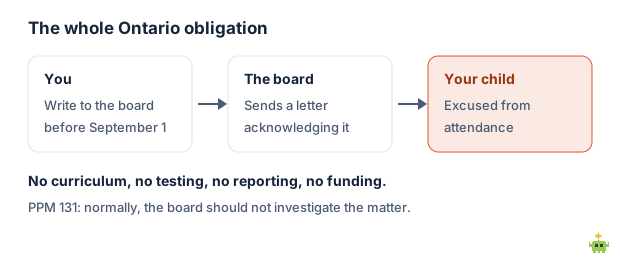
What happens after you send it
Two things, and they are both the board’s job rather than yours.
Your child is excused from attendance. When parents give a board written notification of intent to home school, the board should consider the child excused. That is what ends the attendance obligation, and it is why the letter matters even though nothing is assessed.
The board should send you a letter each year acknowledging the notification, for which the memorandum provides a sample in Appendix C. Keep it. It is the only document in the whole process that proves your status, and it is the thing to reach for if attendance counselling contacts you by mistake, which happens more often than it should.
If an acknowledgement does not arrive within a few weeks, follow up in writing. A board that has not recorded your notification is the single most common cause of an unnecessary attendance enquiry in Ontario.
The investigation exception, and how narrow it is
The memorandum says the board should normally not investigate, which naturally raises the question of what abnormal looks like.
The exception is where a board has reasonable grounds to suspect a child is not receiving satisfactory instruction at home. That is a real threshold rather than a discretion to check up on people, and it is not triggered by choosing an unusual curriculum, teaching outside school hours, or declining to answer optional questions.
If an investigation is opened, the practical advice is the same as everywhere else in this series: respond in writing, promptly, and give the board something concrete. A short description of what your child is learning and a few samples of dated work resolves nearly all of these, and it is far easier to produce if you have kept records along the way even though Ontario never asks to see them.
Records: nobody asks, and keep them anyway
Ontario requires no records at all. That is a genuine freedom and it is also the trap in a light-regulation province, because the situations where you will want records arrive without notice:
- A reasonable-grounds enquiry, rare but real, where dated work ends the conversation quickly.
- Returning to school. Placement is a school decision made largely on age, but evidence of what your child covered is what gets the support pointed correctly in the first month.
- Moving provinces. This is the big one, and Ontario families underestimate it. If you move to Alberta, a supervised program brings two formal evaluations a year by a certificated teacher. Records you never needed in Ontario suddenly matter a great deal.
- High school credits and post-secondary entry, where an Ontario Secondary School Diploma was never accumulated and an alternative route has to be evidenced instead.
Ten minutes a month is enough. Dated work samples across subjects, a short note of what was covered, and photographs of anything that leaves no paper.
Secondary school and the diploma question
Worth being clear-eyed about, because Ontario’s lightness cuts both ways. Home schooling in Ontario earns no credits toward the Ontario Secondary School Diploma, and there is no assessment route that converts home learning into them.
The realistic paths are returning to a secondary school and accumulating credits there, taking courses through an inspected private school or a board’s continuing education program, or going to college or university through a mature student or alternative admission route. Colleges and universities in Ontario do admit home educated applicants and publish their requirements, but the requirements are specific and they are worth reading in grade 10 rather than grade 12.
How Ontario compares with the rest of Canada
Across the three provinces we have written up, one pattern holds: the money and the oversight travel together.
- Ontario gives you nothing and asks you for nothing. One letter, one acknowledgement, no supervision.
- British Columbia pays the school rather than you, and in exchange the school owes you free assessment services and resource loans that most families never claim.
- Alberta is the only one where funding reaches the parent, and the trade is two formal evaluations a year by a certificated teacher.
If you are choosing where to live as much as how to teach, that is the axis to compare on, rather than a general sense of which province is friendlier.
The honest summary
Write to the board where your child last attended, before September 1, with names, dates of birth, gender, your address and phone number, and your signature. Use the sample letter in Appendix B of PPM 131. Keep the acknowledgement the board sends back.
Then teach however you like. No curriculum, no testing, no reporting, no qualification, and a policy that tells boards not to investigate without reasonable grounds.
The one thing to do that Ontario does not require: keep light records anyway, because returning to school, moving provinces and post-secondary admission all ask for evidence that the province itself never will.
Sprout Lessons builds standards-aligned lessons for kindergarten to grade 12, with the curriculum reference on each one, so the records exist without extra work. Start free.
Checked against Ontario Policy/Program Memorandum 131 as at 3 September 2026. This is general information, not legal advice, and boards vary in how they administer notification: confirm current requirements with your own school board before you rely on them.
FAQ
What do I have to put in an Ontario home schooling letter?
The name, gender and date of birth of each child being home schooled, the telephone number and address of the home, and your signature as the parent or parents. That is the entire required content, and PPM 131 provides a sample letter in Appendix B. You are not asked for a curriculum outline, a list of resources, a timetable, an educational philosophy, your qualifications or your reasons.
Do I need permission from the school board to homeschool in Ontario?
No. It is a notification, not a request. When parents give a board written notification of their intent to provide home schooling, the board should consider the child excused from attendance at school, and the board should send a letter each year acknowledging the notification. PPM 131 also tells boards that normally they should not investigate the matter.
When is the Ontario homeschooling notification due?
Before September 1 for each subsequent year, in writing, to the school board in whose jurisdiction your child last attended school. It is annual rather than one-time. The board should reply each year with an acknowledgement letter, and that letter is worth keeping because it is the only document that proves your status.
Can an Ontario school board investigate my homeschooling?
Only in narrow circumstances. PPM 131 says that normally the board should not investigate. The exception is where a board has reasonable grounds to suspect a child is not receiving satisfactory instruction at home, which is a real threshold rather than a general discretion to check up on families, and it is not triggered by an unusual curriculum, teaching outside school hours, or declining to answer optional questions.
Does homeschooling in Ontario count toward a high school diploma?
No. Home schooling in Ontario earns no credits toward the Ontario Secondary School Diploma and there is no assessment route that converts home learning into them. The realistic paths are returning to a secondary school and accumulating credits there, taking courses through an inspected private school or a board’s continuing education program, or applying to college or university through a mature student or alternative admission route. Those requirements are worth reading in grade 10 rather than grade 12.
Is there any funding for homeschooling in Ontario?
None. Nothing goes to the parent and nothing goes to a school on your behalf, which is consistent with the fact that nothing is supervised either. Across Canada the money and the oversight travel together: Ontario gives nothing and asks nothing, British Columbia pays the registering school rather than you, and Alberta is the only province where funding reaches the family, in exchange for two formal evaluations a year.