
Alberta is the only province where home education funding actually reaches the parent, and the trade is two formal evaluations a year by a certificated teacher. Families in a supervised program receive half of the home education grant, spendable on resources for their own child. Nowhere else in the three provinces we have written up does the money reach the family at all.
That single exchange explains the whole Alberta system. Choose the funded route and you accept supervision. Choose the unfunded route and you notify the Minister and are left alone.
Alberta at a glance
| Requirement | Alberta |
|---|---|
| Notification required | Yes, every year, on the Home Education Notification Form |
| Two routes | Supervised and funded, or not supervised and not funded |
| Who you notify, funded route | A willing public, separate or francophone board, or an accredited funded independent school |
| Deadline, funded route | Before September 30 to be eligible for funding |
| Who you notify, unfunded route | The Minister of Education, by form or through PASI myPass |
| Evaluations | Funded route: at least two formal evaluations per student per school year, by certificated teachers |
| Funding to the family | 50% of the home education grant, in a supervised program |
| Parent qualifications | None |
| Provincial testing | Not required of home education students |
The two routes, and how to choose
Everything in Alberta follows from this fork, so make it deliberately.
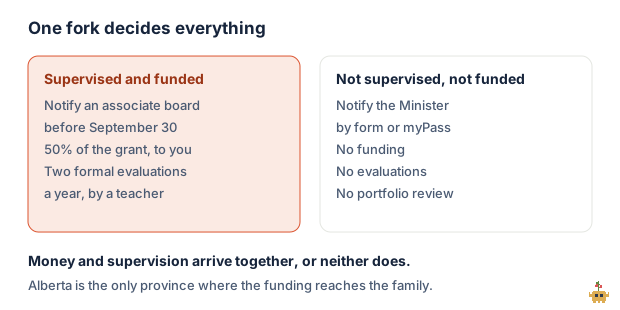
Supervised and funded
You associate with a supervising school authority: a willing public, separate or francophone school board, or an accredited funded independent school. Often called the associate board or associate private school.
That authority then has real obligations to you. It must:
- Provide assistance and advice when you ask for it.
- Arrange for certificated teachers to conduct at least two formal evaluations of each student each school year.
- Ensure students are meeting educational outcomes, through portfolio reviews and recommendations.
In exchange, your family receives 50% of the home education grant, and the supervising authority keeps the rest for administering the program and doing the evaluations.
Not supervised and not funded
You notify the Minister of Education directly, by form or through PASI myPass, and that is the end of the relationship. No associate board, no evaluations, no portfolio reviews and no money.
This route is closer to how Ontario works, and families who value independence above resources choose it deliberately rather than by accident.
What the funding is actually for
The parent portion is reimbursement for resources used in your child’s program, claimed against receipts through your associate authority rather than paid as income. Curriculum, books, materials, and in many programs course fees, lessons and equipment.
One detail worth knowing because it is easy to lose: parents can access up to two years’ worth of the parental funding portion through declaration forms. Programs administer this differently, so ask your associate authority early in the year what is claimable and what evidence they want, rather than discovering the rules in June.
Amounts and administration vary between authorities. The percentage split is provincial; how a given board handles claims is not.
The two evaluations, and what they actually are
This is the part families worry about most and it is the part that resembles the NSW authorised person visit least. Two things make it easier:
It is a review of evidence, not a test of your child. A certificated teacher looks at a portfolio, talks with you and your child, and writes an evaluation of progress against the outcomes of your program. Nobody is examined.
The teacher is also your assigned support. The same authority that arranges the evaluations is obliged to provide assistance and advice on request, and in a good program the evaluator is the person who knows your child and can point you at resources. Families who treat the facilitator as a resource rather than an inspector get far more out of the arrangement, and it is the same person either way.
Practically: keep a portfolio through the year rather than assembling one twice. Dated work across subjects, samples early and late so progress is visible by comparison, and photographs of anything that leaves no paper. Two evaluations a year is a comfortable rhythm if the evidence accumulates and an unpleasant one if it does not.
Notifying, and the September 30 date
Notification is annual on both routes, using the Home Education Notification Form.
- Funded route: notify your supervising school authority before September 30. That date is what makes you eligible for funding for the year, so it is the one to put in a calendar.
- Unfunded route: notify the Minister of Education, by form or through PASI myPass.
- Find a willing authority first. On the funded route the board has to agree to supervise you, so leave time to approach one rather than assuming any board will take you in late September. Programs differ in support offered, claim rules and how they run evaluations, and they are worth comparing.
Records and evidence
Alberta is the one province in this set where records are structurally required rather than merely wise, at least on the funded route, because the portfolio review is built into the program.
- Keep a portfolio continuously. Two evaluations a year means the folder is looked at twice, so the cost of building it in a rush is paid twice too.
- Keep pairs. Comparable work from early and late in the year is what demonstrates progress, which is what the evaluation is about.
- Keep receipts. Unique to Alberta, and the difference between claiming the funding you are entitled to and forfeiting it.
- Keep the evaluation reports. They are external, dated assessments of your child by a certificated teacher, which is the most valuable document a home educating family can hold if the child later returns to school or applies to a post-secondary institution.
How Alberta compares with the rest of Canada
Across all three provinces, one pattern holds: the money and the oversight travel together.
- Ontario gives you nothing and asks nothing. One letter a year, and boards are told not to investigate without reasonable grounds.
- British Columbia pays the school rather than you, supervises nothing, and owes you free assessment services that most families never claim.
- Alberta is the only one where funding reaches the family, and the price is two formal evaluations a year and a portfolio that gets read.
Alberta’s unfunded route is essentially Ontario’s regime with an Alberta postcode, which makes Alberta the only province in this set where you can choose which of the two systems you want to live under.
The honest summary
Pick the route first. Funded means an associate school authority, notification before September 30, 50% of the home education grant reimbursed against receipts, and at least two formal evaluations a year by a certificated teacher. Unfunded means notifying the Minister and being left entirely alone.
On the funded route, approach a board early because it has to be willing, ask what is claimable before you spend, and keep the portfolio continuously rather than twice a year. Treat the evaluator as the support they are obliged to be, since the same authority owes you assistance and advice on request.
And keep the evaluation reports. In a country where two of three provinces produce no external evidence of home education at all, a dated assessment written by a certificated teacher is the most useful document your family will hold.
Sprout Lessons builds standards-aligned lessons for kindergarten to grade 12, with the curriculum reference on each one, which is exactly the evidence a portfolio review is looking for. Start free.
Checked against the Government of Alberta’s current home education guidance as at 3 September 2026. Home education in Alberta is governed by the Education Act and the Home Education Regulation. This is general information, not legal advice, and funding amounts and claim rules are administered by individual school authorities: confirm current requirements and deadlines with your supervising authority before you rely on them.
FAQ
How much funding do Alberta home educating families receive?
Families in a supervised program receive 50% of the home education grant, with the supervising authority keeping the rest for administering the program and carrying out the evaluations. It is reimbursement against receipts for resources used in your child’s program rather than income, and parents can access up to two years’ worth of the parental funding portion through declaration forms. Families on the unsupervised route receive nothing.
What is the difference between the funded and unfunded routes in Alberta?
The funded route means associating with a willing public, separate or francophone school board or an accredited funded independent school, which then owes you assistance and advice on request, arranges at least two formal evaluations a year by certificated teachers, and reviews a portfolio. The unfunded route means notifying the Minister of Education directly, by form or PASI myPass, and having no associate board, no evaluations and no money. Alberta is the only province in this set where you can choose which system to live under.
What happens at an Alberta home education evaluation?
A certificated teacher reviews a portfolio, talks with you and your child, and writes an evaluation of progress against the outcomes of your program. Your child is not examined and it is a review of evidence rather than a test. The same authority that arranges the evaluations is obliged to provide assistance and advice on request, so in a good program the evaluator is also the person who knows your child and can point you at resources.
When do I have to notify in Alberta?
Every year, using the Home Education Notification Form. On the funded route, notify your supervising school authority before September 30, because that date is what makes you eligible for funding for the year. On the unfunded route, notify the Minister of Education by form or through PASI myPass. On the funded route, find a willing authority before the deadline rather than at it, since the board has to agree to supervise you.
Do I need teaching qualifications to home educate in Alberta?
No. There are no parent qualification requirements on either route. What the funded route requires instead is that certificated teachers arranged by your associate authority conduct the two formal evaluations each year, which is a check on the evidence of your child’s progress rather than on your credentials.
Are Alberta home educated students required to sit provincial tests?
No. Provincial testing is not required of home education students. The oversight on the funded route comes from the two formal evaluations and the portfolio reviews rather than from standardized assessment, which is why keeping dated work with early and late pairs matters more in Alberta than a test score would.