
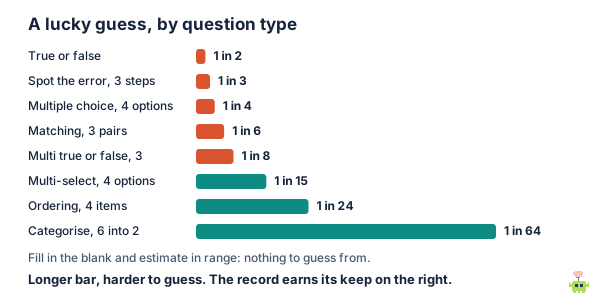
A four-option multiple-choice question can be guessed one time in four. An ordering question with four items can be guessed one time in twenty-four, and a sort of six items into two groups one time in sixty-four. That arithmetic is most of the reason Sprout Tutor uses ten question types rather than one, and it is the reason a practice record built on them means something.
This page lists the ten, gives a worked example of each, and says exactly how each one is marked, because the marking is fixed code with a stored answer key and there is no model deciding whether your child was close. The examples are written for this page; they are not taken from the live question bank.
Checked against the Sprout Tutor source code on 29 September 2026. The type mix quoted below was counted from the Level 9 question bank on that date.
What the beta covers
Sprout Tutor went into public beta on 22 September 2026. It follows the Victorian Curriculum F–10 Version 2.0 only, for Years 1 to 9, in English, maths and science. Other curricula are not covered yet. While it is in beta it is free on every Sprout plan, including the free one.
Why not just ask a question and read the answer
An open text box is the obvious design, and it is the one we did not build. If a child types a sentence, something has to decide whether the sentence is right, and the only thing that can read a free sentence is a language model. A model’s opinion of an answer is not a mark: ask twice and you can get two verdicts, and neither is checkable afterwards.
So every question in the tutor has a fixed shape and a stored key, and marking is one small function per type that compares the child’s answer with the key. The same answer always gets the same result, the result can be reproduced from the record, and the key is stripped from the question before it reaches the child’s screen. The cost is that the tutor can only ask questions with a checkable answer. That cost is real and it is discussed at the end.
The ten types, with an example of each
- Multiple choice. One correct option among three or four. Which of these is a prime number: 21, 27, 29, 33? Marked correct when the chosen option is the keyed one.
- True or false. One statement, one switch. 0.5 is smaller than 0.45. False, and it is the statement, not the answer, that carries the content.
- Fill in the blank. A sentence with one gap, and a typed word or number. Three quarters written as a decimal is ___. Marked against a list of accepted answers, after tidying, described below.
- Multi-select. Choose every option that applies, from four or five. Select every factor of 12: 3, 5, 6, 8. Correct only when the set chosen is exactly the keyed set, no more and no fewer.
- Estimate in range. A number that must land inside a window, for questions where the skill is the estimate rather than the exact figure. Estimate 19 × 21 without working it out. Anything from 380 to 420 is right; 399 gets no more credit than 400.
- Ordering. Drag items into sequence. Put these from smallest to largest: 0.7, 0.45, 0.29, 0.5. The whole sequence has to match; a single swap is wrong.
- Matching. Pair each item on the left with one on the right. Triangle, pentagon, hexagon, matched to 3, 5 and 6 sides. Every pair must be right.
- Categorise. Sort items into named groups. Rational or irrational: √2, 0.75, π, one third. Every item must be in its right group.
- Spot the error. A worked solution in three or four steps, one of which is wrong. Step 1: (2³)² means 2³ multiplied by itself. Step 2: so the exponents multiply, 3 × 2. Step 3: (2³)² = 2⁵. The child picks the step, and only the step where the error was made counts.
- Multi true or false. Several statements about one thing, each marked true or false. For the number 3.06: the 6 is in the hundredths place; it is larger than 3.1; it reads three and six hundredths. True, false, true, and all three switches have to be right.
How each one is marked
Seven of the ten compare identifiers: the option chosen, the step chosen, the order of the items, the pairs, the groups, the set, the switches. There is nothing to interpret, so there is nothing to argue with. The two that take a number or a word need rules, and these are them.
- Estimate in range accepts any number inside the window, inclusive. The window is set per question and is not shown to the child.
- Fill in the blank tidies the typed answer before comparing it with each accepted answer: it lowers the case, removes spaces and ordinary punctuation, drops a trailing percent or degree sign, joins a hyphen between two words (so “first-person” and “first person” are the same), and puts a zero in front of a bare decimal point (so “.75” is “0.75”). It does not change a minus sign, so “-3” is never “3”, and it never adds or removes a leading zero from a whole digit, so “5” is never “0.5”. Formatting differences are never wrong answers; spelling differences can be, unless the question’s accepted list includes them.
- There is no partial credit on any type. An ordering with one swap, a matching with one crossed pair, a categorise with one item in the wrong group: all wrong. The dashboard shows the child’s sequence next to the right one, so you can see that it was one swap, but the engine counts it as one wrong answer.
Two things wrap every type. A hint is available before answering, behind a button, and opening it is recorded but does not change the mark. Revealing the answer instead of giving one is recorded as a reveal, is never marked correct, and counts as a wrong answer for the rules that set difficulty. After any answer, right or wrong, the child sees the working: two or three lines that say how the answer was reached.
What the mix actually is
Each content description has thirty questions per theme, ten at each of the three tiers, and the types are spread across the ten. Counted in the Level 9 bank on 29 September 2026: multiple choice is 19% of questions, true or false 15%, fill in the blank 13%, and the seven structured types share the remaining 53%, from multi-select at 11% down to estimate in range at under 1%. So roughly a fifth of what a child sees can be guessed at one in four, a third is the two simplest shapes, and the rest is the kind of question a guess does not survive. Other Levels differ a little, and the mix is set by what each content description can honestly ask.
The child also chooses a theme at the start of each sitting: Classic, Footy, Netball or Animals. The themed versions of a question change the wording and the setting and keep the numbers and the answer key, so a footy version of a question is the same question with a different story around it. Which theme was used is visible in the wording of the question on the dashboard.
What this shape cannot do
- It cannot assess writing. A structured question can ask which sentence is the topic sentence, or which word is doing the persuading, and it cannot mark a paragraph. Sprout Tutor’s English is analysis and language knowledge, not composition, and a child who needs to write more needs a person to read it.
- It cannot see method. The spot-the-error type is the closest it gets: it asks the child to read working rather than produce it. A child who reaches the right answer by a wrong route is marked right.
- It cannot tell a slip from a misconception in one question. A wrong answer counts once whatever caused it. The pattern over several questions is what to read, and the dashboard keeps every question so you can read it.
- It is not evidence that the tutor works. Whether personalised AI tutoring improves learning has not been independently established, and very few rigorous studies exist. A question shape that makes marking exact and guessing hard is a precondition for finding out, not a finding.
How to check it yourself
Sit with your child for one sitting and count the types as they come up. You should see most of the ten in a session of twenty questions. Then try the guessing test: on an ordering or a categorise question, ask your child what would happen if they just dragged things anywhere. They will tell you, correctly, that it would be wrong, which is the whole point. If you already wonder whether a tutor will simply hand over the answer, the reveal-counts-as-wrong rule is the mechanism to look for, here and anywhere else.
The short version
Ten question types: multiple choice, true or false, fill in the blank, multi-select, estimate in range, ordering, matching, categorise, spot the error and multi true or false. Each is marked by a fixed rule against a stored key that never reaches the child’s screen, with no partial credit and no model in the loop. A guess succeeds one time in four on multiple choice and one time in sixty-four on a six-item sort, and in the Level 9 bank the structured types are just over half of what a child sees.
The shape cannot mark writing, cannot see method, and is not proof of anything. It is a way of asking questions whose answers mean what they say, which is what a practice record needs to be worth reading.
Sprout Lessons builds a lesson from any Victorian Curriculum code, with the code on every lesson. Start free.
FAQ
What question types does Sprout Tutor use?
Ten: multiple choice, true or false, fill in the blank, multi-select, estimate in range, ordering, matching, categorise, spot the error and multi true or false. Each content description has thirty questions per theme, ten at each of the three tiers, with the types spread across them. Counted in the Level 9 bank on 29 September 2026, multiple choice is 19% of questions, true or false 15%, fill in the blank 13%, and the seven structured types share the remaining 53%.
How does Sprout Tutor mark answers?
With a fixed rule per type against a stored answer key, and no language model. Seven of the ten types compare identifiers: the option, the step, the order, the pairs, the groups, the set or the switches. Estimate in range accepts any number inside a window that is not shown to the child. Fill in the blank tidies the typed answer (case, spaces, ordinary punctuation, a trailing percent or degree sign, a hyphen between words, a missing zero before a decimal point) and then compares it with a list of accepted answers. There is no partial credit on any type, and the key is stripped from the question before it reaches the child's screen.
Can a child just guess their way through an AI tutor?
On multiple choice with four options, a blind guess is right one time in four, and on true or false one time in two. On the structured types it is not: matching three pairs is one in six, three true-or-false statements together one in eight, an exact multi-select from four options one in fifteen, ordering four items one in twenty-four, and sorting six items into two groups one in sixty-four. Fill in the blank and estimate in range have no list to guess from. Just over half of the Level 9 bank is the structured kind.
Does a hint or a reveal change the mark?
A hint is available before answering, behind a button; opening it is recorded on the dashboard but does not change whether the answer is marked correct. Revealing the answer instead of giving one is recorded as a reveal, is never marked correct, and counts as a wrong answer for the rules that move a child between tiers and Levels. After any answer the child sees two or three lines of working.
What can a structured question not assess?
Writing, and method. A structured question can ask which sentence is the topic sentence or which word is doing the persuading, but it cannot mark a paragraph, so the tutor's English is analysis and language knowledge rather than composition. It also cannot see how an answer was reached: spot the error asks a child to read working rather than produce it, and a right answer by a wrong route is marked right. And a question shape that makes marking exact is not evidence that the tutoring works; that has not been independently established.