
Most maths practice fails for a boring reason: it does not happen. Not the wrong content, not the wrong level, just twenty minutes that turned into an argument and then into nothing. Any honest conversation about what helps has to start there, because a perfect worksheet that sits on the bench has an effect size of zero.
There is a whole industry built on making that argument go away with points, streaks and badges, and we build some of it. So here is the straight version of what reward design does, what it does not do, and what actually moves the odds at your kitchen table.
Why a chatbot loses this particular fight
It is worth naming, because it is the thing most parents try first. When a child is refusing, a chatbot has one move: it answers. That is not a failure of the product, it is what a chatbot is for, and it neatly removes the friction that was the point of the exercise.
The result is a child who is no longer arguing and also no longer practising. A field experiment with nearly a thousand high school students found unrestricted access to a strong model left them worse on a later unassisted exam than students who never had AI, because they used it as a crutch. The full result, and why a better model does not fix it, is its own page.
What Sprout Tutor actually does about it
Three things, and none of them is a personality. Sprout Tutor is in public beta as of 22 September 2026, covers the Victorian Curriculum only, Years 1 to 9, and is free on every tier while it is in beta.
- A sitting is ten questions. Not a timer, not “until you have had enough”. Ten questions on one curriculum code, and then that topic is finished and the pathway moves on. A finite number a child can see the end of is worth more than any amount of encouragement.
- One theme, chosen by the child at the start. There are four: Classic, Footy, Netball and Animals. It is the only personalisation applied for that whole session, and it changes the wrapper on the question rather than the maths inside it. The curriculum code is identical whichever one they pick.
- XP, which buys colours for their Sprout. Ten XP for a correct answer, five for opening a lesson. That is the whole economy.
The reward economy, in full
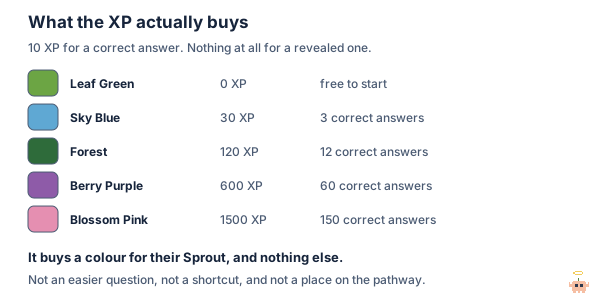
A revealed answer earns nothing. XP is counted from correct attempts only, and a revealed answer is never recorded as correct, so a child who clicks through revealing everything finishes the session with the same XP they started with. That is deliberate, and it is the only part of the reward design we would defend on learning grounds rather than on attendance grounds.
What it does not buy: an easier question, a shortcut through a topic, a higher position on the pathway, or anything another child can see. There is no leaderboard. The thing that decides what comes next is a set of fixed rules about right and wrong answers, and XP is not one of its inputs.
Being honest about what points do
We are not going to tell you that a hat teaches fractions. What a reward system buys is attendance, and only for a while. It gets a reluctant child through the first fortnight, which matters, because the thing that has to happen before anything else is that practice happens at all.
What it does not do is create interest in the subject. A child who is only there for the colours stops when the colours run out, and there are a finite number of colours. If nothing else has changed by then, you are back where you started with a better-dressed cartoon.
So treat it as scaffolding rather than motivation. The things that actually change whether a child will do maths are duller and slower: getting the difficulty right so it is not humiliating, making the session short enough to finish, and an adult being nearby and interested.
What actually gets it done at home
- Make it shorter than you think. Ten questions, or fifteen minutes, with a visible end. Most refusal is a negotiation about how long this is going to last, and removing the ambiguity removes most of the negotiation.
- Same time, same place, every day. A habit survives a bad mood; a decision does not. This is the single highest-return change and it costs nothing.
- Check the level before you check the attitude. A child refusing work that is two years too hard is behaving sensibly. Working below the Year level is common and it is not a verdict.
- Be in the room. Not marking, not hovering. Present. Every study of AI tutoring that found a durable gain had an adult who could see the work, and the same is true of a worksheet.
- Never use it as a punishment. Extra maths for bad behaviour teaches exactly one thing, and it is not maths.
- Let them choose something real. Which subject, which theme, which time. A genuine choice of any kind changes the dynamic more than points do, because the resistance is usually about control rather than about fractions.
If the refusal is bigger than this page
Persistent, distressed refusal is not a motivation problem and no reward system will touch it. It is usually one of three things: the work is far too hard, something about school has gone wrong, or there is an unidentified difficulty underneath. The page on re-engaging a reluctant learner goes further, and a conversation with the classroom teacher is worth more than any app.
The short version
Practice fails because it does not happen, and a chatbot loses this fight by design: when a child is refusing, its one move is to answer, which removes the friction that was the point.
Sprout Tutor’s answer is three plain mechanisms. A sitting is ten questions with a visible end. One theme, chosen by the child, changing the wrapper and not the curriculum code. And XP at ten per correct answer, nothing for a revealed one, which buys colours for a cartoon sprout and buys nothing else: no easier questions, no shortcuts, no leaderboard.
Points buy attendance for a fortnight. They do not buy interest, and there are a finite number of colours. What actually works is shorter sessions with a visible end, the same time every day, the right difficulty, and an adult in the room.
Sprout Lessons builds curriculum-aligned lessons for Foundation to Year 10, around whatever your child is actually into. Start free.
Checked 24 September 2026 against the product code rather than marketing copy: ten questions per topic, four session themes applied as question flavour only, ten XP per correct answer and five per lesson opened, XP counted from correct attempts so a revealed answer earns none, and the unlock costs shown in the figure. Sprout Tutor is in public beta, covers the Victorian Curriculum only for Years 1 to 9, and is free on every tier while in beta. The finding about unrestricted AI access is Bastani et al., PNAS, 2025, covered with its caveats on our does a smarter AI make a better tutor page. This page makes no claim that reward design improves learning, because we do not think the evidence supports one.
FAQ
How do I get my child to do maths practice without a fight?
Make it shorter than you think, with a visible end, since most refusal is a negotiation about duration. Put it at the same time and place every day, because a habit survives a bad mood and a decision does not. Check that the difficulty is right before you interpret the refusal. Be in the room without hovering. Offer a genuine choice about subject, theme or time. And never use extra maths as a punishment.
Do points and rewards actually make children learn more?
We would not claim so. What a reward system buys is attendance, and only for a while, which matters because practice happening at all is the precondition for everything else. It does not create interest in the subject: a child who is only there for the unlockables stops when the unlockables run out, and there is a finite number of them. Treat it as scaffolding rather than motivation.
What does XP buy in Sprout Tutor?
Colours and accessories for the child’s Sprout avatar, and nothing else. Ten XP for a correct answer and five for opening a lesson. Sky Blue costs 30 XP, which is three correct answers; Forest 120; Berry Purple 600; Blossom Pink 1500, which is 150 correct answers. It does not buy an easier question, a shortcut through a topic, a higher position on the pathway, or anything another child can see, and there is no leaderboard.
Can my child earn rewards by revealing the answer?
No. XP is counted from correct attempts only, and a revealed answer is never recorded as correct, so a child who clicks through revealing everything finishes with the XP they started with. That is the one part of the reward design defensible on learning grounds rather than attendance grounds.
Does the theme change the maths?
No. There are four themes, Classic, Footy, Netball and Animals, chosen by the child at the start of a session, and the theme is the only personalisation applied for that whole session. It changes the wrapper on the question, not the content: the curriculum code is identical whichever one they pick.
What if the refusal is more than reluctance?
Persistent, distressed refusal is not a motivation problem and no reward system will touch it. It is usually one of three things: work that is far too hard, something that has gone wrong at school, or an unidentified learning difficulty underneath. A conversation with the classroom teacher is worth more than any app.