
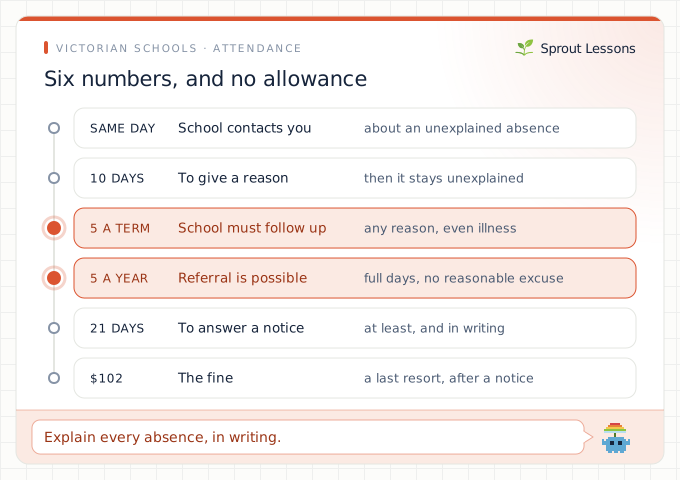
There is no number of days your child is allowed to miss in Victoria. Every absence needs an explanation, and the principal decides whether each one is reasonable. The numbers that do exist all point the other way. A school must follow up once a child has missed more than 5 days in a term, for any reason. Five full days in 12 months without a reasonable explanation is the legal minimum before a School Attendance Notice can be sent. And the fine at the very end of the process is currently $102.
Most parents never get near the far end of that. But the rules decide ordinary things too: whether a term-time holiday gets approved, why the school texts you at 9.30, what “unexplained” on a report means, and when the school has to offer help rather than a warning. This page walks through them in the order you would meet them.
The short version
| The question | The rule in Victoria |
|---|---|
| Who has to attend? | Every child aged 6 to 17, every day the school is open, unless an exemption is in place |
| How many days off are allowed? | None as of right. Each absence needs an explanation the principal accepts |
| When must I tell the school? | On the day, or in advance where you can. If you do not, the school must contact you the same day |
| When does the school have to act? | More than 5 days absent in a term, for any reason, including approved illness |
| When can it go to the Department? | At least 5 full days in the previous 12 months without a reasonable explanation, and only after the school has tried to help |
| What is the fine? | $102 at the time of writing (half a penalty unit), described by the Department as a last resort |
These rules apply to every registered school in Victoria: government, Catholic and independent. The details below come from the Department of Education’s attendance policy and guidance, which government schools must follow and non-government schools are advised to.
Why “how many days” is the wrong question
Parents search for the allowance because other systems have one: sick leave at work, a percentage for a university subject, 80% for an international student visa. Victorian school law does not work that way for local students. The Education and Training Reform Act makes you responsible for your child attending at all times when the school is open for instruction. The Department’s own page for parents puts it bluntly: there is no good number of days for missing school.
So the system does not count days against a quota. It sorts each absence into one of three boxes:
- Approved (your school may call it “excused”): you gave a reason and the principal accepted it as reasonable.
- Unapproved (“unexcused”): you gave a reason and the principal did not accept it. The school must tell you in writing.
- Unexplained: nobody gave a reason. If the school has confirmed your child is safe but still has no explanation after 10 school days, it stays recorded as unexplained and is noted on your child’s file.
Only the last two can ever lead to a notice. A child with fifteen approved sick days and a child with five unexplained days are in completely different positions, even though the first one has missed three times as much school.
What counts as a reasonable explanation
The principal has discretion, but the guidance tells principals what they are generally expected to approve:
- medical and dental appointments that cannot reasonably be made out of hours
- bereavement, or the funeral of a relative or friend, including Sorry Business
- school refusal, if a plan is in place with you to address the causes
- cultural observance, if you tell the school in advance
- family holidays, if you tell the school in advance and your child completes the Student Absence Learning Plan the school agrees with you
And what they are generally not expected to approve:
- an absence where approval was not sought in advance, or not in the way the school’s policy asks
- leisure or social activities without approval (the guidance’s examples include shopping and birthdays)
- an absence where the conditions were not met, such as a holiday learning plan that was not completed
- an absence with no explanation at all
Illness is approved as a matter of course. The Department does not require medical certificates, but many schools ask for one after an extended absence, so check your school’s attendance policy. The Department also asks parents to avoid “wellbeing days”: its advice is that a day at home feels like relief but makes the return harder.
One detail that surprises parents of teenagers: truancy can be a reasonable explanation for you. If your child left for school and did not arrive, and it was their decision and not your fault, the principal can accept that, after considering your child’s age, their previous attendance and how much control you realistically have. It is still an absence the school has to follow up. It is just not one that counts against you.
Taking a holiday in term time
This is the most common version of the question, so here is what the guidance actually requires. There is no ban, and there is no automatic approval.
- Ask before you book, in writing. A holiday that was not discussed in advance is on the “not expected to approve” list. The principal can weigh the length of the trip, the time of year, your child’s age, whether you have asked before, and your family’s circumstances.
- Expect a Student Absence Learning Plan. The guidance says one must be developed for a student planning an extended absence, written together by the teacher, you and your child. It sets out what your child will do while away.
- Do the plan. Approval is conditional on it. A plan that comes back untouched turns an approved absence into an unapproved one.
- If the school says no and you go anyway, the days are recorded as unapproved, and the Department’s page for parents says the matter may be referred to a school attendance officer. A two-week trip is ten school days, double the five-day minimum for a referral.
In practice, a principal is far more likely to approve one week tacked onto a school holiday in Year 3 than two weeks in the middle of Term 3 in Year 9. If you have a choice, the 2027 term dates are the place to start.
What the school has to do, and when
The obligations run in both directions, and it helps to know the school’s half.
- Mark the roll twice a day in primary school and in every class in secondary school. A child counts as present for a half day once they have attended at least two hours of instruction, which is why a late arrival after a dentist visit usually still counts.
- Contact you the same day about an unexplained absence, as soon as practicable. That is the text message. If the school cannot reach you, it must try your emergency contacts, so keep them current.
- Write down the reason you give for every absence, and whether it was accepted.
- Follow up once your child has been absent more than 5 days in a term for any reason. The guidance says this applies “even for parent approved health-related absences”, because five days in a term means attendance has fallen below 90%. This follow-up is support, not enforcement: a conversation about what is behind the absences and what the school can do.
- Report its attendance rate to the school community at least once a year.
If the absences continue, the guidance sets out what the school can offer before anything formal: a meeting that is meant to “feel supportive rather than disciplinary”, an Attendance Support Plan with a target and a named staff member, a Student Support Group, an Individual Education Plan where the cause is the learning itself, a referral to a wellbeing professional, or a re-engagement program. Schools are told not to pile these up: one strategy at a time, reviewed before the next.
Catching up after time away is mostly a maths problem, because maths is the subject where a missed week leaves a hole the next week stands on. Sprout builds short lessons at the exact Victorian Curriculum level your child missed. Start free.
The formal steps, from referral to fine
Here is the whole enforcement path. Notice how many exits it has.
- The principal decides whether to refer. The minimum is at least 5 full days absent in the previous 12 months without a reasonable explanation, attendance measures that have been tried and failed (or are inappropriate), and one identifiable parent to address the notice to. The principal must also have explored the reasons, consulted any Student Support Group, and tried to phone you first. A principal does not have to refer even when all of that is met.
- A School Attendance Officer reviews it. These are the Department’s regional directors. They can send the referral back for more information.
- A School Attendance Notice arrives. It lists the dates and asks you to explain. You get a response date that is at least 21 days after the notice was issued. Notices are available in Vietnamese, Arabic, Cantonese, Turkish and Mandarin.
- You respond. If the officer accepts your explanation, you get a letter confirming you have met your obligations, and the school is told to correct the record. You can also say you were not the parent responsible on some or all of those days.
- If you do not respond, or the explanation is not accepted, the officer chooses between no further action, an official warning, or an Infringement Notice. An official warning is the stated response for a first failure where your circumstances suggest a good reason.
- The fine. The Department’s page for parents gives it as $102, half a penalty unit, and the value changes each financial year. You can ask for an internal review. Court is possible but must be referred to the Department’s central office for a decision.
When the officer must not fine you
The guidance tells officers that a fine or court “must be an action only of last resort”, and that they must not issue an Infringement Notice where it would likely be withdrawn on review. The grounds are worth knowing because they are the same ones you would raise in your response to a notice:
- Special circumstances under the Infringements Act: a mental or intellectual disability or illness, a serious addiction, homelessness, or family violence, where it left you unable to understand or control what happened.
- Exceptional circumstances: a good explanation that falls short of those, including a genuine attempt to comply or reasons beyond your control. The guidance’s example is a parent or family member who was ill or away during the response period.
- A mistake: the wrong person, or a decision that did not follow the law.
- You never received the notice.
The practical point: answer the notice. Under the guidance, not responding within the time is itself the offence, and almost every route to no fine runs through a written reply.
If your child will not go
School refusal is on the list of absences a principal is expected to approve, with one condition: a plan is in place with you to address the causes. That changes what you should do on the first bad week.
- Tell the school it is refusal, in those words, in writing. A string of “sick” days hides the pattern and delays the plan.
- Ask for the meeting and for an Attendance Support Plan. The template covers the work missed, the timetable, a named staff member to go to, a target, and what happens on a day your child does not come.
- Ask what is behind it. The Department’s list for parents includes bullying, feeling isolated, and “falling behind in school work or feeling overwhelmed about keeping up”. If it is the last one, the fix is academic, and an Individual Education Plan is the tool the guidance names.
- If your child has a disability, the school may need to make reasonable adjustments for full-time attendance to be possible, and you can also speak to the disability coordinator at the Department’s regional office.
If the gap is already there, our pages on catching up after falling behind and working out whether your child is behind in maths start from where they are, not from the year on the classroom door.
Part-time, exemptions and leaving school
- A reduced timetable needs an exemption. A principal or regional director can approve attendance at less than full time in writing. With an exemption, a child who attends the four days they are expected to has 100% attendance. Without one, the same child is recorded at 80%.
- Camps, excursions and re-engagement programs count as attendance.
- Home schooling is a legal alternative, through registration with the VRQA, and a home-schooled child can attend a school part time by agreement. See how to register for home schooling in Victoria and how partial enrolment works. Do not simply stop sending your child: if a school loses contact for 10 consecutive school days and cannot find where the student has gone, it can refer the matter.
What a week away actually costs, and how to get it back
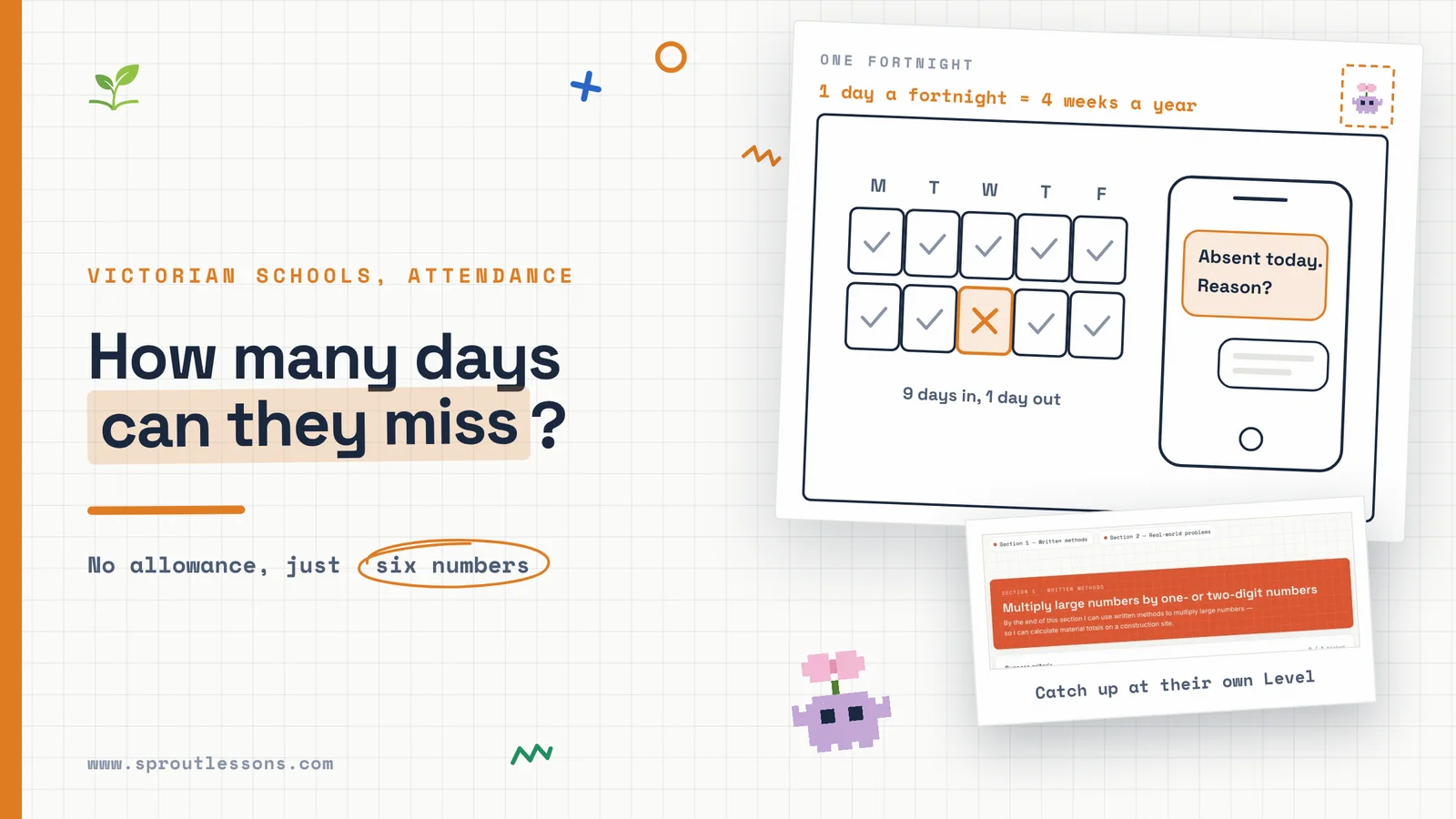
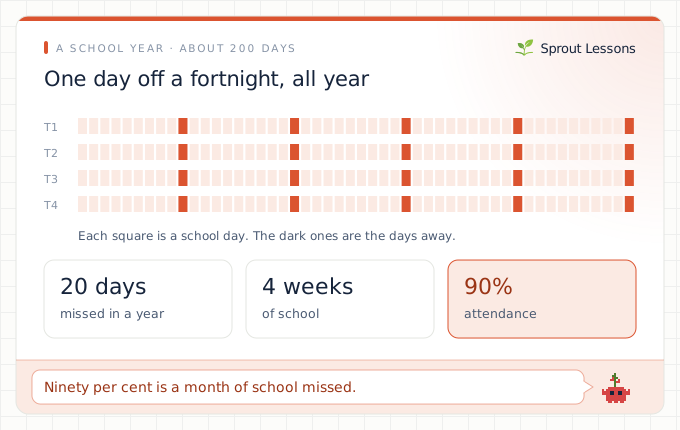
The Department’s figure is that one day a fortnight adds up to four whole weeks of school a year. Carry that on with our own arithmetic, on a school year of about 200 days: that is 20 days a year, or 90% attendance, and across Prep to Year 10 it comes to about 220 days, more than one full school year.
The cost is not spread evenly across subjects. A week of English is mostly practice your child would have had anyway. A week of maths can be the week the class met equivalent fractions or the area model, and the following weeks assume it. So when your child has been away, ask the teacher one question: “What was introduced that week that the rest of the term builds on?”
A twenty-minute routine for the first week back:
- Five minutes: find the hole. Ask your child to show you one question from this week’s work they could not start. That is usually the missed idea.
- Ten minutes: teach that one idea, with objects or a drawing before the written method. The by-year guides for fractions and multiplication and division show what each year expects.
- Five minutes: three questions on it, then stop. Repeat on the next two nights with new questions on the same idea.
More on running that routine without it turning into a fight is in helping with maths at home without a tutor.
Sprout Lessons makes that ten-minute lesson for you: one idea, at your child’s Victorian Curriculum level, wrapped in something they like, with the curriculum code on the page so you can show the teacher exactly what was covered. Start free.
Checked against the current rules as at 15 November 2026: the Department of Education’s Attendance policy (policy last updated 25 January 2026, page updated 8 October 2026) and its School attendance guidance, and the Attendance and missing school page for parents on vic.gov.au (updated 29 October 2026), which is the source of the $102 figure. Your school’s own attendance policy sets the local detail, such as how to report an absence and when a medical certificate is asked for. This is general information, not legal advice.
FAQ
How many days of school can a child miss in Victoria?
There is no allowed number. Under the Education and Training Reform Act a parent must make sure a child aged 6 to 17 attends whenever the school is open, and must explain every absence. The principal decides whether each explanation is reasonable. A school must follow up once a child has missed more than 5 days in a term for any reason, and at least 5 full days in 12 months without a reasonable explanation is the minimum before a School Attendance Notice can be sent.
Can I take my child out of school for a holiday in Victoria?
Only with the principal’s approval. The Department of Education’s guidance says principals are generally expected to approve a family holiday where the parent notifies the school in advance and the student completes the Student Absence Learning Plan agreed with the school. If the school does not approve it and you go anyway, the days are recorded as unapproved and the matter may be referred to a school attendance officer.
What is the fine for not sending a child to school in Victoria?
The Department of Education gives it as $102, which is half a penalty unit; the value changes each financial year. It can only follow a School Attendance Notice that was not answered or not answered with a reasonable explanation, and the guidance describes a fine or court as an action of last resort. An officer can instead take no action or send an official warning.
What is a School Attendance Notice?
A notice from a School Attendance Officer, who is a regional director of the Department of Education, listing a child’s absences and asking the parent to explain them. It can be sent only after a principal’s referral, where the child has missed at least 5 full days in the previous 12 months without a reasonable explanation and the school’s attempts to improve attendance have not worked. The parent has at least 21 days to respond.
Is school refusal an approved absence in Victoria?
It can be. The Department’s guidance lists school refusal among the absences a principal is generally expected to approve, if a plan is in place with the parent to address the causes. Tell the school in writing that it is refusal, ask for a meeting, and ask for an Attendance Support Plan or, where the cause is the learning itself, an Individual Education Plan.