
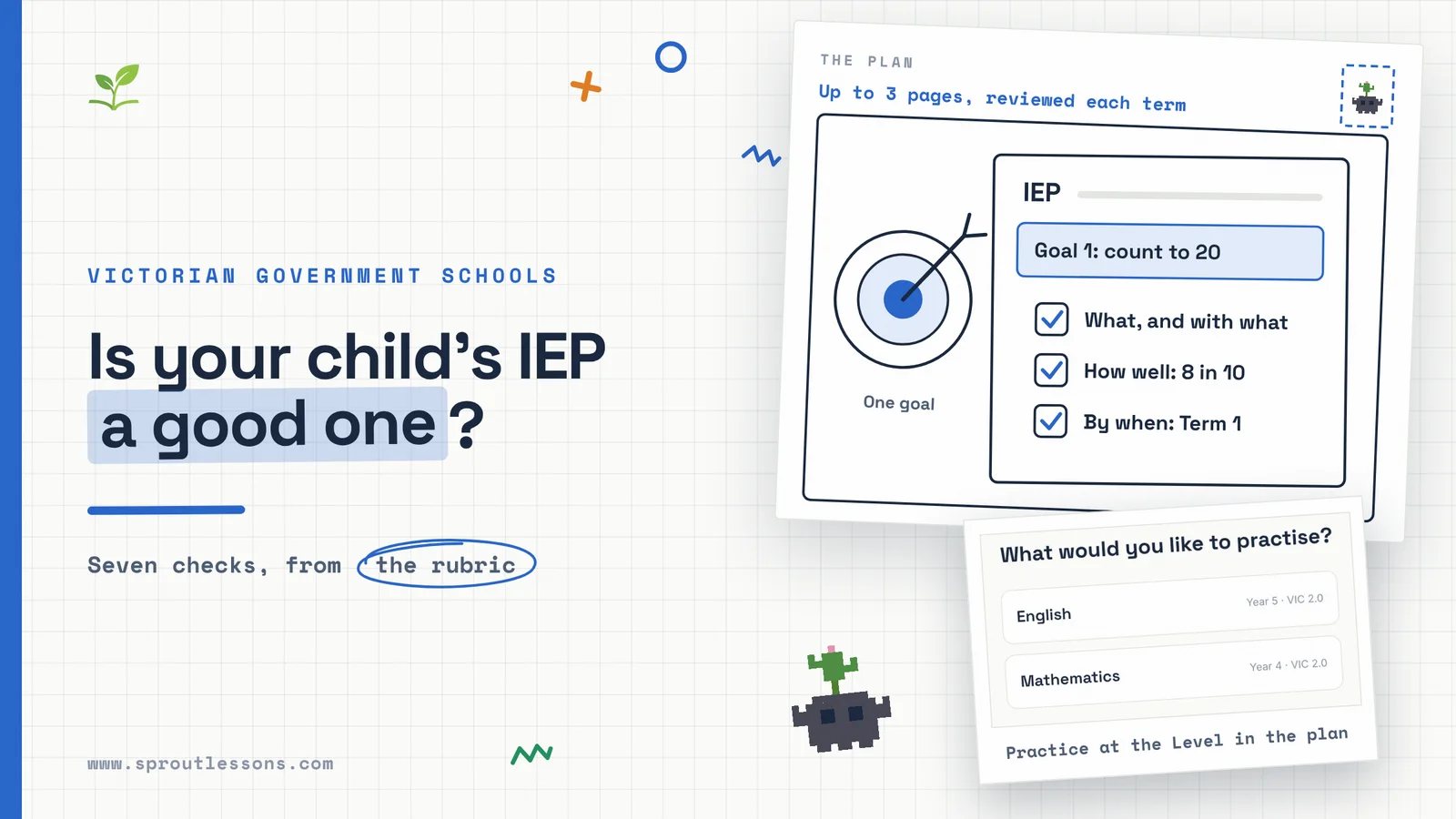
An Individual Education Plan (IEP) in a Victorian government school is a written plan of up to three pages that sets your child’s goals for the term, the adjustments and teaching that will get them there, and who is responsible for each part. It is written by a Student Support Group, and you are a member of that group. It is required for six groups of students, any other child can have one at the school’s discretion, and it should be reviewed about once a term.
The Department of Education also publishes a seven-point checklist that schools use to judge whether an IEP is any good. It was written for teachers, not parents. This page walks through what the plan contains, what happens at the meeting, and how to read your child’s IEP against that checklist, because a plan that says “improve maths” and a plan that says what, how and by when are not the same document.
What an IEP is, in the Department’s words and in plain ones
The policy defines an IEP as a written statement, up to three pages long, that describes “the goals, adjustments and strategies to meet a student’s individual educational needs”. It should hold only what matters for the period it covers, usually one term. Your school may call it an individual learning plan (ILP), an individual learning improvement plan or a Koorie education learning plan. They are the same thing.
Three points about what it is not:
- It is not a diagnosis or a funding decision. Funding for students with disability is decided through the Disability Inclusion Profile. The IEP, the meeting minutes and evidence of progress against IEP goals are used as supporting information for that profile, so a good IEP helps there too.
- It is not a different curriculum. Goals are written with reference to the Victorian Curriculum. A child may be working at a different level from their classmates, which the school report shows separately (see working at a different level).
- It is not only for children with a disability. The plan is for any student who needs a range of supports with their education.
Who must have one, and who can ask
In Victorian government schools an IEP is required for:
- students supported under individualised disability funding (Disability Inclusion or the Program for Students with Disabilities)
- students in statutory out-of-home care
- Koorie students, under the Marrung First Nations education strategy
- students in youth justice, in custody or in the community
- students in re-engagement programs run under contract with another school or provider
- students undertaking Flexible Learning Options
Outside those groups the policy is short: “If other students in addition to the required cohorts would benefit from an IEP, schools have discretion to create them.” That is your opening if your child has a learning difficulty without funding, is well behind in one subject, has missed a lot of school, or is well ahead and coasting. Ask in writing, name the subject, and say what you are seeing at home.
Separately, every school has an obligation under the Disability Standards for Education 2005 to make reasonable adjustments for a student with disability whether or not the student attracts any funding, and to consult you about those adjustments. That is Commonwealth law and it covers Catholic and independent schools too. The IEP policy itself is a government school policy; non-government schools run their own versions of the same process.
What is physically on the page
The Department’s template follows four stages. A school can use its own template, but it is expected to contain the same parts.
| Stage | What is written there | What to look for |
|---|---|---|
| 1. Assess | Strengths and interests, barriers to learning, and current skill levels, with any assessment results or professional advice | A starting point specific enough to measure from |
| 2. Plan | A long-term goal of one or two sentences, then short-term goals set out in four columns: the action, the conditions, the success measure, and by when | Every short-term goal filled in across all four columns |
| 3. Teach | The teaching strategies, adjustments and supports for each goal, and the person responsible | A name against each line, including yours where home is part of it |
| 4. Evaluate | The review date, what the evidence shows, and the decision for next time | A date, not “ongoing” |
The template also carries the list of Student Support Group members, a tick box for “student consulted” and one for “parent/carer consulted”, the principal’s signature, and the date of the next meeting. If the parent box is ticked and nobody spoke to you, say so.
The goal is the whole plan
Short-term goals are meant to be SMART, and the Department’s version of the acronym is worth reading closely: Specific, Measurable, Agreed, Relevant and Time-bound. The A is not “achievable”. It asks whether the team, “including student and family”, agrees on the goal, and the guide tells the school to specify what involvement the student had in developing it.
The Department’s IEP guide gives worked examples. Two of them:
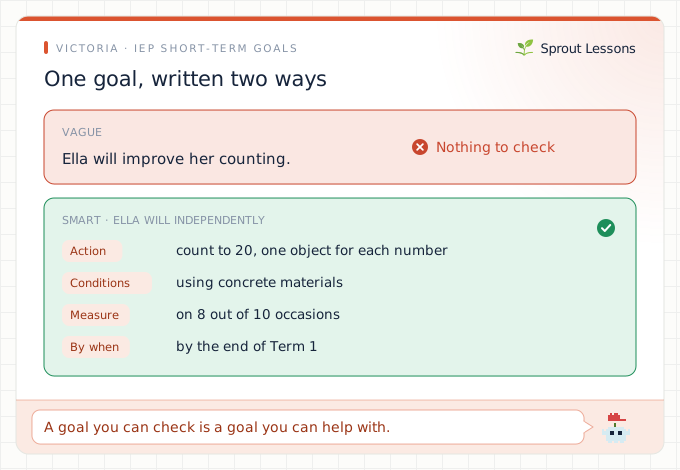
- Ella “will independently count to 20 with one-to-one correspondence”, “using concrete materials”, “on 8 out of 10 occasions”, “by the end of Term 1”.
- Jamal “will independently compare the literary style of four authors”, “in English, using his laptop to access different types of texts about a topic of interest”; “he will complete a compare and contrast checklist to 80% accuracy”, “by the end of the four-week unit”.
Notice what those have that “Ella will improve her number skills” does not. You could watch Ella count 20 blocks tonight and know whether she is there yet. That is the test to apply to every goal on your child’s plan: could I check this at the kitchen table?
The seven checks: reading the IEP like the Department does
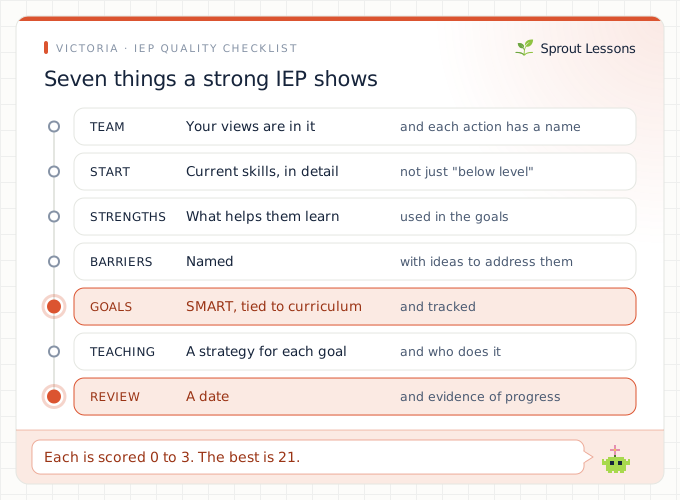
The Department’s IEP quality checklist scores a plan on seven indicators, each from 0 to 3, for a total out of 21. It was written for schools to check their own work. Here is what the lowest and highest scores look like for each, in plain words.
| Indicator | A weak plan (0 or 1) | A strong plan (3) |
|---|---|---|
| 1. A shared effort | No sign that anyone but the teacher had input | Reflects the views of others in the group, including your child where appropriate, and each action has a name against it |
| 2. Starting point | Current skills missing, or brief. The checklist’s own example of too brief is “below level” | Enough detail about current skills to write specific, measurable goals from |
| 3. Strengths | Strengths not recorded, or only listed | Your child has had a say in what helps them learn, and their strengths show up in the goals and strategies |
| 4. Barriers | Barriers to learning not addressed | Barriers named, with thoughtful suggestions for addressing them |
| 5. Goal design | Goals unclear, or present but not SMART | SMART goals clearly linked to the curriculum or a learning continuum, tracked, with long-term goals guiding the short-term ones |
| 6. Teaching and adjustments | No strategies, or general teaching practices | Strategies tailored to each short-term goal that use your child’s strengths |
| 7. Review | No plan to review, or only an implied one | An explicit review plan, and progress tracked with evidence from assessments or observations |
You do not need to hand the school a score. The use of the checklist is that it turns “I am not happy with the IEP” into a specific request: “Can we add his current reading level to the starting point?” or “Who is doing the daily counting practice, and when is it reviewed?”
Once the goal is specific, practice is easy to match to it. Sprout builds a short lesson on the exact Victorian Curriculum level in your child’s plan, in a topic they like. Start free.
The Student Support Group meeting
The Student Support Group (SSG) is responsible for developing and implementing the IEP. A school must set one up for every student with individualised disability funding and every student in out-of-home care, and the policy strongly encourages one for any student with diverse learning needs.
- The principal or their nominee sets up the group, chairs the meetings and makes sure notes are taken and provided to all members. For funded students, meetings must be held at least once a term.
- The teacher or year level coordinator reports on progress, helps set the goals and puts the classroom part of the plan into practice.
- You are there, in the policy’s words, to give a holistic view of your child, to say which past strategies worked, to contribute to the goals, and to choose an advocate if you want one.
- Your child should have an active, age-appropriate role, in person or through a trusted adult.
Other people can be invited where relevant: a speech pathologist, a psychologist, a Koorie Engagement Support Officer, education support staff.
How to prepare, in four steps
- Ask for the draft or the last IEP a few days ahead, along with the minutes of the previous meeting. You are entitled to the notes as a member of the group.
- Write down what you see at home that the school cannot: what your child can do with no help, what they avoid, and what has worked before. That is the “starting point” and “strengths” evidence the checklist asks for.
- Bring one goal of your own, written in the four columns: what, under what conditions, how well, by when.
- Before you leave, ask three things: who is responsible for each strategy, how progress will be recorded, and the date of the review.
How often it is reviewed, and what happens when a goal is missed
The plan is reviewed on the timeline the group agrees. For students with individualised disability funding and students in out-of-home care that must be at least once a term, and once a term is the recommendation for everyone else.
A missed goal is not a failure of the child. The guidance asks the group to work out what is and is not working and then decide whether the goal should be modified, taught in a different way or changed, and whether the strategies should continue, be revised or be replaced. If a goal has rolled over unchanged for three terms, that decision is not being made, and it is reasonable to ask why.
Timing matters at this time of year. A Term 4 review is the handover document for next year’s teacher. Ask that it record where your child actually finished, so that Term 1 does not start with a month of re-assessment. If your child is moving to secondary school, ask for the IEP to go with them: see starting Year 7 in Victoria.
When there are several plans
A child with complex needs may also have a behaviour support plan, a student health support plan, an attendance plan, a transition plan, a career action plan or a cultural support plan. The guidance says these should complement each other and be kept together “so there are no contradictory goals and the student is not overburdened”. If your child has three plans and fifteen goals, ask which three matter this term. Attendance is a common overlap: our page on the school attendance rules covers the Attendance Support Plan.
Using the IEP at home
The most useful thing a parent can do with an IEP is pick one short-term goal and practise exactly that, briefly and often. Ten minutes on the goal in the plan beats an hour of general homework.
- Copy the success measure. If the goal says 8 out of 10, do ten and count. Keep the tally on the fridge and bring it to the next meeting. It is evidence, and the seventh indicator asks for exactly that.
- Copy the conditions. If the goal says “using concrete materials”, use blocks or pasta, not a worksheet. If it says “with visual support”, ask the teacher for the same visual.
- Stay at the level in the plan. If the goal sits at Level 2 of the Victorian Curriculum and your child is in Year 5, practise Level 2. For children working before Foundation, see Foundation Levels A to D.
- Tell the teacher what you saw. One line by email is enough: “7 out of 10 on Tuesday, slips after 15.”
If you are not sure what the goal’s level means, the Victorian school report guide explains how levels and progress are shown.
Sprout Lessons makes that practice for you: tell it the level and the skill from the IEP, and it builds a short lesson in your child’s interests, with the Victorian Curriculum code on the page to show at the next meeting. Start free.
Checked against the current rules as at 15 November 2026: the Department of Education’s Individual Education Plans (IEPs) policy (last updated 6 February 2026), its guidance and resources (the IEP template, the 2026 Individual Education Planning guide and the IEP quality checklist rubric), and the Student Support Groups policy. The goal examples are quoted from the Individual Education Planning guide, © State of Victoria (Department of Education) 2026, used under a Creative Commons Attribution 4.0 International licence; the checklist descriptions are our paraphrase. The Department does not endorse this page. These are government school policies; Catholic and independent schools set their own. This is general information, not legal advice.
FAQ
What is an Individual Education Plan in Victoria?
The Department of Education defines an IEP as a written statement of up to three pages that describes the goals, adjustments and strategies to meet a student’s individual educational needs. It is developed by a Student Support Group that includes the parent or carer, covers a set period such as one term, and is also known as an individual learning plan.
Which students must have an IEP in a Victorian government school?
Six groups: students supported under individualised disability funding (Disability Inclusion or the Program for Students with Disabilities), students in statutory out-of-home care, Koorie students, students in youth justice, students in re-engagement programs under contract with another school or provider, and students undertaking Flexible Learning Options. Schools have discretion to create an IEP for any other student who would benefit.
Can I ask for an IEP if my child has no disability funding?
Yes, you can ask. The policy gives schools discretion to create an IEP for students outside the required groups, and a Student Support Group is strongly encouraged for any student with diverse learning needs. Separately, under the Disability Standards for Education 2005 every school must make reasonable adjustments for a student with disability and consult the parents, whether or not the student attracts funding.
How often should an IEP be reviewed?
On the timeline the Student Support Group agrees. It must be at least once a term for students supported under individualised disability funding and students in out-of-home care, and the Department recommends once a term for other students. At the review the group decides whether each goal has been met and whether goals or strategies should be changed.
What does a good IEP goal look like?
The Department asks for SMART short-term goals: Specific, Measurable, Agreed, Relevant and Time-bound, written as an action, the conditions, a success measure and a date. Its own example is a student who will independently count to 20 with one-to-one correspondence, using concrete materials, on 8 out of 10 occasions, by the end of Term 1.