
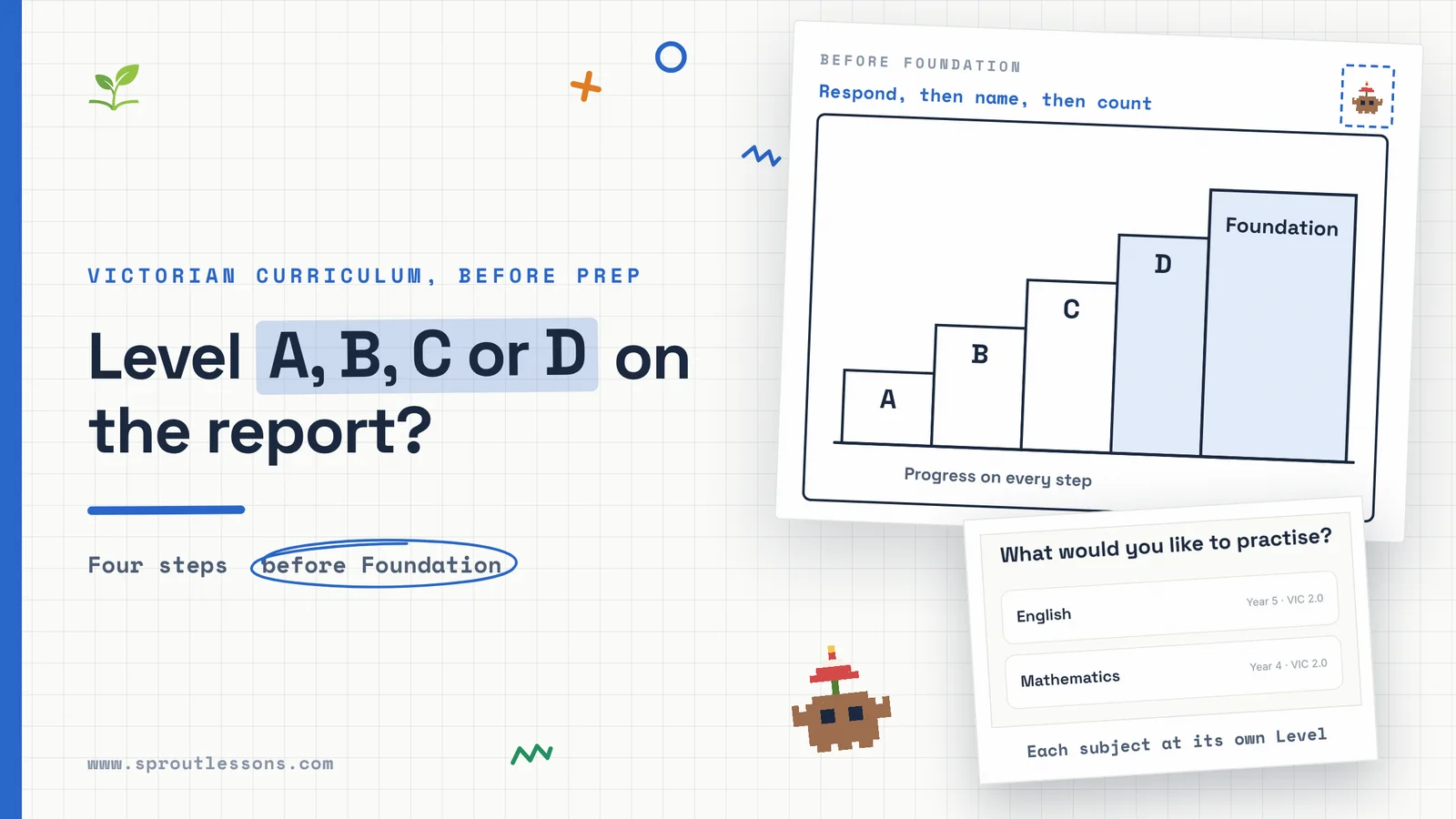
If your child’s Victorian school report says Level A, B, C or D, your child is working on the part of the Victorian Curriculum that comes before Foundation (Prep). These levels are written for students with intellectual or cognitive disability or learning delay, and they run in order: A is the earliest, D sits just below Foundation. From 1 January 2027 the old “Levels A to D (Towards Foundation)” are discontinued and replaced by “Foundation Levels A to D” in the version 2.0 curriculum, which schools started using for maths in 2026.
Victoria has had dedicated levels like these since 2011. What most parents are never shown is what each level actually asks a child to do, so a report that says “Level C” means very little at home. This page sets that out using the maths levels, explains what changes in 2027, how these levels appear on a report, and what practice at home can look like.
Where Levels A to D sit
The Victorian Curriculum is a ladder of Levels. For most children, Foundation is the Prep year, Level 1 is Year 1 and so on to Level 10 (our guide to the Victorian Curriculum explains that mapping). Levels A to D are four more rungs below Foundation. The VCAA describes them as being for a small percentage of students whose learning is well below the Foundation standards, most of whom have a significant intellectual disability.
Two things about them surprise parents:
- They are not tied to age. A 10-year-old in Year 5 can be learning at Level C in maths. The VCAA says the new levels are designed to be used with all learners, regardless of age or disability, and some students work within them for their whole schooling.
- A child can be at different levels in different subjects. Level B in maths and Foundation in Speaking and Listening is an ordinary pattern, the same way a child in Year 4 can be at Level 3 in one subject and Level 5 in another. Our page on working at a different level covers how that is handled.
What changes in 2027
The VCAA has published Foundation Levels A to D (shortened to FLA to FLD) for the version 2.0 curriculum. They replace the version 1.0 “Levels A to D (Towards Foundation)”, which are discontinued from 1 January 2027. The timing, from the VCAA’s announcement:
- Mathematics: Victorian schools began using Foundation Levels A to D in 2026.
- English, the Arts, Health and Physical Education, Critical and Creative Thinking, and Personal and Social Capability: full use is required in Victorian government schools from 2027. Some schools started English early.
- Catholic schools confirm their own timeline with their diocese.
Note what is on that list and what is not. In version 2.0, Foundation Levels A to D exist for those six curriculum areas only: four learning areas and two capabilities. The VCAA chose them because they are the foundation for learning everywhere else, and for balancing academic and everyday skills. Science, the humanities, Technologies and Languages have no levels below Foundation in version 2.0.
For a parent, the practical change is mostly the name, and the content behind it: the VCAA says it rewrote the content using current research, with input from teachers and allied health practitioners, so the knowledge and skills at each level are more clearly sequenced. If your child’s report used the old levels in 2026, expect the 2027 report to use the new ones.
What each level asks for, using maths
The clearest way to see the difference between the levels is the verbs. Here is the version 2.0 maths, level by level, paraphrased from the VCAA’s content descriptions (the codes are there so you can look each one up or quote it to the teacher).
Level A: responding
Every Level A maths description is about responding: to number names and numerals (VC2MFAN01), to a collection of objects changing (VC2MFAN02), to counting and comparing (VC2MFAN03), to adding, taking away and sharing in practical situations (VC2MFAN04, VC2MFAN05), to shapes and to movement in a familiar space (VC2MFASP01, VC2MFASP02), to the routine events of the school day (VC2MFAM01), and to actions that cause something to happen (VC2MFAA01).
A response can be small: turning towards the counting song, reaching for the bowl that just got more blocks, stilling when a routine changes. That is the evidence a teacher is looking for at Level A, and it is real maths. Noticing that a collection changed is where counting starts.
Level B: identifying “one” and “more”
Level B moves from responding to identifying and doing. A child identifies number names and numerals (VC2MFBN01), identifies and shows “one” and “more” (VC2MFBN02), compares two collections side by side to see which has more or whether they are different (VC2MFBN03), adds or takes away objects and says whether the total is more or different (VC2MFBN05), and shares objects equally in practical situations (VC2MFBN06). Measurement is “big” or “little” by direct comparison (VC2MFBM01, VC2MFBSP01), and the child starts and repeats actions that have an effect (VC2MFBA01).
Level C: naming numbers to 5
Level C is where counting with names arrives: saying number names in order to at least 5 (VC2MFCN01), recognising up to 3 objects at a glance without counting, which is called subitising (VC2MFCN02), and comparing collections to 5 using “more” and “less” (VC2MFCN03). Sharing becomes sharing between two (VC2MFCN06). Time becomes morning, afternoon and night-time (VC2MFCM02). Patterns are copied (VC2MFCA01). And data appears for the first time: comparing objects that answer a question with only two possible answers (VC2MFCST01). Levels A and B have no data description at all.
Level D: counting to 10
Level D doubles the range: naming, showing and ordering numbers from zero to at least 10 with objects and numerals (VC2MFDN01), subitising up to 4 (VC2MFDN02), counting to compare collections to 10 and explaining how (VC2MFDN03), and adding and taking away to 10, including simple money situations (VC2MFDN05). Routines are put in order with words like first and next (VC2MFDM02), and patterns are recognised, copied and continued (VC2MFDA01).
Then Foundation: counting to 20
Foundation doubles it again: numbers to at least 20 (VC2MFN01), subitising to 5 (VC2MFN02), and seeing a number as parts and a whole (VC2MFN04). The days of the week join the times of day (VC2MFM02). This is the Prep-year maths most children meet at five, and it is where Levels A to D lead.
How Levels A to D show up on a report
Victorian government schools must report achievement and progress every semester for every student, including students with disability. Your child’s report should name the level for each area, for example “Mathematics: Level C”. What sits next to the level can differ from a typical report, and the Department’s reporting guidance allows three things parents of children at these levels often meet:
- A different rating scale. Instead of the usual five-point scale that compares your child with what is expected for their age, a school can use a learning objectives met scale: Occasionally, Sometimes, Often, Usually, Consistently. “Often” means your child met most learning objectives in familiar tasks and needs some support in new situations. “Consistently” means almost all, without support. The Department’s own example is “English: Writing, Level A, Often”.
- A progress comment instead of a previous level. Specialist schools do not have to print last semester’s level. When they leave it off, the report must describe what your child has achieved this semester that they had not before.
- Levels left off, at your request. A specialist school may stop printing levels on a particular child’s report if you ask, and the child has not moved on the curriculum scale for 24 months. Teachers still record the levels, and you can ask for them at any time.
The Department also says an Individual Education Plan cannot replace the semester report, though goals from it can inform what the report says. It recommends setting curriculum goals that can realistically be reached in six months, which gives you a natural question for every Student Support Group meeting: which of last semester’s goals were met?
Progress within a level
One reason Levels A to D unsettle parents is that a child can sit at the same letter for a long time. The Department says so directly: students can make progress while working within or towards a level for a long period. Teachers who use the levels describe the same thing in practice: one specialist teacher describes a 10-year-old at Level C who took six months, with a communication aid, tactile numbers and a lot of repetition, to put the right number of objects beside each numeral to 5.
So the useful question is rarely “when will they move to Level D?” It is “which of the Level C descriptions can they do now that they could not last term?” The codes above let you ask that precisely.
Practice at home, level by level
These are ideas, not curriculum: short games that line up with the descriptions above, using things already in the house. Five minutes, often, beats a long session. If your child uses a communication device or signs, use it for the number words.
- Level A. Count out loud as you put grapes in a bowl, then pause before the last one and watch for a response. Add a block to a tower and say “more”. Sing the same counting song at the same moment of a routine, every day.
- Level B. Two plates of snacks, one clearly bigger: “which has more?” Hand over “one” spoon, then “more” spoons. Share crackers between two teddies, one for you, one for you.
- Level C. Roll a dice and name the dots for 1, 2 and 3 without counting. Line up five cars and count them together, pointing. Sort photos of the day into morning, afternoon and night.
- Level D. Count steps to the letterbox to 10. Shop with real coins and 10 items. Put three picture cards of a routine in order and say first, next and last.
Ask the teacher which descriptions are this semester’s goals, and practise those rather than the whole level.
Questions worth asking the teacher
- Which level is my child working at in each subject, and which version of the curriculum is the report using?
- Which content descriptions are this semester’s goals, and which did my child achieve last semester?
- Which rating scale does the report use, and what would “Usually” look like for my child?
- What can we practise at home that matches what you are doing at school?
If your child has a Disability Inclusion Profile, the level of adjustment it records and the curriculum level on the report are different things, and both are worth understanding. Our parent guide to the Disability Inclusion Profile covers the profile, including the new version from Term 1 2027, and the Victorian school report explained covers the rest of the report.
When your child reaches Foundation, Sprout builds short maths and English lessons on the exact Victorian Foundation code they are working on, set in something they love, and its tutor reads Foundation questions aloud. It does not cover Levels A to D, so for now it is the next step rather than this one. See how it works, free.
The short version
- Levels A to D come before Foundation in the Victorian Curriculum, for students with intellectual or cognitive disability or learning delay.
- From 1 January 2027 they are Foundation Levels A to D in version 2.0. Maths started in 2026.
- Version 2.0 has them for six areas only: English, Mathematics, the Arts, Health and PE, and two capabilities.
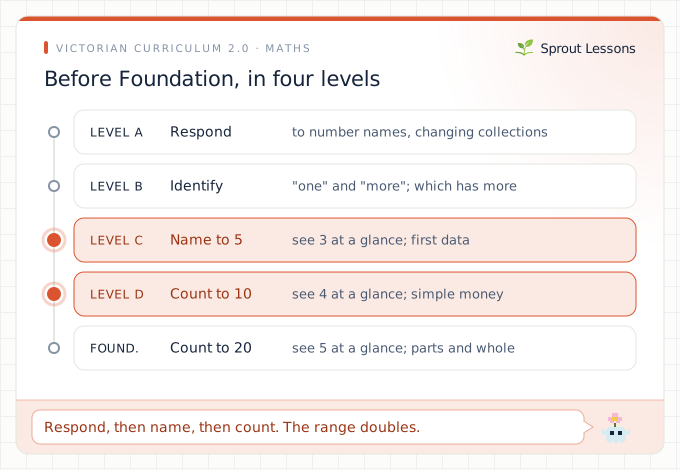
- In maths the verbs climb: respond (A), identify (B), name to 5 (C), count to 10 (D), then 20 at Foundation.
- Reports may use an Occasionally to Consistently scale, and a progress comment, instead of age comparisons.
- Progress happens within a level. Ask which descriptions your child can do now that they could not before.
How this page was checked
The 2027 change and the six curriculum areas come from the VCAA’s announcement, Updated Foundation Levels A to D to support inclusive teaching. The maths descriptions were read from the VCAA’s version 2.0 Mathematics curriculum (56 content descriptions from Foundation Level A to Foundation) and are paraphrased, not quoted. The reporting rules come from the Department of Education’s guidance on reporting for students with disability (updated 5 August 2026). The home practice ideas are ours. Checked as at 9 November 2026.
Curriculum codes reference the Victorian Curriculum F–10 Version 2.0 © VCAA. The curriculum can be accessed directly at f10.vcaa.vic.edu.au. The VCAA does not endorse this product. Always verify against the current content descriptions and achievement standards.
FAQ
What does Level A mean on a Victorian school report?
Level A is the earliest of four levels that sit before Foundation (Prep) in the Victorian Curriculum. They are written for students with intellectual or cognitive disability or learning delay and are not tied to age. In maths, every Level A description is about responding: to number names, to collections changing, to shapes and to the routines of the day.
What is changing with Levels A to D in 2027?
The version 1.0 Levels A to D (Towards Foundation) are discontinued from 1 January 2027 and replaced by Foundation Levels A to D in version 2.0. Schools began using them for maths in 2026, and they are required in Victorian government schools from 2027 for English, the Arts, Health and Physical Education, Critical and Creative Thinking, and Personal and Social Capability. Catholic schools follow their diocese.
Which subjects have Foundation Levels A to D?
In version 2.0, six curriculum areas: English, Mathematics, the Arts, Health and Physical Education, and the capabilities Critical and Creative Thinking, and Personal and Social Capability. The VCAA chose them as the areas that underpin learning across the curriculum and balance academic and everyday skills.
What is the difference between Level C and Level D in maths?
At Level C a child names numbers in order to at least 5, recognises up to 3 objects at a glance, compares collections to 5 and shares between two (VC2MFCN01 to VC2MFCN06). At Level D the range doubles: numbers from zero to at least 10, recognising up to 4 at a glance, and counting to compare and to add or take away to 10 (VC2MFDN01 to VC2MFDN06).
Why does my child’s report say Often or Usually instead of a level comparison?
The Department of Education lets schools use a learning objectives met scale for students with disability: Occasionally, Sometimes, Often, Usually and Consistently. Often means your child met most learning objectives in familiar tasks and needs some support in new situations; Consistently means almost all, without support. It replaces the comparison with what is expected for their age.