
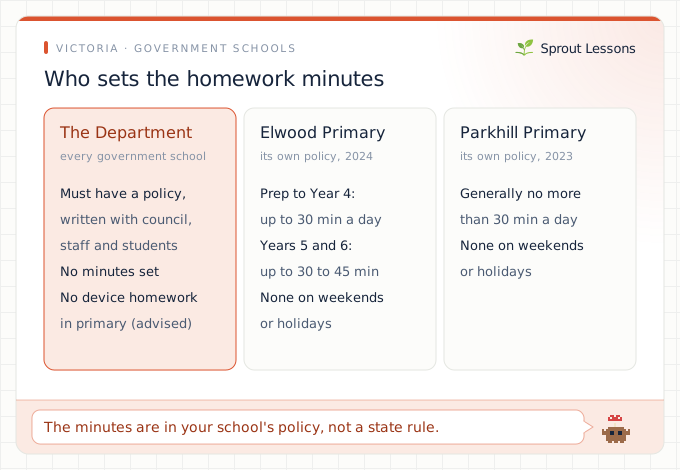
The Victorian Department of Education does not set how much homework your child should get. It requires every government school to have its own homework policy, developed with the school council, staff and students, and to tell families what it says. The content is the school’s call. The one firm line the Department adds is a strong recommendation that primary schools do not set homework that needs a digital device. So the answer to “how much homework is normal?” is in your school’s policy, not in a state rule, and the “30 minutes a night” figure you may have heard comes from older Department guidelines the current policy no longer contains.
That matters most when homework is causing a fight: too much, too little, too hard, or mostly on a tablet. This page sets out what the Department’s policy actually requires, what four real Victorian school policies do with that freedom, and what you can ask your child’s teacher, with the policy behind you.
What the Department’s homework policy requires
The Department’s homework policy in its Policy and Advisory Library applies to Victorian government schools. It is short, and almost all of it is about process rather than content:
- Every government school must have a homework policy and communicate it periodically to staff, parents, carers and students, for example in the newsletter or on the school website.
- The content is not prescribed. It should be evidence-informed and set out a rationale, plus what teachers, students and parents are each expected to do in setting, completing, monitoring and responding to homework.
- It must be developed in consultation with the school council (as the community’s representatives), staff and students. The council does not have to approve it.
- Primary schools are strongly recommended not to set homework that requires a digital device, because supervision at home varies and internet filters may not be in place. Families can still choose to use a device for homework themselves.
Homework is defined as tasks set by teachers to be done outside school hours. Reading a library book your child chose themselves is not homework under that definition; a reading log the teacher checks is.
The policy also lists when homework tends to work: it is pitched at the right level for each student (support for those who struggle, extension for those who are ahead), it relates to essential learning, the student has some choice in the task, the teacher assesses it formally or informally and gives feedback, and it leaves time for family, sport, recreation, culture and, for older students, a job. Those five conditions are the most useful thing in the document for a parent, because they describe what good homework looks like without naming a number of minutes.
One scope note: this is a Department policy, so it binds government schools. Catholic and independent schools set their own homework policies, usually on similar lines, and the place to find yours is the school website or the office.
Where the “30 minutes a day” comes from
Many Victorian parents have been told there is a state limit, often 30 minutes a day in the early years with more in Years 5 and 6. School policies attribute those figures to earlier Department guidelines, whose page has since been archived. The current policy, last updated on 15 June 2020, gives no times for any year level, and its guidance section says there is no further guidance on the topic.
The numbers survive in school policies instead. Elwood Primary School’s policy, amended in April 2024, still lists “DET Guidelines” of no more than 30 minutes a day for Prep to Year 4 and 30 to 45 minutes for Years 5 and 6, with nothing set for weekends or holidays. Parkhill Primary School’s policy says students are generally not expected to do more than 30 minutes a day, again with no homework over weekends or holidays. Both are legitimate choices under the current policy. They are the school’s numbers, though, not the state’s, and another school can choose differently.
Same template, different choices
The Department gives schools a template homework policy, and you can see it in the wording: Parkhill Primary in Melbourne’s east, Tallygaroopna Primary near Shepparton (reviewed 18 May 2026) and Pakenham Secondary College share whole paragraphs. That makes the places where they differ more telling.
- Unfinished classwork. Parkhill’s and Pakenham’s policies both say homework should be purposeful, which they define as not “busy work” and not finishing off work a student did not complete in class. Tallygaroopna’s lists completing unfinished classroom tasks among the kinds of homework its teachers may set. If your child keeps bringing home the worksheet the class ran out of time for, your school’s policy tells you whether that is intended.
- What counts. Tallygaroopna names reading for decoding, fluency and comprehension, maths consolidation, spelling practice, research for class topics, and family tasks such as rehearsing a presentation or interviewing a relative. Elwood makes reading an essential, regular task from Prep to Year 6, plus regular number sense and fluency practice.
- What parents are asked to do. In the three template-based policies the parent list starts the same way: keep a balance between homework and family, sport and cultural life, and talk to the teacher about concerns. The two primary versions add a quiet place to work and talking about homework in your home language if it is not English. Elwood’s own wording asks parents to give time and space and to encourage their child to take responsibility. None of the four asks you to do the homework, or to correct it before it goes back.
- Secondary is looser on time. Pakenham Secondary College’s policy sets no minutes at all; it asks teachers to keep the amount compatible with recreation, family and cultural life, and students to organise their time around sport and part-time work. The Victorian Government’s homework page for parents says homework gets harder and more frequent in secondary school, and suggests a 10 to 15 minute break for every hour of study.
Homework on a tablet in primary school
This is the part of the policy parents most often do not know about. The Department strongly recommends that primary schools do not set homework that requires a digital device. It is a recommendation, not a ban, and it is about what the school sets, not what your family chooses: you can still use an app or a laptop for practice if it suits your child.
So if your Year 2 child’s only homework is a login, it is fair to ask the teacher whether there is a paper alternative, and to quote the policy when you do. Many families are happy with app homework; the point is that you are allowed to ask, and that a school setting it as the only option is going against the Department’s advice.
When homework is too much, too little or too hard
The template that most schools use already gives you the opening line. It says that if a parent is concerned their child does not understand the homework, or is spending a long time on it, they should speak to the class teacher. That is the route, and it works best with specifics.
- Find the policy first. Check the school website (it is usually under policies or the parent handbook), or ask the office for a copy. Note any minutes it gives and whether it sets work on weekends or holidays.
- Time it for a week. Write down how long homework actually takes each night, and where the time goes. “Forty minutes, thirty of them on one maths sheet” is a conversation the teacher can act on; “it’s too much” is not.
- Say which problem it is. Too much time is a load question. Tears over a particular kind of task is usually a level question: the policy itself says homework should be set at the right level for each student, which is a reasonable thing to ask for. Bored and finished in five minutes is a level question too, the other way.
- Ask what the teacher does with it. The policy expects homework to be assessed, formally or informally, with feedback. If it comes back unmarked every week, ask how the teacher uses it.
If the struggle is with the work rather than the time, it often shows up on the report too. Our guide to the Victorian school report explains how to tell whether your child is working below the expected level, and the catch-up plan sets out what to do about it without a tutor.
If you want more practice than the school sets
Some schools set very little homework, by design. If you would like your child to do more, short and regular beats long and occasional: our page on helping with maths at home has a short routine of three 15 to 20 minute sessions a week, and over the summer break, when two of the four policies we read rule homework out altogether, this page on the summer slide covers how much practice is enough.
Want practice pitched at your child’s actual level? Sprout writes a maths or English lesson on the exact Victorian Curriculum code your child is working on, set in something they love, and it prints, so it works without a device. Try it free.
The short version
- There is no Victorian state limit on homework. Each government school sets its own policy.
- The school must write it with the school council, staff and students, and tell families what it says.
- Primary schools are strongly recommended not to set homework that needs a device.
- “30 minutes a day” is a figure from older guidelines that some school policies still use.
- Find your school’s policy, time a week of homework, and take the numbers to the teacher.
How this page was checked
The requirements come from the Department of Education’s homework policy in the Policy and Advisory Library (policy last updated 15 June 2020; page updated 27 July 2026) and the Victorian Government’s homework page for parents (updated 26 March 2026). The school examples come from the published homework policies of Elwood Primary School (amended April 2024), Parkhill Primary School (reviewed May 2023), Tallygaroopna Primary School (reviewed 18 May 2026) and Pakenham Secondary College (reviewed 21 March 2024), each read in full. They are examples, not a survey: schools review these policies every three to four years, so check your own school’s current version. Checked against the current rules as at 8 November 2026.
FAQ
How much homework should a primary school child get in Victoria?
The Victorian Department of Education does not set an amount. Every government school must have its own homework policy, and the minutes, if any, are in it. Some school policies set no more than 30 minutes a day in the early years, with no homework on weekends or holidays, but those are the school's numbers, not a state rule.
Do Victorian schools have to have a homework policy?
Yes. The Department's homework policy requires every government school to have one, developed in consultation with the school council, staff and students, and to communicate it periodically to families, for example on the school website or in the newsletter. The school council does not have to approve it. Catholic and independent schools set their own policies.
Can a primary school set homework on an iPad or laptop?
The Department strongly recommends that primary schools do not set homework that requires a digital device, because supervision and internet filtering at home vary. It is a recommendation rather than a ban, and families can still choose to use a device. If device homework is the only option offered, it is reasonable to ask the teacher for a paper alternative.
Is there a rule against homework on weekends in Victoria?
Not at state level. Some schools rule it out in their own policy: Elwood Primary and Parkhill Primary both set no homework on weekends or holidays. Check your school's policy, which it must make available to families.
What should I do if my child has too much homework?
Read the school's homework policy first, then time a week of homework and note where the time goes. Take the numbers to the class teacher and say whether the problem is the amount or the difficulty. The Department's policy says homework should be set at the right level for each student and leave time for family, sport and recreation.