
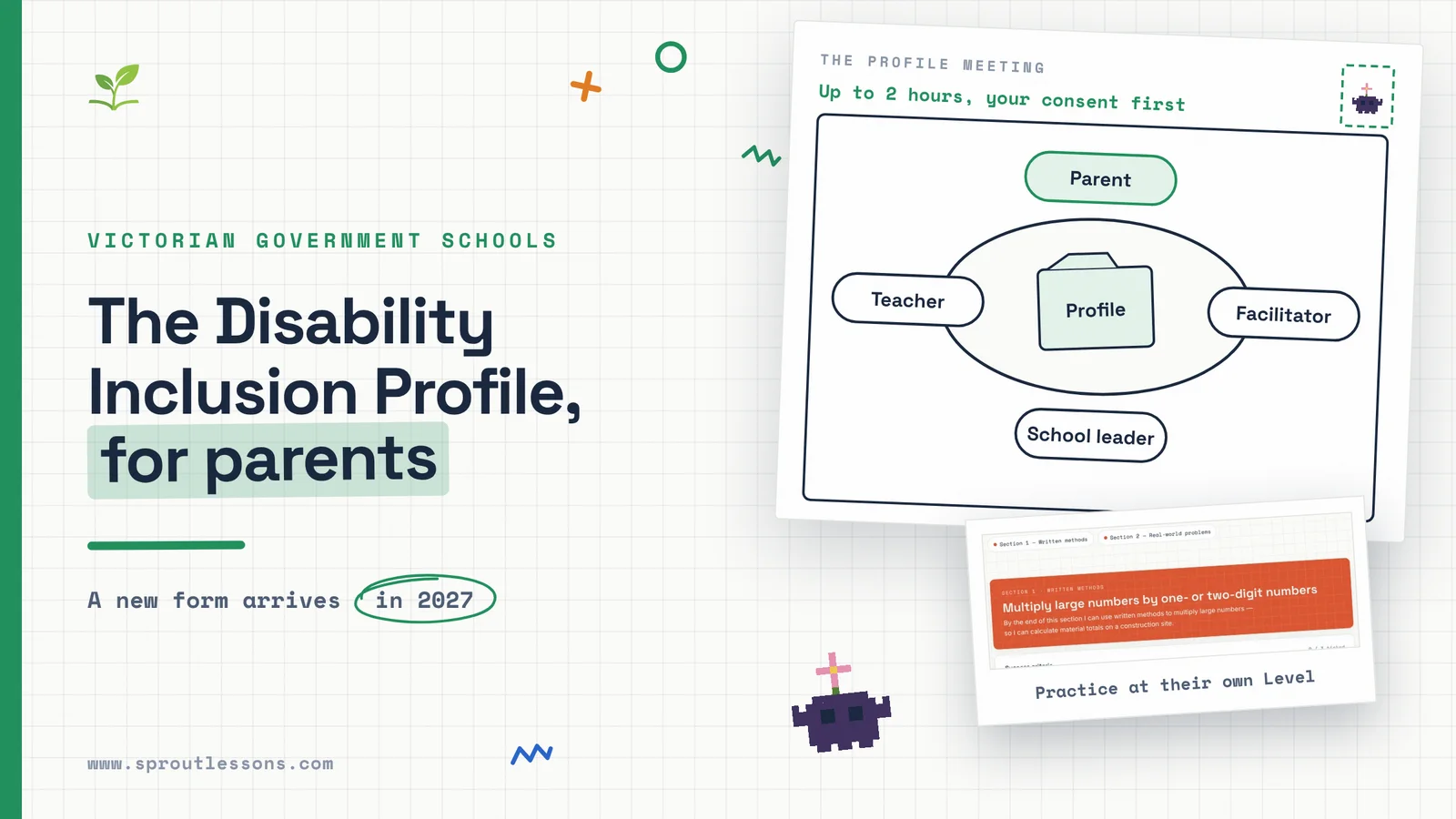
The Disability Inclusion Profile is a structured meeting, of up to two hours, where your child’s school, you and a trained facilitator work through what your child can do, what they need help with, and what the school is already doing to support them. It is voluntary and needs your written consent. The report it produces feeds into your child’s learning plan and decides whether the school gets extra funding for them. From Term 1 2027 the profile itself changes, from 31 activities in six areas to 26 activities in five, but the process and the funding threshold stay the same.
If the school has just suggested a profile, or you have heard the word at a Student Support Group meeting and nodded along, this page is the parent’s version: what happens, in order, what you can prepare, what the 2027 change means, and the questions worth asking. It applies to Victorian government schools, which is where the profile is used.
What the profile is, and what it is not
The Department of Education describes the profile as a strengths-based tool for detailing a student’s strengths, needs and the educational adjustments they need to take part at school. Three things follow from how it is designed, and they are the ones parents most often have wrong:
- It is not a diagnosis. Nobody assesses your child for a condition. The meeting talks about what your child does at school (following a routine, communicating, eating lunch, moving between classes) and what the school does to make each of those work.
- It is not only about money. The profile informs tier 3 student-level funding, but the Department says it is open to, and may help, a wider group of students than those who will qualify. The report is also meant to shape your child’s Individual Education Plan.
- Funding does not set the floor. Every Victorian school must make reasonable adjustments for every student with disability, under the Disability Standards for Education and state and federal discrimination law, whether or not a profile is done and whatever it finds. A profile that does not lead to funding does not end the school’s obligations.
The reform was rolled out to all Victorian government schools over five years, from 2021 to 2025, so every government school now uses it.
Who is in the room
The meeting is held with your child’s Student Support Group, the people who know your child and their schooling best, and it is run by a Disability Inclusion Facilitator. Facilitators are experienced allied health professionals or teachers trained in inclusive education, and they come from the Department’s facilitator service rather than your school.
- You. The Department calls parents and carers essential members of the meeting and strongly recommends it does not go ahead without you. You can attend by phone or video, and the school can give you a letter confirming the meeting, which may help with carer’s leave.
- Your child’s teacher and a school leader, usually the principal or their nominee.
- An advocate or support person, if you want one. You can nominate someone before the meeting; any extra attendee has to be agreed between you and the school.
- An interpreter, if you need one. Schools must offer interpreting to parents with limited English, and the Department publishes information about the profile in 33 community languages.
- Your child, in whatever way suits them: for part or all of the meeting, or through drawings, photos, a student voice template or a trusted adult who speaks for them.
What happens, in order
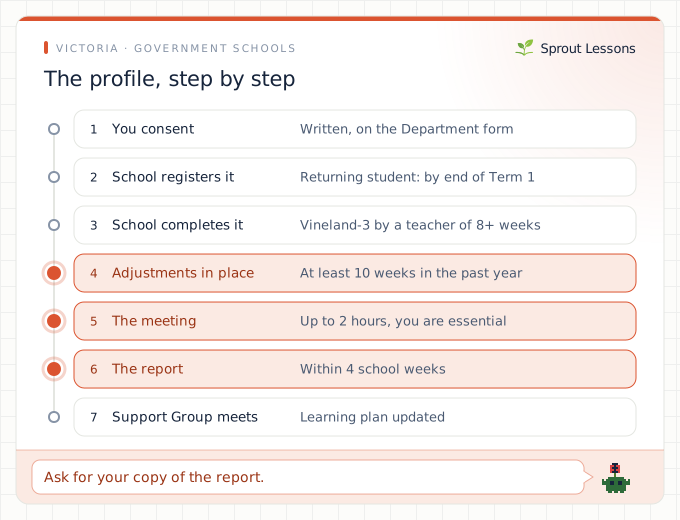
The Department’s guidance sets out each step, with times that are easy to miss in the detail. In order:
- Agreement and your consent. You and the Student Support Group agree to ask for a profile, and you sign the Department’s consent form. One signature is enough, though the school should try to get consent from every parent with decision-making responsibility. Without consent, there is no profile.
- The school registers the request with the Disability Inclusion Facilitator Service. Registration dates matter for funding. For a student already at the school last year and without current funding, the school must register by the school census date for funding from Term 1, and by the end of Term 1 for funding at all that year. For a new student starting at the beginning of the year, the dates are the end of Term 1 and the end of Term 2. If the profile is likely, ask the school to register early.
- The school completes the request. This includes your consent, the school’s evidence of the adjustments it is making, and a scored Vineland-3 (a rating of everyday adaptive skills) completed within the last 12 months by the teacher who knows your child best, who must have known them for at least eight weeks. A parent version of the Vineland-3 is used only in exceptional cases, such as a child who has been home schooled.
- The meeting is booked. For a child already at the school, the adjustments must have been in place for at least 10 weeks over the past 12 months before the meeting can happen. A child about to start school, from kinder for example, can have a profile at any time.
- The meeting, of up to two hours, in or just outside school hours. You talk through your child’s strengths, interests and goals, then each area of school life and the level of adjustment it takes.
- The report arrives within four school weeks of the meeting (or of any extra information the facilitator asked for), after a moderation check. The school should give you a copy as soon as it can and help you understand it.
- A Student Support Group meeting to discuss the report, ideally soon after, where the learning plan is updated. The Department highly recommends the school tells you the funding outcome at this meeting.
How to prepare, as a parent
The Department says parent preparation is encouraged but not required. You already know more about your child than anyone else in the room. A little preparation turns that knowledge into examples a facilitator can use, which is what actually moves a rating. Four things are worth doing:
- Use the parent voice tool. The Department publishes one for exactly this, plus Easy English guides to the process and the meeting. Ask the school for them if you have not been given them.
- Bring examples, not labels. “He has anxiety” tells the meeting little. “If the timetable changes without warning he cannot start work for the rest of the morning, and at home we use a picture schedule” tells it what the adjustment is and how much it takes.
- Ask the school what evidence it has sent. The facilitator can only consider information shared with the whole group, or documents they ask for after the meeting, and a finished profile cannot be reopened for evidence that turns up later. If the learning plan and Student Support Group minutes do not show what the school is really doing, say so before the meeting, not after.
- Help your child have a say. Drawing or photographing what helps them, or telling you what to say for them, all count as student voice.
If your child is working below the expected level in maths or English, it helps to know how that shows up on paper too. Our page on working at a different level of the Victorian Curriculum explains what the report’s Levels mean, and Foundation Levels A to D covers the levels before Foundation that some students with disability learn at.
What changes in 2027
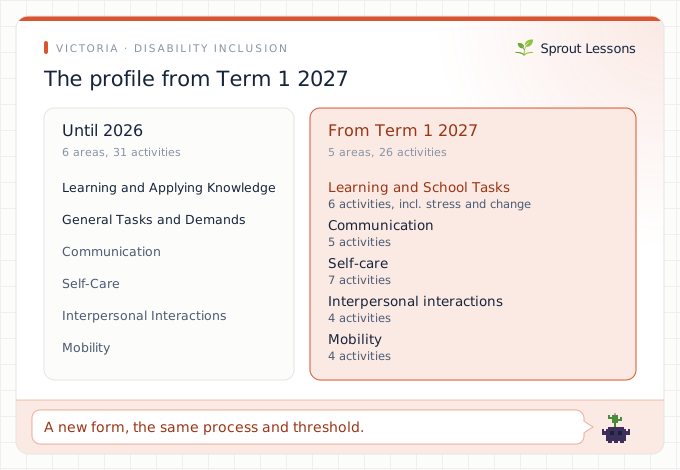
The Department has announced a revised profile from Term 1 2027, used for every profile meeting from then on. The change is to the tool, not the process:
- 26 activities in five areas, down from 31 in six. The two current areas Learning and Applying Knowledge and General Tasks and Demands are replaced by one, Learning and School Tasks, which covers watching, listening, engaging with the curriculum, tasks and routines, and, named separately, responding to stress and responding to change. Communication, Self-care, Interpersonal Interactions and Mobility stay as areas.
- Some activities are renamed or redefined. Self-care, for instance, now lists drinking, eating, dressing, toileting, washing, keeping healthy and keeping safe.
- A new guide for schools in Term 1 2027 will put more weight on how adjustments are carried out, rather than on lists of supporting documents.
What is not changing, according to the same guidance:
- The tier 3 funding eligibility threshold and the rules for checking it.
- The framework facilitators use to rate the level of adjustment.
- What the school has to show: how personalised, intense and frequent the adjustments are, in its own records of planning, carrying out and checking them.
- The school’s legal duty to make reasonable adjustments for every student with disability.
For a parent, the practical upshot is that a profile already done stays valid until its next date, and a profile in 2027 will ask about the same school life in slightly different headings. Stress and change get their own lines, which may make a child whose difficulties are mostly about routine and regulation easier to describe. The Department has also published an information sheet for parents about the 2027 changes; ask your school for it.
When the next profile happens
There is no fixed cycle. The report recommends when the next profile should be, and the Department’s guidance gives the usual shape:
- Generally no sooner than two years and no later than seven after the last one, except in exceptional circumstances.
- Many students have one when they start school, one in Year 3 or 4, and a final one as they start secondary school.
- Not usually in Years 5 or 6, or Years 11 or 12. Plan the Year 7 profile rather than squeezing one in at the end of primary.
- Sooner, if things change. A school can request one between two years and the recommended year if needs or settings change. Within two years it needs a meaningful change, a deteriorating medical condition or significant new adjustments, plus the disability coordinator’s advice.
- You must be consulted on any decision about a later profile.
If your child moves between Victorian government schools, the report and the funding notice go with them, and the new school decides with you whether a fresh profile is worth doing. A profile cannot be held once a child has left the government system, which matters if you are weighing home education in Victoria or an independent school.
If you disagree with the outcome
This is the part families are least often told. Only the principal can lodge an appeal, and only when the profile found the student not eligible for tier 3 funding. There are two grounds: a procedural problem in the process, or new and substantial information that existed at the time but was not considered. Supports put in place after the meeting do not count, and nor does a facilitator’s style.
- The appeal must be lodged within 15 school days of the school receiving the report.
- The school must talk to its disability coordinator first, and the Student Support Group has to agree to the appeal, so you will be part of that decision.
- Only one appeal per outcome, and it can take up to a term to finalise.
So if you think the outcome is wrong, raise it with the principal straight away. Three weeks of school days goes quickly, especially across the end of a term. If the issue is a factual error in the report rather than the funding outcome, the school can contact the Department to correct it.
Questions worth asking the school
- Can I have the parent voice tool and the Easy English guide before the meeting?
- What supporting information are you sending, and can I see the learning plan it relies on?
- Who will be at the meeting, and can I bring a support person?
- When will I get my copy of the report, and when is the Student Support Group meeting to discuss it?
- What changes in my child’s learning plan as a result, whatever the funding outcome?
The last one matters most. The profile is a snapshot. The adjustments in the learning plan, and whether they happen every day, are what your child actually feels.
Supporting learning at home as well? Sprout builds a short maths or English lesson on the exact Victorian Curriculum Level your child is working at, from Foundation up, set in something they love, so practice at home matches the plan rather than their year level. Try it free.
The short version
- The profile is a structured meeting about what your child does at school and what support it takes. It is not a diagnosis.
- It is voluntary, needs your consent, and you are an essential member of the meeting.
- It informs the learning plan and tier 3 funding, but the school must make reasonable adjustments regardless.
- From Term 1 2027: 26 activities in five areas instead of 31 in six. Same process, same funding threshold.
- Profiles usually happen at school entry, Year 3 or 4, and the start of secondary.
- Only the principal can appeal, within 15 school days, and only an ineligible outcome.
How this page was checked
Everything above comes from the Department of Education’s Disability Inclusion Profile policy (policy updated 27 October 2026) and its guidance chapters in the Policy and Advisory Library, each read in full: purpose of the meeting, registering and completing a request, scheduling, preparing, notification of the outcome, steps after notification, subsequent profiles, appeals (all updated 27 October 2026), and the changes to the profile in 2027 (updated 4 November 2026, which says further detail is due in mid-November 2026). It describes Victorian government schools only; Catholic and independent schools have their own processes. This is general information, not advice about your child: your school’s leadership and disability coordinator can tell you how it applies. Checked against the current guidance as at 9 November 2026.
FAQ
What is a Disability Inclusion Profile?
It is a structured meeting, of up to two hours, between a student’s Student Support Group (including parents) and a trained Disability Inclusion Facilitator, used in Victorian government schools. It records the student’s strengths, functional needs at school and the adjustments the school makes. The report informs the student’s learning plan and decides eligibility for tier 3 student-level funding. It is voluntary and needs parent consent.
What is changing in the Disability Inclusion Profile in 2027?
From Term 1 2027 the Department uses a revised profile for every meeting: 26 activities across five domains instead of 31 across six. Learning and Applying Knowledge and General Tasks and Demands are replaced by one domain, Learning and School Tasks, which names responding to stress and responding to change separately. The tier 3 funding threshold, the rating framework and the process stay the same.
Do parents have to attend the Disability Inclusion Profile meeting?
The Department calls parents and carers essential members of the meeting and strongly recommends it does not go ahead without them. You can attend by phone or video, bring an advocate agreed with the school, and ask for an interpreter. In exceptional circumstances you can nominate someone who knows your child well to attend in your place.
How often does a child have a Disability Inclusion Profile?
There is no fixed cycle. Profiles are generally at least two and no more than seven years apart, and many students have one when they start school, one in Year 3 or 4 and a final one at the start of secondary school. They are not usually done in Years 5 or 6 or Years 11 or 12. An earlier profile is possible if needs or settings change.
Can I appeal a Disability Inclusion Profile outcome?
Only the school principal can lodge an appeal, and only if the profile found the student not eligible for tier 3 funding. The grounds are a procedural problem or new and substantial information that existed at the time but was not considered. It must be lodged within 15 school days of the school receiving the report, after talking to the disability coordinator and with the Student Support Group’s agreement.