
The Australian Curriculum has a vocabulary content description in every year from Foundation to Year 10, and none of them is a word list. Foundation and Year 1 build the words of everyday life and school topics. Year 2 starts choosing words on purpose. Year 3 learns that one word can mean different things in different subjects, Year 4 works with synonyms and antonyms, and Years 5 and 6 use words for precision and effect. From Year 7 the focus is technical and academic vocabulary. Victoria follows the same order. NSW gives vocabulary its own outcome in every stage to Year 6 and sorts words into three tiers.
Vocabulary is the quiet limit on a lot of schoolwork. A Year 4 child who reads a maths question fluently and then cannot answer it may not know that product means the answer to a multiplication, not something you buy. That is a vocabulary gap, not a maths gap, and the curriculum names it in Year 3. This page sets out what each year asks for, five signs that tell you where your child is, a two-minute check with their own reading, and twenty minutes a week that builds words better than a list does.
What the curriculum asks for, year by year
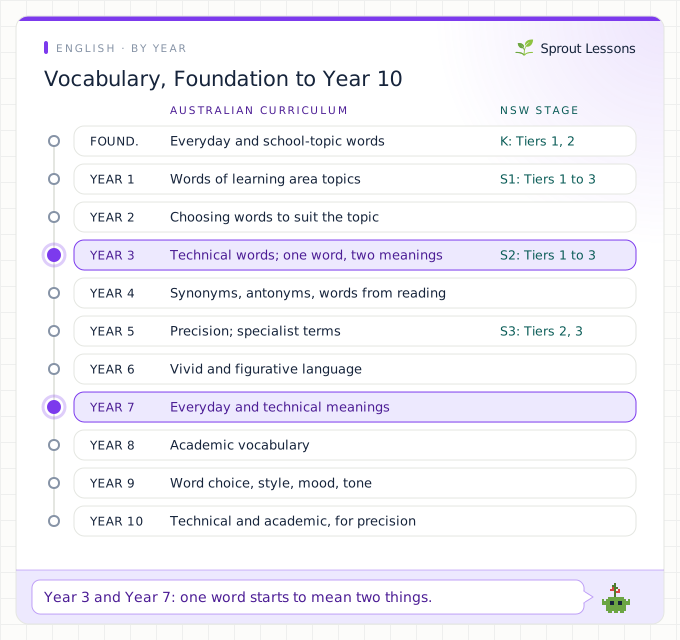
Each of these sits in the Language strand of English. The descriptions, quoted from ACARA:
- Foundation, AC9EFLA08: “recognise and develop awareness of vocabulary used in familiar contexts related to everyday experiences, personal interests and topics taught at school”. A Prep child who comes home with habitat from a class topic on animals is doing exactly this.
- Year 1, AC9E1LA09: “recognise the vocabulary of learning area topics”. The words of maths, science and HASS start to be taught as words: longer, heavier, season, past.
- Year 2, AC9E2LA09: “experiment with and begin to make conscious choices of vocabulary to suit the topic”. This is the first year a child is expected to pick a word rather than just use the first one that comes: scurried instead of went, in a story about a mouse.
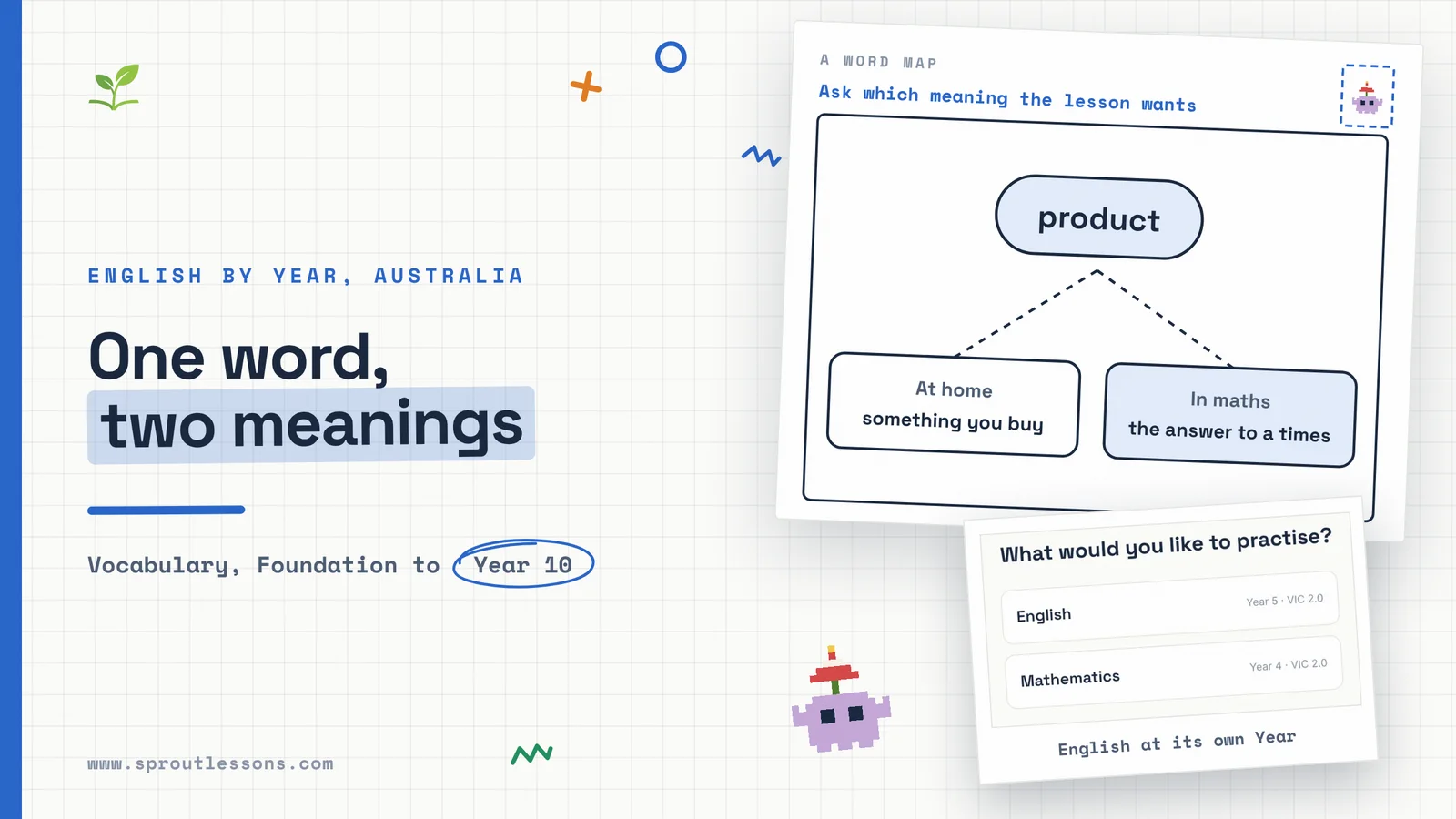
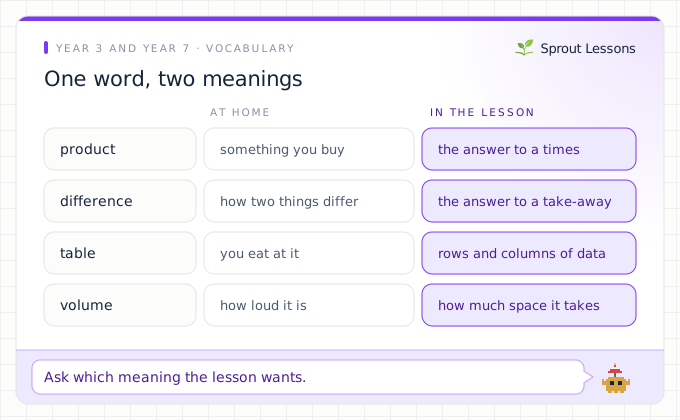
- Year 3, AC9E3LA10: “extend topic-specific and technical vocabulary and know that words can have different meanings in different contexts”. The second half is the important part. Table, difference, product and volume each mean one thing at home and another in a maths or science lesson.
- Year 4, AC9E4LA11: “expand vocabulary by exploring a range of synonyms and antonyms, and using words encountered in a range of sources”. Words come from reading now, not just from being taught: a Year 4 child should be picking up words from books and using them.
- Year 5, AC9E5LA08: “understand how vocabulary is used to express greater precision of meaning, including through the use of specialist and technical terms, and explore the history of words”. Said becomes muttered, insisted or admitted, and each one means something different.
- Year 6, AC9E6LA08: “identify authors’ use of vivid, emotive vocabulary, such as metaphors, similes, personification, idioms, imagery and hyperbole”. Vocabulary is now about effect as well as meaning.
- Year 7, AC9E7LA08: “investigate the role of vocabulary in building specialist and technical knowledge, including terms that have both everyday and technical meanings”. Year 3’s idea comes back at secondary level, with many more subjects: energy in science, source in history, expression in algebra.
- Year 8, AC9E8LA08: “identify and use vocabulary typical of academic texts”. Words such as evaluate, significant and consequently, which belong to no one subject and turn up in all of them.
- Year 9, AC9E9LA08: “analyse how vocabulary choices contribute to style, mood and tone”.
- Year 10, AC9E10LA08: “use an expanded technical and academic vocabulary for precision when writing academic texts”.
Vocabulary also turns up inside other descriptions. From Year 1 to Year 3 the writing and speaking descriptions ask for “topic-specific vocabulary”, and Year 3’s presentations add “precise vocabulary”. Word parts (prefixes, suffixes, base words and, from Year 6, Latin and Greek roots) sit in the spelling descriptions rather than here; our page on spelling by year covers them.
Where Victoria and NSW differ
Victoria has a vocabulary code at every level in the same place in its Language strand, in the same order, with three differences worth knowing. Its Level 5 vocabulary code, VC2E5LA08, keeps the precision and technical terms but drops the history of words, which Victoria puts in its Level 5 spelling code (VC2E5LY04) instead. Its Level 8 code, VC2E8LA08, asks students to examine the role and use of academic vocabulary, rather than to identify it. And its Level 10 code, VC2E10LA08, asks for an expanded vocabulary used with precision, without tying it to technical words or academic writing as the Australian Curriculum does. Each of these is paraphrased from the VCAA.
NSW does it differently. Its English K–10 syllabus gives vocabulary its own outcome in every stage from Kindergarten to Year 6 (ENE-VOCAB-01, EN1-VOCAB-01, EN2-VOCAB-01 and EN3-VOCAB-01), and sorts words into three tiers:
- Tier 1: everyday words most children learn by talking, such as happy, run or dog.
- Tier 2: words that appear across many subjects and in books more than in conversation, such as compare, reluctant or predict.
- Tier 3: words that belong to one subject, such as photosynthesis, numerator or colony.
Paraphrasing the NSW outcomes: Kindergarten works with Tier 1 words and Tier 2 words in familiar settings. Stage 1 (Years 1 and 2) adds taught Tier 2 and Tier 3 words to extend ideas. Stage 2 (Years 3 and 4) builds all three tiers through talk, wide reading and writing, and asks students to define and analyse words. Stage 3 (Years 5 and 6) concentrates on Tier 2 and Tier 3, adding morphological analysis and precise definitions for particular contexts.
The tiers are a useful idea for any parent, whatever state you are in, because they tell you where your help counts most. Tier 1 words arrive on their own. Tier 3 words are taught in the lesson that needs them. Tier 2 words are the ones that fall through the gaps: no teacher owns them, they are rare in conversation, and they are exactly the words a reading comprehension question or a test instruction leans on.
Five signs that tell you where your child is
- Everything is “nice”, “good” or “big”. A Year 3 or 4 child whose writing uses one word for every job has not yet started choosing, which the curriculum expects from Year 2. It is a habit as much as a gap: they often know enormous but do not reach for it.
- They know the home meaning only. Ask a Year 3 or Year 7 child what difference means in “find the difference between 12 and 7”. If the answer is “how they are not the same”, that is the Year 3 and Year 7 descriptions in action, and it explains a lot of wrong answers that look like maths mistakes.
- They read it perfectly and miss the point. A child who decodes well but answers comprehension questions badly is often stopped by two or three words in the passage. Our page on reading comprehension by year covers this pattern.
- The new word is used slightly wrong. “The dog was very enormous” or “she was reluctant to go to the party, so she ran there”. This is a good sign: the word is being tried out, which is the Year 2 and Year 4 work. It needs a conversation about what the word really carries, not a red pen.
- They can use it but not explain it. Defining a word is harder than using it, and NSW names it as a Stage 2 skill. A Year 5 or 6 child who cannot say what predict means, but uses it correctly, is partway there.
A two-minute check with their own reading
You do not need a test. Take the book your child is reading, or this week’s homework, and pick five words that are not everyday words: Tier 2 words are best. For each one, point to it in its sentence and ask two questions:
- “What does it mean here?” Accept any fair explanation in their own words, or an example. “Like when you don’t want to do something” is a good answer for reluctant.
- “What other word could go here?” This checks the Year 4 idea of synonyms, and whether they know the word well enough to swap it.
Four or five explained is fine. Two or three suggests the book is a stretch, which is not a problem if someone reads it with them. One or none, in a book they chose and seem to be reading happily, is the pattern from sign 3, and worth telling the teacher about.
Twenty minutes a week that works better than a list
A list of words and definitions does little on its own, because a definition does not show how a word behaves in a sentence. What works is meeting a word several times, in different places, and using it. A simple routine:
- Read aloud above their level. Ten minutes, a few times a week, of a book a year or two harder than they read alone. Listening comprehension runs ahead of reading, so this is where new words come from, right through primary school.
- Stop on two words, not ten. Choose two Tier 2 words from what you read. Say what each means here, in plain words, and give one example from your own life.
- Use them on purpose for a week. “You look reluctant to get out of the pool.” Children notice and start using them back, which is the part that makes a word stick.
- Ask which meaning. When a school word has a home meaning too, ask which one the lesson wants: “What’s the product in maths?” Two minutes before homework saves a wrong page of answers.
Want practice built around the words your child is learning? Sprout writes an English lesson on the exact vocabulary code for their year, with sentences set in what they love, from footy to horses. Try it free.
What is not the problem
- Not using long words. The curriculum asks for precise words, not long ones. Snapped can be more precise than exclaimed.
- Not knowing a Tier 3 word before the lesson. Subject words are meant to be taught when they are needed. A Year 5 child who has never heard adaptation before the science unit is right on time.
- Speaking another language at home. A child learning English as an additional language may know the idea in their first language and need only the English word. Keep talking about ideas richly in your home language: the knowledge carries across.
Where this sits
Vocabulary sits in the Language strand of English, beside grammar and spelling, and it feeds every other strand. For its neighbour in the same strand, see grammar by year; for the writing side, narrative writing by year. For everything in one year level, see what a Year 4 student should know. If you are not sure which curriculum your child’s school follows, start with which curriculum your state uses, and in Victoria, with the Victorian Curriculum explained.
The short version
- Every year from Foundation to Year 10 has a vocabulary description. None is a word list.
- Foundation to Year 2: everyday and topic words, then choosing words on purpose.
- Year 3: one word, different meanings in different subjects. Year 7 returns to this.
- Year 4: synonyms and antonyms. Years 5 and 6: precision and effect.
- Years 8 to 10: academic vocabulary, and word choice for style and tone.
- NSW sorts words into three tiers; Tier 2 words are where a parent helps most.
- Read aloud above their level, stop on two words, and use them all week.
How this page was checked
The Australian Curriculum descriptions are quoted from our copy of version 9.0, which matches the Year 3 English content descriptions on the Australian Curriculum website. The Victorian codes are from the Victorian Curriculum F–10 version 2.0 and the NSW codes from the NSW English K–10 outcomes, both paraphrased. The example words, the five signs and the routine are our own, chosen to match each description. Checked 8 November 2026.
Australian Curriculum content descriptions are © Australian Curriculum, Assessment and Reporting Authority (ACARA) 2010 to present, licensed under CC BY 4.0, and quoted here unmodified. ACARA does not endorse any product that uses the Australian Curriculum. Victorian Curriculum codes reference the Victorian Curriculum F–10 Version 2.0 © VCAA, paraphrased; the VCAA does not endorse this product. NSW outcome codes reference the NSW syllabuses © NSW Education Standards Authority (NESA) for and on behalf of the Crown in right of the State of New South Wales, paraphrased, available at curriculum.nsw.edu.au; NESA does not endorse this product.
FAQ
Is there a vocabulary list for each year in the Australian Curriculum?
No. The Australian Curriculum has a vocabulary content description in every year from Foundation to Year 10, but none gives a list of words. Each describes a skill: using topic words in Year 1, choosing words on purpose in Year 2, knowing that a word can mean different things in different subjects in Year 3, synonyms and antonyms in Year 4, and academic vocabulary from Year 8.
What vocabulary should a Year 3 child know?
AC9E3LA10 asks Year 3 students to "extend topic-specific and technical vocabulary and know that words can have different meanings in different contexts". In practice that means subject words, and knowing that words such as product, difference, table and volume mean one thing at home and another in maths or science.
What are Tier 1, Tier 2 and Tier 3 words?
NSW sorts vocabulary into three tiers. Tier 1 words are everyday words learnt by talking. Tier 2 words appear across many subjects and in books more than conversation, such as compare or reluctant. Tier 3 words belong to one subject, such as numerator. Tier 2 words are where a parent's help counts most, because no single lesson teaches them.
How do Victoria and the Australian Curriculum differ on vocabulary?
Only in detail. Victoria has a vocabulary code at every level in the same order. Its Level 5 code leaves the history of words to spelling, its Level 8 code asks students to examine academic vocabulary rather than identify it, and its Level 10 code asks for precise, expanded vocabulary without tying it to academic writing.
How can I build my child's vocabulary at home?
Read aloud a book a year or two above their reading level a few times a week, stop on two useful words rather than ten, explain them in plain words with an example, and use them on purpose during the week. When a school word has an everyday meaning too, ask which meaning the lesson wants.