
In the Australian Curriculum, the reading comprehension strategies are almost the same list every year from Foundation to Year 8: visualising, predicting, connecting, summarising and questioning, with monitoring added in Year 2. What changes is the text and the job. Year 1 builds “literal and inferred meaning”, Year 3 begins to evaluate texts, Year 5 adds skimming and scanning, Year 6 compares several sources, and inferring is only named as a strategy in its own right in Year 7. Victoria uses the same list; NSW has its own Reading comprehension outcome every stage and names inference in Stage 1.
So when a school report says your child is working on “comprehension strategies”, it says very little on its own: a Prep child and a Year 6 child are both doing that. What tells you where your child actually is, is the kind of question they cannot yet answer. This page sets out what each year asks for, the five comprehension mistakes worth watching for, a two-minute check using a short paragraph we wrote for it, and a twenty-minute routine you can run with whatever your child is already reading.
What the curriculum asks for, year by year
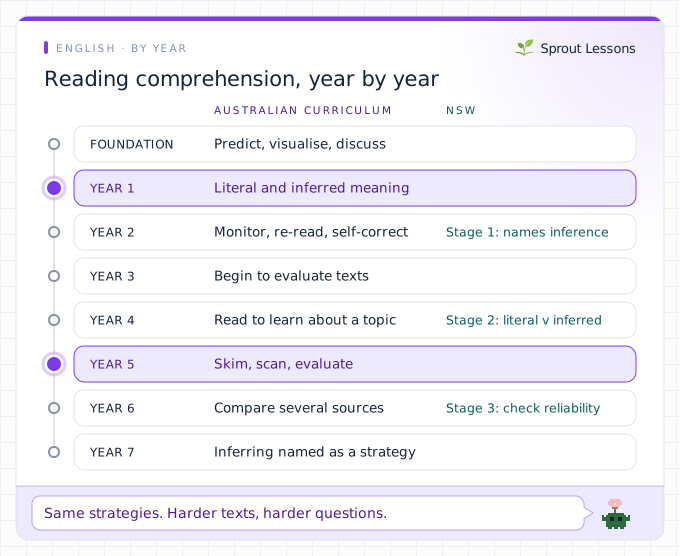
The comprehension descriptor is the fifth Literacy descriptor in every year (AC9E1LY05, AC9E2LY05 and so on), and next to it sits a reading descriptor about accuracy and fluency. Quoted from ACARA:
- Foundation, AC9EFLY05: “use comprehension strategies such as visualising, predicting, connecting, summarising and questioning to understand and discuss texts listened to, viewed or read independently”. Most of this is done with books read aloud, because most Prep children cannot yet read the books they can understand.
- Year 1, AC9E1LY05: the same strategies “to build literal and inferred meaning by drawing on vocabulary and growing knowledge of context and text structures”. Literal is what the text says; inferred is what it means but does not say.
- Year 2, AC9E2LY04 and AC9E2LY05: reading “with phrasing and fluency ... monitoring meaning by re-reading and self-correcting”, and “monitoring” joins the list of strategies. This is the year children are expected to notice when something they read has stopped making sense.
- Year 3, AC9E3LY05: “build literal and inferred meaning, and begin to evaluate texts by drawing on a growing knowledge of context, text structures and language features”. AC9E3LY04 asks children to read “accurately and fluently, re-reading and self-correcting when required”.
- Year 4, AC9E4LY05: comprehension “to expand topic knowledge and ideas, and evaluate texts”. Reading becomes a way of learning about a subject, not just a story.
- Year 5, AC9E5LY04 and AC9E5LY05: “navigate and read texts for specific purposes, monitoring meaning using strategies such as skimming, scanning and confirming”, and comprehension “to evaluate information and ideas”.
- Year 6, AC9E6LY04 and AC9E6LY05: reading using “structural features; for example, table of contents, glossary, chapters, headings and subheadings”, and comprehension “to connect and compare content from a variety of sources”.
- Year 7, AC9E7LY05: the list becomes “visualising, predicting, connecting, summarising, monitoring, questioning and inferring”, used “to analyse and summarise information and ideas”. Inferred meaning has been there since Year 1; this is the first time inferring is listed as a strategy in its own right.
Where Victoria differs (the VCAA wording is paraphrased here, not quoted). The strategy list is the same, with monitoring added at Level 2, and inferring named at Level 7 (VC2E7LY07). The difference is the verb. Victoria asks children to begin to analyse texts at Level 2 (VC2E2LY10) and to analyse them at Level 3 (VC2E3LY10), where the Australian Curriculum says “begin to evaluate” in Year 3. Level 4 expands topic knowledge and begins to evaluate (VC2E4LY09), Level 5 evaluates information and ideas (VC2E5LY09), and Level 6 connects and compares ideas from several sources (VC2E6LY08).
Where NSW differs (the NESA wording is paraphrased). NSW gives reading comprehension its own outcome in every stage, separate from fluency and vocabulary, and its content is far more specific. In Kindergarten, children learn to stop reading when they notice they have lost the meaning, re-read and ask a question (ENE-RECOM-01). Stage 1 (Years 1 and 2) tracks pronouns back to the nouns they stand for across sentences, and names making an inference by connecting the meaning of words across sentences or paragraphs (EN1-RECOM-01). Stage 2 states the difference outright: literal information comes straight from the text, and an inference uses several pieces of it (EN2-RECOM-01). Stage 3 checks the accuracy and reliability of sources and compares texts on the same topic to pull ideas together (EN3-RECOM-01).
Five mistakes that tell you where your child is
1. Reads every word, cannot say what happened (Years 1 to 3)
Some children read aloud beautifully and, at the bottom of the page, cannot tell you what it was about. All their attention went on the words. Others read on happily after a sentence has stopped making sense, because they have not learned to notice. Both are what the Year 2 and Year 3 descriptors mean by monitoring and self-correcting. The fix is a pause at the end of each page (“what just happened?”) and permission to go back: re-reading is a strategy, not a failure. If the words themselves are still a struggle, decoding is the problem, not comprehension, and our Phonics Check page covers how to tell.
2. “It doesn’t say” (Years 1 to 4)
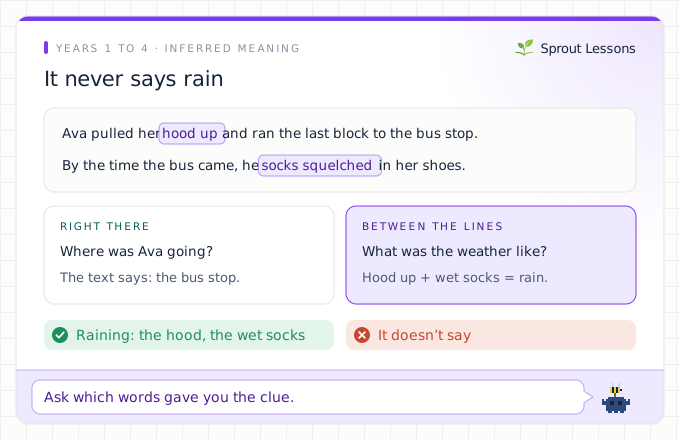
Ask “where was Ava going?” and almost every child finds “the bus stop”, because the answer is right there. Ask “what was the weather like?” and some children say “it doesn’t say”. They are right that it does not, and that is the point: “hood up” and “socks squelched” mean rain. This is inferred meaning, in the curriculum from Year 1 and named explicitly in NSW Stage 1. The fix is one question asked after every answer: which words told you? Children who have to point at the clue quickly start looking for clues.
3. Answering from their own life, not the text (Years 2 to 5)
The opposite problem. Ask why a character was nervous before the school concert, and the child says “because concerts are scary”, when the story said she had lost her music. Making connections to your own life is on the strategy list from Foundation, but a connection is a way into the text, not a replacement for it. The fix is the same pointing habit with a different question: show me where it says that. If it is not on the page, it is a guess.
4. A summary that is longer than the story (Years 3 to 5)
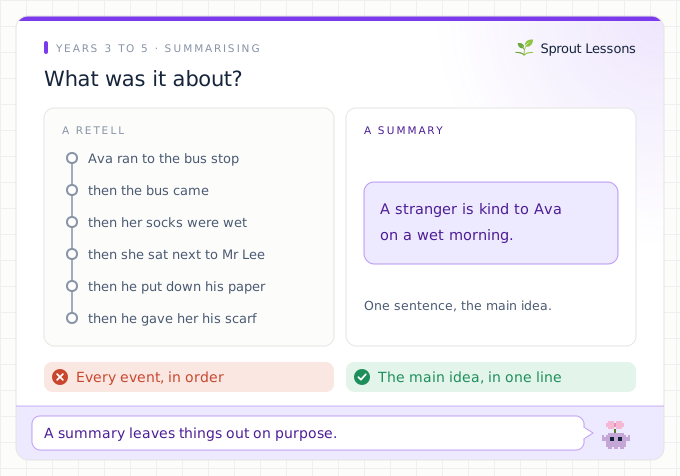
Ask a Year 4 child what a chapter was about and you will often get every event in order: first this, then this, then this. That is a retell, and it shows they remember. A summary is a harder skill, because it means deciding what matters and leaving the rest out. Summarising is on the list every year, and by Year 4 the texts are long enough that a retell no longer works. The fix is a shrinking limit: tell me in one sentence; now in ten words; now give it a title.
5. Reading the whole page to find one fact (Years 5 and 6)
Give a Year 5 child an information page and ask what year something happened, and many start at the first word and read every line until they find it. AC9E5LY04 names skimming and scanning, and Year 6 adds using the contents page, glossary and headings. A child who reads everything at the same speed will run out of time on longer texts, including the longer passages in the NAPLAN reading test. The fix is to scan before reading: look at the headings, decide which section the answer is in, then run a finger down it looking for a number or a keyword.
A two-minute check with one paragraph
Read this aloud together, or let your child read it, then ask the questions in order.
Ava pulled her hood up and ran the last block to the bus stop. By the time the bus came, her socks squelched in her shoes. She sat down next to Mr Lee, who lowered his newspaper, looked at her, and quietly handed her his scarf.
- Foundation and Year 1, literal: Where was Ava going? (The bus stop.)
- Years 1 and 2, inferred: What was the weather like? Which words tell you? (Raining: the hood, the wet socks.)
- Year 2, words in context: What does “squelched” mean here? (Made a wet, squishy sound.)
- Years 3 and 4, character: Why did Mr Lee give Ava his scarf? (She was wet and cold, and he was being kind.)
- Years 4 and 5, summary: Tell me what happened in one sentence.
- Years 5 and 6, evaluate: Why do you think the writer never used the word “rain”? (It lets the reader work it out, which makes it more vivid.)
The first question that goes wrong is where to start, whatever your child’s year. A Year 5 child who answers question 6 well but cannot do question 5 in one sentence has the harder skill and is missing a narrower one.
Want reading practice set in their world? Sprout writes an English lesson on AC9E3LY05 or AC9E5LY05 around what your child loves, from horses to space. Try it free.
Twenty minutes with the book they are already reading
- Two minutes before: predict. Look at the title, the cover or the chapter heading and guess what will happen. Check the guess afterwards.
- Ten minutes reading, with one stop per page. At each stop, one question: what just happened, or which words told you that?
- Three minutes: the ten-word summary. Your child sums up what they read in ten words or fewer. You do one too, and compare what each of you left out.
- Five minutes: a new word. Pick one word your child did not know, work out its meaning from the sentence around it, then check. NSW calls this activating word meaning, and vocabulary is often the hidden limit on comprehension.
What is not the problem
- Understanding stories read aloud better than ones they read alone. That is normal for years, and it is why Foundation comprehension is mostly done with texts listened to.
- Not knowing the word “inference”. Children work out inferred meaning from Year 1 without needing the word. The Australian Curriculum lists inferring as a named strategy from Year 7, although NSW uses the word in Stage 1.
- Reading slowly in Year 5. Slow, accurate reading with good understanding is better than fast reading with none. Speed comes from practice and from knowing more words.
Where this sits
Comprehension rests on decoding and on knowing words: see how reading is taught and spelling by year. It is the reading half of the writing pages, from narrative writing to informative writing. For the NAPLAN reading test in Year 3, see what NAPLAN actually tests, and for every English code in that year, the teacher-facing Year 3 English codes. If you are not sure which curriculum applies, start with which curriculum your state uses.
The short version
- The strategies are the same list every year: visualise, predict, connect, summarise, question, and monitor from Year 2.
- Year 1: literal and inferred meaning. Year 3: begin to evaluate. Year 4: read to learn about a topic.
- Year 5: skim and scan. Year 6: compare sources and use contents pages and glossaries.
- Year 7: inferring is named as a strategy. NSW names inference in Stage 1.
- The quickest check is one question after every answer: which words told you?
Sprout makes a lesson on the exact code your child is working on, with texts about their own interests. Start free.
How this page was checked
The Australian Curriculum descriptors are quoted from our copy of version 9.0, which matches AC9E5LY05 on the Australian Curriculum website; we read every Foundation to Year 8 Literacy descriptor about reading. The Victorian codes are from the Victorian Curriculum F–10 version 2.0. The NSW findings come from the four Reading comprehension content pages from Early Stage 1 to Stage 3 of the NSW English K–10 Syllabus, read on 29 October 2026. The NAPLAN detail is from the reading section of the NAPLAN page on nap.edu.au. Victorian and NSW wording is paraphrased, and the Ava paragraph was written for this page. Checked 29 October 2026.
Australian Curriculum content descriptions are © Australian Curriculum, Assessment and Reporting Authority (ACARA) 2010 to present, licensed under CC BY 4.0, and quoted here unmodified. ACARA does not endorse any product that uses the Australian Curriculum. Victorian Curriculum codes reference the Victorian Curriculum F–10 Version 2.0 © VCAA, paraphrased; the VCAA does not endorse this product. NSW outcome codes reference the NSW syllabuses © NSW Education Standards Authority (NESA) for and on behalf of the Crown in right of the State of New South Wales, paraphrased, available at curriculum.nsw.edu.au; NESA does not endorse this product.
FAQ
What comprehension strategies are taught in primary school in Australia?
The Australian Curriculum lists visualising, predicting, connecting, summarising and questioning from Foundation, adds monitoring in Year 2 and names inferring in Year 7. The same list appears every year (AC9EFLY05 to AC9E8LY05); what changes is the complexity of the texts and what the child does with the meaning, from discussing it in Foundation to comparing several sources in Year 6.
When do kids learn inference?
Children build inferred meaning from Year 1 in the Australian Curriculum (AC9E1LY05), meaning what a text suggests but does not say. NSW names making an inference by connecting words across sentences in Stage 1, and the Australian Curriculum lists inferring as a separate strategy from Year 7.
My child reads well but does not understand. What does that mean?
Usually that their attention is going on the words, or that they are not noticing when the meaning breaks down. Monitoring, re-reading and self-correcting are Year 2 and Year 3 skills. Stop at the end of each page and ask what just happened, and treat going back to re-read as a strategy rather than a failure.
What is the difference between a retell and a summary?
A retell lists every event in order and shows your child remembers. A summary chooses the main idea and leaves the rest out, which is harder. By Year 4 texts are long enough that retelling no longer works, so practise with a shrinking limit: one sentence, then ten words, then a title.
When do kids learn skimming and scanning?
Year 5 in the Australian Curriculum, which asks students to read texts for specific purposes using strategies such as skimming, scanning and confirming (AC9E5LY04). Year 6 adds using the table of contents, glossary, chapters, headings and subheadings to find information.