
In the Australian Curriculum, phonics starts before letters: Foundation children learn to hear rhymes, syllables and the separate sounds in spoken words, then learn the most common sound for every letter and read three-letter words such as “cat”. Year 1 adds consonant blends, long vowels and digraphs such as “sh”, and Year 2 adds vowel digraphs and silent letters. From Year 3 the work moves to long words, and from Year 4 to prefixes and suffixes. Victoria follows the same order and checks it in the Year 1 Phonics Check; NSW asks for common digraphs a year earlier, in Kindergarten.
So a Prep child who knows the letter names but not their sounds is a few weeks of practice from fine, and a Year 1 child who sounds out “s-h-i-p” as four sounds is meeting Year 1 content right on time. The useful thing for a parent is the short list of mistakes that show exactly where a child is stuck in the sequence. This page sets out what each year asks for, five of those mistakes, a two-minute check, and a fifteen-minute routine. It is about the reading side; the writing side is on our spelling by year page.
What the curriculum asks for, year by year
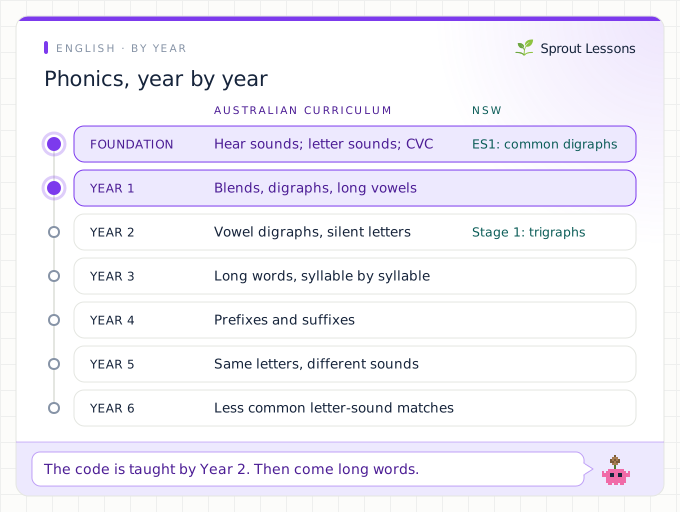
Phonics lives in the Literacy strand of English, in the “phonic and word knowledge” descriptors. The ones that change what your child does, quoted from ACARA:
- Foundation, AC9EFLY09 and AC9EFLY10 (heard, not read): “recognise and generate rhyming words, alliteration patterns, syllables and sounds (phonemes) in spoken words”, and “orally blend and segment single-syllable spoken words; isolate, blend and manipulate phonemes in single-syllable words”. All of this happens out loud, before any letters.
- Foundation, AC9EFLY11 and AC9EFLY12 (letters): “recognise and name all upper- and lower-case letters (graphs) and know the most common sound that each letter represents”, and “write consonant–vowel–consonant (CVC) words by representing sounds with the appropriate letters, and blend sounds associated with letters when reading CVC words”.
- Year 1, AC9E1LY11 and AC9E1LY12: “use short vowels, common long vowels, consonant blends and digraphs to write words, and blend these to read one- and two-syllable words”, and “understand that a letter can represent more than one sound and that a syllable must contain a vowel sound”. AC9E1LY04 has children reading “decodable and authentic texts using developing phonic knowledge”.
- Year 2, AC9E2LY10: “use phoneme–grapheme (sound–letter/s) matches, including vowel digraphs, less common long vowel patterns, consonant clusters and silent letters when reading and writing words of one or more syllables, including compound words”. The “ai” in rain, the “igh” in night, the silent “k” in knee.
- Year 3, AC9E3LY09: “understand how to apply knowledge of phoneme–grapheme (sound–letter) relationships, syllables, and blending and segmenting to fluently read and write multisyllabic words with more complex letter patterns”.
- Year 4, AC9E4LY09: “understand how to use and apply phonological and morphological knowledge to read and write multisyllabic words with more complex letter combinations, including a variety of vowel sounds and known prefixes and suffixes”. Meaning units (un-, re-, -ing, -ful) join sound units.
- Years 5 and 6, AC9E5LY08 and AC9E6LY08: words “that share common letter patterns but have different pronunciations” (the “ough” in tough, though and through), then “common and less common grapheme–phoneme relationships” in “increasingly complex words”.
Where Victoria differs (the VCAA wording is paraphrased here, not quoted). The order is the same, but the Victorian Curriculum labels the strands of the skill more sharply. It separates phonological awareness, hearing syllables, rhymes and sounds (VC2EFLY03), from phonemic awareness, blending, segmenting and changing the sounds in one-syllable spoken words (VC2EFLY04), and tags the letter work as phoneme–grapheme correspondence (VC2EFLY05, VC2EFLY06). Level 1 puts blends and digraphs in VC2E1LY04, and Level 2 puts vowel digraphs and silent letters in VC2E2LY04. Since 2026 every Victorian government school runs the Year 1 Phonics Check in Term 3, 40 words with 28 as the expected-level benchmark, which tests the Foundation and Level 1 content above.
Where NSW differs (the NESA outcomes are paraphrased). NSW is a step ahead early. Its Kindergarten outcome for phonic knowledge already includes common digraphs alongside the single-letter sounds (ENE-PHOKW-01), where the Australian Curriculum leaves digraphs to Year 1. Phonological awareness has its own Kindergarten outcome (ENE-PHOAW-01). In Stage 1 (Years 1 and 2) the phonics outcome names vowel digraphs and trigraphs, three letters for one sound as in “igh” (EN1-PHOKW-01). From Stage 2 there is no separate phonics outcome: the work continues inside spelling and reading fluency.
Five mistakes that tell you where your child is
1. Cannot blend sounds they can hear (Foundation)
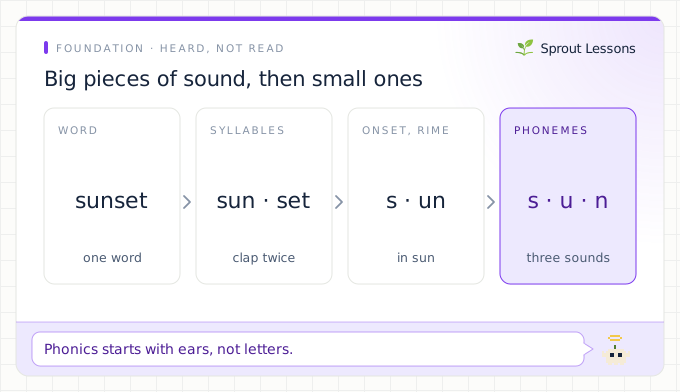
Say “c … a … t” slowly and ask what word that makes. A child who says “cat” can blend; a child who repeats the three sounds back cannot yet, and no amount of letter flashcards will fix it, because the gap is in hearing, not seeing. AC9EFLY10 is the oral version of the skill, and Victoria gives it its own descriptor (VC2EFLY04). The fix is games in the car: “I spy something that sounds like d-o-g”, then shorter gaps between the sounds until they run together.
2. Letter names instead of letter sounds (Foundation)
A child who reads “cat” as “see-ay-tee” knows the alphabet song, not the code. The names are useful for spelling aloud, but blending needs the sounds: “k”, “a”, “t”. AC9EFLY11 asks for both, the name and “the most common sound that each letter represents”. The fix is to use only sounds while reading, keep them short and clipped (“mmm”, not “muh”), and save the names for when you write a word together.
3. Four sounds in “ship” (Year 1)
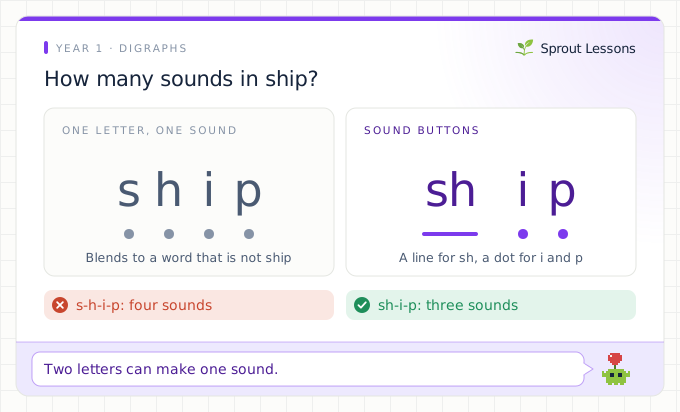
A child who has just mastered one letter, one sound will sound out “ship” as “s-h-i-p” and get stuck, because “s” plus “h” does not make “sh”. Year 1 is where two letters start making one sound (AC9E1LY11), and the matching idea, that “a letter can represent more than one sound” (AC9E1LY12), is in the same year. The fix is the sound buttons most Prep and Year 1 classrooms already use: a dot under each letter that makes its own sound and a line under letters that work together. Before reading the word, your child marks it up, then reads one sound per mark.
4. Guessing from the picture or the first letter (Years 1 and 2)
“Horse” for house, or “pony” because there is a pony in the picture. The child has learned that reading means producing a likely word, not decoding the one on the page. This is why AC9E1LY04 names “decodable” texts: books written mostly with the patterns the child has been taught, so sounding out actually works. The fix is to cover the picture for the first read, point under the whole word, and when your child guesses, ask them to check: does what you said match every sound you can see? Praise the check, not just the right answer.
5. Stopping dead at long words (Years 3 and 4)
A Year 3 child who reads short words well can freeze at “fantastic” or “remember”. They are trying to blend nine letters at once. Year 3 asks for multisyllabic words syllable by syllable (AC9E3LY09), and the rule that every syllable has a vowel sound is Year 1 knowledge (AC9E1LY12) that now earns its keep: find the vowels, split between them, read each chunk, then join. “Fan-tas-tic.” From Year 4, add the meaning chunks: in “unhelpful”, spot “un” and “ful” first, and “help” is left (AC9E4LY09).
A two-minute check
No paper for the first two. Stop when one goes wrong; each maps to a year.
- Foundation, heard: Does “cat” rhyme with “hat” or “cup”? Clap the syllables in “elephant” (three).
- Foundation, heard: What word is “m … o … p”? What sounds are in “sun”?
- Foundation, seen: Write s, m, a, t, p, i, n on a card. Point to each: what sound does it make? Now read “pin”, “mat” and the made-up word “nim”. A made-up word shows whether your child is decoding or remembering.
- Year 1: Read “ship”, “chop”, “frog” and “hand” (digraphs, then blends at each end).
- Year 2: Read “rain”, “boat”, “night” and “knee” (vowel digraphs, a trigraph, a silent letter).
- Years 3 and 4: Read “fantastic” and “unhelpful”. Watch whether they chunk or freeze.
The first one that goes wrong is the place to start, and it is often lower than you expect. A Year 2 child who stumbles on “night” but also hesitates on “ship” needs the Year 1 digraphs secured first. If your child is in Victoria and in Year 1, the Phonics Check results page has a longer version of this check built around the real test.
Want practice set in their world? Sprout writes an English lesson on AC9E1LY11 or AC9E2LY10 around what your child loves, from dinosaurs to netball. Try it free.
Fifteen minutes a day, in three parts
- Three minutes: sounds out loud. One game with no letters: rhyme tennis, clapping syllables, or “say ‘sand’ without the ‘s’” (Year 1’s manipulating sounds, AC9E1LY10).
- Five minutes: one pattern. Pick the pattern from the check, say “sh” or “ai”, write six words that use it, and mark sound buttons together before reading them.
- Seven minutes: a decodable book. Your child reads to you from a book matched to the patterns they know; ask the school for the series they use. Then you read a real picture book to them, for the joy of it. Both kinds of text are in the curriculum for a reason.
What is not the problem
- Writing “rane” for rain in Year 1. It is a sensible phonic spelling. Vowel digraphs are Year 2 content (AC9E2LY10). The spelling side is on spelling by year.
- Not knowing the words “phoneme” and “grapheme”. Teachers use them; children only need to do the thing. “Sound” and “letters” are fine at home.
- Slow but accurate reading in Year 1. Accuracy comes first and speed follows. A child who sounds out carefully and gets it right is on the right path; the one to watch is the fast guesser.
Where this sits
Phonics is the decoding half of early reading; the meaning half is in reading comprehension by year, and the writing half in spelling by year and handwriting by year. In Victoria, the Year 1 Phonics Check tests the Foundation and Year 1 rows of this page, and the end of Prep checklist shows what Foundation does and does not ask for. The teacher-facing codes are in Foundation English codes and Year 1 English codes. If you are not sure which curriculum applies, start with which curriculum your state uses.
The short version
- Foundation: hear rhymes, syllables and sounds out loud first, then one sound per letter and CVC words.
- Year 1: blends, digraphs such as sh and ch, and common long vowels. Victoria checks this in the Year 1 Phonics Check.
- Year 2: vowel digraphs, less common long vowels and silent letters.
- Year 3: long words, syllable by syllable. Year 4 on: prefixes, suffixes and odd spellings.
- NSW teaches common digraphs in Kindergarten and trigraphs in Stage 1.
Sprout makes a lesson on the exact code your child is working on, built around what they love. Start free.
How this page was checked
The Australian Curriculum descriptors are quoted from our copy of version 9.0, which matches AC9E1LY11 on the Australian Curriculum website; we read every Foundation to Year 6 Literacy descriptor on phonic and word knowledge. The Victorian codes are from the Victorian Curriculum F–10 version 2.0. The NSW outcomes are from the NSW English K–10 Syllabus outcomes, Early Stage 1 to Stage 2. Victorian and NSW wording is paraphrased. Checked 30 October 2026.
Australian Curriculum content descriptions are © Australian Curriculum, Assessment and Reporting Authority (ACARA) 2010 to present, licensed under CC BY 4.0, and quoted here unmodified. ACARA does not endorse any product that uses the Australian Curriculum. Victorian Curriculum codes reference the Victorian Curriculum F–10 Version 2.0 © VCAA, paraphrased; the VCAA does not endorse this product. NSW outcome codes reference the NSW syllabuses © NSW Education Standards Authority (NESA) for and on behalf of the Crown in right of the State of New South Wales, paraphrased, available at curriculum.nsw.edu.au; NESA does not endorse this product.
FAQ
What phonics should a Prep child know by the end of the year?
The Australian Curriculum asks Foundation children to hear rhymes, syllables and the separate sounds in spoken words, know the most common sound for every letter, and read and write consonant-vowel-consonant words such as cat and pin (AC9EFLY09 to AC9EFLY12). NSW also expects common digraphs such as sh and ch in Kindergarten.
When do kids learn digraphs like sh, ch and th?
Year 1 in the Australian Curriculum (AC9E1LY11) and the Victorian Curriculum (VC2E1LY04). NSW starts common digraphs in Kindergarten (ENE-PHOKW-01). Vowel digraphs such as ai and oa are Year 2, and trigraphs such as igh are named in the NSW Stage 1 outcome.
What is the difference between phonological awareness and phonics?
Phonological awareness is hearing and playing with the sounds in spoken words, with no letters: rhymes, syllables, blending and splitting sounds. Phonics is matching those sounds to letters. The curriculum teaches the first in Foundation alongside the second, and a child who cannot blend sounds out loud will struggle to blend them from print.
Why does my child guess words instead of sounding them out?
Usually because guessing from the picture or first letter has worked often enough. Decodable books, written with the patterns your child has been taught, make sounding out work instead. Cover the picture on the first read and ask your child to check each sound they can see against the word they said.
Does phonics stop after Year 2?
The core letter-sound code is taught from Foundation to Year 2, but phonics carries on: Year 3 applies it to long words syllable by syllable, Year 4 adds prefixes and suffixes, and Years 5 and 6 cover letter patterns with different pronunciations and less common letter-sound matches.