
In the Australian Curriculum, children sort, name and make familiar shapes in Foundation, classify them in Year 1, count their sides and use words such as “parallel” in Year 2, and move to 3D objects and why they suit their jobs in Year 3. Nets of objects arrive in Year 5 and cross-sections of prisms in Year 6. Classifying triangles and quadrilaterals by their sides and angles, the idea that a square is a kind of rectangle, waits until Year 7. NSW gets to nets in Stage 2 and to classifying triangles and quadrilaterals in Stage 3, a year or two earlier.
So a Year 4 child who cannot say whether a square is a rectangle is not behind, and a Prep child who calls a tilted square a “diamond” is doing what nearly every five-year-old does. The useful part for a parent is the handful of mistakes that show exactly where a child is: shapes that stop being shapes when they turn, triangles that have to point up, a cube called a square, six squares that are sure to fold into a box, and squares that are not allowed to be rectangles. This page sets out what each year asks for, those five mistakes, a two-minute check with things from the pantry, and a twenty-minute routine.
What the curriculum asks for, year by year
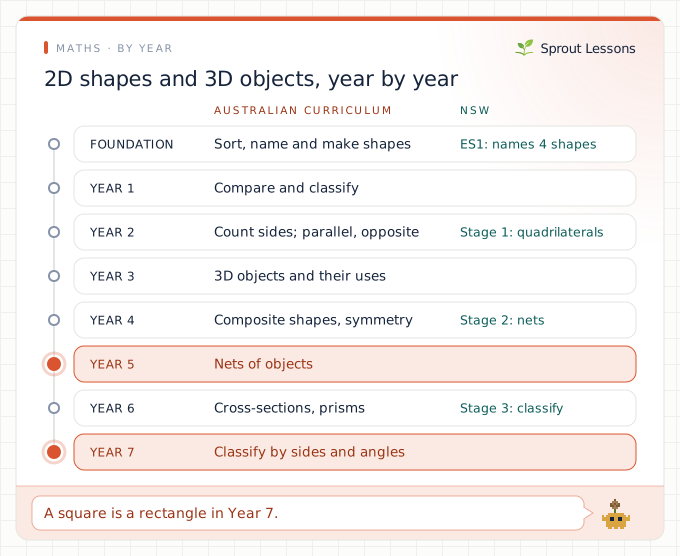
Shapes sit in the Space strand, which has two or three descriptors a year. The ones about shapes and objects, quoted from ACARA (the others cover position, maps and transformations):
- Foundation, AC9MFSP01: “sort, name and create familiar shapes; recognise and describe familiar shapes within objects in the environment, giving reasons”. The window is a rectangle, the clock is a circle, and why.
- Year 1, AC9M1SP01: “make, compare and classify familiar shapes; recognise familiar shapes and objects in the environment, identifying the similarities and differences between them”. Objects (a ball, a box) join the shapes.
- Year 2, AC9M2SP01: “recognise, compare and classify shapes, referencing the number of sides and using spatial terms such as ‘opposite’, ‘parallel’, ‘curved’ and ‘straight’”. This is where a triangle becomes “three straight sides” rather than a picture.
- Year 3, AC9M3SP01: “make, compare and classify objects, identifying key features and explaining why these features make them suited to their uses”. Why are cereal boxes prisms and not spheres? Why do wheels roll?
- Year 4, AC9M4SP01 and AC9M4SP03: “represent and approximate composite shapes and objects in the environment, using combinations of familiar shapes and objects”, and “recognise line and rotational symmetry of shapes and create symmetrical patterns and pictures”.
- Year 5, AC9M5SP01: “connect objects to their nets and build objects from their nets using spatial and geometric reasoning”. The flat pattern that folds into a box.
- Year 6, AC9M6SP01: “compare the parallel cross-sections of objects and recognise their relationships to right prisms”. Slice a loaf of bread straight and every slice is the same shape: that is what makes it a prism.
- Year 7, AC9M7SP02: “classify triangles, quadrilaterals and other polygons according to their side and angle properties; identify and reason about relationships”. This is the first time a square is formally a special rectangle, and a rectangle a special parallelogram.
Where Victoria differs (the VCAA wording is paraphrased here, not quoted). Almost word for word the same at every level, with one addition: Level 4 has an extra descriptor of its own, asking students to explain and compare the geometric properties of two-dimensional shapes and three-dimensional objects (VC2M4SP01). So a Victorian Year 4 child talks about faces, edges, corners and sides on purpose, a year before nets (VC2M5SP01). The Victorian Level 4 codes after it shift by one, so composite shapes are VC2M4SP02 and symmetry VC2M4SP04. Classifying by sides and angles is Level 7 (VC2M7SP02), as in the Australian Curriculum.
Where NSW differs (the NESA outcomes are paraphrased). NSW splits shapes into two-dimensional and three-dimensional spatial structure, and gets to the bigger ideas sooner. In Early Stage 1 (Kindergarten) the outcome names triangles, circles, squares and rectangles outright (MAE-2DS-01). Stage 1 (Years 1 and 2) already includes quadrilaterals and other common polygons (MA1-2DS-01). Stage 2 (Years 3 and 4) makes and sketches nets of prisms and pyramids (MA2-3DS-01), where the Australian Curriculum waits for Year 5. Stage 3 (Years 5 and 6) classifies triangles and quadrilaterals by their properties (MA3-2DS-01), where the Australian Curriculum waits for Year 7.
Five mistakes that tell you where your child is
1. The diamond (Foundation to Year 1)
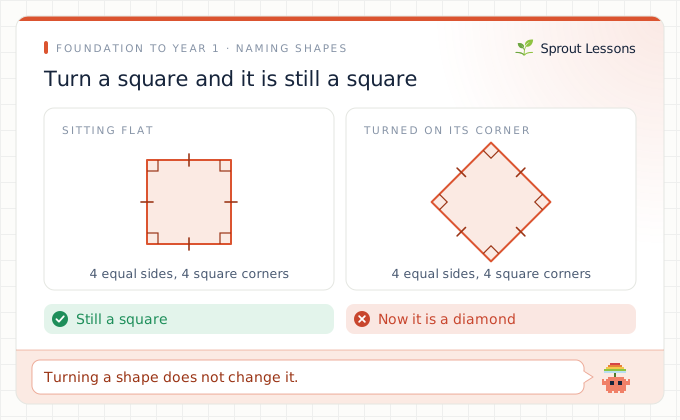
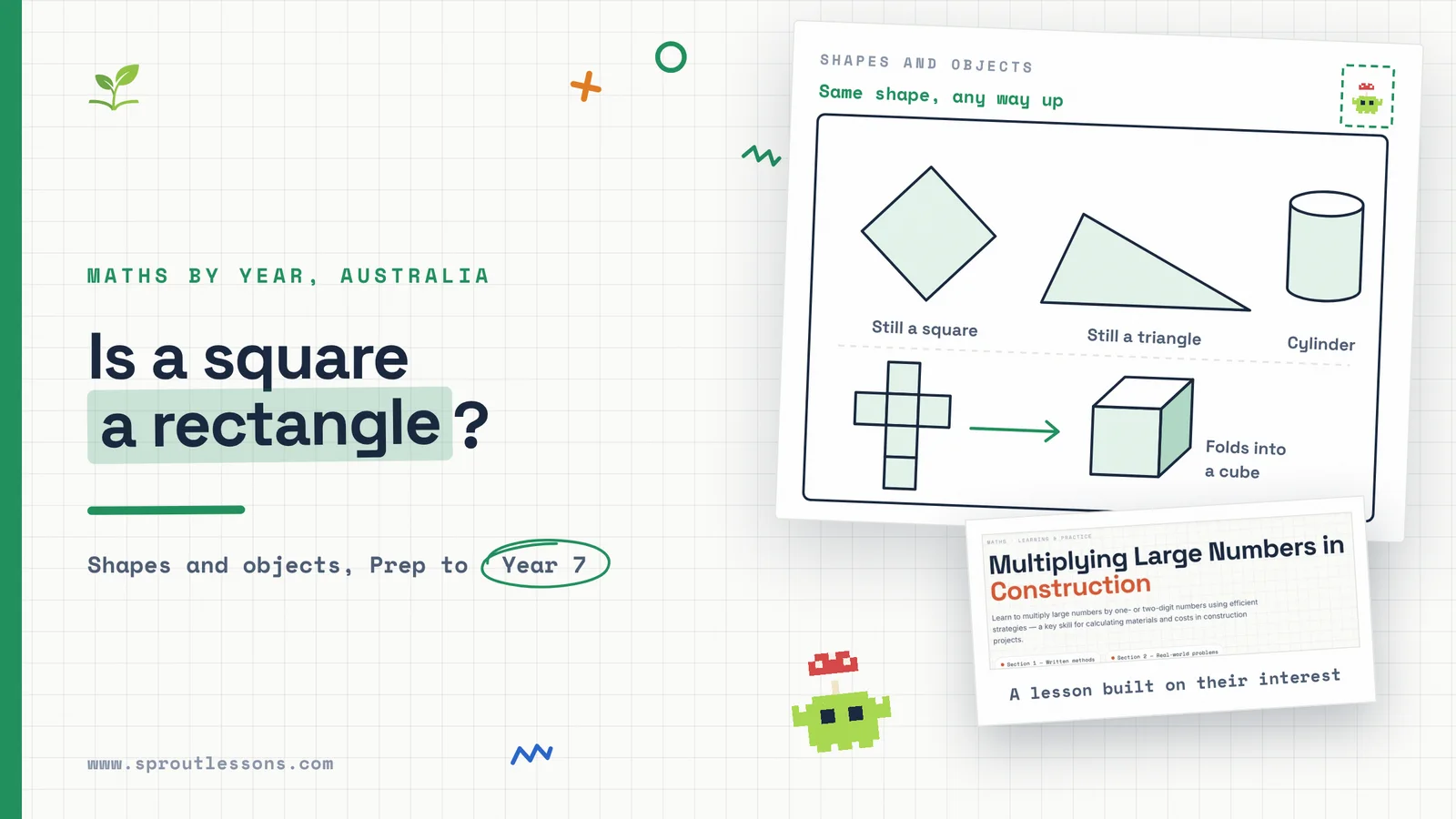
Turn a square onto its corner and most young children say it has become a diamond. They are naming the picture, not the shape. The fix is to make the shape out of something you can hold (a coaster, a cracker, four icy-pole sticks), then turn it slowly while your child watches. Did any side get longer? Did a corner change? It is the same square. Foundation’s “giving reasons” (AC9MFSP01) is exactly this: a shape is what its sides and corners are, not which way it sits.
2. The triangle that has to point up (Years 1 and 2)
Draw a long, thin triangle lying on its side, or one with a very wide angle, and ask whether it is a triangle. Plenty of six- and seven-year-olds say no, because every triangle they have seen in a picture book is the neat, pointy-at-the-top kind. Year 2 fixes this with counting (AC9M2SP01): three straight sides, joined up, is a triangle, whatever it looks like. Draw five very different triangles and one shape with a curved side, and let your child find the one that is not.
3. “A cube is a square” (Years 3 and 4)
A child holding a dice says it is a square. They are right that its faces are squares, and wrong about the dice. The same thing happens with “a ball is a circle” and “a can is a rectangle”. Year 3 is about objects and what makes them suit their use (AC9M3SP01), and Victoria makes the comparison explicit in Level 4 (VC2M4SP01). The fix is two words used every time: flat things are shapes, solid things are objects, and objects have faces that are shapes. “It is a cube; each face is a square” is a whole Year 4 sentence.
4. Any six squares make a cube (Year 5)
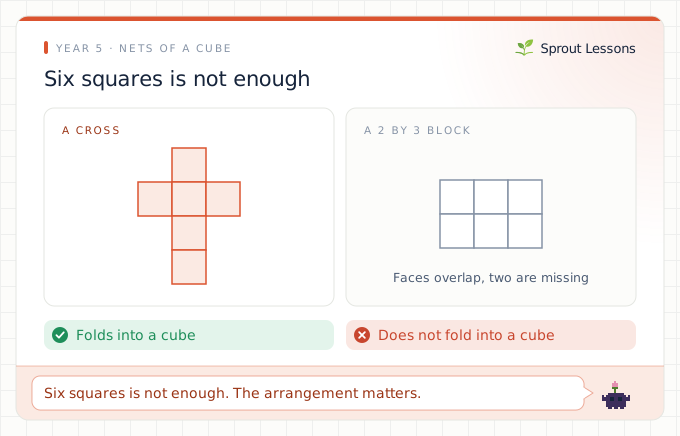
A cube has six square faces, so a Year 5 child will often assume any six squares joined edge to edge will fold into one. A tidy 2 by 3 block is the classic wrong answer: fold it up and three squares pile onto the same side while two faces are left open. There are 11 different nets of a cube, and the cross shape is the one most children meet first. The fix is scissors, not a worksheet: draw both on grid paper, cut them out and fold them. After that, ask your child to predict before they fold, which is the “spatial and geometric reasoning” in AC9M5SP01.
5. “A square is not a rectangle” (Year 7, Stage 3 in NSW)
For years, children sort squares and rectangles into separate piles, and they are right to: that is what Foundation to Year 4 asks for. Then Year 7 asks them to classify by properties (AC9M7SP02). A rectangle is a four-sided shape with four right angles. A square has four right angles, so it is a rectangle, a special one with equal sides. The fix is to make the definition do the work: write the rule for a rectangle on a card and test shapes against it, rather than comparing them to a picture. If your child is in Year 5 or 6 in NSW, this is Stage 3 content (MA3-2DS-01), so it is on time for them, not early. The angle half of it is in angles by year.
A two-minute check from the pantry
Put a cereal box, a tin, an orange, a toilet roll and a stock cube on the table. Stop when one question goes wrong. Each one maps to a year.
- Foundation: Which ones could roll? Which could stack? Point to a rectangle on the cereal box.
- Years 1 and 2: Sort them into two groups and tell me your rule. How many sides does the front of the cereal box have? Which sides are opposite?
- Year 3: Why is a cereal box a box shape and not a ball shape? (It stacks, it stands up, it fits on a shelf.)
- Year 4: How many faces, edges and corners does the stock cube have? (6, 12 and 8.) Does the front of the box have a line of symmetry? How many?
- Year 5: If you cut the cereal box along some edges and laid it flat, what would it look like? Draw it first, then open a real one along its glued seams and check.
- Year 6: If you sliced the tin straight across, what shape is every slice? What about the box? (Circle; rectangle. That is why both are prisms.)
- Year 7: Is the front of the stock cube a rectangle? Prove it from the rule, not the look.
The first question that goes wrong is the place to start. A Year 6 child who can describe slices but cannot draw the flattened box has missed the Year 5 step, which a couple of opened cereal boxes will fix in a week.
Want practice set in their world? Sprout writes a maths lesson on AC9M5SP01 or AC9M2SP01 around what your child loves, from footy goalposts to Minecraft blocks. Try it free.
Twenty minutes, mostly with your hands
Shapes are the maths topic where a pair of scissors beats a screen.
- Five minutes: a shape hunt. Around the house or the street, find five shapes and say what they are and how you know. From Year 2, the “how you know” should include the number of sides.
- Five minutes: build it. Make shapes from icy-pole sticks or straws and Blu Tack, then objects: a cube needs 12 straws and 8 blobs. Building is the fastest way to learn edges and corners.
- Five minutes: flatten a box. From Year 5, open a real box along its seams, look at the net, and fold it back. Then draw a net that will not work and explain why.
- Five minutes: the rule game. One person thinks of a rule (“has a right angle”, “has a curved edge”), the other draws shapes and is told yes or no until they guess it. This is classification, which is what Year 7 asks for.
What is not the problem
- Not knowing “rhombus” or “trapezium” in Year 3. Naming and classifying all the quadrilaterals is Year 7 in the Australian and Victorian curricula and Stage 3 in NSW.
- Saying “corners” instead of “vertices”. The descriptors care about the idea. The formal word will come; a child who counts corners correctly has the maths.
- Drawing 3D objects badly. Representing objects in two dimensions is a Year 7 descriptor (AC9M7SP01). A wobbly cube in Year 4 is normal.
Where this sits
Shapes sit next to angles by year, which supplies the angle half of Year 7 classification, and area and perimeter by year, which measures the shapes this page names. Faces and nets lead into volume in measurement by year. For the whole picture of the year nets arrive, see what a Year 5 student should know, or the teacher-facing Year 5 maths codes. If you are not sure which curriculum applies, start with which curriculum your state uses.
The short version
- Foundation to Year 2: name, sort and classify shapes, then count sides and use words like parallel.
- Year 3: objects, and why their shape suits their use. Year 4: composite shapes and symmetry.
- Year 5: nets. Year 6: cross-sections and prisms.
- Year 7: classify by sides and angles, so a square is a rectangle. NSW does nets in Stage 2 and classification in Stage 3.
- Turning a shape never changes it. Six squares do not always make a cube.
Sprout makes a lesson on the exact code your child is working on, with shapes from their own interests. Start free.
How this page was checked
The Australian Curriculum descriptors are quoted from our copy of version 9.0, which matches AC9M5SP01 on the Australian Curriculum website; we read every Foundation to Year 7 Space descriptor. The Victorian codes are from the Victorian Curriculum F–10 version 2.0. The NSW outcomes are from the NSW Mathematics K–10 Syllabus outcomes, Early Stage 1 to Stage 3. Victorian and NSW wording is paraphrased. Checked 30 October 2026.
Australian Curriculum content descriptions are © Australian Curriculum, Assessment and Reporting Authority (ACARA) 2010 to present, licensed under CC BY 4.0, and quoted here unmodified. ACARA does not endorse any product that uses the Australian Curriculum. Victorian Curriculum codes reference the Victorian Curriculum F–10 Version 2.0 © VCAA, paraphrased; the VCAA does not endorse this product. NSW outcome codes reference the NSW syllabuses © NSW Education Standards Authority (NESA) for and on behalf of the Crown in right of the State of New South Wales, paraphrased, available at curriculum.nsw.edu.au; NESA does not endorse this product.
FAQ
What shapes should a Prep child know in Australia?
The Australian Curriculum asks Foundation children to sort, name and create familiar shapes and spot them in objects around them, giving reasons (AC9MFSP01). In practice that means circles, squares, rectangles and triangles. NSW names those four in its Kindergarten outcome. Calling a tilted square a diamond is very common at this age.
When do kids learn about nets of 3D objects?
Year 5 in the Australian Curriculum (AC9M5SP01) and the Victorian Curriculum (VC2M5SP01): connecting objects to their nets and building objects from them. NSW starts earlier, with nets of prisms and pyramids in Stage 2 (Years 3 and 4).
Is a square a rectangle?
Yes. A rectangle is a four-sided shape with four right angles, and a square has four right angles, so it is a special rectangle with equal sides. Children are formally asked to classify shapes this way in Year 7 (AC9M7SP02), or Stage 3 in NSW. Before that, keeping squares and rectangles in separate piles is normal.
What is the difference between a 2D shape and a 3D object?
A 2D shape is flat, like a square drawn on paper. A 3D object is solid, like a cube or a tin, and its faces are 2D shapes. Year 3 introduces objects and why their shape suits their use, and Victoria adds a Level 4 descriptor on comparing the properties of shapes and objects (VC2M4SP01).
How can I help my child with shapes at home?
Use your hands more than a screen: hunt for shapes around the house, build shapes and cubes from straws or icy-pole sticks, open a cereal box along its seams to see its net, and play a guess-my-rule sorting game. Ten to twenty minutes is plenty.