
In the Australian Curriculum, children compare length, mass and capacity side by side in Foundation, measure with informal units like paper clips and hand spans in Years 1 and 2, and meet centimetres, metres, grams, kilograms, litres and millilitres for the first time in Year 3. Year 4 reads scales between the labelled marks and adds temperature, Year 5 combines units (1 m 25 cm), and Year 6 converts between units using decimals. Victoria matches this year by year. NSW starts metres and centimetres a year earlier, in Stage 1.
So a Year 2 child in Melbourne who has never used a ruler is right on track, and so is a Year 2 child in Sydney who has. What matters more is the handful of mistakes that show where a child is stuck, and most of them are not about numbers at all: they are about where the ruler starts, what the marks on a jug mean, and which way to move the decimal point. This page sets out what each year asks for, the five mistakes worth watching for, a two-minute check with a tape measure, kitchen scales and a measuring jug, and a twenty-minute routine.
What the curriculum asks for, year by year
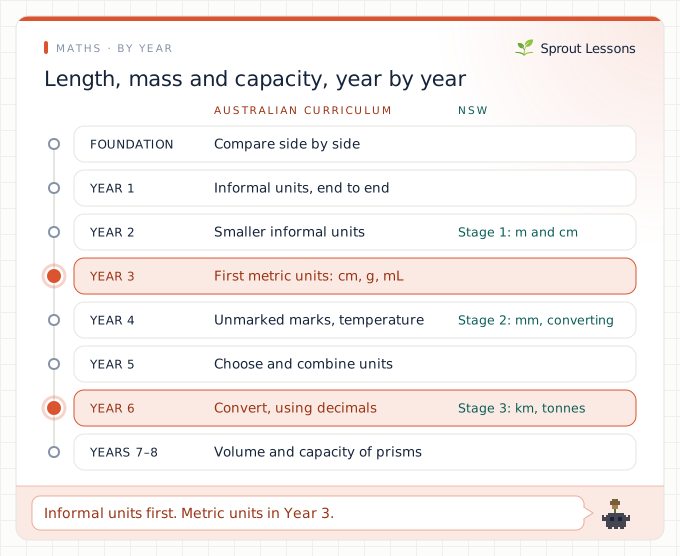
The Australian Curriculum puts length, mass and capacity in one descriptor each year rather than three, so the progression is short to read. Quoted from ACARA:
- Foundation, AC9MFM01: “identify and compare attributes of objects and events, including length, capacity, mass and duration, using direct comparisons and communicating reasoning”. Direct means side by side: stand two pencils next to each other, hold two bags, pour one cup into another.
- Year 1, AC9M1M02: “measure the length of shapes and objects using informal units, recognising that units need to be uniform and used end-to-end”. AC9M1M01 adds indirect comparison, using a piece of string to compare two things that cannot be put side by side.
- Year 2, AC9M2M01: “measure and compare objects based on length, capacity and mass using appropriate uniform informal units and smaller units for accuracy when necessary”. Still no centimetres or grams.
- Year 3, AC9M3M01 and AC9M3M02: “identify which metric units are used to measure everyday items”, then “measure and compare objects using familiar metric units of length, mass and capacity, and instruments with labelled markings”. This is the year of the first ruler, kitchen scale and measuring jug.
- Year 4, AC9M4M01: “interpret unmarked and partial units when measuring and comparing attributes of length, mass, capacity, duration and temperature, using scaled and digital instruments and appropriate units”. The scale now has marks without numbers, and temperature joins the list.
- Year 5, AC9M5M01: “choose appropriate metric units when measuring the length, mass and capacity of objects; use smaller units or a combination of units to obtain a more accurate measure”. A desk is 1 m 25 cm, not “about a metre”.
- Year 6, AC9M6M01: “convert between common metric units of length, mass and capacity; choose and use decimal representations of metric measurements relevant to the context of a problem”. 1 m 25 cm becomes 1.25 m, and 750 g becomes 0.75 kg.
- Years 7 and 8: the volume of right prisms by formula (AC9M7M02), then volume and capacity of prisms together (AC9M8M02).
Where Victoria differs (the VCAA wording is paraphrased here, not quoted). It barely does. The Victorian Curriculum has the same descriptor at every level from Foundation to Level 8, from comparing side by side (VC2MFM01) to informal units (VC2M1M02, VC2M2M01), first metric units at Level 3 (VC2M3M02), reading scaled and digital instruments with temperature at Level 4 (VC2M4M01), combined units at Level 5 and converting with decimals at Level 6 (VC2M6M01). The difference is the order of the words, not the content.
Where NSW differs (the NESA wording is paraphrased). NSW runs about a year ahead on length and a little ahead on the others. In Stage 1 (Years 1 and 2), children measure with informal units placed end to end without gaps or overlaps, then move to the metre and the centimetre, learn that 100 centimetres make a metre and measure to the nearest centimetre (MA1-GM-02). Mass in Stage 1 uses an equal-arm balance and informal units, and notes that mass is conserved when an object changes shape (MA1-NSM-01). Stage 2 adds millimetres, measures with kilograms and grams and litres and millilitres, and converts between metres, centimetres and millimetres with decimals to two places (MA2-GM-02, MA2-NSM-01, MA2-3DS-02). Stage 3 adds kilometres and tonnes, records measurements to three decimal places, measures the volume of irregular objects by water displacement and finds volumes in cubic centimetres and cubic metres (MA3-GM-02, MA3-NSM-01, MA3-3DS-02).
Five mistakes that tell you where your child is
1. Gaps, overlaps and mixed units (Years 1 and 2, Stage 1 in NSW)
Ask a Year 1 child to measure a book with paper clips and you will often see clips laid with gaps between them, or clips of two sizes mixed together, or a clip that hangs off the end. The answer comes out as “eight clips” whatever the book. That is exactly what AC9M1M02 is for: units have to be the same size and laid end to end. The fix is to measure the same book twice, once carefully and once with gaps, and ask why the answers differ. Then measure it with big clips and small clips and ask the question the NSW syllabus asks: why did the small clips give a bigger number?
2. The ruler starts at 1 (Year 3)
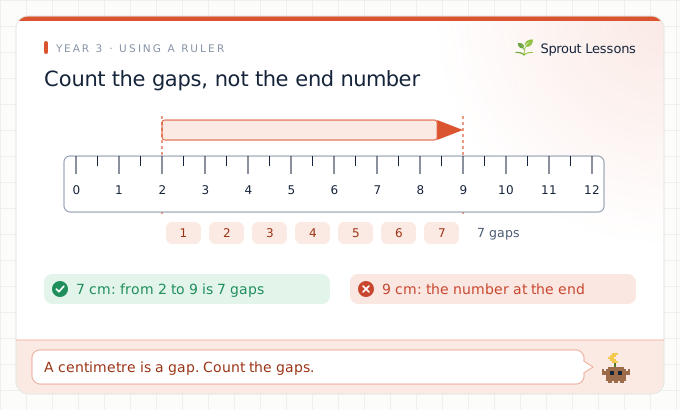
Year 3 brings the first ruler, and with it the most common measuring mistake in primary school: lining the object up with the 1, or with the end of the ruler, or reading whatever number the far end touches. A pencil laid from 2 cm to 9 cm gets written down as 9 cm. The child is counting marks, not the gaps between them, and a centimetre is a gap. The fix is a broken ruler: lay the pencil from the 2 and ask how long it is. If they say 9, count the centimetre gaps together with a finger: 1, 2, 3 ... 7. After a few of those, starting at zero stops being a rule they were told and becomes the shortcut they worked out.
3. The tall glass holds more (Foundation to Year 2)
Pour a cup of water into a tall thin glass and a short wide one, and a young child will often say the tall one has more. The same child may say a big box of cereal is heavier than a small bag of rice. Height and size are easy to see, and capacity and mass are not. This is the comparison Foundation and Year 1 ask for, and NSW Stage 1 says it outright: mass stays the same when an object changes shape. The fix is to test, never to tell: pour from one to the other and back, or hold one in each hand and then put them on the kitchen scales.
4. Every mark is one (Year 4)
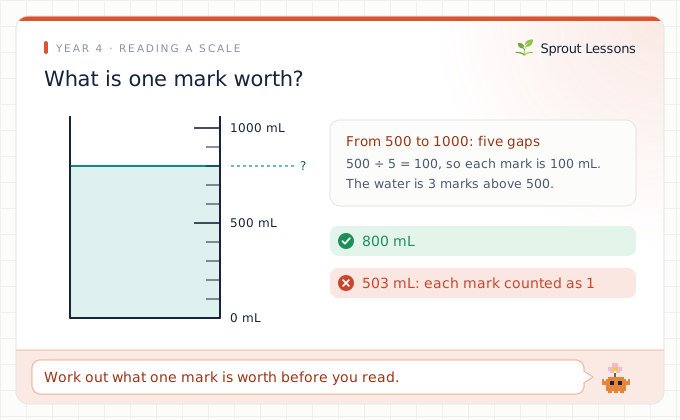
AC9M4M01 asks children to read “unmarked and partial units”, and this is where they go wrong. A measuring jug is labelled 0, 500 and 1000 mL, with four unlabelled marks between each label. Water reaches the third mark above 500. A child who counts each mark as one says 503 mL. The answer is 800 mL, because there are five gaps between 500 and 1000, so each mark is worth 100. Kitchen scales, thermometers and bathroom scales all do the same thing, each with a different step. The fix is one question, asked every time, before reading anything: what is one mark worth? Our page on place value by year covers counting in hundreds if that is what trips them up.
5. 1.5 kg is 150 g (Years 5 and 6)
A child who knows there are 1000 g in a kilogram still writes 1.5 kg as 150 g, or 1 m 5 cm as 1.5 m. The first mistake treats every conversion like centimetres to metres (two zeros). The second forgets that 5 cm is five hundredths of a metre, so 1 m 5 cm is 1.05 m. Year 5 combines units (AC9M5M01) and Year 6 converts with decimals (AC9M6M01), so this is the point where measurement and decimals meet. The fix is to say the unit out loud: 1.5 kg is one and a half kilograms, one thousand grams and five hundred more, 1500 g. Our decimals by year page covers the place value this leans on.
A two-minute measuring check
You need a ruler or tape measure, kitchen scales and a measuring jug. Stop when one goes wrong. Each question maps to a year.
- Foundation: Which holds more, this mug or this glass? How could we find out? (Pour one into the other.)
- Year 1: Measure the table with your hand spans. Why might my answer be different from yours? (Our hands are different sizes.)
- Year 3: How long is this pencil in centimetres? Start it at the 2. (Count the gaps, not the end number.)
- Year 4: What does the jug say? Ask before they read it: what is one mark worth?
- Year 5: Measure the door in metres and centimetres. (Something like 2 m 4 cm.)
- Year 6: Write 2 m 4 cm in metres, and 1.5 kg in grams. (2.04 m, 1500 g.)
The first question that goes wrong is the place to start, whatever year your child is in. A Year 6 child who gets question 6 right but reads the jug as 503 has the conversion and not the scale, and the scale is the one they will use for the rest of their life.
Want practice set in their world? Sprout writes a maths lesson on AC9M3M02 or AC9M6M01 around what your child loves, from baking to building Lego towers. Try it free.
Twenty minutes, mostly in the kitchen
Measurement is easier to practise at home than at school, because home has the real instruments.
- Five minutes: estimate first. Before measuring anything, everyone writes down a guess. The closest guess wins. Estimating is in the Year 3 descriptor, and it builds the sense of how long a centimetre or how heavy a kilogram is far faster than measuring alone.
- Five minutes: the broken ruler. Measure three things starting from a number other than zero: the 3, the 5, the 10.
- Five minutes: one mark is worth. Find three scales in the house (jug, scales, thermometer, oven dial) and, for each one, work out what a single mark is worth before reading it.
- Five minutes: double the recipe. From Year 5, take a recipe and double or halve it, writing each amount in two ways: 750 g and 0.75 kg, 1 L 250 mL and 1.25 L.
What is not the problem
- No centimetres before Year 3 outside NSW. The Australian and Victorian curricula use informal units in Years 1 and 2 on purpose: a child who has measured with paper clips understands why a centimetre has to be the same size every time.
- Not converting units in Year 4. Conversions with decimals are Year 6 in the Australian and Victorian curricula (Stage 2 in NSW, for length).
- Estimates that are a long way out. That is how estimating gets better. The curriculum asks children to estimate and then check from Year 3.
Where this sits
Measurement sits next to area and perimeter by year and telling the time by year, which cover the other measurement topics in the same strand. For the whole picture of a year level, see what a Year 4 student should know, and for every maths code in the year metric units arrive, the teacher-facing Year 3 maths codes page. If you are not sure which curriculum applies, start with which curriculum your state uses.
The short version
- Foundation: compare side by side. Years 1 and 2: informal units, same size, end to end.
- Year 3: the first centimetres, metres, grams, kilograms, litres and millilitres.
- Year 4: reading scales between the labelled marks, and temperature.
- Year 5: combined units (1 m 25 cm). Year 6: converting with decimals (1.25 m).
- NSW: metres and centimetres in Stage 1, millimetres and conversions in Stage 2. Victoria matches the Australian Curriculum.
Sprout makes a lesson on the exact code your child is working on, with examples in their own interests. Start free.
How this page was checked
The Australian Curriculum descriptors are quoted from our copy of version 9.0, which matches AC9M3M02 on the Australian Curriculum website; we read every Foundation to Year 8 measurement descriptor. The Victorian codes are from the Victorian Curriculum F–10 version 2.0. The NSW findings come from the length, mass and volume content pages in Stage 1 to Stage 3 of the NSW Mathematics K–10 Syllabus, read on 28 October 2026 (Geometric measure, Non-spatial measure and Three-dimensional spatial structure, A and B). Victorian and NSW wording is paraphrased. Checked 28 October 2026.
Australian Curriculum content descriptions are © Australian Curriculum, Assessment and Reporting Authority (ACARA) 2010 to present, licensed under CC BY 4.0, and quoted here unmodified. ACARA does not endorse any product that uses the Australian Curriculum. Victorian Curriculum codes reference the Victorian Curriculum F–10 Version 2.0 © VCAA, paraphrased; the VCAA does not endorse this product. NSW outcome codes reference the NSW syllabuses © NSW Education Standards Authority (NESA) for and on behalf of the Crown in right of the State of New South Wales, paraphrased, available at curriculum.nsw.edu.au; NESA does not endorse this product.
FAQ
What year do kids learn centimetres in Australia?
Year 3 in the Australian Curriculum and the Victorian Curriculum. Years 1 and 2 measure with informal units such as paper clips and hand spans, and Year 3 is the first year of metric units and instruments with labelled markings (AC9M3M02). NSW starts earlier: Stage 1 (Years 1 and 2) measures with metres and centimetres.
Why do Years 1 and 2 use informal units?
Because measuring with paper clips or blocks teaches why units must be the same size and laid end to end without gaps or overlaps (AC9M1M02). A child who has seen two different answers for the same book understands why a centimetre has to be the same every time.
Why does my child read a ruler wrong?
Most often they start at 1 or at the end of the ruler, or read the number at the far end of the object. A pencil from 2 cm to 9 cm is 7 cm long, because a centimetre is the gap between marks. Have them count the gaps with a finger until starting at zero makes sense.
When do kids learn to convert kilograms to grams?
Converting between common metric units, using decimals, is Year 6 in the Australian Curriculum (AC9M6M01) and Level 6 in Victoria. Year 5 combines units, such as 1 m 25 cm. NSW starts converting lengths in Stage 2 and masses in Stage 3.
When do kids learn temperature in maths?
Year 4 in the Australian Curriculum, which adds temperature to length, mass, capacity and duration and asks children to read scaled and digital instruments, including the unlabelled marks between numbers (AC9M4M01). Victoria matches this at Level 4.