
In the Australian Curriculum, children report ideas and events from Foundation, write short texts to report on a topic in Year 1, and write informative texts alongside stories and persuasive texts every year from Year 2. Paragraphs arrive in Year 3, the difference between opinion and factual language in Year 4, and bias in Year 6. No Australian Curriculum descriptor names the school text types (recount, procedure, information report, explanation), and NAPLAN never tests informative writing. NSW names all four in Stage 2.
That gap explains a lot of homework confusion. Your child comes home asked to write an information report on koalas, you look up what the curriculum says about information reports, and the curriculum says nothing by that name. The school is using the text types teachers have used for decades, and the curriculum describes the skills underneath them. This page lines the two up: what each year asks for, the four text types and their parts, the five mistakes worth watching for, a two-minute check you can do in conversation and a twenty-minute routine.
What the curriculum asks for, year by year
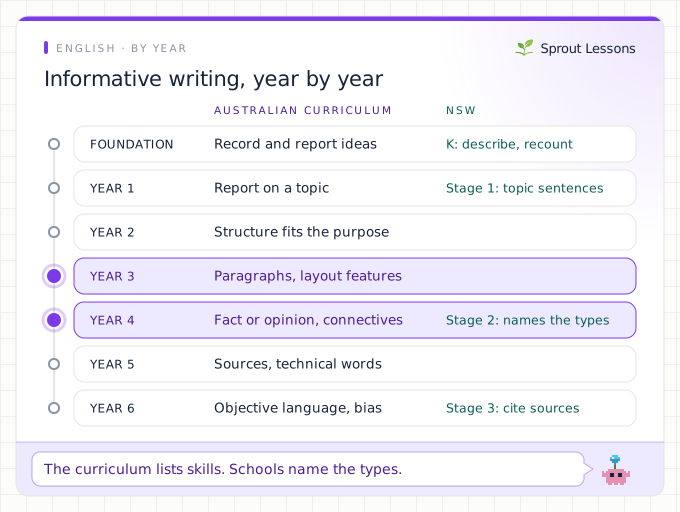
The Australian Curriculum puts informative writing inside one writing descriptor per year that covers stories and persuasive texts too, so the useful detail is in the clauses. Quoted from ACARA:
- Foundation, AC9EFLY06: “create and participate in shared editing of short written texts to record and report ideas and events using some learnt vocabulary, basic sentence boundary punctuation and spelling some consonant–vowel–consonant words correctly”. AC9EFLY03 asks children to identify some differences between imaginative and informative texts.
- Year 1, AC9E1LY06: “create and re-read to edit short written and/or multimodal texts to report on a topic, express an opinion or recount a real or imagined event”. AC9E1LA03 is the one descriptor that lists the purposes by name: texts are organised “to recount, narrate, express opinion, inform, report and explain”.
- Year 2, AC9E2LY06: “create and edit short imaginative, informative and persuasive written and/or multimodal texts for familiar audiences, using text structure appropriate to purpose”. AC9E2LA05 adds finding information with tables of contents, indexes and menus.
- Year 3, AC9E3LA04: “understand that paragraphs are a key organisational feature of the stages of written texts, grouping related information together”. AC9E3LA05 adds the purpose of layout features in print and digital texts, and AC9E3LY06 asks for “ideas grouped in simple paragraphs”.
- Year 4, AC9E4LA02: “identify the subjective language of opinion and feeling, and the objective language of factual reporting”. AC9E4LA04 adds text connectives, “including temporal and conditional words”, the first, next and if that hold a procedure or an explanation together.
- Year 5, AC9E5LA02: “understand how to move beyond making bare assertions by taking account of differing ideas or opinions and authoritative sources”. AC9E5LY06 asks for “specialist and technical vocabulary”.
- Year 6, AC9E6LA02: “understand the uses of objective and subjective language, and identify bias”. AC9E6LA03 explains how texts are organised into “characteristic stages and phases depending on purposes”, which is the curriculum describing text types without naming them.
Where Victoria differs (the VCAA wording is paraphrased here, not quoted). Victoria matches the Australian Curriculum closely: it names the same purposes at Level 1 (VC2E1LA03), and from Level 1 asks for informative texts with an opening, a middle and a conclusion (VC2E1LY13), a year before the Australian Curriculum’s writing descriptor asks for a structure (its Year 1 opening, middle and end is for spoken presentations, AC9E1LY07). Informative texts then sit alongside narrative and persuasive texts at every level (VC2E2LY11, VC2E3LY11, VC2E4LY10). Level 4 tells apart the language of opinion, facts and feelings (VC2E4LA02), and Level 6 adds objective and subjective language and bias (VC2E6LA02).
Where NSW differs (the NESA wording is paraphrased). NSW is the only one of the three to name the text types. In Kindergarten (ENE-CWT-01), children write texts that describe, give an opinion, recount an event or tell a story. Stage 1 (EN1-CWT-01) adds texts that explain, and already groups sentences into paragraphs that start with a topic sentence. Stage 2 gives informative writing its own outcome (EN2-CWT-02) and spells out the parts: informative texts with headings and topic sentences; texts that instruct, with a goal, a list of what you need and a series of steps; texts that explain how or why something happens, with an opening statement and a conclusion; and factual and historical accounts that open with who, what, when, where and why. Stage 3 (EN3-CWT-01) adds comparing and contrasting, cause and effect, researching from several sources, judging how reliable a source is, and acknowledging sources.
The four text types, and what each one needs
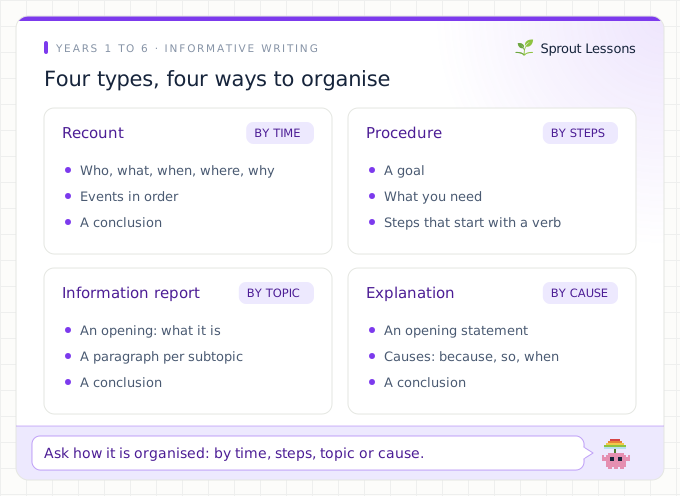
Most Australian primary schools teach informative writing as four types. The stages below are the ones the NSW syllabus lists in Stage 2, which match what most schools use everywhere:
- Recount (factual account): what happened, in order. Opens with who, what, when, where and why, then the events, then a conclusion. Organised by time. Our school excursion, my weekend, the first fleet.
- Procedure (instructions): how to do something. A goal, a list of what you need, then numbered steps that start with a verb: cut, pour, stir. Organised by steps.
- Information report: what something is like. An opening that says what it is, then one paragraph per subtopic, often under headings: appearance, habitat, diet. Organised by topic.
- Explanation: how or why something happens. An opening statement, then a chain of causes joined by because, so and when, then a conclusion. Organised by cause. How a volcano erupts, why it rains.
Five mistakes that tell you where your child is
1. The report is a recount (Years 1 to 3)
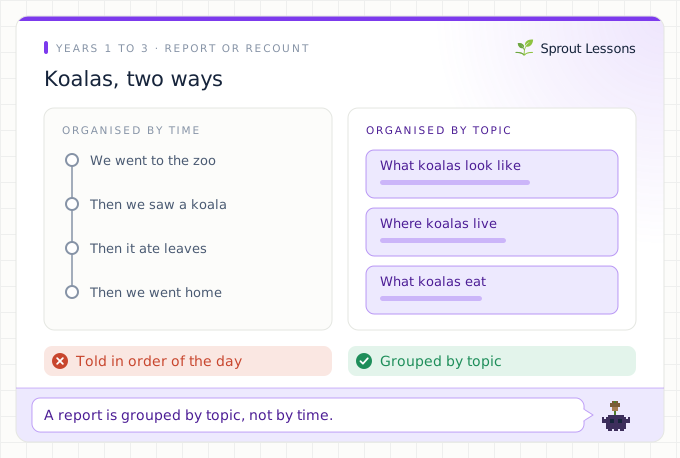
Asked to write an information report on koalas, a Year 2 child writes: “We went to the zoo and we saw a koala and it was eating leaves and then it went to sleep.” Every fact may be right, but it is a recount, organised by time, because that is the shape a young child knows from telling you about their day. A report is organised by topic: everything about what koalas eat goes together, wherever in the day they learnt it. That is what AC9E3LA04 means by paragraphs “grouping related information together”. The fix is to plan in boxes before writing: three boxes with a heading each (looks like, lives, eats), facts sorted into them on sticky notes, then one paragraph per box.
2. The steps start with “First you get” (Years 2 and 3)
A procedure written by a seven-year-old often reads: “First you get the bread and then you put it in the toaster and then you wait.” It is a recount of making toast, not instructions. A procedure has a goal (how to make toast), a list of what you need, and numbered steps that each start with a verb in the command form: put, press, wait, spread. NSW Stage 2 names both parts: texts that instruct with a goal, resources and steps, and imperative sentences that give instructions. The fix is a test, not a correction: follow your child’s instructions literally, exactly as written. When the butter goes on the toast before it comes out of the toaster, they find the missing step themselves.
3. The explanation describes instead of explaining (Year 4)
Asked why volcanoes erupt, a child writes: “Volcanoes are very hot. They have lava. Some volcanoes are in Hawaii.” Three true facts, no because. That is a description, and an explanation has to say how or why: one thing causes the next. AC9E4LA04 is where the curriculum asks for connectives that sequence ideas, and NSW Stage 2 asks for texts that explain how or why through a series of steps. The fix is a because chain: write the question at the top, then make every sentence start from the end of the one before. Magma is lighter than the rock around it, so it rises. As it rises, gas builds up, so the pressure grows. When the pressure is too great, the volcano erupts.
4. “Koalas are the cutest animal” (Years 4 to 6)
Opinions creep into reports: koalas are cute, the best animal, really amazing. That is fine in a persuasive text and wrong in a report, and Year 4 is when the curriculum asks children to tell the two apart, the “subjective language of opinion and feeling” against “the objective language of factual reporting” (AC9E4LA02). Year 6 adds spotting bias in what they read (AC9E6LA02). The fix is a sort: read a paragraph together and sort each sentence into fact (can be checked) or opinion (someone’s view). Then rewrite the opinions as facts: “koalas are cute” becomes “koalas have thick grey fur and round ears”. Our persuasive writing by year page covers the other side of the same skill.
5. Copied from the source (Years 5 and 6)
By Year 5, research is part of the task, and the common result is a report that reads like the encyclopedia because whole sentences came from it. The vocabulary is too adult, the facts do not connect, and your child cannot explain half of what they wrote. The curriculum points the other way: Year 5 asks children to draw on “authoritative sources” (AC9E5LA02), and NSW Stage 3 asks them to research from several sources, judge which are reliable and acknowledge them. The fix is note-taking in dot points, two or three words per fact, with the book closed before writing. Then write from the notes, and add a list of where each fact came from at the end.
A two-minute informative writing check
This one is done in conversation, because a child who cannot say it in order cannot write it in order. Stop when one goes wrong. Each question maps to a year.
- Foundation: Tell me one thing that happened at school today. (A clear event, not a list of everything.)
- Year 1: Tell me three things you know about dogs. (Facts, not a story about a dog.)
- Year 2: Tell me how to make a sandwich, as if I have never made one. (A goal, what you need, steps in order.)
- Year 3: If you wrote a report on dogs, what would the paragraphs be about? (Topics, such as what they eat and how to look after them.)
- Year 4: Is “dogs are the best pets” a fact or an opinion? How would you say it as a fact? (Opinion. “Dogs can hear sounds that people cannot”, or any fact that can be checked.)
- Year 5 and 6: Why does it rain? Then: how would you check that? (A because chain, and a source better than “I just know”.)
The first question that goes wrong is the place to start. A Year 5 child who answers question 6 well but tells question 3 as “first you get the bread and then” has the ideas and not the shapes, and the shapes are quicker to teach.
Want practice set in their world? Sprout writes an English lesson on AC9E3LA04 or AC9E4LA02 around what your child loves, from sharks to space. Try it free.
Twenty minutes, mostly talking
- Five minutes: the instruction test. Your child writes instructions for something small (brushing teeth, setting the table). You follow them exactly as written, and they fix what goes wrong.
- Five minutes: sort the facts. Write ten facts about one animal on sticky notes. Your child sorts them into three or four topic piles and gives each pile a heading. That is the plan for a report.
- Five minutes: fact or opinion. Read a short news article or a product page together and mark each sentence F or O. From Year 6, ask who wrote it and what they want.
- Five minutes: the because chain. Pick a why question (why do leaves fall, why does bread go mouldy) and build the answer out loud, each sentence starting with because, so or when.
What is not the problem
- Not knowing the names. The curriculum does not use the words procedure or information report, so a child who writes good instructions but cannot name the type is fine.
- No informative practice for NAPLAN. The NAPLAN writing test is either narrative or persuasive, revealed on the day. Informative writing is assessed by the school, and it is the writing most subjects ask for from Year 7.
- Short reports in Years 1 and 2. A few sentences on one topic is the Year 1 standard. Paragraphs are Year 3.
Where this sits
Informative writing is the third text type next to narrative writing by year and persuasive writing by year, and it leans on the sentence skills in grammar by year. For the whole picture of a year level, see what a Year 4 student should know, and for every English code in the year paragraphs arrive, the teacher-facing Year 3 English codes page. If you are not sure which curriculum applies, start with which curriculum your state uses.
The short version
- Foundation and Year 1: report ideas and events, a few sentences on a topic.
- Year 2: informative texts with a structure that fits the purpose.
- Year 3: paragraphs that group related information, and headings.
- Year 4: fact against opinion, and connectives like first, next, because and if.
- Years 5 and 6: sources, technical words, objective language and bias.
- Recount, procedure, report and explanation are school names. NSW names them in Stage 2. NAPLAN does not test them.
Sprout makes a lesson on the exact code your child is working on, with examples in their own interests. Start free.
How this page was checked
The Australian Curriculum descriptors are quoted from our copy of version 9.0, which matches AC9E4LA02 on the Australian Curriculum website; we searched every Foundation to Year 6 English descriptor for the text type names. The Victorian codes are from the Victorian Curriculum F–10 version 2.0. The NSW findings come from the Creating written texts content pages, Early Stage 1 to Stage 3, of the NSW English K–10 Syllabus, read on 28 October 2026. The NAPLAN text types are from the NAPLAN writing page on nap.edu.au. Victorian and NSW wording is paraphrased. Checked 28 October 2026.
Australian Curriculum content descriptions are © Australian Curriculum, Assessment and Reporting Authority (ACARA) 2010 to present, licensed under CC BY 4.0, and quoted here unmodified. ACARA does not endorse any product that uses the Australian Curriculum. Victorian Curriculum codes reference the Victorian Curriculum F–10 Version 2.0 © VCAA, paraphrased; the VCAA does not endorse this product. NSW outcome codes reference the NSW syllabuses © NSW Education Standards Authority (NESA) for and on behalf of the Crown in right of the State of New South Wales, paraphrased, available at curriculum.nsw.edu.au; NESA does not endorse this product.
FAQ
What year do kids learn information reports in Australia?
Children write short texts to report on a topic from Year 1 (AC9E1LY06) and informative texts every year from Year 2. Year 3 is when paragraphs that group related information arrive (AC9E3LA04), which is what turns a list of facts into a report. NSW names informative texts, instructions, explanations and factual accounts in Stage 2 (EN2-CWT-02).
Does the Australian Curriculum use the words procedure and information report?
No. No Australian Curriculum or Victorian Curriculum English descriptor names recount, procedure, information report or explanation as text types. The Year 1 descriptor AC9E1LA03 lists purposes such as to recount, inform, report and explain, and later years describe characteristic stages and phases. The type names come from teaching practice and from the NSW syllabus.
Is informative writing tested in NAPLAN?
No. The NAPLAN writing test asks for either a narrative or a persuasive text, revealed on the day, and all year levels write the same type. Informative writing is assessed by the school and appears on school reports.
What is the difference between a recount and an information report?
A recount tells what happened in order, so it is organised by time. An information report tells what something is like, so it is organised by topic, with one paragraph per subtopic such as appearance, habitat and diet. A report written in the order the child learnt the facts is really a recount.
When do kids learn fact and opinion?
Year 4. AC9E4LA02 asks students to identify the subjective language of opinion and feeling and the objective language of factual reporting. Year 6 adds identifying bias (AC9E6LA02). Victoria matches this at Levels 4 and 6.