
In the Australian Curriculum, children recount a real or imagined event in Year 1, write short imaginative texts in Year 2, and build their own stories from characters, settings and plot structures in Year 3. Year 4 develops storylines and punctuates dialogue, and Year 5 experiments with figurative language and point of view. No Australian Curriculum descriptor names the orientation, complication and resolution structure, yet the NAPLAN narrative task is marked against it. NSW names it in Stage 2.
That gap explains a lot of Year 3 and Year 5 NAPLAN results. A child can write a lively, well spelled page of “and then” and lose marks for structure without ever having been told what structure was wanted. This page sets out what each year asks for, how the NAPLAN narrative task is marked, the five mistakes that tell you where your child is, a two-minute spoken check and a twenty-minute routine.
What the curriculum asks for, year by year
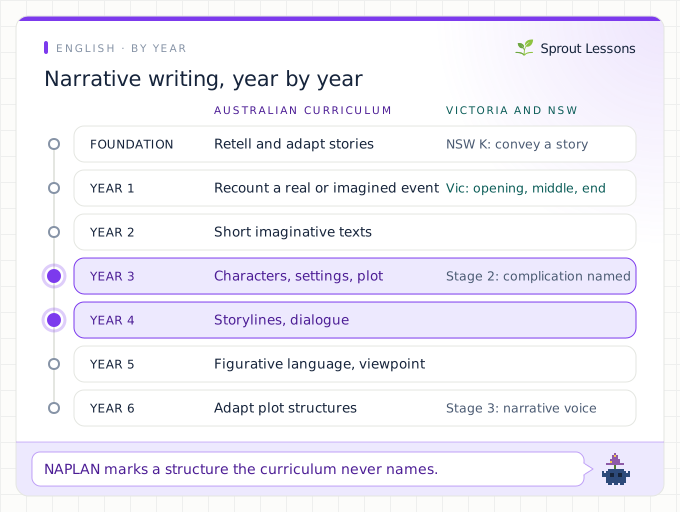
The Australian Curriculum descriptors, quoted from ACARA:
- Foundation, AC9EFLE05: “retell and adapt familiar literary texts through play, performance, images or writing”. AC9EFLE03 adds spotting events, characters, “and beginnings and endings”.
- Year 1, AC9E1LY06: short texts to “recount a real or imagined event”, and AC9E1LE03: “discuss plot, character and setting, which are features of stories”. The three words a parent will hear for the next decade arrive here, in reading.
- Year 2, AC9E2LY06: “create and edit short imaginative, informative and persuasive written and/or multimodal texts for familiar audiences, using text structure appropriate to purpose”. AC9E2LE05 adapts the structures of familiar stories.
- Year 3, AC9E3LE05: “create and edit imaginative texts, using or adapting language features, characters, settings, plot structures and ideas encountered in literary texts”. AC9E3LY06 asks for “ideas grouped in simple paragraphs, mostly correct tense”. This is the first year children write a whole story of their own design.
- Year 4, AC9E4LE05: “create and edit literary texts by developing storylines, characters and settings”. AC9E4LE03 looks at how authors use “plot tensions”, and AC9E4LA12 teaches that “punctuation signals dialogue through quotation marks”.
- Year 5, AC9E5LE05: “create and edit literary texts, experimenting with figurative language, storylines, characters and settings from texts students have experienced”. AC9E5LE03 adds that point of view shapes how readers respond to events and characters.
- Year 6, AC9E6LE05: “create and edit literary texts that adapt plot structure, characters, settings and/or ideas from texts students have experienced, and experiment with literary devices”. AC9E6LY06 asks for “topic-specific and vivid vocabulary”.
Notice the pattern: from Year 2 to Year 6, the writing descriptors build stories out of stories the child has read. That is deliberate, and it is the best argument there is for reading aloud well past the age a child can read alone.
Where Victoria differs (the VCAA wording is paraphrased here, not quoted). The Victorian Curriculum says “narrative” where the Australian Curriculum says “imaginative”, from Foundation (telling narrative and informative texts apart, VC2EFLY11) to Level 4 (VC2E4LY10). Its Level 1 writing descriptor also gives children a structure: short narrative and informative texts with an opening, a middle and a conclusion (VC2E1LY13), which the Australian Curriculum’s Year 1 descriptor does not. Level 3 adds building a plot to what children notice in the books they read (VC2E3LE03), and Level 5 adds experimenting with vocabulary (VC2E5LE05). Otherwise the literature descriptors match the Australian Curriculum level by level.
Where NSW differs (the NESA wording is paraphrased). The NSW English K–10 Syllabus has Kindergarten children conveying a story in writing, and in Stage 1 telling a story with ideas and events in a logical order, grouped into paragraphs. Stage 2 (Years 3 and 4) gives imaginative writing its own outcome, EN2-CWT-01, and its content is the most specific in the country: write in first or third person, try second person for effect, use an orientation, complication and resolution structure built around time, place and characters, give each stage its own paragraph, and experiment with punctuating dialogue. Stage 3 (Years 5 and 6) asks for deliberate choices about when and where a story is set, character profiles and motives, and control of narrative voice across a whole text.
How the NAPLAN narrative task is marked
The NAPLAN writing test sets either a narrative or a persuasive task, and nobody knows which until the day. Years 3 and 5 get different prompts from Years 7 and 9, and Year 3 writes on paper. Students get 5 minutes to plan, 30 to write and 5 to edit. The prompt tells them to think about the characters and where they are, the complication or problem, and how the story ends, and the marking guide defines a narrative by its three stages: orientation, complication and resolution.
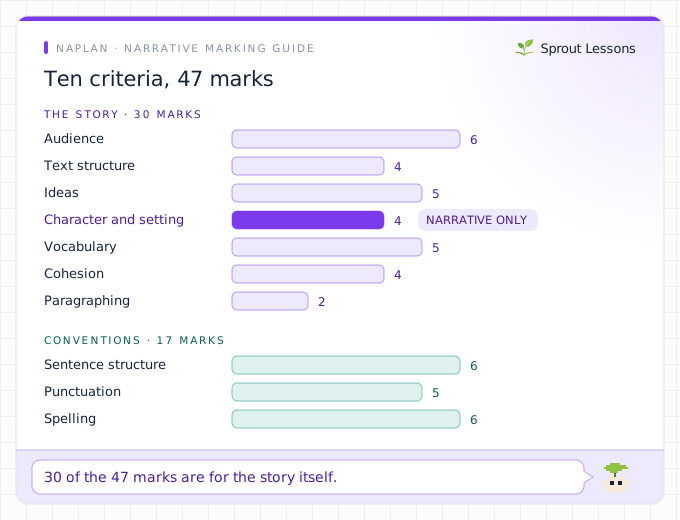
The narrative guide scores ten criteria for 47 marks. Seven are about the story: audience (0 to 6), text structure (0 to 4), ideas (0 to 5), character and setting (0 to 4), vocabulary (0 to 5), cohesion (0 to 4) and paragraphing (0 to 2). Three are conventions: sentence structure (0 to 6), punctuation (0 to 5) and spelling (0 to 6). Two differences from the persuasive guide are worth knowing: character and setting is a criterion only in narrative, and paragraphing is worth 2 marks here against 3 in persuasive.
Five mistakes that tell you where your child is
1. “And then we went… and then we had…” (Years 1 to 3)
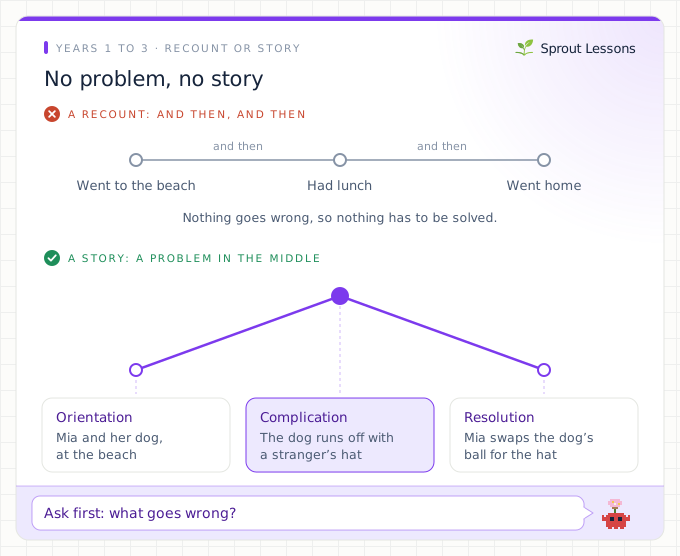
The child writes a list of things that happened, joined by “and then”. It is a recount, which is exactly what Year 1 asks for, so it is not a bad habit, just an early one. The step up is a problem: something has to go wrong, and the character has to do something about it. Ask one question before your child starts: what goes wrong? If they cannot answer, the story is not ready to write.
2. “Then I woke up and it was all a dream” (Years 3 to 5)
The complication grows for a page and a half and is solved in one sentence, often by luck, magic, a parent or waking up. Often the child simply ran out of time, and in a 30-minute test that is an easy way to lose structure marks. Two fixes work together. First, decide the ending in the planning minutes, before writing a word. Second, make the main character solve the problem themselves: a reader cares about what the character does, not what happens to them.
3. Past tense that slides into the present (Years 3 and 4)
“She opened the door. A dog jumps out and runs down the street.” Tense slips are common in children’s stories, because spoken storytelling slides between tenses all the time. The Australian Curriculum takes it on in Year 3 (“verbs are anchored in time through tense”, AC9E3LA08) and asks only for “mostly correct tense”, so occasional slips are expected. The fix is in editing: read the story aloud and underline every verb. Our grammar by year page has more on verbs and tense.
4. Dialogue with no quotation marks, or nothing but dialogue (Years 4 and 5)
Dialogue punctuation is Year 4 content (AC9E4LA12) and comes back in Year 5 writing (AC9E5LY06), so a Year 3 child who writes speech without quotation marks is not behind. The second version of this mistake is the opposite: a story that is all talk, line after line, with no setting and no action. Show your child a page from a book they love: each new speaker starts a new line, and the talk is broken up by what people do. Our punctuation by year page covers when quotation marks arrive in each state.
5. “She was very scared” (Years 5 and 6)
The child names the feeling instead of letting the reader see it. NAPLAN gives character and setting its own criterion, and a character who is only labelled (brave, sad, scared) rarely scores well on it. The fix is the old writing-class instruction to show, not tell: what does scared look like? Her hands shook so much the torch beam wobbled. This is also where the Year 5 figurative language descriptor (AC9E5LE05) earns its place, as long as the simile is doing a job. One good one beats five.
A two-minute spoken check
Do this out loud, not on paper, so you are checking the storytelling and not the handwriting or spelling. Stop when one goes wrong. Each one maps to a year.
- Foundation and Year 1: Retell a story you know well, like a favourite picture book. (Listen for a beginning, a middle and an end, in order.)
- Year 2 and Year 3: Tell me a story in three sentences: who and where, what goes wrong, and how it gets fixed. (Listen for a real problem in sentence two.)
- Year 3: Tell it again, starting “Yesterday…”. (Listen for the tense staying in the past.)
- Year 4: Write one line where your character says something, and punctuate it. (Quotation marks around the spoken words, and a comma or other punctuation inside them.)
- Year 5 and Year 6: Show me your character is nervous without using the word nervous. (Listen for an action or a detail, not a label.)
The first one that goes wrong is the place to start. A Year 5 child who manages question 5 beautifully but stalls on question 2 has the sentences and not the shape, and the shape is the quicker thing to fix.
Want story starters set in their own world? Sprout writes an English lesson on AC9E3LE05 or AC9E5LE05 around what your child loves, from horses to Minecraft. Try it free.
Twenty minutes, mostly planning
Most children write too much and plan too little. This routine is the other way round, and only the last step needs a pen.
- Five minutes: steal a structure. After a read-aloud, ask: who was it about, where were they, what went wrong, and how did it get fixed? Every story they love has the same bones, and the curriculum wants them to borrow them.
- Five minutes: three boxes. Draw three boxes labelled who and where, what goes wrong, how it is fixed. Your child fills each with a few words, using a prompt you choose (a lost key, a door that will not open, a dog that will not come back).
- Five minutes: one small scene. Out loud, describe the moment the problem happens, with one detail you can see, one you can hear and one thing the character does.
- Five minutes: write the ending first. Write only the last paragraph, where the character solves the problem. It is the part that gets rushed in a test, and practising it on its own takes the panic out of it.
What is not the problem
- Short stories in Year 2 or Year 3. Length is not one of the ten NAPLAN criteria. A short story with a real problem and an ending beats a long one without.
- Stories borrowed from books, shows and games. Adapting stories the child has read is what the curriculum asks for, every year from Foundation to Year 6.
- Spelling mistakes in a first draft. Spelling is 6 of 47 marks. Get the story down first and fix the spelling in the edit, which NAPLAN gives five minutes for.
Where this sits
Narrative is the partner of persuasive writing by year, and a child sitting NAPLAN needs both because the genre is a surprise. For the sentence-level skills that feed into the conventions marks, see spelling by year. If the writing is fine but the reading underneath it is not, our page on a child who reads fluently but does not understand is the place to start, and what Year 3 NAPLAN actually tests covers the rest of the test. For every English code in one year, see the teacher-facing Year 3 English codes page.
The short version
- Year 1: recount a real or imagined event. Year 2: short imaginative texts.
- Year 3: a whole story from characters, settings and a plot, in simple paragraphs.
- Year 4: developing storylines and punctuating dialogue. Year 5: figurative language and point of view.
- No Australian Curriculum descriptor names orientation, complication and resolution. NAPLAN does, and so does NSW Stage 2.
- NAPLAN narrative: ten criteria, 47 marks, 30 of them for the story.
- Plan the problem and the ending before writing, and let the character solve it.
Sprout makes a lesson on the exact code your child is working on, with story starters from their own interests. Start free.
How this page was checked
The Australian Curriculum descriptors are quoted from our copy of version 9.0, which matches AC9E3LE05 on the Australian Curriculum website; we searched every Foundation to Year 10 English descriptor in both the Australian and Victorian curricula for orientation, complication, resolution and narrative voice, and found none. The NAPLAN facts come from the NAPLAN writing page and the 2026 NAPLAN Writing Narrative Marking Guide linked from it (criteria, score ranges, timing and the narrative definition), summarised in our own words. The Victorian codes are from the Victorian Curriculum F–10 version 2.0, and the NSW findings from the Creating written texts pages of the NSW English K–10 syllabus content for Early Stage 1 to Stage 3, read on 27 October 2026. Checked 27 October 2026.
Australian Curriculum content descriptions are © Australian Curriculum, Assessment and Reporting Authority (ACARA) 2010 to present, licensed under CC BY 4.0, and quoted here unmodified. ACARA does not endorse any product that uses the Australian Curriculum. Victorian Curriculum codes reference the Victorian Curriculum F–10 Version 2.0 © VCAA, paraphrased; the VCAA does not endorse this product. NSW outcome codes reference the NSW syllabuses © NSW Education Standards Authority (NESA) for and on behalf of the Crown in right of the State of New South Wales, paraphrased, available at curriculum.nsw.edu.au; NESA does not endorse this product. NAPLAN is administered by ACARA, which does not endorse this product.
FAQ
What year do kids learn narrative writing in Australia?
From the start. Foundation retells and adapts familiar stories (AC9EFLE05), Year 1 recounts a real or imagined event (AC9E1LY06), Year 2 writes short imaginative texts, and Year 3 is the first year children create whole stories from characters, settings and plot structures (AC9E3LE05). Victoria calls them narrative texts from Foundation.
How is NAPLAN narrative writing marked?
Against ten criteria worth 47 marks: audience (6), text structure (4), ideas (5), character and setting (4), vocabulary (5), cohesion (4), paragraphing (2), sentence structure (6), punctuation (5) and spelling (6). Students have 5 minutes to plan, 30 to write and 5 to edit, and only find out on the day whether the task is narrative or persuasive.
What is orientation, complication and resolution?
The three stages of a narrative: the orientation introduces who and where, the complication is the problem, and the resolution is how it is solved. The NAPLAN marking guide defines a narrative by these stages and the NSW syllabus names them in Stage 2, but no Australian Curriculum or Victorian Curriculum descriptor uses the words.
When do kids learn to punctuate dialogue?
Year 4. AC9E4LA12 teaches that quotation marks signal dialogue and that dialogue follows conventions for capital letters, commas and boundary punctuation, and Year 5 writing asks for dialogue punctuation (AC9E5LY06). Victoria matches this at Level 4 (VC2E4LA11). NSW Stage 2 experiments with punctuating dialogue.
Why does my child's story have no complication?
Because they are still writing a recount, a list of events joined by "and then", which is what Year 1 asks for. The step up is a problem the character has to solve. Before your child starts writing, ask one question: what goes wrong? If they cannot answer it, the story is not ready to write.