
Yes, a home educated child in Victoria can still go to the town school part-time. It is called partial enrolment: your child is registered for home education with the VRQA and also enrolled at your local government school for particular subjects or activities, such as sport, art, science, a language or maths. The principal has to agree, and can say no on reasonable grounds. You stay responsible for the whole education program, and your child must turn up whenever the enrolled class runs. In a small town, where the school is also where the sport, the music and the other children are, it is often the arrangement that makes home education work. This page sets out how to ask for it in Daylesford, what the school can expect of you, and what to keep.
Why it matters more in a small town
In Melbourne a home educated child can find a choir, a soccer club, a science workshop and a co-op of other home educating families within a short drive. Around Daylesford the options are fewer and further apart. Daylesford Primary School on Vincent Street and Daylesford Secondary College, the only government secondary college in Hepburn Shire, are where most of the town’s children spend their week, and the things that are hardest to do at home (a science lab, a team, an ensemble, a language teacher) are mostly there.
That is exactly what partial enrolment is for. It is not a half-way house between school and home education; it is home education, with the school providing one or two parts of it.
What the rules say
The Department of Education’s home schooling and partial enrolment policy allows home educated students to partially enrol at a government school for specific activities, where the school and the parent agree. It rests on three principles: the parent keeps responsibility for the education program, the school and the parent work in partnership, and the child is fully included in whatever they enrol in. In practice that means:
- The principal decides. Principals should accept a partial enrolment where they can, taking into account things like class sizes in that year level or subject, and can decline or cancel one where there are reasonable grounds, such as a change in the school’s capacity. The VRQA’s note for schools puts it plainly: any partial enrolment is at the principal’s discretion, and you need the principal’s written confirmation to give to the VRQA.
- The year level is agreed with you. The policy says the right year level for the enrolled subject is decided in consultation with the parent, so a child who is ahead in maths, or behind, can be placed where they are rather than by age.
- You cannot partially register for home education. Registration is all or nothing. Partial enrolment is the school part added to a full home education registration.
- Not for VCE. The VRQA says partial enrolment is not an option for a student doing a senior secondary qualification: VCE, VCE Vocational Major, the Victorian Pathways Certificate, the IB Diploma or individual units of them. It is a Foundation to Year 10 arrangement in practice.
- It is about government schools. The Department’s policy is written for your local government school. Catholic and independent schools, such as St Michael’s in Daylesford, are not covered by it, so ask them directly if that is the school you have in mind.
The rest of home education registration, the learning plan, the eight learning areas and the random review, is covered on homeschool registration in Victoria.
Two routes in
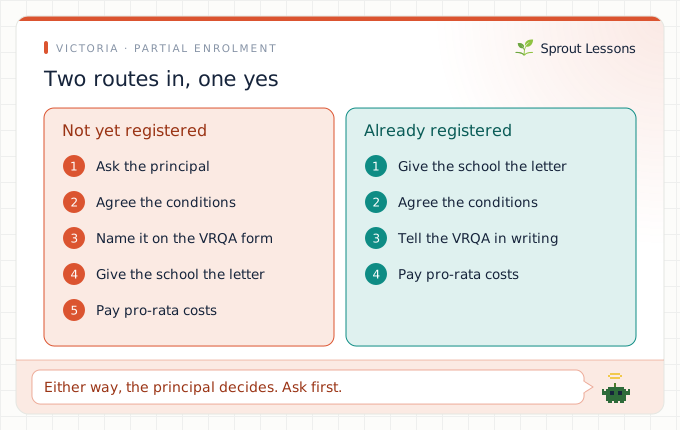
The Victorian Government’s partial enrolment page (updated 26 March 2026) sets out two routes, depending on where you are.
If you have not registered for home education yet:
- Talk to the principal of your local government school and get in-principle agreement.
- Agree the conditions of the enrolment with the principal.
- Include it in your home education application, using the “Notice of intention to partially enrol a student” form.
- When the VRQA approves your registration, give the school a copy of its letter.
- Tell the VRQA if the final arrangement ends up different from your application.
- Pay for essential items.
If your child is already registered:
- Give the school a copy of your VRQA registration letter.
- Agree the conditions with the principal.
- Tell the VRQA in writing.
- Pay for essential items.
One timing point catches families who are leaving school. Your child must stay enrolled and attending until the VRQA approves the registration, which takes up to 28 days from a complete application. If you want them to keep, say, Thursday sport at the same school afterwards, sort out the partial enrolment in the same application, so there is no gap.
What the school can expect of you
The conditions are agreed with the principal and can cover how long the enrolment lasts, behaviour, dress code and attendance. The government page is clear on a few points:
- Attendance is not optional. Your child must attend whenever their enrolled subject or activity runs, including related camps and excursions unless you agree otherwise with the principal. Whether they can stay at school before or after that is the principal’s call.
- They are fully included. That includes being assessed like everyone else in that subject and getting a report card on it.
- You pay a share. Essential education costs are charged pro rata. The school may also invite voluntary contributions, within the law.
- Transport is the principal’s call too. Whether your child can use a school bus for the enrolled sessions is decided by the principal.
- NAPLAN is available. A partially enrolled child can sit NAPLAN, only at the school, and gets an individual report; the results are confidential.
Which subject to ask for
The government page lists sport, art, maths, science and a language as examples. In a small town, the best choice is usually whatever is hardest to do well at home and easiest for the school to include you in:
- A practical science class, especially in Years 7 to 10, for the lab, the equipment and the safety supervision.
- A language, because a weekly class with a teacher and other learners is hard to replace with an app.
- Sport, music or art, for the team, the ensemble or the materials, and for the social side that home educating families in small towns most often say they miss.
Maths is the subject families most often keep at home, because it is the easiest to teach one-to-one at your child’s own pace. If you do enrol for maths, remember the class runs at the class’s pace and timetable, and that your child will be assessed and reported on it like everyone else. That report is worth keeping with your home education records.
Keeping the home half on track
Partial enrolment does not change what the VRQA expects of the rest of the week: a learning plan across the eight learning areas, and records you could show at a review. A few things that help when part of the week is at school:
- Write the school part into the learning plan, so a reviewer can see which area it covers and which parts you teach.
- Keep the school’s report for the enrolled subject alongside your own work samples.
- Name any app you use, and keep extracts. The VRQA asks for full names of programs and apps, not “the internet”, and lists app extracts as review evidence. How to do that is on apps in a Victorian learning plan.
Sprout Tutor is built for the home half. It follows the Victorian Curriculum for Foundation to Year 10 in maths, English and science, each subject at its own Year, so a child who does science at school and maths at home can practise maths at their own Level without the science moving. The parent dashboard records every question, answer and Year change, which is the kind of extract the VRQA asks for, though it has no export, so save screenshots each term. It is in public beta and free on every plan while it is in beta. Details are on how Sprout Tutor works.
Sprout Lessons builds one lesson on one curriculum code in about thirty seconds, around an interest your child has, from horses to chickens to footy. Start free. Software is a small part of a home education week, and the evidence that personalised-learning tools improve outcomes is thin, because very few rigorous studies exist.
The short version
A home educated child in Victoria can be partially enrolled at the local government school for particular subjects or activities, with the principal’s agreement. In Daylesford that means talking to Daylesford Primary School or Daylesford Secondary College first, then either naming the arrangement in your VRQA application or, if you are already registered, giving the school your VRQA letter and telling the VRQA in writing. Your child must attend whenever the class runs, is assessed and reported on like everyone else, and can sit NAPLAN at the school; you pay a pro-rata share of essential costs and stay responsible for everything else.
For the home half, Sprout Tutor follows the Victorian Curriculum with every answer recorded, free on every plan while it is in beta. Start free.
How this page was checked
Checked 7 November 2026 against the Department of Education’s home schooling and partial enrolment policy (policy last updated 23 April 2024, page updated 7 April 2026), the Victorian Government’s partial enrolment page (updated 26 March 2026) and the VRQA’s information for schools about home education (updated 19 March 2024). The 28-day assessment period and the VRQA’s learning plan and review requirements are from the VRQA’s home education pages, as recorded on our registration guide. School names are from the Victorian Government’s school records and the schools’ own listings; ask the school directly about what it can offer. This page is general information, not legal advice.
FAQ
Can a homeschooled child go to school part-time in Victoria?
Yes. It is called partial enrolment: a child registered for home education with the VRQA can also be enrolled at a government school for particular subjects or activities, such as sport, art, maths, science or a language. The principal must agree and can decline on reasonable grounds, and the parent stays responsible for the whole education program.
How do I arrange partial enrolment?
Start with the principal of your local government school. If you are not yet registered, get in-principle agreement, agree the conditions, include the arrangement in your home education application using the Notice of intention to partially enrol a student form, and give the school the VRQA’s letter once approved. If you are already registered, give the school your VRQA letter, agree the conditions and tell the VRQA in writing. Either way you pay essential costs pro rata.
Can a partially enrolled child do VCE subjects?
No. The VRQA says partial enrolment is not an option for students undertaking a senior secondary qualification, which covers VCE, VCE Vocational Major, the Victorian Pathways Certificate, the IB Diploma and individual units of study. In practice partial enrolment is a Foundation to Year 10 arrangement.
Does a partially enrolled child sit NAPLAN?
They can. A partially enrolled child is eligible to sit NAPLAN, which can only be done at the school, and receives an individual report; the results are confidential. They are also assessed like everyone else in the subject they are enrolled in and get a report card on it.
What do I have to do for the subjects taught at home?
Everything the VRQA expects of any home educating family: a learning plan across the eight learning areas and records you could show at a review. Write the school part into the plan, keep the school’s report for that subject, and if you use apps, name them in full and keep extracts, which the VRQA lists as review evidence.