
Khan Academy is free and excellent, and it is a fine core for maths in an Australian homeschool, but it is written for the United States. Its grade courses are aligned to the US Common Core, not the Australian Curriculum, and Khan publishes no Australian mapping. Use “Nth grade” for Year N as a starting point, then patch four gaps by hand: chance and probability (four Australian years with no Khan grade course coverage), Australian money, metric-only measurement, and Years 9 and 10, where US courses are organised by subject, not by year.
This page is for homeschooling parents in any Australian state who want to use Khan Academy without missing anything a registration review or a return to school would expect. The differences below are read from the Common Core standards and the Australian Curriculum Version 9.0 content descriptions, not from memory. Khan’s own statements come from its help centre, read on 26 October 2026.
What Khan Academy says it is aligned to
Khan Academy’s help centre says its “2nd grade through Pre-Calculus courses are aligned to the Common Core”, and that it has mapped its maths content to the standards of every US state and territory except Puerto Rico. Its curriculum alignment section lists mappings for France, Mexico and India. There is no Australian one. You cannot switch Khan to “Year 4, Australian Curriculum”; you can only pick the US course that is closest.
That is not a criticism. Khan is a nonprofit giving away a world-class maths library, and most primary mathematics is the same mathematics everywhere. It just means the parent does the mapping, and the mapping is not one to one.
Which Khan course for which Australian year
| Your child is in | Start with Khan’s | Watch for |
|---|---|---|
| Foundation (Prep, Kindergarten, Reception, Pre-primary) | Kindergarten | Not one of the courses Khan says is Common Core aligned; fine for counting and shapes. |
| Year 1 | 1st grade | Also outside Khan’s stated alignment. Australian Year 1 adds money transactions. |
| Year 2 | 2nd grade | US coins and inches. Skip those lessons. |
| Years 3 to 6 | 3rd to 6th grade | No chance or probability in these courses. Add it. |
| Years 7 and 8 | 7th and 8th grade | Close. Probability arrives in 7th grade, as it continues in Year 7. |
| Years 9 and 10 | Topic search across Algebra 1, Geometry and Algebra 2 | US high school courses are by subject, not year. Work from the Australian content list. |
The “same number” rule works because a US grade and an Australian year line up roughly by age: a Year 4 child and a 4th grader are both about nine or ten. If your child is working above or below their year in one subject, which is common and fine, our page on how to tell if your child is behind in maths will help you pick the right starting course.
Gap 1: chance and probability, Years 3 to 6
This is the biggest one. The Australian Curriculum has two chance content descriptions in every year from Year 3 to Year 6, eight in all. Year 3 starts with everyday language: students “identify practical activities and everyday events involving chance; describe possible outcomes and events as ‘likely’ or ‘unlikely’ and identify some events as ‘certain’ or ‘impossible’ explaining reasoning” (AC9M3P01). By Year 6 they “recognise that probabilities lie on numerical scales of 0 – 1 or 0% – 100%” (AC9M6P01).
The Common Core has no probability standard before 7th grade. Its first is 7.SP.C.5: “Understand that the probability of a chance event is a number between 0 and 1 that expresses the likelihood of the event occurring.” So a child who follows Khan’s 3rd to 6th grade courses in order meets no probability for four years that their Australian peers spend on it.
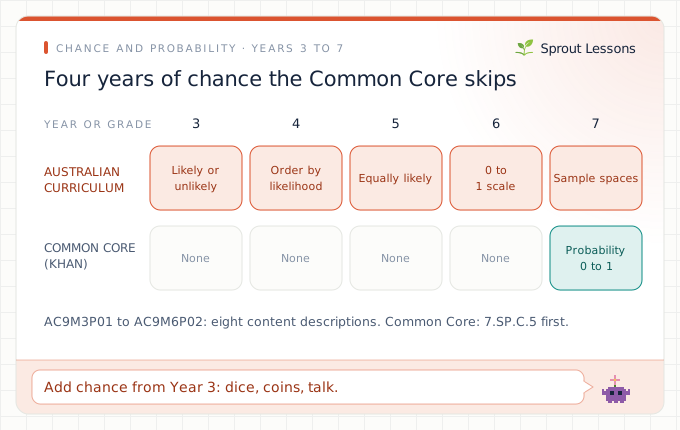
The fix is cheap. Chance in the primary years is mostly talk and experiments: coin tosses, dice, spinners, a bag of coloured blocks, recording results and asking why twenty tosses did not give ten heads. Fifteen minutes a fortnight covers it. Khan does have probability lessons in its later courses, and its search box finds them by topic, but pitched at older students.
Gap 2: money is American
Khan’s 2nd grade course follows standard 2.MD.C.8: “Solve word problems involving dollar bills, quarters, dimes, nickels, and pennies, using $ and ¢ symbols appropriately.” Australian children have no quarters, dimes, nickels or pennies, and no one-dollar note.
Australian money runs through the curriculum from Year 1, which asks students to solve problems “including simple money transactions” (AC9M1N05). Year 3 asks them to “recognise the relationships between dollars and cents and represent money values in different ways” (AC9M3M06), and from Year 3 on, financial contexts appear in number descriptions every year. Skip the US coin lessons and use real Australian coins instead; our money by year page has what each year expects.
Gap 3: inches, feet and US spelling
Common Core measurement is mixed: 2.MD.A.3 asks children to “estimate lengths using units of inches, feet, centimeters, and meters”, and 3.MD.B.4 uses “rulers marked with halves and fourths of an inch”. The Australian Curriculum is metric only: Year 3 students “identify which metric units are used to measure everyday items” (AC9M3M01).
Skip the customary-unit exercises; they teach nothing your child will be assessed on. Expect the vocabulary to be American too: “math”, “fourths” for quarters, “centimeters”. That is harmless for understanding but worth naming, so your child does not start writing “meters” in their workbook.
Gap 4: Years 9 and 10
Up to 8th grade, Khan’s courses are by grade. After that they follow the US high school sequence, which is organised by subject (Algebra 1, Geometry, Algebra 2) rather than by year. The Common Core does the same: its high school standards are one band, grades 9 to 12. The Australian Curriculum keeps going year by year to Year 10, so the course names stop matching.
From Year 9, work the other way round: take the Australian content descriptions for the year, then use Khan’s search to find lessons on each topic. Our page on what a Year 9 student should know lists them in plain English.
Where the timing differs slightly
Most topics arrive in the same year or close to it, and a homeschool can absorb a year either way. Two worth knowing about, in case your child is moving between Khan and a state school:
- Fractions on a number line are 3rd grade in the Common Core (3.NF.A.2). In the Australian Curriculum, locating fractions on number lines is Year 4 (AC9M4N04). Khan’s 3rd grade runs a little ahead here.
- Decimals to hundredths are 4th grade in the Common Core and Year 4 in the Australian Curriculum (AC9M4N01). These match.
Our fractions by year and decimals by year pages have the full Australian sequence.
Putting Khan in your registration paperwork
Every state lets you use Khan Academy. What changes is how you describe it. In Victoria, the VRQA asks you to name the apps and websites in your learning plan, not just “the internet”; our page on apps in the learning plan covers the wording. In states that review against the Australian Curriculum, list the gaps above and how you cover them; it shows you know where Khan stops. For the state-by-state rules, start at homeschooling requirements in Australia.
If you want the four gaps filled without building them yourself, Sprout Lessons writes a lesson on any Australian Curriculum content description, AC9M3P01 chance included, in about 30 seconds, written in Australian English for an Australian classroom or kitchen table. Create a free account and try it on the chance gap first.
Khan Academy or a paid program?
Khan is free, deep, and has a video for nearly every primary and secondary maths idea. What it does not do is follow the Australian sequence, produce Australian records, or give you a teacher. If those matter, our comparison of online homeschool programs in Australia sets out what the paid options add and what they cost. Plenty of Australian homeschoolers use Khan as the core and patch the gaps above, and that is a sound plan.
How this page was checked
Khan Academy’s alignment statements are from its help centre article “Is Khan Academy math content aligned to Common Core or other U.S. state standards?” and its curriculum alignment section, read on 26 October 2026. Common Core standards are quoted from the Common Core State Standards; Australian Curriculum content descriptions are quoted from the Australian Curriculum Version 9.0. The counts (eight chance descriptions from Year 3 to Year 6, none in the Common Core before 7th grade) were made from both full standard sets.
Australian Curriculum content descriptions are © Australian Curriculum, Assessment and Reporting Authority (ACARA) 2010 to present, licensed under CC BY 4.0, and quoted here unmodified. ACARA does not endorse any product that uses the Australian Curriculum. Common Core State Standards © 2010 National Governors Association Center for Best Practices and Council of Chief State School Officers. All rights reserved. This product is not endorsed by NGA/CCSSO. Khan Academy is a trademark of Khan Academy, which does not endorse this page.
FAQ
Is Khan Academy aligned to the Australian Curriculum?
No. Khan Academy says its 2nd grade to Pre-Calculus courses are aligned to the US Common Core, and its curriculum alignment section lists mappings for the US states, France, Mexico and India, not Australia. Most primary maths is the same mathematics, so it works well in an Australian homeschool if the parent covers the gaps.
Which Khan Academy grade is Year 4 in Australia?
Start with 4th grade. A US grade and an Australian year line up roughly by age, so Nth grade is a sensible starting point for Year N up to Year 8, and Kindergarten for Foundation. From Year 9, US high school courses are by subject (Algebra 1, Geometry, Algebra 2), so work from the Australian content list and search Khan by topic.
What does Khan Academy miss for Australian students?
Four things. Chance and probability: the Australian Curriculum has eight chance content descriptions from Year 3 to Year 6, and the Common Core has none before 7th grade. Money: Khan teaches US coins. Measurement: Common Core uses inches and feet as well as metric. And Years 9 and 10, where course names stop matching Australian years.
Can I list Khan Academy in my homeschool registration?
Yes, in every state. Name it specifically rather than writing "online resources"; in Victoria the VRQA asks for apps and websites to be named in the learning plan. If your state reviews against the Australian Curriculum, note the gaps and how you cover them.
Is Khan Academy free?
Yes. Khan Academy is a US nonprofit and its courses are free to use.