
Year 9 is the year maths stops being about numbers. Of its 23 maths content descriptions, exactly one sits in the Number strand. Year 5 had ten. What replaces them is algebra, trigonometry and the first quadratics, which is why a child who was fine in Year 8 can look lost by the middle of Year 9 without having forgotten anything.
That is the change worth knowing about. The rest of this page is what the Australian Curriculum actually asks of a Year 9 student in maths, English and science, read from Version 9 rather than remembered, what is Year 10 and not Year 9, and four questions you can ask at the kitchen table.
The change that actually matters
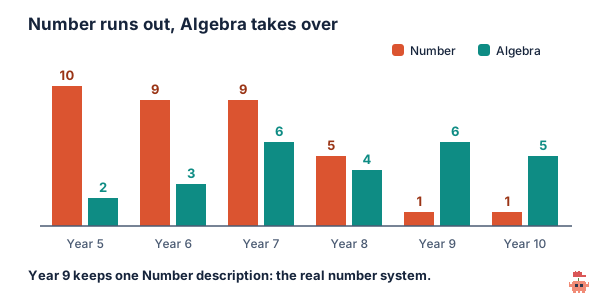
The Number strand is the part of maths a parent can help with from memory: place value, fractions, decimals, percentages, the four operations. It carries ten content descriptions in Year 5, nine in Year 6 and Year 7, five in Year 8, and then one in Year 9, AC9M9N01, which asks students to “recognise that the real number system includes the rational numbers and the irrational numbers, and solve problems involving real numbers using digital tools”. That is the whole strand.
Algebra is the largest strand in Year 9 at six descriptions, and three of them introduce things that did not exist in Year 8. AC9M9A01 extends the exponent laws to integer exponents, which means negative ones, and to variables; Year 8 stopped at positive exponents and zero. AC9M9A02 asks students to “expand binomial products and factorise monic quadratic expressions”. AC9M9A04 graphs quadratic functions and solves quadratic equations, and the same year brings trigonometry: AC9M9M03 applies “Pythagoras’ theorem and trigonometry in right-angled triangles”, and AC9M9SP01 asks students to recognise why the sine, cosine and tangent ratios are constant for a given angle.
So Year 9 is not harder arithmetic. It is a different subject with the same name. A student who reaches for a number to check an answer, which is what Year 8 rewarded, finds that in Year 9 the answer is often an expression, a graph or a ratio, and there is no number to check against. That is the specific thing to watch for, and it is a reason to be slower to read a dip in Year 9 as a dip in ability.
Year 9 by the numbers
Three learning areas, three counts, read from Version 9 rather than estimated. These are content descriptions, which is the unit a teacher plans from.
- Maths: 23 content descriptions. Algebra 6, Measurement 5, Statistics 5, Probability 3, Space 3, Number 1. The count falls from 27 in Year 8 and falls again to 21 in Year 10, so fewer descriptions, each one carrying more.
- English: 23. Language 9, Literacy 8, Literature 6. English has sat between 23 and 25 descriptions every year since Year 6; what changes is what the words inside them ask for.
- Science: 19. Science Inquiry 8, Science Understanding 7, Science as a Human Endeavour 4. The same 19 in Year 8 and again in Year 10, and the four Human Endeavour descriptions are word for word the same in Year 9 and Year 10.
One more number worth knowing: Statistics is now as large as Measurement, five descriptions, up from three in Year 7. AC9M9ST01 asks students to analyse survey reports in digital media for how the data was obtained, and AC9M9ST02 asks how sampling methods and the choice of representation can be used “to support a particular point of view”. A fourteen-year-old is being asked to read a poll the way a sceptical adult should.
Seven things a Year 9 student should manage by December
- Use the exponent laws with negative exponents, and with letters. AC9M9A01. Two to the power of minus three is one eighth, and the same rule holds when the base isx.
- Expand a binomial product and factorise a monic quadratic. AC9M9A02. Both directions: (x + 3)(x + 5) out to x² + 8x + 15, and back again. Note the word monic: the descriptor limits Year 9 to quadratics whose x² term has no coefficient in front of it.
- Find the gradient, midpoint and distance between two points on the plane. AC9M9A03. Year 8 graphed lines; Year 9 measures them.
- Use sine, cosine and tangent in a right-angled triangle. AC9M9M03 with AC9M9SP01. Pythagoras was Year 8 (AC9M8M06); trigonometry is new this year, and the curriculum asks for the why, that the ratios are constant because the triangles are similar, not just the calculation.
- Write very large and very small numbers in scientific notation. AC9M9M02. The distance to the Sun and the width of a bacterium, and time intervals, all as a number between 1 and 10 times a power of ten.
- List every outcome of a compound event and assign probabilities. AC9M9P01, “with and without replacement, using lists, tree diagrams, tables or arrays”. Two coins, two dice, two draws from a bag.
- Balance a chemical equation, and say what it conserves. AC9S9U07 in science asks students to model reactions with “word and simple balanced chemical equations” and use them to demonstrate the law of conservation of mass. It is the first place a Year 9 student meets an equation that must balance in a subject other than maths.
In English, the two descriptions parents notice are AC9E9LA06, which asks students to understand how nominalisation turns actions into abstract nouns to summarise ideas (the difference between “the council decided” and “the council’s decision”), and AC9E9LA09, punctuation conventions for referencing and citing others. Year 9 is the year the essay starts to cite.
Sprout Lessons builds a lesson from any of these codes, with the code in the footer. Start free.
What is Year 10, not Year 9
The reassuring half. Several things that get taught as “high school maths” in one breath are a year away.
- Simultaneous equations. AC9M10A02, “solve linear inequalities and simultaneous linear equations in 2 variables”. Year 9 solves one equation at a time.
- Exponential growth and decay. AC9M10A03 and AC9M10A04. Year 9 models change with “either linear or quadratic functions” (AC9M9A05); the exponential model arrives in Year 10.
- Anything past a monic quadratic with integer roots. AC9M9A04 says exactly that: “solve monic quadratic equations with integer roots algebraically”. The general case waits.
- Angles of elevation and depression, and direction. AC9M10M03. Year 9 trigonometry stays inside the triangle.
- Logarithmic scales. AC9M10M02. Year 9 does scientific notation, which is the idea underneath, without the word.
- Boxplots and scatterplots. AC9M10ST02 and AC9M10ST03. Year 9 compares distributions using “comparative representations” (AC9M9ST03) and talks about centre, spread, shape and outliers, but the two named displays are Year 10.
- Conditional probability. AC9M10P01, the language of “if ... then”, “given” and “knowing that”. Year 9 does “and” and “or” (AC9M9P02).
- Formal proof and networks. AC9M10SP01 and AC9M10SP02.
In science the split is just as clean. Genetics, DNA and inheritance are AC9S10U01, evolution by natural selection is AC9S10U02, the big bang is AC9S10U03, Newton’s laws done quantitatively are AC9S10U05 and the periodic table is AC9S10U06. Year 9 science is body systems and negative feedback (AC9S9U01), reproduction (AC9S9U02), the carbon cycle (AC9S9U03), wave and particle models of energy (AC9S9U04), energy efficiency (AC9S9U05), the atom and radioactive decay (AC9S9U06) and balanced equations (AC9S9U07). A Year 9 student who cannot explain natural selection has not been asked to yet.
The five-minute check
Four questions. You are listening to the reasoning rather than marking the answer.
- “What is two to the power of minus three?” One eighth. If the answer is minus eight, the negative sign has been read as a sign on the number rather than an instruction to divide, and AC9M9A01 has not landed. This is the single most common Year 9 error and it survives because minus eight looks like a reasonable thing for a calculator to say.
- “Expand (x + 3)(x + 5).” x² + 8x + 15. If the answer is x² + 15, the two middle products were skipped, which means the student is multiplying first with first and last with last and has never drawn the rectangle. AC9M9A02, and it is the fix that unlocks factorising too.
- “Toss two coins. What is the probability of exactly one head?” One half. If the answer is one third, the student has listed three outcomes (two heads, one of each, two tails) and treated them as equally likely. AC9M9P01 exists precisely to make them write out all four, and the tree diagram is the tool.
- Show them a headline that says “80% of readers agree” and ask who was asked. There is no single right answer, and that is the point. A Year 9 student should get to “the site’s own readers, who chose to answer” without help, because AC9M9ST02 asks exactly how a sampling method can be used to support a point of view.
If something is missing
- Go back to Year 8 exponents before Year 9 exponents. AC9M8N02 established the laws with positive exponents and numbers only. If 2³ × 2² is not automatically 2⁵, the negative exponent rule has nothing to attach to, and the letters make it worse rather than better.
- Draw every binomial as an area. A rectangle split into four parts makes the two middle terms visible, and the same picture runs backwards for factorising. Students who skip the middle terms almost always learned FOIL as a chant.
- Do trigonometry on a real triangle first. Measure a ramp, a roof or a ladder, calculate the angle, then check it with a protractor. AC9M9SP01 asks for the ratios to be understood through similarity, and a measured triangle is the fastest route to believing that the ratio does not change when the triangle gets bigger.
- Do not skip ahead to Year 10 to get ahead. Simultaneous equations and exponential models both assume the Year 9 algebra is fluent. Starting them early usually produces a student with two procedures and no idea which one to use.
- Short and often beats a holiday blitz. The plan for doing this at home without a tutor applies at fourteen as much as at nine, and most “behind” is a topic the curriculum has not asked for yet.
Year 9 is also the last NAPLAN year. The tests sit in March, so a Year 9 student is assessed on what they carried in from Year 8, not on the algebra above. ACARA’s parent and carer page is the source for what the test does and does not cover.
A note on which curriculum applies to you
Everything above is Version 9 of the Australian Curriculum, which most states and territories use. Victoria does not. Victorian schools follow the Victorian Curriculum F–10 Version 2.0, a separate document with its own codes, in which Level 9 maths runs to 24 content descriptions with Algebra again the largest strand, and the differences are set out here. New South Wales runs its own K–10 syllabuses organised by stage, so a Year 9 student there is in Stage 5, covered in our NSW explainer. Check your state before you check your child.
If you are in Victoria, Sprout Tutor now covers Year 9. It follows the Victorian Curriculum only, for Years 1 to 9, in English, maths and science, and while it is in public beta it is free on every Sprout plan, including the free one. How it decides what comes next is its own page, and it applies to Level 9 exactly as it does to Level 4.
Where to go next
- Year 9 maths, all 23 content descriptions
- Year 9 English, all 23
- Year 9 science, all 19
- Year 10 maths, if you want to see what is coming
- The same page for Year 6, the last one before the step up
The short version
Year 9 is 23 maths content descriptions, 23 English and 19 science. The real change is that the Number strand shrinks to a single description and algebra becomes the subject: negative exponents, binomial expansion, monic quadratics, gradient and distance on the plane, and trigonometry in right-angled triangles. Statistics grows to match Measurement, and asks students to read a poll for how it was sampled.
Check four things: two to the power of minus three, (x + 3)(x + 5), the probability of exactly one head from two coins, and who was asked in a headline poll.
Then leave Year 10 for Year 10. Simultaneous equations, exponential growth, logarithmic scales, boxplots, scatterplots, conditional probability, formal proof, genetics and evolution are all a year away, and the counts agree: maths falls from 23 descriptions to 21, and each one asks for more.
Sprout Lessons builds curriculum-aligned lessons for Foundation to Year 10, with the content description on every lesson. Start free.
Checked 29 September 2026 against Version 9 of the Australian Curriculum. Every code and count on this page was read from the published content descriptions for Year 9 mathematics, English and science, and the Year 8 and Year 10 descriptions the comparisons rely on. The ACARA site renders its content in the browser, so the link opens normally for a reader even though it cannot be checked by an automated tool.
© Australian Curriculum, Assessment and Reporting Authority (ACARA) 2010 to present, unless otherwise indicated. This material was downloaded from the Australian Curriculum website (accessed 2026-06-24) and was not modified. The material is licensed under CC BY 4.0. ACARA does not endorse any product that uses the Australian Curriculum.
FAQ
What should a Year 9 student know in maths?
Year 9 is 23 maths content descriptions in Version 9: Algebra 6, Measurement 5, Statistics 5, Probability 3, Space 3, Number 1. By December a Year 9 student should apply the exponent laws with negative exponents and with variables, expand binomial products and factorise monic quadratics, find the gradient, midpoint and distance between two points, use sine, cosine and tangent in right-angled triangles, write very large and very small numbers in scientific notation, find the volume and surface area of prisms and cylinders, and list every outcome of a compound event with a tree diagram or table.
Why does Year 9 maths feel so different from Year 8?
Because the Number strand almost disappears. It carries ten content descriptions in Year 5, nine in Years 6 and 7, five in Year 8 and one in Year 9, AC9M9N01 on the real number system. Algebra is the largest strand in Year 9 at six, and it introduces negative exponents, binomial products, quadratics and trigonometry, none of which existed in Year 8. A student who checks answers by reaching for a number finds that the answer is now often an expression or a graph, and there is no number to check against.
When do Australian students learn trigonometry?
Year 9. AC9M9M03 asks students to solve spatial problems applying angle properties, scale, similarity, Pythagoras' theorem and trigonometry in right-angled triangles, and AC9M9SP01 asks them to recognise the constancy of the sine, cosine and tangent ratios for a given angle using properties of similarity. Pythagoras' theorem itself is Year 8, AC9M8M06. Angles of elevation and depression and problems involving direction are Year 10, AC9M10M03.
Are simultaneous equations taught in Year 9?
No. AC9M10A02 asks Year 10 students to solve linear inequalities and simultaneous linear equations in 2 variables. Year 9 solves one equation at a time, and its quadratic work is limited by AC9M9A04 to monic quadratic equations with integer roots, solved graphically, numerically and algebraically. Exponential growth and decay are also Year 10, at AC9M10A03 and AC9M10A04.
How many content descriptions does Year 9 have?
Maths 23, English 23 and science 19. Maths falls from 27 in Year 8 to 23 in Year 9 and 21 in Year 10, so there are fewer descriptions and each one carries more. English has sat between 23 and 25 every year since Year 6. Science is 19 in Year 8, Year 9 and Year 10: Science Inquiry 8, Science Understanding 7 and Science as a Human Endeavour 4, with the four Human Endeavour descriptions worded identically in Years 9 and 10.
Does this apply in Victoria and New South Wales?
Not directly. Victoria follows the Victorian Curriculum F-10 Version 2.0, which is derived from the Australian Curriculum but is a separate document with its own codes; its Level 9 maths runs to 24 content descriptions with Algebra again the largest strand. New South Wales runs its own K-10 syllabuses organised by stage, so a Year 9 student there is in Stage 5. The sequence is broadly similar in both, but the codes and the exact wording differ, so check the document that applies to your state.