
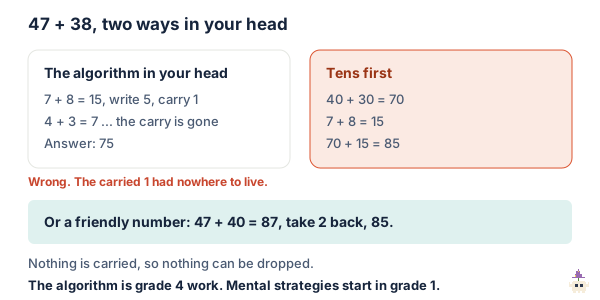
Ask your child to add 47 and 38 in their head, then ask how they did it. If the answer is “7 plus 8 is 15, write the 5, carry the 1”, they are not doing mental math. They are doing the written method with their eyes closed, and that is why it is slow and why the answer is so often 75. Mental math in the Common Core is a different thing: start with the tens, 40 and 30 make 70, then 7 and 8 make 15, so 85. Or go to a friendly number first, 47 plus 40 is 87, take 2 back, 85. No carrying, nothing to hold.
Most pages on mental math are lists of tricks. This one starts from what the standards say in grades 1 to 3, where the word “mentally” appears and where the word “algorithm” appears for the first time, the wrong answers that tell you which strategy is missing, and a five-minute check.
What the standards ask for, and when the algorithm arrives
The Common Core spends three years on mental strategies before it names the standard algorithm. These are the standards that carry it:
- Kindergarten, K.OA.A.4: for any number from 1 to 9, “find the number that makes 10 when added to the given number”. The ten-pairs. Everything below leans on them.
- Grade 1, 1.OA.C.6: add and subtract within 20 using named strategies: “counting on; making ten (e.g., 8 + 6 = 8 + 2 + 4 = 10 + 4 = 14); decomposing a number leading to a ten (e.g., 13 - 4 = 13 - 3 - 1 = 10 - 1 = 9)”, and “creating equivalent but easier or known sums (e.g., adding 6 + 7 by creating the known equivalent 6 + 6 + 1 = 12 + 1 = 13)”. The standard lists the strategies by name, with worked numbers, which is rare.
- Grade 1, 1.NBT.C.5: “Given a two-digit number, mentally find 10 more or 10 less than the number, without having to count; explain the reasoning used.”
- Grade 2, 2.OA.B.2: “Fluently add and subtract within 20 using mental strategies. By end of Grade 2, know from memory all sums of two one-digit numbers.”
- Grade 2, 2.NBT.B.5: “Fluently add and subtract within 100 using strategies based on place value, properties of operations, and/or the relationship between addition and subtraction.”
- Grade 2, 2.NBT.B.8: “Mentally add 10 or 100 to a given number 100–900, and mentally subtract 10 or 100 from a given number 100–900.”
- Grade 3, 3.NBT.A.2: add and subtract within 1000 “using strategies and algorithms based on place value”. This is the first time the word algorithms appears for addition.
- Grade 4, 4.NBT.B.4: “Fluently add and subtract multi-digit whole numbers using the standard algorithm.” The first time the standard algorithm is required.
So a grade 2 child who adds 47 and 38 by picturing columns is using a grade 4 tool for a grade 2 task. The standards for grades 1 and 2 say “mentally”, “mental strategies” and “strategies based on place value”, and two of them add “explain the reasoning used”. The column method is not a mental strategy. It is a paper method, designed so you never have to hold anything in your head, which is exactly why it falls apart when you try to.
The five wrong answers worth knowing
1. 47 + 38 = 75: the carry fell out
This is the algorithm in the head. 7 plus 8 is 15, write the 5, carry the 1, and by the time the child reaches the tens the carried 1 has gone. 4 plus 3 is 7, so 75. The written method puts that 1 on paper for a reason.
The fix: tens first, out loud. “40 and 30 is 70. 7 and 8 is 15. 70 and 15 is 85.” Left to right matches the way we say numbers, and there is never anything to carry because the tens are already done.
2. 47 + 38 = 715: the 15 went in whole
Same method, different failure. The child gets 15 for the ones and writes it in full, then 7 for the tens in front of it. A child who has never been asked whether 715 is a sensible answer for two numbers under 50 will not notice. That is the estimation habit the standards ask for from grade 3 (3.OA.D.8, “assess the reasonableness of answers using mental computation and estimation strategies”), and it belongs here.
The fix: ask “about how much?” before any calculation. About 50 and about 40, so about 90. 715 is impossible before it is wrong.
3. 10 more than 47: 48, 49, 50, 51 ... on the fingers
1.NBT.C.5 says “without having to count”. A child who counts on ten from 47 gets there, eventually, usually with one finger wrong. The standard wants them to see that 10 more changes the tens digit and nothing else: 47, 57. The grade 2 version (2.NBT.B.8) is 100 more than 362, which is 462, and a child who hesitates there has the same gap one place to the left.
The fix: a hundred chart. Ten more is one row down, ten less is one row up, and the ones digit never moves. Three days of “point to 47, now point to 10 more” usually does it.
4. 8 + 6: counting on from 8, one at a time
Counting on is a named grade 1 strategy and it is fine in grade 1. By the end of grade 2 the standards say “know from memory all sums of two one-digit numbers”, and the route from counting to memory is the make-ten strategy in between: 8 needs 2 to make 10, 6 is 2 and 4, so 10 and 4. A child who skips the middle step tends to stay on their fingers, which is a page of its own.
The fix: the ten-pairs first (K.OA.A.4): what goes with 8, with 7, with 6. Then make ten, on a ten frame if you have one and on fingers if you do not. The standard’s own worked example is 8 + 6 = 8 + 2 + 4.
5. 52 - 29 = 37: smaller from larger
The subtraction version of the algorithm in the head. 2 take away 9, you cannot, so the child does 9 take away 2 instead and gets 7, then 5 take away 2 is 3. 37. The correct answer is 23. On paper this child would at least be looking at a borrow; in the head there is nothing to look at.
The fix: do not subtract 29. Subtract 30, then give 1 back: 52 - 30 is 22, plus 1 is 23. Or count up: 29 to 30 is 1, 30 to 52 is 22, so 23. Both are the “relationship between addition and subtraction” that 2.NBT.B.5 names. If the written version of this is also going wrong, subtraction with regrouping covers it.
Want practice that asks for the strategy, not just the answer? Sprout builds a lesson from 1.OA.C.6, 2.NBT.B.5 or 2.NBT.B.8 with the standard in the footer, set around whatever your child is into. Try it free.
The five-minute check
Out loud, no pencil, and watch their hands. Ask “how did you do that?” after every answer, because the method is the diagnosis.
- “What goes with 7 to make 10?” 3, instantly. If this takes thought, start with the ten-pairs and nothing else for a week. Every strategy below uses them.
- “8 + 6?” 14. Watch for counting on the fingers. From grade 2 the target is memory or make ten; counting is the gap.
- “10 more than 47? 10 less than 83?” 57 and 73, with no counting. Counting means the hundred chart, not more sums.
- “47 + 38, and tell me how.” 85. “7 and 8 is 15, carry the 1” is the algorithm in the head, whatever the answer was. Teach tens first.
- “52 - 29?” 23. 37 is smaller-from-larger. Teach subtract 30, give 1 back.
- Grade 2 and up: “100 more than 362?” 462. 372 means the hundreds and tens are not yet separate places in their head, which is a place value question before it is a mental math one.
The twenty-minute reteach
- Ban the word carry for a month. Not forever: the algorithm is a grade 4 standard and they will need it. But while the mental strategies are being built, the column method crowds them out, because it is the one the child already has.
- Tens first, out loud, every time. “40 and 30 is 70.” Say the tens before the ones. After a few days the child does it silently, which is what mental math is.
- Make ten, with a ten frame. Two rows of five. 8 fills a row and three more; 6 more fills the frame and leaves 4. Seeing it beats being told it.
- Round the ugly number, then fix it. 47 + 38 is 47 + 40 - 2. 52 - 29 is 52 - 30 + 1. Ask “which number is nearly a ten?” and start there.
- Hundred chart on the fridge. 10 more is one down. 100 more, on a thousand chart or just by saying it, is the same move one place over.
- Ask for the strategy, not the answer. Two standards say “explain the reasoning used”. “How did you do it?” is the question, and a child who can answer it has the thing the standard is actually asking for.
What is not the problem
- Fingers in kindergarten and grade 1. K.OA.A.1 names fingers as a tool. They become a gap at the end of grade 2, not before.
- Not knowing the standard algorithm in grade 2. It is not required until grade 4. A grade 2 child who can do 47 + 38 tens first and cannot do it in columns is exactly on track.
- Being slower with a new strategy for a week. Tens first is slower than the algorithm for about five days, because the algorithm is practiced and the strategy is not. Then it is faster, and it stays faster.
Where this sits
The grade guides that carry these standards in full:
- Grade 1 math, strategies within 20 and 10 more or less
- Grade 2 math, fluency within 100 and 10 or 100 more
- Grade 3 math, within 1000 and estimation
Related pages if the trouble looks a little different: counting on fingers, which is this page one grade earlier, place value, which is underneath the 10-more and 100-more questions, and rounding, which is how the “about how much?” habit gets built.
The short version
The Common Core says “mentally” in grades 1 and 2 and does not require the standard algorithm until grade 4. A child adding in their head by picturing columns is using the wrong tool, and the carried 1 is the part that falls out.
47 + 38 is 85. 75 means the carry was dropped, 715 means the 15 went in whole, and 37 for 52 - 29 means smaller-from-larger. Counting on for 8 + 6 or for 10 more than 47 means the make-ten and hundred-chart strategies were skipped.
Tens first, make ten, round the ugly number and fix it, and ask “how did you do it?” every time.
Sprout Lessons builds standards-aligned lessons for grades K–12, with the standard on every lesson. Start free.
Standard wording checked 7 October 2026 against our copy of the Common Core dataset, accessed 2026-07-16, not written from memory. Read the official text at the grade 1 operations standards and the grade 2 base ten standards. Common Core State Standards © 2010 National Governors Association Center for Best Practices and Council of Chief State School Officers. All rights reserved. This product is not endorsed by NGA/CCSSO. Not every state uses Common Core and some sequence these topics differently: check your state department of education for the standards that apply to you.
FAQ
Why does my child get 47 + 38 wrong in their head but right on paper?
Because they are running the written column method in their head, and the carried 1 is the part that falls out: 7 plus 8 is 15, write 5, carry 1, then 4 plus 3 is 7, giving 75. Mental math goes the other way: 40 and 30 is 70, 7 and 8 is 15, so 85. Or 47 plus 40 is 87, take 2 back, 85. Nothing to carry.
What grade do kids learn mental math in the Common Core?
From grade 1. 1.OA.C.6 names the strategies, including making ten (8 + 6 = 8 + 2 + 4), and 1.NBT.C.5 asks for 10 more or 10 less mentally, without counting. Grade 2 asks for fluency within 20 using mental strategies (2.OA.B.2), within 100 using place value strategies (2.NBT.B.5), and 10 or 100 more or less mentally (2.NBT.B.8). The standard algorithm is not required until grade 4 (4.NBT.B.4).
What is the make ten strategy?
Splitting one number so the other reaches 10 first. For 8 + 6, 8 needs 2 to make 10, and 6 is 2 and 4, so 10 and 4 is 14. It is written into the grade 1 standard with that exact example, and it is the step between counting on fingers and knowing the fact from memory.
Should my second grader use the standard algorithm?
Not yet, if the goal is the grade 2 standards. They ask for strategies based on place value, and the standard algorithm first appears in grade 3 alongside strategies and is required in grade 4. A grade 2 child who can do 47 + 38 tens first and cannot do it in columns is on track.
How do I help my child with mental math at home?
Tens first, out loud: 40 and 30 before 7 and 8. Make ten on a ten frame. Round the awkward number and fix it afterwards: 47 + 38 is 47 + 40 take 2. A hundred chart on the fridge for 10 more and 10 less. And ask how did you do it after every answer, because two of the standards say explain the reasoning used.