
The VCE Vocational Major (VCE VM) is not a separate certificate: it is a two-year, hands-on way of earning the VCE. Both need 16 units. The difference is how they are assessed and what they lead to. VCE VM subjects are assessed by teachers in class, the only exam is Section A of the General Achievement Test (GAT), and they give no study scores, so they cannot count towards an ATAR. Every VCE VM student also does a VET certificate at Certificate II level or above. If your child needs an ATAR for what they want to do next, choose the VCE. If they are heading for an apprenticeship, a traineeship, TAFE or work, the VCE VM is built for that.
Most Victorian families settle this before Year 11 starts on 28 January 2027, and the choice often gets made in a single subject-selection meeting. This page sets out what each program requires, according to the Victorian Curriculum and Assessment Authority (VCAA), how a VCE VM student can still reach university, what switching between the two after Year 11 involves, and the five questions to ask your child’s school before the enrolment is locked in.
What each one requires
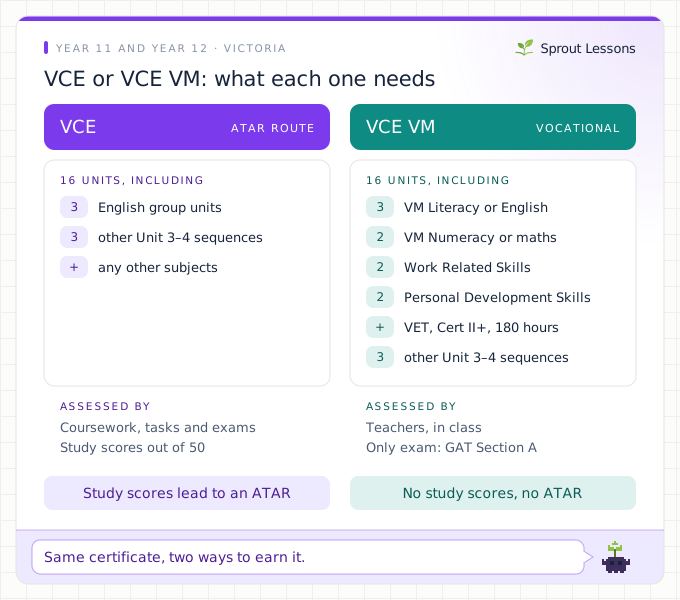
The VCE needs at least 16 satisfactory units, including three units from the English group with a Unit 3–4 sequence among them, and three more Unit 3–4 sequences in any subjects. Units 3 and 4 are assessed by school-assessed coursework, sometimes school-assessed tasks, and an external exam, and those graded assessments produce a study score out of 50. An ATAR needs the VCE plus study scores in at least four subjects, including an English subject.
The VCE VM also needs at least 16 satisfactory units, but more of them are set:
- 3 units of VCE VM Literacy or VCE English, including a Unit 3–4 sequence
- 2 units of VCE VM Numeracy or VCE Mathematics
- 2 units of VCE VM Work Related Skills
- 2 units of VCE VM Personal Development Skills
- VET at Certificate II level or above, 180 nominal hours (two VET credits)
- 3 other Unit 3–4 sequences, for four sequences in all
The four VCE VM studies (Literacy, Numeracy, Work Related Skills and Personal Development Skills) are assessed by the school only. There are no exams in them, and students who take a VCE VM Unit 3–4 sequence sit only Section A of the GAT, the literacy and numeracy section. VCE VM studies give no study score. Students who finish receive the VCE with the words “Vocational Major” added, a Statement of Results, and their VET qualification or Statement of Attainment from the training provider. According to the Victorian Government, the VCE VM is offered at about 500 schools, including every government school.
If you are wondering where VCAL went: the Victorian Certificate of Applied Learning has been discontinued, and the VCAA’s handbook says students who completed VCAL units in or before 2023 may be eligible for credit towards the VCE.
Does the VCE VM close the door to university?
Not completely, but it changes the door. Three things are worth knowing.
- VCE VM Literacy can never count towards an ATAR. The VCAA’s handbook is explicit: it generates no study score, and the Victorian Tertiary Admissions Centre (VTAC) needs a scored Unit 3–4 sequence from the English group, excluding VCE VM Literacy, to calculate an ATAR. A VCE VM student who wants to keep an ATAR possible needs VCE English, English Language, Literature or EAL at Units 3 and 4 instead.
- VCE VM students can take ordinary VCE subjects. The VCAA’s own example student, Tory, takes VCE VM Literacy, Work Related Skills and Personal Development Skills, a Certificate III through VCE VET, and Mathematical Methods across Years 11 and 12. Methods is a normal VCE subject with a study score. It does not give Tory an ATAR on its own, because the ATAR needs four scored subjects including English, but it keeps maths options open at TAFE and beyond. If maths is the question, our page on General, Methods and Specialist explains what each one leads to.
- University without an ATAR is a real route. The VCAA lists “university via non-ATAR pathways” among the places the VCE VM leads, and the Victorian Government’s page says alternative entry programs. In practice that usually means a TAFE diploma first, or a university’s own entry program, which each university sets for itself. Check the course your child has in mind rather than assuming either way.
Switching after Year 11
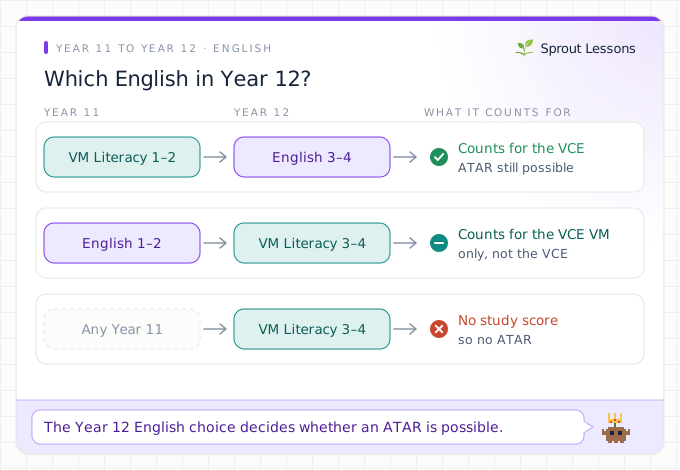
A choice made at fifteen or sixteen is not final, and the VCAA’s own table of English combinations shows it. A student who did VCE VM Literacy Units 1 and 2 in Year 11 and then English Units 3 and 4 in Year 12 meets the VCE English requirement; the VCAA notes that this is for a student whose pathway has changed from the VCE VM to the VCE. Going the other way, a student who did English Units 1 and 2 can take VCE VM Literacy Units 3 and 4, which counts for the VCE VM only.
The harder part of switching is everything else. Moving from the VCE VM to the VCE for Year 12 means VCE English Units 3 and 4 and three more Unit 3–4 sequences, and an ATAR needs study scores in four subjects, so it is a full Year 12 load. Moving from the VCE to the VCE VM means fitting in the Work Related Skills and Personal Development Skills units and 180 hours of VET, and the VCAA designs the VCE VM as a program of at least two years: its flexible delivery options cannot be used to finish it in less. So a switch into the VCE VM for Year 12 alone is a question for the school’s VCE coordinator, not something to assume. Two safety nets help. A VCE VM student who meets the ordinary VCE requirements but not the VCE VM ones is still awarded the VCE, without the Vocational Major words. And there is no limit on the years it takes: units can be accumulated over any number of years, which our page on repeating a year in Victoria covers in more detail.
How to decide
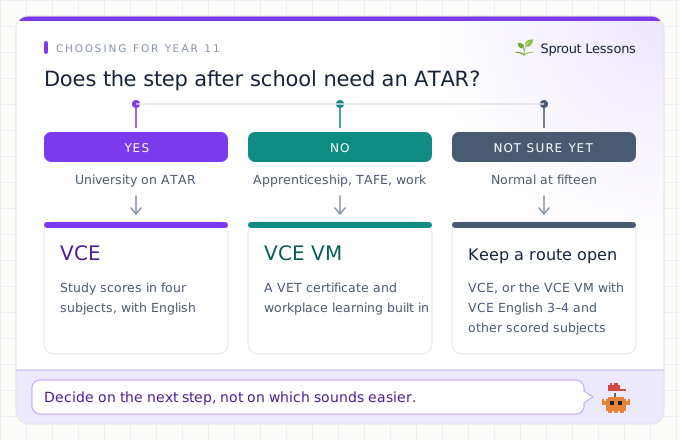
The most useful question is not which program is easier, because neither is: the VCE VM has more set units and a VET certificate on top. The question is what your child wants to do in the year after school. If it is a university course entered on ATAR, the VCE. If it is an apprenticeship, a traineeship, a TAFE course or a job, the VCE VM was built for exactly that, and finishing with a Certificate II or III and workplace experience is a real head start.
If your child does not know yet, which is normal at fifteen, you have two honest options. The VCE keeps every door open, including TAFE and apprenticeships, which do not need an ATAR either. Or the VCE VM with VCE English (not VM Literacy) at Units 3 and 4 and some ordinary VCE subjects keeps a route back to an ATAR, at the cost of a fuller timetable. The wrong reason to pick either is a friend group or a guess about which one has less homework.
Your child’s Year 10 results are useful evidence too. A student who is working below the expected level in Year 10 maths or English will find VCE Units 3 and 4 hard going, and our guide to the Victorian school report explains how to read where they sit.
Building Year 10 skills before Year 11? Sprout writes maths and English lessons on the exact Victorian Curriculum code your child needs, set in what they love, from cars to netball. Try it free.
Five questions to ask the school
- Which VET certificates do you offer, and where? Some are taught at school, some at a TAFE or another provider one or two days a week. The certificate shapes your child’s week far more than the VM subjects do.
- Can my child take ordinary VCE subjects alongside the VCE VM? The VCAA allows it; whether the timetable does is up to the school.
- If my child changes their mind after Year 11, what would Year 12 look like? Ask for the actual subjects, using the English rule above.
- How does workplace learning work here? The VCE VM can include Structured Workplace Learning Recognition as part of the VET, and schools organise it differently.
- For VCE students: which subjects will have a study score? Every VCE Unit 3–4 subject can produce one if the graded assessments are completed, and the VCAA encourages schools to support all students to do scored assessment. Make sure your child is not opting out of scores without understanding what that does to an ATAR.
The short version
- The VCE VM is a way of earning the VCE, not a lesser certificate. Both need 16 units.
- VCE VM subjects are teacher-assessed with no exams except GAT Section A, and give no study scores or ATAR.
- Every VCE VM student does VET at Certificate II level or above, 180 nominal hours.
- VCE VM Literacy can never count towards an ATAR; VCE English at Units 3 and 4 can.
- VM Literacy in Year 11 then English Units 3 and 4 in Year 12 is the VCAA’s listed route from the VM to the VCE.
- Choose from the step after school: ATAR course, the VCE; apprenticeship, TAFE or work, the VCE VM.
How this page was checked
The requirements come from the VCAA’s About the VCE Vocational Major page, the VCE section of the VCE Administrative Handbook (eligibility for the award, the table of English combinations, VCAL credit and flexible delivery) and the VCAA’s Where to Now? guide (ATAR requirements, the GAT and the example program). The GAT, the certificate wording and the number of schools come from the Victorian Government’s About the VCE Vocational Major page (updated 29 June 2026). Checked against the current rules as at 24 October 2026. University alternative entry programs are set by each university and were not checked course by course.
FAQ
Is the VCE VM a real VCE?
Yes. The VCE Vocational Major is a program within the VCE, and students who finish it receive the VCE with the words Vocational Major added. It needs 16 units, like the VCE, but more of them are set: VM Literacy or English, VM Numeracy or maths, Work Related Skills, Personal Development Skills and VET at Certificate II level or above.
Can you get an ATAR with the VCE VM?
Not from the VCE VM subjects. They are assessed by the school only and give no study scores, and VCE VM Literacy cannot count towards an ATAR. An ATAR needs the VCE plus study scores in at least four subjects including a scored English, so a VCE VM student would need VCE English Units 3 and 4 and three other scored subjects on top of the VM program.
Can a VCE VM student go to university?
Yes, but usually not on an ATAR. The VCAA lists university via non-ATAR pathways among the places the VCE VM leads, and the Victorian Government describes alternative entry programs. In practice that is often a TAFE diploma first or a university's own entry program, which each university sets, so check the course your child has in mind.
Can my child switch from the VCE VM to the VCE after Year 11?
It is possible. The VCAA's table of English combinations accepts VM Literacy Units 1 and 2 followed by English Units 3 and 4 for a student whose pathway changes from the VCE VM to the VCE. Year 12 then needs English Units 3 and 4 and three more Unit 3 and 4 sequences, so it is a full year. Ask the VCE coordinator what it would look like before Year 11 starts.
What happened to VCAL?
The Victorian Certificate of Applied Learning has been discontinued. The VCE Vocational Major is the applied learning program within the VCE now, and the VCAA says students who completed VCAL units in or before 2023 may be eligible for credit towards the VCE.