
Grade 5 has fewer math standards than grade 4 and is the harder year by a distance. Twenty-six against twenty-eight. The count goes down because grade 5 is where two long build-ups finally turn into arithmetic: fractions become something you add, subtract and multiply, and decimals become something you calculate with rather than read.
The rest of this page is the specific version: what the standards ask for, a five-minute check you can run at the kitchen table, and the list of things people expect in grade 5 that do not arrive until grade 6. That second half matters more here than in any other year, because grade 5 sits right before the cliff and almost everything a worried parent tests for is on the far side of it.
Grade 5 by the numbers
Three subjects, three counts, read from the standards rather than estimated.
- Math: 26 standards. Number and Operations in Base Ten 7, Number and Operations with Fractions 7, Measurement and Data 5, Geometry 4, Operations and Algebraic Thinking 3. Fractions and base ten tie for largest, which is the whole story of the year in one line.
- English: 43 standards. Writing 10, Informational Reading 10, Literature 9, Language 6, Speaking and Listening 6, Foundational Skills 2. Identical in shape to grade 4, and identical in total.
- Science: 16. Thirteen grade 5 standards plus the three engineering design standards published for the grades 3 to 5 band rather than for a single year, which is why a grade-level search misses them.
Foundational Skills still has two standards in grade 5, phonics and word analysis, and fluency sufficient to support comprehension. They disappear at grade 6. Grade 5 is the last year in which decoding is formally part of the curriculum, which is worth knowing if that is where your child is.
The hinge of the year, drawn
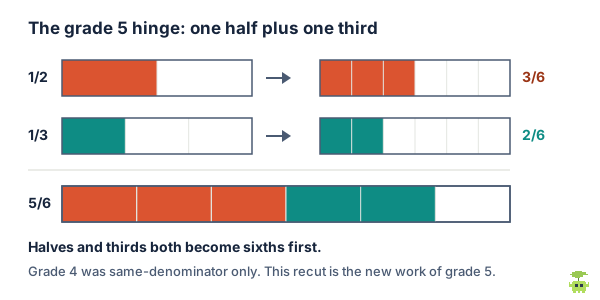
Six things a fifth grader should be able to do by June
Phrased as a parent would check them rather than as the standards phrase them.
- Add and subtract fractions with unlike denominators, including mixed numbers. 5.NF.A.1. The method the standard names is replacing the fractions with equivalent ones that do share a denominator, which is why the grade 4 equivalence idea has to be understood rather than performed before this year works at all.
- Multiply a fraction by a fraction, not just by a whole number, and know the answer can be smaller than what they started with. 5.NF.B.4 is the operation and 5.NF.B.5 is the idea, which the standard calls interpreting multiplication as scaling. This is the year the rule of thumb that multiplication makes things bigger stops being true, and a child who has not been told that out loud will assume their answer is wrong.
- Multiply multi-digit whole numbers using the standard algorithm, fluently. 5.NBT.B.5. This is the first fluency-with-an-algorithm standard in the whole of elementary math, and it arrives in grade 5 rather than grade 4, which surprises almost every parent.
- Read, write and compare decimals to thousandths, and add, subtract, multiply and divide decimals to hundredths. 5.NBT.A.3 and 5.NBT.B.7. Grade 4 stopped at hundredths and at reading them; grade 5 calculates with them.
- Divide four-digit numbers by two-digit divisors, by strategy, and explain it. 5.NBT.B.6 asks for place value strategies, the properties of operations, or the relationship between multiplication and division, illustrated with equations, arrays or area models. The explanation is the standard.
- Measure and reason about volume. Three of the five Measurement and Data standards are volume: recognizing it as an attribute, measuring it by counting unit cubes, and relating it to multiplication and addition. It is a bigger share of the year than most people expect and it is usually the part that gets squeezed out in April.
What does not arrive until grade 6
The half of the question nobody answers, and it prevents a great deal of unnecessary worry. Grade 6 is a genuinely different year, and almost everything parents reach for as a test of readiness belongs to it.
- The standard long division algorithm is grade 6. 6.NS.B.2. Grade 5 asks for two-digit divisors by strategy with an explanation. Why that matters, and what to do instead, is its own page.
- Dividing a fraction by a fraction is grade 6. 6.NS.A.1. Grade 5 goes as far as unit fractions with whole numbers, so a fifth of six and six divided by a fifth are in, and two thirds divided by three quarters is not.
- Ratios and rates are grade 6. The whole Ratios and Proportional Relationships domain starts there. There is no ratio standard in grade 5.
- Percent is not in grade 5 math at all. It arrives with ratios and rates the following year.
- Negative numbers are grade 6. The grade 5 coordinate plane standard, 5.G.A.2, says first quadrant explicitly. Nothing in grade 5 goes below zero.
- Variables and equations are grade 6. Grade 5 algebraic thinking is three standards: using parentheses, brackets and braces; writing and interpreting numerical expressions; and generating two numerical patterns and graphing the pairs. 5.OA.A.2 even asks students to interpret expressions without evaluating them, which is a reading skill rather than an algebra one.
If your fifth grader cannot do the things on this list, they are not behind. They are on schedule, and several of these are a full year away.
The five-minute check
Four questions, in this order. You are listening to the reasoning rather than grading the answer, and each one tells you something the others do not.
- “What is one half plus one third?” The hinge of the year. The answer is five sixths. If you get two fifths, your child has added the tops and added the bottoms, which means the equivalence idea from grade 4 never landed and this year has nothing to stand on. Go back and fix that before anything else.
- “Is 6 times two thirds bigger or smaller than 6? How do you know?” The scaling standard, 5.NF.B.5, and the one that catches out confident children. Multiplying by a number less than one makes things smaller. A child who says bigger is applying five years of reliable experience, which is why saying it out loud matters more than another worksheet.
- “Which is bigger, 0.7 or 0.65?” Grade 5 compares decimals to thousandths, and 0.65 is a common wrong answer for the same reason four sixths looked bigger than two thirds last year: the numbers are longer. That misconception has its own page.
- Read a page of nonfiction together and ask them to quote the bit that proves it. This is the grade 5 jump in reading, and it is precise: grade 4 asked students to refer to details and examples, while grade 5 asks them to “quote accurately from a text” when explaining what it says and when drawing inferences. Both the literature and the informational standard say it in the same words. If the answer is a summary in their own words, the skill being asked for this year is the missing one.
If something is missing
- Fix fraction equivalence before fraction arithmetic. Everything in 5.NF assumes that turning halves and thirds into sixths is obvious rather than magic. If it is magic, the arithmetic will be too.
- Say the scaling idea out loud. Multiplying by less than one makes things smaller, dividing by less than one makes them bigger. Children find this genuinely strange and nobody tells them it is supposed to feel strange.
- Do not accelerate into grade 6 to catch up. The order is load-bearing. A child who is taught the long division algorithm in grade 5 to get ahead usually ends up with a procedure and no estimate, which makes grade 6 worse rather than better.
- Protect the volume work. It is three of the five Measurement and Data standards and it is the first place a child sees three-dimensional measurement, which grade 6 builds on immediately.
- Twenty minutes a night is the realistic dose. The wider plan is here.
A curiosity worth knowing
One of the grade 5 science standards, 5-ESS2-2, asks students to “describe and graph the amounts and percentages of water and fresh water in various reservoirs”. Percent is not in grade 5 math. Science gets there first by a year, which is not a mistake in either document but does mean the vocabulary has to come from somewhere, and at home that somewhere is usually you.
Where to go next
Full standard-by-standard guides, with teaching order and the misconceptions each topic produces:
- Grade 5 math, all 26 standards
- Grade 5 English, all 43
- Grade 5 science, and the band standards
- The same page for grade 4, if you are checking backwards
The short version
Grade 5 is 26 math standards, 43 English and 16 science. Two of the math domains tie for largest, fractions and base ten, and both of them are doing the same thing: turning something the child could previously only recognize into something they have to calculate with.
Check four things. One half plus one third. Whether 6 times two thirds is bigger or smaller than 6. Whether 0.7 beats 0.65. And whether they can quote the line that proves their answer rather than paraphrasing it.
Then check the other list before worrying. Long division, dividing by a fraction, ratios, percent, negative numbers and variables are all grade 6. A fifth grader who cannot do any of them is exactly where they should be.
Sprout Lessons builds standards-aligned lessons for grades K–12, with the standard on every lesson. Start free.
Counts and standard wording checked 19 September 2026 against our copy of the Common Core and NGSS datasets, accessed 2026-07-16, not written from memory. Read the official text at the Common Core mathematics standards. Common Core State Standards © 2010 National Governors Association Center for Best Practices and Council of Chief State School Officers. All rights reserved. This product is not endorsed by NGA/CCSSO. Next Generation Science Standards © 2013 Achieve, Inc.; NGSS is a registered trademark of WestEd and this product is not endorsed by WestEd or the lead states. Not every state uses Common Core and some sequence these topics differently: check your state department of education for the standards that apply to you.
FAQ
What math should a 5th grader know?
Grade 5 is 26 Common Core math standards: base ten 7, fractions 7, measurement and data 5, geometry 4, operations and algebraic thinking 3. By June a fifth grader should add and subtract fractions with unlike denominators including mixed numbers, multiply a fraction by a fraction and know the answer can be smaller, multiply multi-digit whole numbers fluently with the standard algorithm, read and compare decimals to thousandths and calculate with them to hundredths, divide four-digit numbers by two-digit divisors by strategy with an explanation, and measure and reason about volume.
Is grade 5 harder than grade 4?
It has fewer math standards, 26 against 28, and it is the harder year. The count goes down because grade 5 is where two long build-ups turn into arithmetic: fractions become something you add, subtract and multiply rather than compare, and decimals become something you calculate with rather than read. Fractions and base ten tie for the largest domain of the year.
Should my 5th grader be doing long division?
Not the standard algorithm. That is 6.NS.B.2. Grade 5 asks for whole-number quotients with up to four-digit dividends and two-digit divisors using strategies based on place value, the properties of operations, or the relationship between multiplication and division, illustrated and explained with equations, arrays or area models. The explanation is the standard rather than the answer.
What fractions should a 5th grader be able to do?
Adding and subtracting with unlike denominators including mixed numbers at 5.NF.A.1, interpreting a fraction as division at 5.NF.B.3, multiplying a fraction or whole number by a fraction at 5.NF.B.4, understanding multiplication as scaling at 5.NF.B.5, and dividing unit fractions by whole numbers and whole numbers by unit fractions at 5.NF.B.7. Dividing a fraction by a fraction in general is grade 6.
When do children learn percent and ratios?
Grade 6. There is no percent standard and no ratio standard anywhere in grade 5 math. One curiosity: the grade 5 science standard 5-ESS2-2 asks students to describe and graph the amounts and percentages of water and fresh water in various reservoirs, so science reaches the word a year before math does.
How do I know if my 5th grader is behind?
Run four questions and listen to the reasoning. One half plus one third. Whether 6 times two thirds is bigger or smaller than 6. Whether 0.7 beats 0.65. And whether they can quote the line that proves their answer rather than paraphrasing it. Then check what is grade 6 before worrying, because long division, dividing by a fraction, ratios, percent, negative numbers and variables are all a full year away.