
Grade 7 math is 24 Common Core standards, and it is the only year between kindergarten and high school that teaches probability. Four standards, 7.SP.C.5 to 7.SP.C.8, and then the word does not appear in another standard until high school statistics. Add the four sampling and inference standards next to them and Statistics and Probability is 8 of the 24, a full third of the year, and it is the domain most likely to get quietly dropped at home.
The other thing worth knowing before you plan: 24 standards is fewer than grade 6’s 29, and grade 7 is not an easier year. The count fell because The Number System shrank to three standards, and those three carry every operation on every kind of number.
The year runs about 180 to 210 hours at home, roughly an hour a day across four days.
The 24 standards, by domain
| Domain | Standards | What it is |
|---|---|---|
| Statistics and Probability | 8 | Sampling, inference, comparing populations, and all of probability |
| Geometry | 6 | Scale drawings, constructing triangles, cross sections, circles, angles, volume |
| Expressions and Equations | 4 | Linear expressions, multi-step problems, equations and inequalities |
| The Number System | 3 | All four operations on all rational numbers, negatives included |
| Ratios and Proportional Relationships | 3 | Unit rates with fractions, proportional relationships, percent problems |
Do not plan this year by counting. The three Number System standards will take longer than the eight statistics ones, and 7.RP.A.2 is a single line of text carrying the idea that grade 8 algebra is built on.
The three hard ones
7.NS.A.1 and 7.NS.A.2, arithmetic with negatives
Apply and extend previous understandings of addition and subtraction to add and subtract rational numbers; represent addition and subtraction on a horizontal or vertical number line diagram. Apply and extend previous understandings of multiplication and division and of fractions to multiply and divide rational numbers.
The misconception: that a minus sign is an instruction to make things smaller. Grade 6 taught negatives as position on a number line, deliberately, and grade 7 is where the arithmetic lands on top of that.
The wrong answer it produces: two of them, and they are the most common errors in the whole year. Ask for -3 - (-5) and you get -8. Ask for -4 × -6 and you get -24, or you get 24 with no idea why. A child who has memorized “two negatives make a positive” will also cheerfully apply it to -3 + -5 and answer 8.
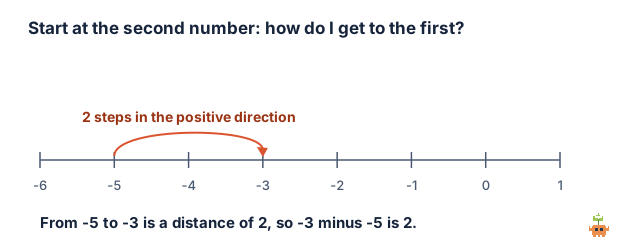
The reteach: notice that the standard itself says represent addition and subtraction on a number line diagram. That is not a suggestion about pedagogy, it is what is being assessed. Subtraction is not “take away” here, it is the distance and direction from one number to the other. From -5 to -3 you travel 2 steps in the positive direction, so the answer is 2. Every subtraction gets read aloud as “starting at the second number, how do I get to the first”, and the sign rules stop needing to be memorized.
Multiplication is a separate repair and should not be taught in the same week. Build it as a pattern the child completes themselves: 3 × -4, 2 × -4, 1 × -4, 0 × -4, then keep going. They will write -1 × -4 = 4 before you tell them, and having produced it they tend to keep it.
7.RP.A.2, what makes a relationship proportional
Recognize and represent proportional relationships between quantities.
The misconception: that any relationship with a steady pattern is proportional. This is the single most consequential misunderstanding in middle school math, because grade 8 turns proportional relationships into slope and then into linear functions.
The wrong answer it produces: a plumber charges a $50 call-out fee plus $30 an hour. Ask whether doubling the hours doubles the bill and most children say yes. Two hours is $110 and four hours is $170, which is not double, and the child who answered yes has no way to notice. Every table with a constant step looks proportional to them, because in grade 6 every table they saw was.
The reteach: two questions, asked of every single relationship for a term. Does it pass through zero? Zero hours has to cost zero dollars. And is y divided by x the same every time? For the plumber it is 55, then 42.50, then 36.67, which visibly is not constant. Two columns on a table, one for the numbers and one for y divided by x, and proportional stops being a vibe and becomes a test the child can run.
Keep a few non-proportional relationships around on purpose. A child who has only ever seen proportional tables has learned nothing about proportionality, because they have never had to distinguish it from anything.
7.RP.A.3, percent increase and decrease
Use proportional relationships to solve multistep ratio and percent problems.
The misconception: that a percent is a fixed quantity rather than a share of something that keeps changing.
The wrong answer it produces: the classic. A price goes up 20% and then down 20%, and the child says it is back where it started. It is not: it is at 96%. Same family, a shop offers 20% off and then another 10% off, and the child adds them to 30%. Adults get both of these wrong constantly, which is worth saying out loud to a child who is embarrassed about it.
The reteach: stop adding and subtracting percents and start multiplying. Up 20% is × 1.2. Down 20% is × 0.8. Together that is × 0.96, and the 4% loss is visible in the arithmetic rather than being a surprise. Two successive discounts are × 0.8 then × 0.9, which is × 0.72, so 28% off rather than 30%. Once percent change is a multiplier, compound interest in high school is already done.
The domain that gets cut, and why not to cut it
Statistics and Probability is a third of grade 7 and it is the first thing to go when a year runs long. It feels optional in a way the algebra does not, and nothing in grade 8 obviously depends on it.
Two reasons to keep it anyway. The first is structural: probability appears in exactly these four standards and then not again until high school. There is no grade 8 revision, no second pass. Skip it in grade 7 and a child meets probability next in a high school course that assumes it was covered.
The second is that the sampling standards are the most directly useful mathematics in middle school. 7.SP.A.1 says outright that generalizations from a sample are valid only if the sample is representative. That is the entire basis for reading a news article about a survey, and it is four sentences long.
It also happens to be the cheapest domain to teach at home. Dice, coins, a bag of colored counters and a question the child actually wants answered. 7.SP.C.6 asks for long-run relative frequency, which means rolling a die 200 times and watching the fractions settle, and that is a genuinely good afternoon rather than a chore.
One misconception worth catching while you are there: after four heads in a row, ask what is more likely next. A lot of children say tails, “because it is due”. Coins have no memory, and 7.SP.C.7 comparing a model against observed frequencies is exactly where to have that argument.
The three-year spine
One idea runs from grade 6 to grade 8 under three different names, and seeing it laid out makes both middle school years easier to plan.
| Grade | Name | What it is |
|---|---|---|
| 6 | Ratio and unit rate | Two quantities compared, in a table or a double number line |
| 7 | Proportional relationship | The same thing named as an object, with a constant of proportionality |
| 8 | Slope, then linear function | The constant becomes the slope of a graph, then the rate of change of a function |
The word proportional appears in only three standards across all of K to 8: 7.RP.A.2, 7.RP.A.3 and 8.EE.B.5, and the grade 8 one is where it is reinterpreted as slope. If a child leaves grade 7 unable to tell a proportional relationship from a merely steady one, grade 8 algebra has no foundation, and that is the failure that shows up as “they were fine until algebra”.
How long this actually takes at home
About 180 to 210 hours. Where it goes:
- The Number System: about a quarter, from three standards, because negative arithmetic needs rebuilding rather than covering.
- Statistics and probability: about a quarter, and much of it is data collection that runs alongside other work rather than replacing it.
- Ratios and proportion: a fifth, concentrated on 7.RP.A.2 and 7.RP.A.3.
- Geometry and expressions split the rest, and geometry is more enjoyable than it looks: 7.G.A.2 is constructing triangles with a ruler and protractor.
What to cut when it runs long. 7.G.A.3 (cross sections of solids) and 7.G.B.6 (composite area and volume) compress into single sittings. 7.SP.B.3 (visual overlap of two distributions) is the one statistics standard that can wait. Do not cut negative arithmetic, 7.RP.A.2, or the probability block, for the reasons above.
Readiness check
- Can they place negatives on a number line without hesitating? Grade 6 taught negatives as position (6.NS.C.5 to C.7). If -8 versus -3 is still slow, do not start grade 7 arithmetic on top of it.
- Fraction division. 7.RP.A.1 asks for unit rates from ratios of fractions in the first standard of the domain. That is 6.NS.A.1 with the training wheels off.
- Decimal fluency. Grade 6 was the last year the standards asked for it, and grade 7 spends the whole year on rational numbers in every form. A child still slow on decimal arithmetic will find this year exhausting for reasons that have nothing to do with grade 7.
- Do they know what a variable is? Not can they solve for one: can they say that a letter is a number. 7.EE.B.4 assumes it completely.
A sequence for a flexible year
- Adding and subtracting negatives (7.NS.A.1), on a number line, read aloud as journeys rather than take-aways.
- Multiplying and dividing negatives (7.NS.A.2), separately, weeks later, via the descending pattern the child completes themselves.
- All four operations in context (7.NS.A.3, 7.EE.B.3), which consolidates and is where the year’s arithmetic actually gets fluent.
- Unit rates with fractions (7.RP.A.1), the bridge from grade 6.
- Proportional or not (7.RP.A.2), the two questions, run on every relationship you meet for a term.
- Percent as a multiplier (7.RP.A.3), including the up-20-down-20 trap on purpose.
- Expressions and equations (7.EE.A.1, A.2, B.4), where factoring and expanding arrive and where 7.EE.A.2 quietly asks the child to say why a rewritten form is useful.
- Probability (7.SP.C.5 to C.8), the dice and coins block, ideally in a run of consecutive days.
- Sampling and inference (7.SP.A.1 to B.4), built around a question the child chose.
- Geometry (7.G.A.1 to B.6), with scale drawings and triangle construction first, circles and angles after, and cross sections last.
The split-grade case
- Grades 6 and 7 combine well. They share all five domain names and the ratio thread runs straight through. A shared block on proportional reasoning with different expectations is realistic and worth doing.
- Grades 7 and 8 combine badly. Grade 8 drops Ratios and Proportional Relationships entirely and adds Functions, and its geometry is transformations rather than measurement. The two years barely overlap.
- Probability and data collection combine with anything. Rolling dice and tallying works from about grade 3 upward, with each child asked a different question about the same data. It is the one genuinely multi-age block in the year.
And the standing reminder: a child two grades apart across subjects is normal. A strong reader who needs another year on negatives should have it, because grade 8 built on shaky grade 7 arithmetic is a much more expensive problem.
Evidence and records for this grade
Grade 7 is not a testing year in Pennsylvania (3, 5 and 8) or North Dakota (4, 6, 8 and 10), but testing years vary by state, so read your own rather than assuming. See what goes in a homeschool portfolio for the general shape.
Worth keeping, specifically for grade 7:
- The proportional-or-not table. A page of relationships with the y-divided-by-x column filled in and a verdict on each. It is 7.RP.A.2 in one artifact and it shows reasoning rather than answers.
- The probability experiment with its raw tally. Two hundred rolls, the running fractions, and a sentence comparing what happened to what the model predicted. That is 7.SP.C.6 and 7.SP.C.7 together.
- The sampling investigation. The child’s own question, how they chose the sample, and one honest paragraph on why the sample might not represent the population. The honesty is the standard.
The honest summary
Twenty-four standards, about 195 hours, and a smaller list than grade 6 that is not a lighter year. Three standards carry all rational-number arithmetic, and rebuilding negatives is where the time goes.
Three repairs. Subtraction read as a journey on the number line, so -3 - (-5) stops being -8. Two questions asked of every relationship, does it pass through zero and is y over x constant, so proportional becomes a test rather than a feeling. And percent change as a multiplier, so that up 20% then down 20% lands on 96% where the child can see it.
Then the one that needs protecting: a third of this year is statistics and probability, and probability does not come back before high school. It is also the cheapest and most enjoyable thing in grade 7 to teach at home, which makes it a strange thing to have cut.
The previous math year is grade 6, the next is grade 8, the science running alongside is middle school science, and for the planning method behind these pages, what a scope and sequence actually is.
Sprout Lessons builds standards-aligned lessons for grades K–12. Start free.
Common Core State Standards © 2010 National Governors Association Center for Best Practices and Council of Chief State School Officers. All rights reserved. Accessed via the Common Standards Project (accessed 2026-07-16). This product is not endorsed by NGA/CCSSO. Standard counts and domain names in this guide were taken from that dataset, not written from memory. Not every state uses Common Core: check your state department of education for the standards that apply to you.
FAQ
Why does my child say minus three minus minus five is minus eight?
Because they read a minus sign as an instruction to make things smaller. Grade 6 taught negatives as position on a number line deliberately, and grade 7 puts the arithmetic on top. Follow the standard, which says to use a number line diagram: subtraction is the distance and direction from one number to the other, so from -5 to -3 you travel two steps in the positive direction and the answer is 2. Teach multiplying negatives weeks later, separately, as a descending pattern the child completes themselves.
What actually makes a relationship proportional?
Two things, and a child should test both. It has to pass through zero, since zero hours must cost zero dollars, and y divided by x has to be the same every time. A plumber charging a fifty dollar call-out plus thirty an hour fails both: two hours is 110 and four hours is 170, which is not double. Every table with a constant step looks proportional to a child who has only ever been shown proportional tables, so keep counterexamples around deliberately.
Why is a price not back where it started after 20% up and 20% down?
Because the second percent is taken from a different number. Up 20% is times 1.2 and down 20% is times 0.8, which together is times 0.96, so the price is 4% lower than it began. The same reasoning shows that 20% off then 10% off is 28% off rather than 30%. Once percent change is a multiplier rather than an addition, compound interest in high school is already done, and it is worth telling a child that most adults get this wrong.
How many standards are in grade 7 Common Core math?
Twenty-four: eight in Statistics and Probability, six in Geometry, four in Expressions and Equations, three in The Number System, and three in Ratios and Proportional Relationships. That is fewer than grade 6, which had 29, and it is not an easier year. The count fell because The Number System shrank to three standards that carry every operation on every kind of number.
Is grade 7 really the only year that teaches probability?
Between kindergarten and high school, yes. Probability appears in 7.SP.C.5 through 7.SP.C.8 and then not in another standard until high school statistics. There is no grade 8 revision and no second pass, so a child who skips it meets probability next in a course that assumes it happened. It is also the cheapest and most enjoyable thing in grade 7 to teach at home, which makes it a strange thing to have cut.
What can I safely cut from grade 7 math?
Cross sections of solids (7.G.A.3) and composite area and volume (7.G.B.6) compress into single sittings, and the visual overlap of two distributions (7.SP.B.3) is the one statistics standard that can wait. Do not cut negative arithmetic, 7.RP.A.2, or the probability block. The first is assumed everywhere in grade 8, the second is what grade 8 algebra is built on, and the third does not come back.