
Parents do not renew because the session went well. They renew because they can see something changed. Those are different things, and the gap between them is where tutoring clients quietly go.
The report is the only artifact most parents ever actually hold. They were not in the room, they cannot judge your subject knowledge, and their child says “fine” when asked. What they have is whatever you send afterwards, and for a great many tutors that is a friendly paragraph that could describe any student on the books.
Why reporting is the pain, not scheduling
The obvious thing to automate is calendars, and most tutoring software starts there. It is the wrong end.
The OECD’s TALIS 2024 survey of teachers makes the point precisely: “Although administrative tasks account for a comparatively small proportion of total working time, high levels of teachers report them as sources of stress.” The survey suggests why: teachers see this work as interfering with the actual job rather than as neutral bureaucracy. In Australia, to take one system’s breakdown, the most common sources of teacher stress were too much administrative work (69%), too much marking (50%), and keeping up with curriculum changes (46%).
For a private tutor, that ordering is sharper still, because the hour is the invoice. Preparation, grading and writing to parents are unbilled by definition. Shaving ten minutes off scheduling saves ten minutes of a small problem. Removing the grading, and having the report fall out of the work rather than being composed after it, is the one that changes the economics.
What a report has to contain to be worth sending
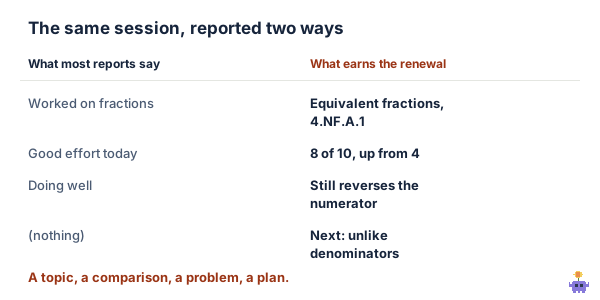
Four things, and a report missing any of them is doing less work than it looks like.
- What you covered, named specifically. Not “fractions”. “Equivalent fractions with related denominators”, and if you can attach the curriculum code from the child’s own system, attach it. A parent can take a code to a teacher. They cannot take “fractions” anywhere.
- What changed, as a number. Eight of ten today against four of ten two weeks ago. It does not have to be a formal assessment. It has to be two points in time, because progress is a comparison and a single score is not one.
- What is still wrong, stated plainly. This is the part tutors avoid and the part that builds the most trust. A report with no remaining problem in it reads as either flattery or a finished job, and neither is a reason to book another term.
- What happens next. One sentence. It answers the question the parent has not asked out loud, which is whether you have a plan or are improvising weekly.
The three habits that lose clients
- Reporting effort as though it were progress. “Tried hard, stayed focused, great attitude.” All true, all worth saying, none of it evidence. A parent who receives six of these in a row starts doing the arithmetic on the fee.
- Waiting for the end of term. A report that arrives with the renewal invoice looks like a sales document. The same content sent weekly, in four lines, is a record.
- Forwarding the raw dashboard. Whatever tool you use, a screenshot of its analytics is your working, not their report. Parents want the finding, not the data.
Make it a by-product, not a task
The reason reports get thin is not that tutors do not care. It is that writing one honestly means reconstructing, from memory, an hour that finished forty minutes ago, and memory produces adjectives rather than numbers.
The fix is structural: if the practice is delivered by something that asked the questions, it already holds the report. Whatever asked knows what it asked, what the right answer was, and what the student chose. Which topics went badly is then a fact in a table rather than an impression to be recalled.
This is also the difference between a practice tool and a general AI assistant. An open chatbot can help a student and leaves you nothing to report, because nobody recorded what was asked or whether it was right. That distinction is worth understanding before choosing anything, and it is laid out in chatbot versus tutor.
We are building for this, so read it as the interest it is. Sprout Tutor is in development: a student works behind their own PIN, every question is tied to a code in their own curriculum across seven frameworks including Common Core, and the adult view shows the literal questions they got right and wrong plus which codes they are struggling on. It is not released yet and I am not selling it to you today. The point that stands regardless is that a report you have to write will always be worse than a report that already exists.
A four-line template
Send this weekly. It takes two minutes if the underlying record exists, and it outperforms a page of prose.
- Covered: equivalent fractions with related denominators (4.NF.A.1).
- Now: 8 of 10 correct, up from 4 of 10 two weeks ago.
- Still catching her out: reverses the numerator and denominator when the fraction is written in words.
- Next session: comparing fractions with unlike denominators, plus five minutes on the reversal.
Four lines. It contains a specific topic, a comparison over time, a named remaining problem and a plan, which is all four of the requirements above and roughly none of the adjectives.
Two things worth being careful about
Do not report a curriculum code you have not checked. If you attach a code, a parent may well take it to the classroom teacher, which is exactly the outcome you want and exactly why the code has to be right. Read it from the actual standards document or from a tool that carries them, never from memory.
Do not let the tool become the relationship. The recurring finding in research on AI-assisted tutoring is that the degree of human involvement is what determines whether it works. That is a commercial argument as well as a pedagogical one: the automated part is not what the parent is paying for, and a report that reads as machine-generated undoes the thing it was supposed to demonstrate. Let the tool supply the facts and supply the judgment yourself.
The short version
Parents renew on evidence, and the report is the only evidence most of them ever see. Four things make one worth sending: the specific topic, ideally coded; a number compared with an earlier number; the problem that is still there; and the next step.
Automating your calendar addresses a small problem. The expensive, unbilled work is preparation, grading and writing to parents, and the durable fix is structural: deliver practice through something that asked the questions, so the record exists before you sit down to write.
Then add the judgment, which is the part being paid for. Four honest lines a week will hold a client that a page of warm adjectives will not.
Sprout Lessons builds standards-aligned lessons for grades K–12, with the code on every lesson. Start free.
Checked 15 September 2026. The finding that administrative tasks take a comparatively small share of working time while being a disproportionate source of reported stress, and the Australian breakdown of stress sources, are from the OECD’s The demands of teaching: Results from TALIS 2024. TALIS surveys school teachers rather than private tutors, so it is the closest available evidence rather than a direct measurement of tutoring work, and it is presented here as such.
FAQ
What should a tutoring progress report actually contain?
Four things. The topic you covered, named specifically and ideally carrying the curriculum code from the child’s own system. A number compared with an earlier number, because progress is a comparison and a single score is not one. The problem that is still there, stated plainly. And one sentence on what happens next. A report missing any of those is doing less work than it appears to.
Why do clients leave when the sessions are going fine?
Because the parent was not in the room, cannot judge your subject knowledge, and gets fine when they ask their child. The report is the only artifact they hold, and if it reports effort rather than progress, good attitude, tried hard, stayed focused, then after about six of them they start doing the arithmetic on the fee. All of those observations are true and worth making, but none of them is evidence that anything changed.
Should I automate my scheduling to save time?
It is the wrong end of the problem. For a private tutor the teaching hour is the invoice, so preparation, grading and writing to parents are unbilled by definition. The OECD’s TALIS 2024 finds that administrative tasks take a comparatively small share of working time yet are a disproportionate source of reported stress, because they are experienced as interfering with the real work. Ten minutes off scheduling saves ten minutes of a small problem; removing the grading changes the economics.
How often should I send a progress report?
Weekly, and short. A report that arrives with the renewal invoice looks like a sales document no matter how good it is, while the same content sent in four lines every week is a record. Four honest lines weekly will hold a client that a page of warm adjectives at the end of term will not.
Can I just forward the app’s dashboard to the parent?
No. Whatever tool you use, its analytics screen is your working rather than their report. Parents want the finding, not the data, and a screenshot transfers the interpretation work to someone who is paying you to do it. Read the dashboard, then write the four lines.
Will using an AI tool make my reports look automated?
It can, and that is worth guarding against, because the automated part is not what the parent is paying for. The recurring finding in research on AI-assisted tutoring is that the degree of human involvement determines whether it works, which is a commercial argument as well as a pedagogical one. Let the tool supply the facts, which is what it is good at, and supply the judgment yourself, which is what you are being paid for.