
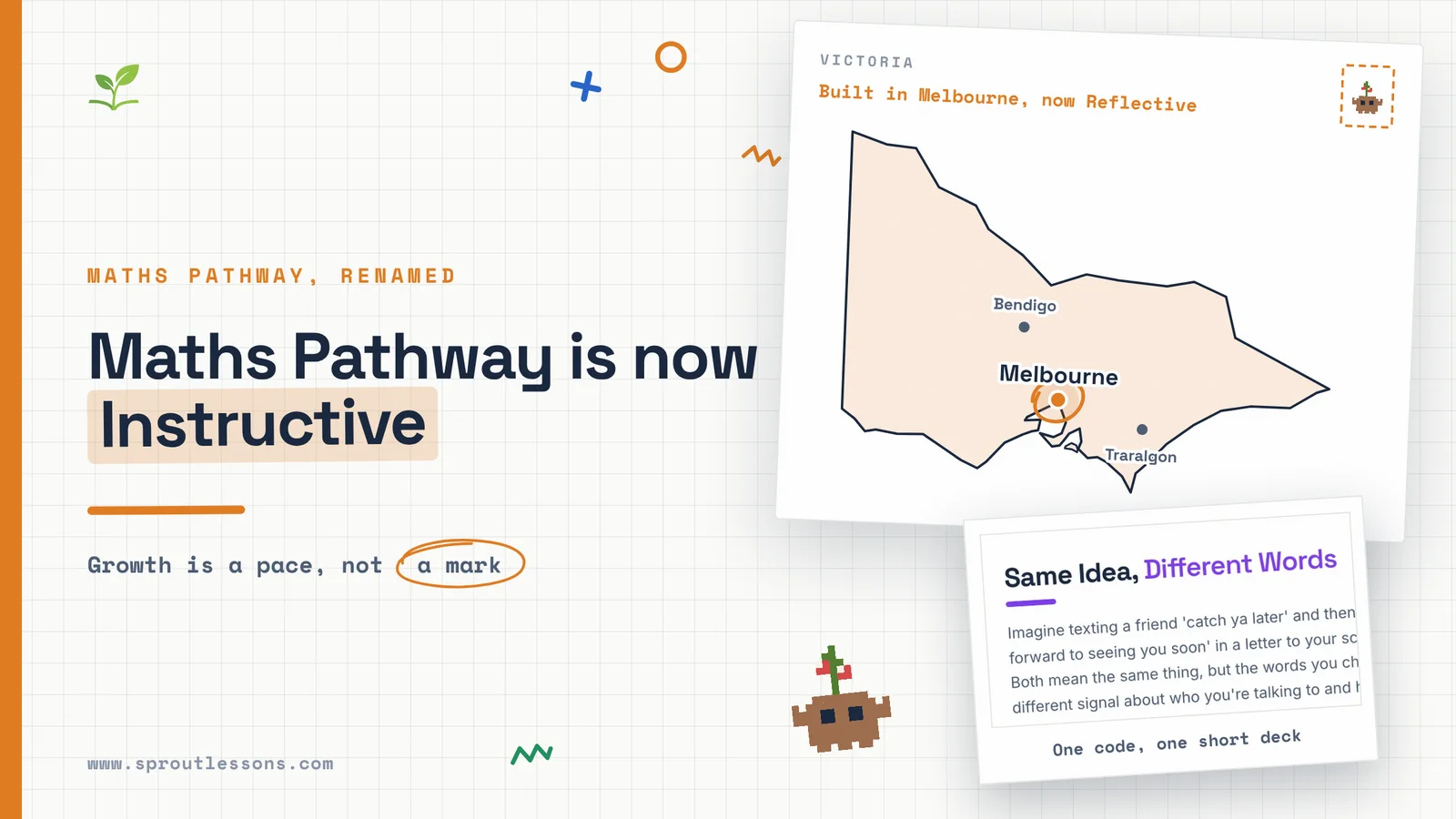
Maths Pathway has been renamed. The company is now called Reflective, the version schools buy is now called Instructive, and the name Maths Pathway lives on only in a separate product for homeschooling families. If you type mathspathway.com today, you land on reflective.global. Nothing about that changes what happens in your child’s maths class tomorrow, but it does explain why the school newsletter, the login page and the website no longer use the same name.
This page is for parents whose child’s school uses it, mostly in Years 5 to 10. It covers what changed, what the familiar Growth, Effort and Accuracy percentages mean, which claims on the new site deserve a second look, and what you can actually see from home. Everything about the rename comes from Reflective’s own pages, read on 13 October 2026. We build a competing practice tool, Sprout Tutor, and say so where it comes up.
What changed, in one table
| Old name | New name | Who it is for |
|---|---|---|
| Maths Pathway (the company) | Reflective | Everyone. The site says: “You may know us as Maths Pathway, now Reflective.” |
| Maths Pathway (in schools) | Instructive | Schools, Years 5 to 10. Priced per school by quote. |
| Maths Pathway for homeschoolers | Maths Pathway Homeschool | Homeschooling families, Years 1 to 10, $299 a year or $29 a month per child. |
| (new) | Lingo and Lingo Home | A literacy program: Years 7 to 9 in schools, and a home version. |
Reflective describes itself as the coming together of two companies, “Reflective Learning in South Africa and Maths Pathway in Australia”. The teacher login still runs on a mathspathway.com address, so a student or parent login link from the school may still say Maths Pathway too. If you are a homeschooling parent comparing it as a purchase, we wrote a separate page: Maths Pathway Homeschool vs Sprout Tutor.
What Instructive adds: explicit teaching
The one substantive change the new name signals is in Reflective’s own words: Instructive is “the evolution of Maths Pathway, with explicit teaching now built in”. It lists ready-to-use lesson ideas with worked examples, topic tests and optional exams, and alignment to the Victorian Curriculum, the NSW syllabus, the Australian Curriculum and the WA curriculum.
That matters because a worry parents raised about the original model, including in one school’s own consultation before adopting it, was that their child spent maths class working alone through modules on a laptop. Schools that used it typically described about 70 per cent of class time as individual module work, often set as homework too, and the rest as whole-class problem solving. The research on mastery approaches backs the worry up in general terms: the Evidence for Learning toolkit rates mastery learning as worth about five months of progress, but notes it appears “much less effective when students work at their own pace”. A version with the teacher teaching more of the lesson is a reasonable response to that. How much your child’s class has actually changed depends on the school, so it is worth asking.
Reading Growth, Effort and Accuracy
The three percentages are the numbers most parents actually see, in an email or on the parents and carers page, after each fortnightly test. Reflective’s current homeschool page still uses the same three words:
- Effort: “how consistently your child completes their assigned learning”.
- Accuracy: “how well they demonstrate understanding of the concepts assessed”.
- Growth: “how much progress they make through the curriculum over time”.
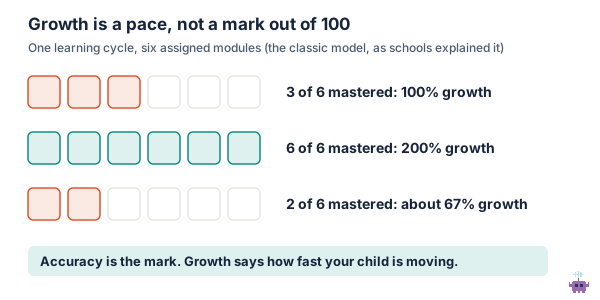
Growth is the one that confuses people, because it routinely goes above 100 per cent. In the classic school model, as maths coordinators explained it in their newsletters, a student was assigned six modules per learning cycle, then sat a test on that cycle’s work. Mastering three of the six earned 100 per cent growth. Mastering all six earned 200 per cent. So 100 per cent does not mean full marks: it is roughly a pace, and a student mastering six modules every cycle was expected to finish the year at 200 per cent or more.
Read together, the three numbers tell different stories. High effort with low accuracy means your child is doing the work and something is not landing, which is a conversation to have with the teacher about the explanation, not about trying harder. Low effort with high accuracy usually means the work is too easy or not being done at home. Growth below 100 per cent for several cycles in a row is the signal that matters most, because it means your child is moving through the curriculum slower than a year’s pace.
One honest caveat: the six-module, 100-and-200 description comes from school newsletters about the original model, and Reflective’s help centre now labels its explanation as being for “Maths Pathway Classic”. Instructive may set cycles or targets differently, and the help pages could not be read for this page. Ask the teacher what 100 per cent means in your child’s class this year.
Two claims on the new site worth reading carefully
The Instructive page says “School studies using PatMaths show students learn nearly 50% faster with Instructive.” Its FAQ, further down the same page, says the program results in “60% faster learning annually”. Those are two different figures for the same claim, and the page does not say faster than what, over how long, or in which schools. PAT Maths is a real, well-built national test, and we explain how to read it in what a PAT Maths score means. One detail from that page is relevant here: from Year 6 onwards the average PAT Maths score rises by less than 3.5 points a year, so a percentage-faster claim built on PAT gains can rest on a few scale points. Neither figure is necessarily wrong. Neither is independent, and until the method is published it is a marketing number.
What a parent can see from home
In the classic model, schools told parents to log in with their child’s details and click a parents and carers link at the top of the home screen, and that they could sign up for emails with each test result. The new Instructive pages describe teacher dashboards in detail and do not describe a parent view at all, and the homeschool product has its own parent hub, called Reflective Home, which is not the school product. So the honest answer is: check with the school whether the parent link still works in Instructive, and whether they will forward the test emails.
Either way, what you get is a summary: modules mastered and three percentages. It will tell you that accuracy dropped. It will not usually tell you which question your child got wrong, or what they wrote instead, which is where the useful information is.
Want to see the actual questions? Start free and turn on Sprout Tutor for your child: every answer shows up on your dashboard as the question itself, on the Victorian Curriculum, free while in beta.
What Instructive does that home practice cannot
- It is the whole maths program, taught by a teacher. Lesson ideas, investigations, topic tests and exams across the full Years 5 to 10 sequence, with a teacher in the room deciding when to stop and reteach. Nothing your child does at home replaces that.
- It shows a teacher the whole class at once. Which students are stuck on the same module, who is ahead, who needs to be pulled aside. A home tool only ever sees one child.
- It runs in every state. The school product claims alignment to every Australian curriculum. Sprout Tutor follows the Victorian Curriculum only, for now.
When home practice helps alongside it
If Growth has been under 100 per cent for a few cycles, or accuracy keeps dropping on one kind of module, a short bit of targeted practice at home on that topic is reasonable. Ask the teacher which modules are stuck, and practise those, not next term’s.
Sprout Tutor is our version of that for Victorian families. Your child unlocks their own page with a PIN you set, picks maths, sees a short teaching deck on one Victorian Curriculum code, then answers ten questions on it. It moves up a tier after three right in a row and down after five wrong, by fixed rules, and your dashboard shows each question with the answer your child gave. It does not connect to Instructive or know what was set at school, so you choose the topic. As with every personalised-learning product, Instructive included, its effectiveness has not been independently established. How Sprout Tutor works has the detail, and our Year 7 transition page covers the jump many Instructive students make in the same years.
The short version
- Maths Pathway is now Reflective. The school product is Instructive (Years 5 to 10).
- Maths Pathway Homeschool is a separate paid product for families, not what your school uses.
- Growth of 100 per cent was a pace, not a mark, in the classic model. Accuracy is the mark.
- The “50% faster” and “60% faster” claims have no published method on the page.
- Ask the school whether the parent link and result emails still work.
Checked 13 October 2026. Rename, products, year ranges, prices and quoted claims from reflective.global and its Instructive for schools page; mathspathway.com redirects there. The classic Growth, module and parent-portal details come from Australian school newsletters about the original program; Reflective’s help centre could not be fetched, so they were not confirmed against it. We are not affiliated with Reflective. Sprout Tutor is ours, is in public beta, follows the Victorian Curriculum only, and is free on every plan while in beta.
Got a fortnightly result and a stuck module? Start free and practise that topic on the Victorian Curriculum tonight.
FAQ
What happened to Maths Pathway?
The company renamed itself Reflective, describing it as the coming together of Reflective Learning in South Africa and Maths Pathway in Australia. The version schools buy is now called Instructive and covers Years 5 to 10. The name Maths Pathway now belongs to Maths Pathway Homeschool, a separate paid product for families. mathspathway.com redirects to reflective.global.
What is the difference between Maths Pathway and Instructive?
Reflective describes Instructive as the evolution of Maths Pathway with explicit teaching now built in: ready-made lesson ideas with worked examples, topic tests and exams alongside the diagnostic and individual module work. How much a particular class has changed depends on the school.
What does 100% growth mean in Maths Pathway?
In the classic model, as schools explained it, students were assigned six modules per learning cycle. Mastering three earned 100 per cent growth and mastering all six earned 200 per cent. So growth is a pace through the curriculum, not a mark out of 100. Accuracy is the closest thing to a mark. Instructive may set targets differently, so ask the teacher.
Can parents log in to Maths Pathway or Instructive?
In the classic model, schools told parents to log in with their child's details and use a parents and carers link, and offered result emails after each test. Reflective's Instructive pages describe teacher dashboards and do not describe a parent view, so check with the school whether that link still works.
Is Instructive proven to make students learn faster?
Its page claims students learn nearly 50% faster, citing school studies using PAT Maths, and its FAQ says 60% faster, without publishing the method on the page. Neither figure is independent. The effectiveness of personalised-learning software in general has not been independently established.