
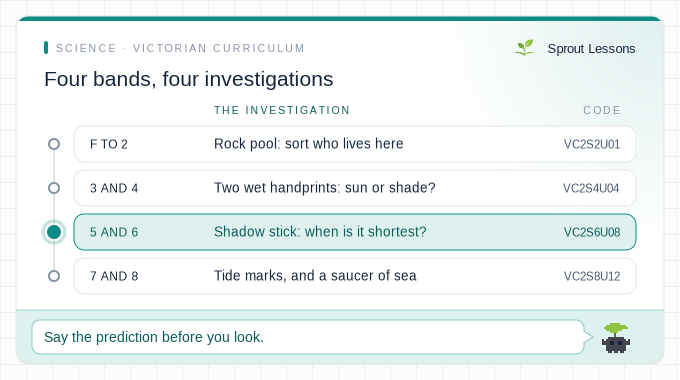
School science from Prep to Year 8 is mostly one habit: ask a question, predict, look, and compare what you saw with what you expected. A Victorian beach in January supplies the questions for free. This page gives one investigation for each two-year band of the Victorian Curriculum: a rock pool sort for Prep to Year 2, two wet handprints for Years 3 and 4, a shadow stick for Years 5 and 6, and tide marks plus a saucer of seawater for Years 7 and 8. Each takes under half an hour and needs nothing you would not already pack.
It also gives the wrong idea each one tends to flush out, because that is the useful part. The shadow stick, for instance, shows that the sun is highest over Melbourne at about 1:20 pm in late December, not at midday, which most adults get wrong too.
Why the beach works for school science
The Victorian Curriculum sets science in two-year bands, not single years: Foundation to Level 2, Levels 3 and 4, Levels 5 and 6, Levels 7 and 8. Each band has a list of things to understand (12, 10, 9 and 17 of them in those four bands) and a separate inquiry strand, which is the method. In the three primary bands the inquiry strand has the same six parts every time: pose a question and predict, plan a safe way to test it, observe and record, organise what you recorded, compare it with the prediction, and tell someone what you found.
So the method stays the same for seven years while the content changes. That is why one routine works for a five-year-old and a twelve-year-old on the same afternoon: say what you think will happen before you look. A prediction said out loud is the difference between an investigation and a nice walk.
Before you start: two rules that are also science
- Look, do not take. Victoria restricts what can be collected between the tide marks. The Victorian Fisheries Authority’s intertidal zone rules say that in Port Phillip Bay’s intertidal zone you may only collect marine worms, sandworms, burrowing shrimp, squid, octopus and cuttlefish, and that all other invertebrates are protected and must not be collected. That covers the crabs, snails and sea stars a child most wants in a bucket. Elsewhere on the coast the list is different and still short, and marine national parks and sanctuaries have their own rules. The simple family version: watch it where it lives, put back any rock you turn, take a photo.
- Go by the UV, not the heat. SunSmart’s advice for Victoria is that sun protection is usually needed from mid-August to the end of April, whenever the UV index is 3 or above, and that there can be high UV on cool and cloudy days. It calls the idea that heat causes sunburn a myth, and notes that UV and temperature usually peak at different times of day. The Years 5 and 6 investigation below shows why.
Prep to Year 2: who lives in the rock pool?
The question: how many different kinds of living things can we find in one pool, and how could we sort them?
Predict: ask for a number before you look. Most children say three or four.
Do: sit by one pool for five minutes without touching it. Count kinds, not animals. Then let your child choose a way to sort them: has a shell or does not, moves or stays put, has legs or does not. Then sort the same animals a second way.
What the curriculum is after: that living things have features you can see and can be grouped by them in more than one way (VC2S2U01), and that the place an animal lives gives it what it needs (VC2S2U02). Follow up with “why does the limpet stay on the rock when the tide goes out?”
The wrong idea to listen for: “that one is a plant”, said of a sea anemone or a sponge, because it does not walk. And “it’s dead”, said of anything that is not moving. Ask what it would need if it were alive, then watch an anemone when a bit of food drifts past.
Years 3 and 4: two wet handprints
The question: where does the water go when something dries?
Predict: press one wet hand on concrete or a dark rock in full sun and one in the shade. Which print disappears first, and how much sooner?
Do: time both with a phone. Then try a third print in the sun with wind blocked by a towel.
What the curriculum is after: that adding heat changes a liquid to a gas (VC2S4U04), and that this is one step in the way water moves through sky, land and sea (VC2S4U07). The wet towel on the fence and the puddle on the path are the same experiment.
The wrong idea to listen for: “it soaked in” or “it just went away”. Some does soak into concrete, which is why a smooth rock or a metal slide makes a cleaner test. The answer you are after is that the water is still water, now in the air as a gas you cannot see. Ask where the water on a wet swimsuit goes, since it has nothing to soak into.
Want the idea behind each of these explained at your child’s level? Create a free account. Sprout Tutor covers science on the Victorian Curriculum from Foundation to Year 10 and is free on every plan while it is in beta.
Years 5 and 6: the shadow stick
The question: at what time of day is a shadow shortest?
Predict: nearly everyone says 12 o’clock.
Do: push a straight stick upright into flat sand before 11 am. Every half hour, put a shell at the tip of its shadow and scratch the time beside it. Keep going until about 3 pm. The shells make a curve, and the one closest to the stick marks the moment the sun was highest.
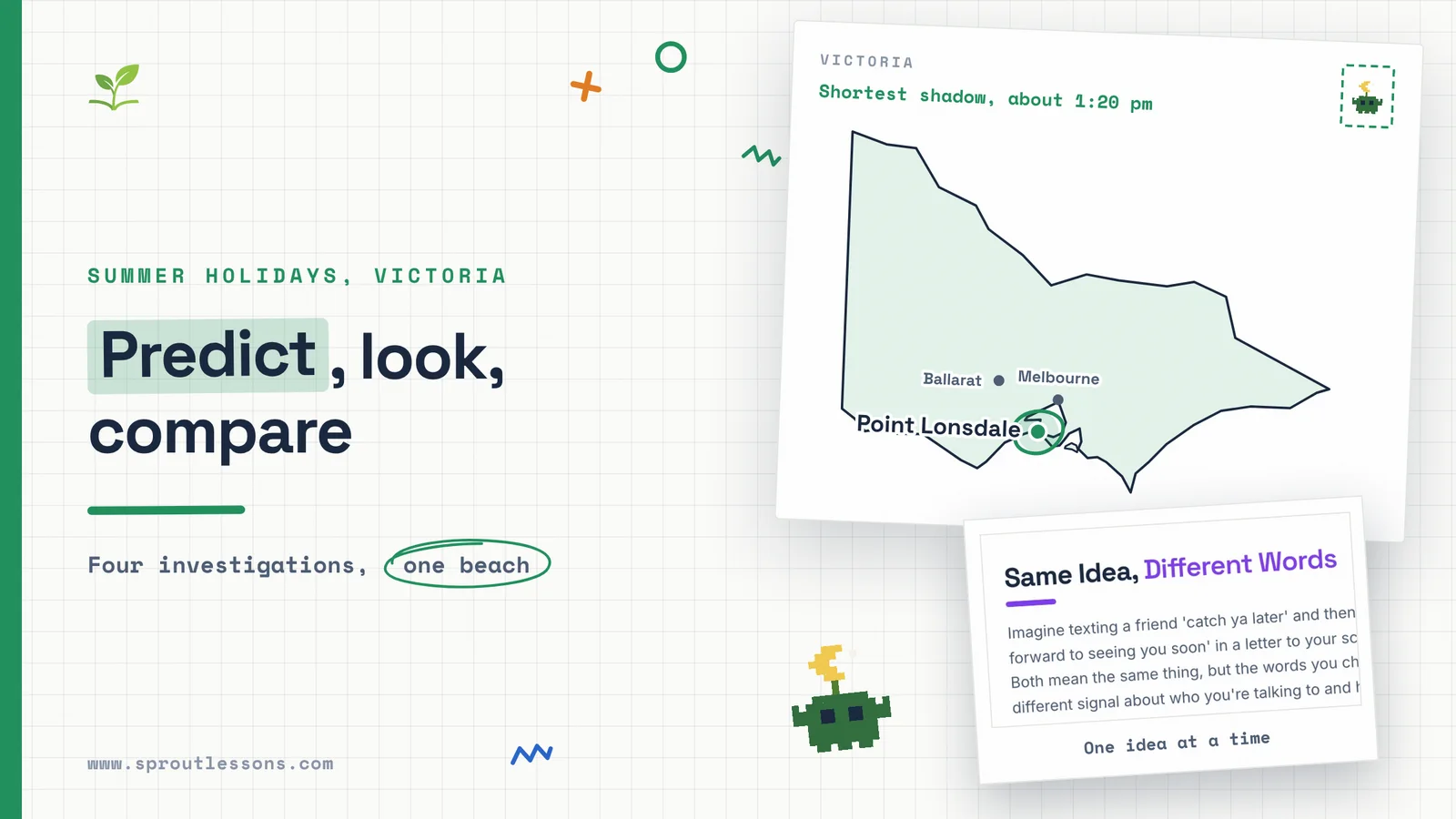
What you will find: in Melbourne the shortest shadow falls at about 1:20 pm in late December and nearer 1:30 pm by late January. On Tuesday 22 December 2026, the day of the summer solstice, the sun rises at 5:54 am and sets at 8:42 pm, and the midpoint of those is 1:18 pm. An hour of the gap is daylight saving. The rest is because Melbourne sits west of the line its time zone is set on.
What the curriculum is after: that light travels in straight lines and makes shadows (VC2S6U08), and that the changing length of the day comes from Earth’s tilt as it travels round the Sun (VC2S6U07). The second one can be seen across the holidays. Melbourne has 14 hours 47 minutes of daylight on 22 December and 14 hours 10 minutes on 27 January, so the day your child goes back to school is 37 minutes shorter than the longest day. Write down the sunset time once a week and the pattern appears on its own.
The wrong idea to listen for: “the sun is strongest at lunchtime, when it is hottest”. The sun is highest at about 1:20 pm, and the hottest part of a summer day usually comes later in the afternoon. The shadow stick is a visible reason to keep the hat on after lunch.
Years 7 and 8: tide marks, and a saucer of sea
The first question: when will low tide be tomorrow?
Predict: most students say the same time as today.
Do: look up today’s tide times for the nearest listed place (the Bureau of Meteorology publishes tide predictions). Push a stick in at the water’s edge at low tide and note the time. Do the same the next day, and the day after if you can.
What you will find: the times slide later each day, by a little under an hour on average. The Moon takes about 24 hours and 50 minutes to come back to the same place in the sky, and the tides keep time with the Moon, not the clock. Most days on the Victorian coast have two high tides and two low tides, usually of different heights.
What the curriculum is after: that the cycles of Earth, Sun and Moon can be modelled, and that the model explains predictable things on Earth, including tides and seasons (VC2S8U12). A student who can explain why there are two high tides a day and not one has done the Level 8 thinking.
The wrong idea to listen for: “the wind pushes the tide in”, or that there is one high tide a day, on the side of Earth facing the Moon.
The second question: is seawater one substance? Leave a saucer with a few spoonfuls of seawater on a sunny windowsill for a day or two. The water goes and white crystals stay. That is separating a mixture by evaporation and crystallisation, two of the techniques the Levels 7 and 8 chemistry content names (VC2S8U06), and it is the Years 3 and 4 handprint again with a result you can keep.
Three questions that tell you where your child is
- “What did you think would happen?” If they cannot say, they skipped the prediction. Next time, get it said aloud first. This is the most common gap at every level, and the easiest to fix.
- “What did you actually see?” If the answer is an explanation (“the sun dried it”) and not an observation (“the sunny one was gone in four minutes, the shady one took eleven”), ask for the numbers. Recording is its own skill in the curriculum, separate from knowing the reason.
- “Would it come out the same tomorrow?” A child who says “not if it is cloudy” or “the tide would be later” is thinking about what else could change the result. That is the start of a fair test, and it is worth more than the right fact.
Where Sprout fits
Sprout Tutor is ours. It follows the Victorian Curriculum only, covers science as well as English and maths, and gives a short teaching deck on one curriculum code followed by ten marked questions. It is free on every plan while in beta. It is a reasonable way to put words to what your child just saw, on the evening of a beach day, and it is no substitute for the beach. The effectiveness of personalised learning software like ours has not been independently established. The full list of what each band covers is on our Foundation to Year 2, Years 3 and 4, Years 5 and 6 and Years 7 and 8 science pages, which are written for teachers but list every code.
The short version
One investigation per band: sort a rock pool two ways (Prep to Year 2), race two wet handprints (Years 3 and 4), mark a shadow every half hour and find it shortest at about 1:20 pm (Years 5 and 6), track low tide sliding later each day and grow salt in a saucer (Years 7 and 8). Say the prediction first, record what happened, look without collecting, and go by the UV index and not the temperature.
Start free if you want the explanation at their level afterwards. For the rest of the summer, see summer reading for every year level, summer holiday maths without a workbook and how much practice a Victorian summer needs.
How this page was checked
The intertidal collecting rules are from the Victorian Fisheries Authority’s recreational fishing guide, and the sun protection advice from SunSmart’s frequently asked questions, both linked above and checked on 26 November 2026. Check the Fisheries page for the place you are visiting, because the rules differ around the coast. Sunrise, sunset, day length and the solstice time (7:50 am on 22 December 2026, Melbourne time) are from timeanddate.com’s Melbourne tables; the 1:18 pm midpoint and the 37 minute difference are our arithmetic from those figures. The band structure, the counts and the codes are from the Victorian Curriculum F–10 Version 2.0 Science descriptors, paraphrased. The four investigations and the wrong ideas listed with them are ours.
Victorian Curriculum codes reference the Victorian Curriculum F–10 Version 2.0 © VCAA, paraphrased; the VCAA does not endorse this product. Sprout Lessons is not affiliated with SunSmart or the Victorian Fisheries Authority.
FAQ
What science can kids do at the beach?
Prep to Year 2 children can sort the animals in one rock pool two different ways. Years 3 and 4 can time two wet handprints drying, one in sun and one in shade. Years 5 and 6 can mark the tip of a stick's shadow every half hour to find when it is shortest. Years 7 and 8 can track low tide over three days and evaporate a saucer of seawater to leave salt crystals. Each matches a Victorian Curriculum science descriptor.
What time is the sun highest in Melbourne in summer?
At about 1:20 pm in late December and nearer 1:30 pm by late January, not at midday. On 22 December 2026 the sun rises in Melbourne at 5:54 am and sets at 8:42 pm, and the midpoint is 1:18 pm. An hour of the gap from 12 noon is daylight saving and the rest is because Melbourne is west of the line its time zone is set on.
Can you take shells and crabs from rock pools in Victoria?
Mostly no for living animals. The Victorian Fisheries Authority says that in the intertidal zone of Port Phillip Bay you may only collect marine worms, sandworms, burrowing shrimp, squid, octopus and cuttlefish, and all other invertebrates are protected. Elsewhere on the coast the list is different and still short, and marine national parks and sanctuaries have their own rules. Look, put rocks back, and take photos.
When do children need sun protection in Victoria?
SunSmart advises sun protection whenever the UV index is 3 or above, which in Victoria is usually from mid-August to the end of April. UV can be high on cool and cloudy days, and UV and temperature usually peak at different times of day, so go by the UV index and not the heat.
How is science organised in the Victorian Curriculum?
In two-year bands: Foundation to Level 2, Levels 3 and 4, Levels 5 and 6, and Levels 7 and 8. Each band has Science Understanding content (12, 10, 9 and 17 descriptors in those bands) and a Science Inquiry strand. In the three primary bands the inquiry strand has the same six parts: question and predict, plan, observe and record, organise, compare with the prediction, and share.