
If your child does one school-ish thing over the Victorian summer holidays, make it reading: ten to twenty minutes on most days, of something they chose. What counts as reading changes with the year level, though. A Prep child needs sound-it-out books read aloud to you, a Year 2 child needs easy books read smoothly, and a Year 6 child needs to be choosing the stack themselves. Victoria’s public libraries run a free challenge for exactly this, the Big Summer Read, from 1 December 2026 to 31 January 2027.
This page gives the right kind of summer reading for each level from Foundation to Year 8, read off the Victorian Curriculum, then how the library challenge works, the four mistakes that turn holiday reading into a fight, and a one-minute check that tells you whether a book is too hard. The research on forgetting over summer, and the maths side of it, is on our page about how much practice a Victorian summer needs; this page is only about books.
The Big Summer Read, in plain terms
The Big Summer Read is a library-led summer reading program that Public Libraries Victoria describes on its Big Summer Read page. The facts a parent needs:
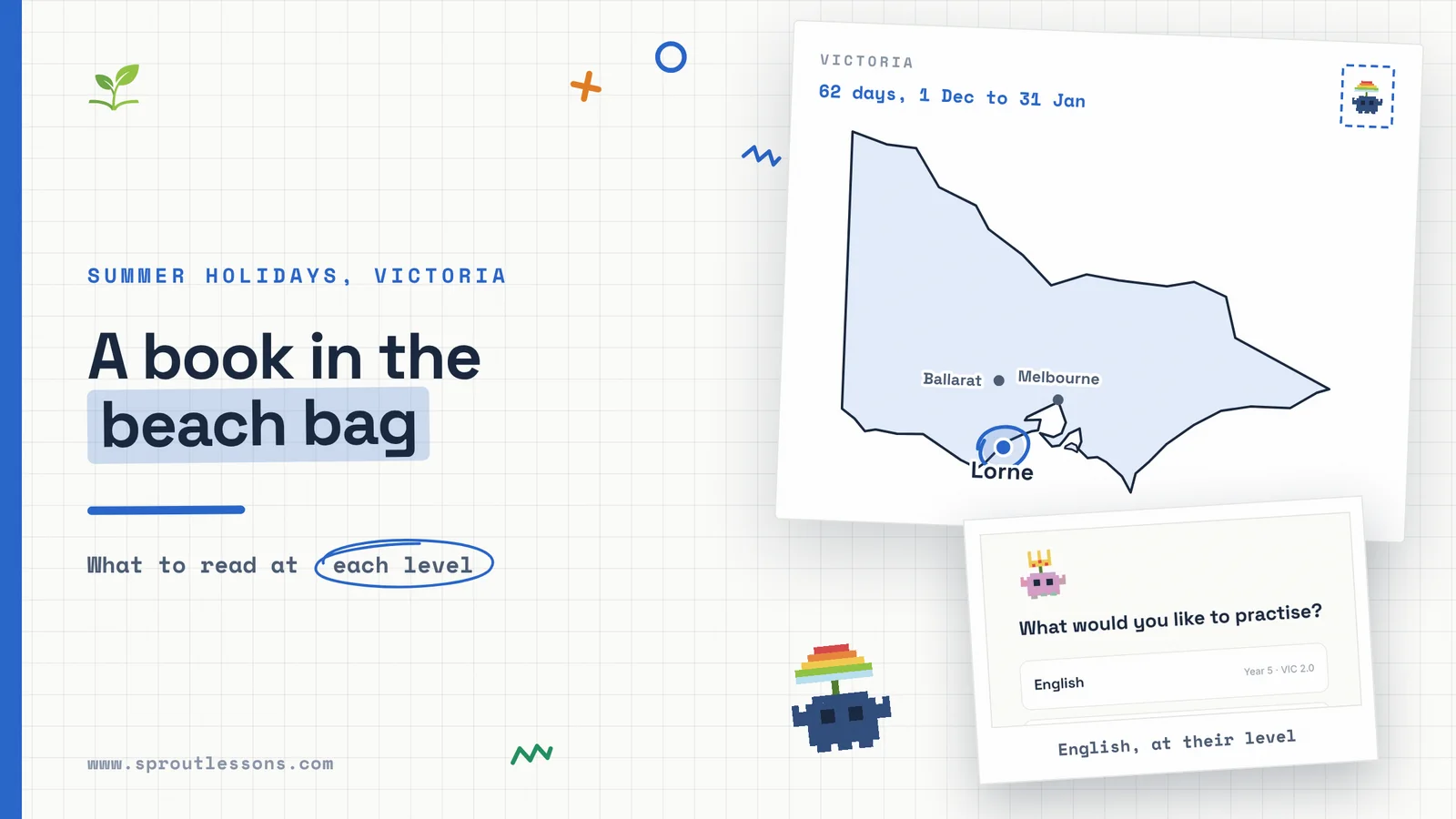
- Dates. It starts on 1 December and finishes on 31 January each year. This summer that is 1 December 2026 to 31 January 2027, which is 62 days and covers the whole school break (Term 4 ends on Friday 18 December; government school students return on Thursday 28 January).
- Who. Anyone aged 0 to 18. Babies count, because being read to counts.
- Cost. Registration is free. You join online or through your local library, which is also where the borrowing is free.
- What counts. Any book your child reads, has read to them, or listens to as an audiobook. That last part matters and we come back to it below.
- Prizes. Library services usually offer prizes of their own for finishing, and there is a wider prize draw. The bar is low on purpose. Wyndham City Libraries, for example, asks for five books or five days of reading logged to enter its draw. Your own library sets its own, so check its page.
One number from the program’s 2025–26 evaluation is worth more than any target we could invent: registered children logged an average of 17 books or 20 days of reading. Twenty days out of 62 is about one day in three. That is what children who signed up for a reading challenge actually did, so a plan of “every single day” is asking for three times the real thing. Most days is a fine aim. One day in three is a normal result.
What to read at each level
The Victorian Curriculum is written in levels rather than years, and Level 3 is roughly Year 3 (our plain-English guide explains the structure). Use the level your child has just finished, not the one they start in January. Each row below is the reading that level asks for, paraphrased, and what that means for a beach bag.
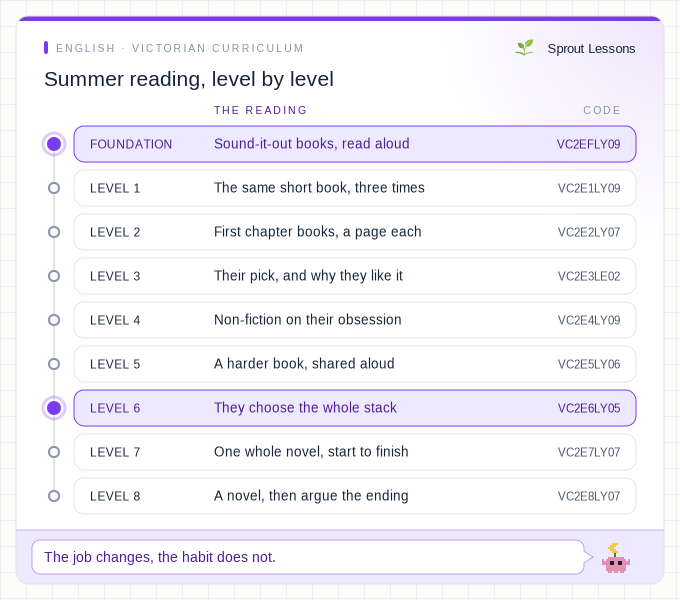
- Foundation (Prep): sound-it-out books, aloud, to you. The Foundation descriptor (VC2EFLY09) has children reading decodable and real texts with the phonics they have so far. Decodable books are the thin readers that only use letter patterns already taught, and they are the ones to borrow for your child to read. Picture books are for you to read to them. Both count. Which sounds a Prep child should have is on our phonics by year page.
- Level 1: the same short book, three times. Level 1 adds phrasing and fluency to the same sentence (VC2E1LY09), plus a growing stock of high-frequency words (VC2E1LY07). Fluency comes from re-reading, so a book read on Monday, Wednesday and Friday is doing more than three new books. The third read should sound like talking.
- Level 2: first chapter books, a page each. Level 2 expects different kinds of texts read with phrasing, and names re-reading and self-correcting (VC2E2LY07). Take turns, a page each. On their pages, listen for a child who notices a sentence did not make sense and goes back. That habit is the Level 2 skill.
- Level 3: their pick, and why they like it. Reading is now meant to be accurate and fluent for meaning (VC2E3LY07), and the literature strand asks children to give reasons for their preferences (VC2E3LE02). So let them choose, then ask why that one. A whole series by one author is a good answer to a long summer.
- Level 4: non-fiction on the current obsession. The comprehension descriptor at this level is about building topic knowledge and starting to judge texts (VC2E4LY09). Sharks, Minecraft, the Matildas, volcanoes: a child who knows a lot about a topic can read well above their usual level on it.
- Level 5: one harder book, shared aloud. The word “increasingly complex” arrives in the reading descriptor (VC2E5LY06). Keep the easy reading going for pleasure, and add one book a little beyond them that you read aloud at night. Reading aloud does not stop being useful when a child can read.
- Level 6: they choose the whole stack. This is the first level where the curriculum says students select what they read (VC2E6LY05). Take them to the library with a ten-book limit and no vetoes. A stack with two duds in it is what choosing looks like.
- Levels 7 and 8: one whole novel, start to finish. From Level 7 the curriculum has no reading-fluency descriptor at all. It assumes fluency and asks for inferring, analysing and evaluating (VC2E7LY07, VC2E8LY07). The summer job is stamina: one complete novel, not the first three chapters of four. At Level 8, ask whether the ending was earned and expect an argument.
One thing stands out when you read those descriptors side by side. From Level 3 to Level 6 the sentence barely changes: read accurately and fluently for meaning, fixing your own mistakes. What moves is the difficulty of the text, and then, at Level 6, who picks it. So a Year 4 child reading easy books all summer is still practising the right thing.
Want reading practice at your child’s level between library trips? Create a free account. Sprout Tutor covers English on the Victorian Curriculum from Foundation to Year 10, and it is free on every plan while it is in beta.
Four mistakes that start the fight
- Handing a Prep child a book they cannot decode. You will see it as guessing: the page says “The dog sat on a log” and your child, looking at the picture, says “The puppy is on the tree.” Nothing is wrong with the child. The book has patterns they have not been taught. Swap it for a decodable reader and read the picture book to them yourself.
- Correcting every slip the moment it happens. If you jump in on each wrong word, your child never gets the chance to notice it. Wait until the end of the sentence. If they go back on their own, say so. If they read on, ask “did that make sense?” and let them find it.
- Banning re-reads, comics and audiobooks. The library challenge counts books listened to, and it is right to. Re-reading builds fluency, graphic novels are still plot, character and vocabulary, and an audiobook on the drive to Lakes Entrance lets a child follow a story two levels above what they can decode. Keep one book going that they read with their own eyes, and stop policing the rest.
- Turning the log into homework. A logged day needs a title and a tick, not a summary. The moment a child has to write about every book, the lesson they take from it is to read fewer books.
The one-minute “is this book too hard” check
Ask your child to read one page aloud, about 100 words, and count on your fingers the words they cannot work out. This is a rule of thumb many teachers use, not an official test:
- Five or fewer: fine to read alone. This is holiday reading.
- Six to ten: a book to read together, a page each.
- More than ten: too hard to read alone right now. Read it to them, or get the audiobook, and try again in the Easter holidays.
Then three questions, each of which points somewhere different:
- “What has happened so far?” If the reading sounded fine but the answer is a shrug, the words are going in and the meaning is not. Read the next chapter aloud to them and talk as you go. Our reading comprehension by year page lists what each year is expected to do with a text.
- “Read me that long word again.” If they skip it or guess from the first letter, the gap is decoding, and the fix is easier books plus the sound patterns for their level, not more pages.
- “Would you read the next one?” If the answer is no three books in a row, the problem is the choosing. Go back to the library and let them pick, including the ones you would not.
If the decoding worry is in Prep or Year 1, two school checks are already looking at it: the Year 1 Phonics Check and, from Term 1 2027, the Reading Assessment F to 8. A summer of the right books is the best preparation for either, and nothing else is needed.
If you home educate
The challenge is open to every child in the age range, enrolled in a school or not, and the log is a dated list of what was read. Keep a copy. It is a tidy record of reading across the summer for your own files, whatever else you keep for your Victorian registration.
Where Sprout fits, and where it does not
Books do this job, and a library card is the tool. Sprout Tutor is ours, and it does something narrower: short English topics on the Victorian Curriculum, each a small teaching deck on one curriculum code followed by ten marked questions at your child’s level. It follows the Victorian Curriculum only, and it is free on every plan while in beta. Use it for the ten minutes when the book is finished and the library is shut. It does not replace reading a book, and the effectiveness of personalised learning software like ours has not been independently established.
The short version
Join the Big Summer Read at your library (free, ages 0 to 18, 1 December 2026 to 31 January 2027). Match the reading to the level just finished: decodable books aloud in Prep, the same book three times in Year 1, a page each in Year 2, their own choices from Year 3, the whole stack chosen by them in Year 6, one complete novel in Years 7 and 8. Count audiobooks and re-reads. Check a book with one page and ten fingers. Aim for most days and be content with one in three.
Start free if you want short English practice at their level as well. For the other subjects this summer, see summer holiday maths for every level and science at the beach.
How this page was checked
Big Summer Read dates, ages, cost, what counts and the 2025–26 evaluation figures (11,771 registered participants nationally, an average of 17 books or 20 days read per child) are from Public Libraries Victoria’s program page. The 2026–27 dates and the five-books-or-five-days example are from Wyndham City Libraries’ page. Both were read on 26 November 2026; each library service sets its own prizes and entry rules. Term dates are from the Victorian Government’s school term dates page. The level-by-level reading expectations are paraphrased from the Victorian Curriculum F–10 Version 2.0 English descriptors, and the one-in-three figure is our arithmetic (20 days of 62). The finger-count check is a common classroom rule of thumb and is labelled as one.
Victorian Curriculum codes reference the Victorian Curriculum F–10 Version 2.0 © VCAA, paraphrased; the VCAA does not endorse this product. Sprout Lessons is not affiliated with Public Libraries Victoria or the Big Summer Read.
FAQ
What is the Big Summer Read and when does it run?
It is a free, library-led summer reading program run through public libraries. It starts on 1 December and finishes on 31 January each year, so this summer it runs from 1 December 2026 to 31 January 2027. Anyone aged 0 to 18 can join online or through their local library, and library services usually offer prizes of their own.
Do audiobooks and being read to count as reading?
In the Big Summer Read, yes: children can log any book they read, that is read to them, or that they listen to as audio. That is sensible at home too. An audiobook lets a child follow a story above the level they can decode, and re-reading a favourite builds fluency. Keep one book going that they read themselves.
How much should my child read over the summer holidays?
Ten to twenty minutes on most days is a good aim. For a sense of what is normal, the Big Summer Read's 2025-26 evaluation found registered children logged an average of 17 books or 20 days of reading, and 20 days out of the program's 62 is about one day in three.
What should a Prep child read over the holidays?
Decodable books, read aloud to you. These are the thin readers that only use the letter patterns already taught, which matches the Victorian Curriculum Foundation descriptor for reading with developing phonic knowledge. Picture books are for you to read to them. If your child guesses words from the picture, the book has patterns they have not been taught yet.
How do I know if a book is too hard for my child?
Have them read one page aloud, about 100 words, and count the words they cannot work out. As a rule of thumb many teachers use: five or fewer is fine to read alone, six to ten is a book to read together, and more than ten is too hard to read alone for now, so read it to them or use the audiobook.