
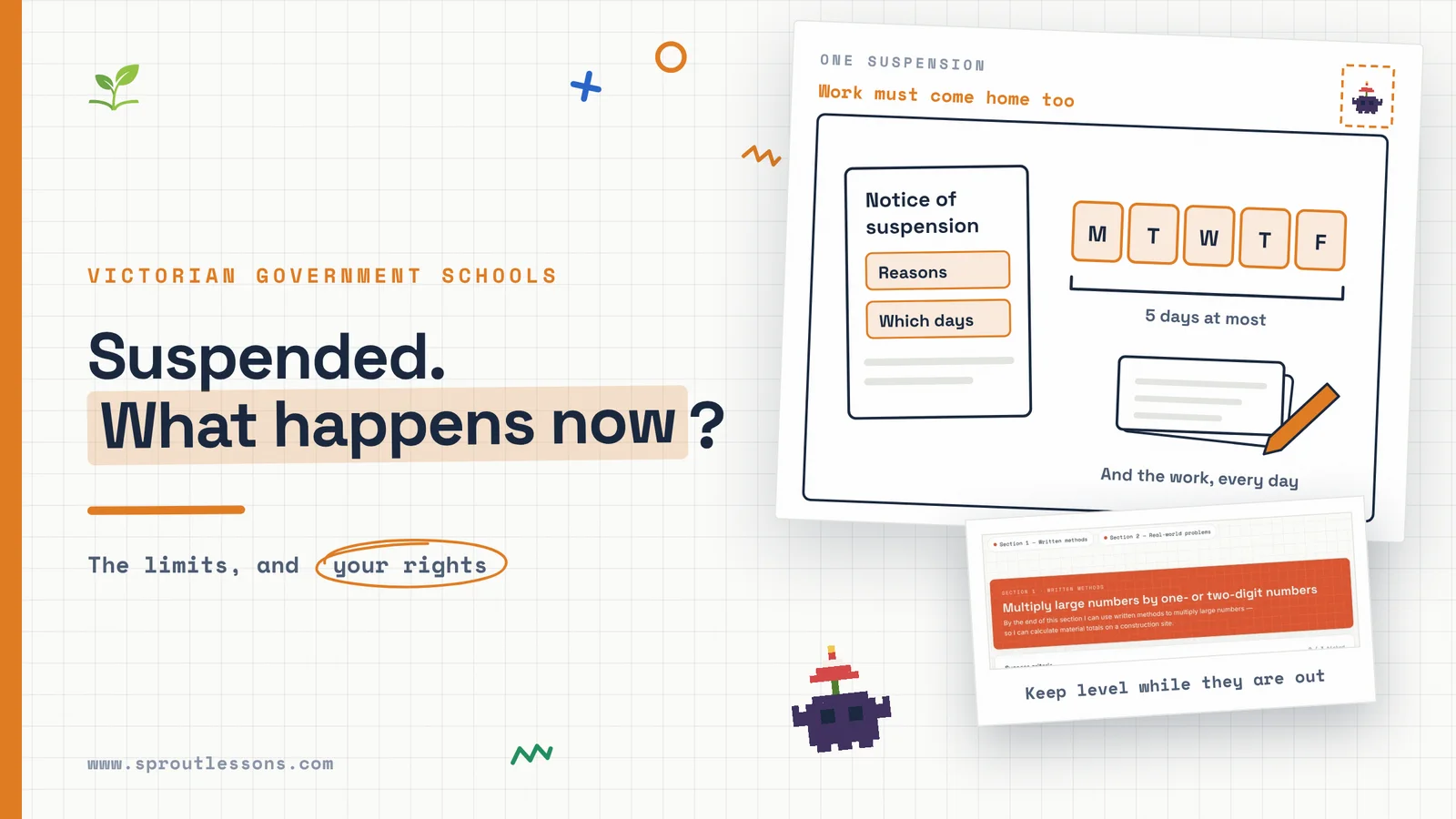
In a Victorian government school only the principal can suspend a student, for no more than 5 school days at a time and no more than 15 days in a school year without the regional director’s approval. The school must give your child work for every day they are out. An expulsion is a separate, longer process with a meeting you are invited to, a written notice, and a right of appeal that runs for 10 business days from the day you receive that notice.
Most parents meet these rules in a phone call at 2 pm, with no time to read a policy. This page puts the limits, the school’s obligations and your rights in the order you will need them, from the first call to the day your child walks back in. It covers government schools. Catholic and independent schools write their own discipline policies, so ask for theirs.
The short version
| The question | The rule in Victorian government schools |
|---|---|
| Who can suspend? | The principal or acting principal only. It cannot be delegated to an assistant principal or a year level coordinator |
| How long? | Up to 5 school days at a time, and up to 15 school days in a school year. More needs the regional director |
| What must I be given? | A phone call or a conversation, a written Notice of Suspension, the parent brochure, and school work |
| Does my child get a say? | Yes. The principal must give the student the opportunity to be heard before deciding |
| Can a suspension be appealed? | The guidelines set out no appeal for a suspension. You can ask for a Student Support Group meeting and use the complaints process |
| Can an expulsion be appealed? | Yes, within 10 business days of receiving the Notice of Expulsion, on four grounds |
The source for all of it is Ministerial Order 1125, which sets the grounds and procedures for suspension and expulsion in government schools, and the Department of Education’s mandatory guidelines that sit on top of it. In those guidelines “the principal must” marks a legal or policy requirement and “the principal should” marks best practice. The distinction is kept below.
What a school can suspend for
The Department defines suspension as excluding a student from the standard instruction or educational opportunities given to other students, for part of a day, a full day or several days. That definition matters: a child kept in the office away from class for the day has been suspended in school, and the same rules apply as if they had been sent home.
The behaviour has to have happened at school, on the way to or from school, or at or on the way to a school activity such as a camp or excursion. And it has to fit at least one of seven grounds. In plain words:
- behaving in a way that poses a danger, actual, perceived or threatened, to anyone’s health, safety or wellbeing
- causing significant damage to or destruction of property
- stealing, trying to steal, or being knowingly involved in a theft
- having, using, selling, or deliberately helping someone else with illicit substances or weapons
- refusing a clear and reasonable instruction from staff in a way that creates that same danger
- consistently vilifying, defaming, degrading or humiliating another person on the basis of a protected attribute such as race, religion, sex, sexual orientation, gender or impairment
- consistently behaving in an unproductive way that interferes with other students’ wellbeing, safety or learning
The word “consistently” in the last two is doing real work. A single bad lesson is not ground 7. If your child has been suspended for disruption, a fair question is what the earlier incidents were and what the school did about them.
Behaviour outside school, including online
A principal can also suspend, in exceptional circumstances, for something that happened outside school altogether, including online. The bar is higher and has two parts, and both must be met:
- the behaviour poses a significant danger, actual or threatened, to another student or a staff member of the same school, and
- it has a clear and close connection to the school, meaning it unreasonably stops that person from taking part in a school activity, engaging with their learning, or doing their job there.
The guidelines say plainly that this “does not extend to all negative behaviour undertaken by young people in the community”, and that the seriousness of the behaviour alone is not enough. A fight at a weekend party with someone from another school does not fit. A group chat that leaves a classmate too frightened to come to school can.
What the principal has to do first
Suspension is described as a serious measure, best kept for when other measures have not worked. Before deciding, the principal:
- must consider alternative interventions and supports that could address the reasons for the behaviour
- must make sure the student has had the opportunity to be heard, and take into account anything the student or you provide
- must weigh the behaviour itself, the student’s educational needs, any disability, their age, and their residential and social circumstances
- must consider whether the suspension limits the student’s human rights under the Victorian Charter and, if it does, whether that is justified
- should investigate properly and write down who, what, where, when and why, including what your child says happened
Your child also has to have a “relevant person” in the process, someone to support and speak up for them. For almost every student that is you. If you cannot do it, you can nominate another adult on a form, and if nobody is available the principal appoints a trained Department staff member from a list, who cannot be someone employed at the same school.
The numbers on a suspension
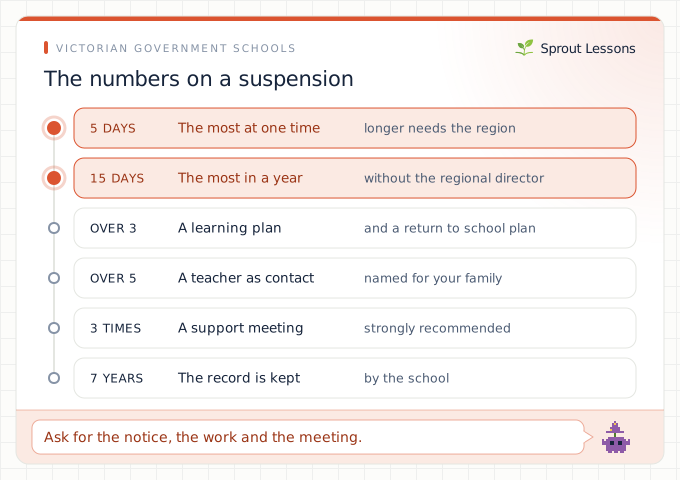
- 5 school days is the most at any one time. The only exception is where the principal has suspended immediately, is considering expulsion, and the regional director has approved a longer period to run that process.
- 15 school days in a school year is the most without the regional director’s written approval. By our arithmetic, on a school year of about 200 days, that is three school weeks, or 7.5% of the year.
- End of term. If the suspension is longer than the days left in the term, the principal should think about the disruption before letting it run into the next one.
- 7 years is how long the school keeps a suspension record.
An immediate suspension is allowed where the behaviour puts someone’s health, safety or wellbeing at significant risk. Even then the school must supervise your child until you or your emergency contact collects them, or until the end of the school day if nobody can come earlier. The school cannot simply send them out of the gate mid-morning.
What you must be given on the day
Before the suspension starts, or on the day for an immediate one, the principal must do all of the following. Treat it as a checklist, because the pieces often arrive separately.
- Tell your child verbally, and tell you by phone or in person, the reasons, the school days it covers, and whether it is in school or out of school.
- Give you contact details for support services, where appropriate.
- Arrange school work for the whole period (the detail is in the next section).
- Give you and your child a written Notice of Suspension with the reasons and the days, plus copies of any learning plan and return to school plan.
- Give you the parent brochure on procedures following suspension. Under the guidelines, documents should be provided in other formats and community languages where you need them.
- Record it on the school’s student system.
If you get the call and nothing else, ask the same day, in writing: “Please send the Notice of Suspension and the work for the days listed.” If your child’s parents are separated, the guidelines say all parents and carers must be notified and involved unless that is not in the child’s best interests or would breach an intervention order.
The work the school owes your child
This is the part most often missed, and it scales with the length of the suspension.
| Length | What the school provides |
|---|---|
| 3 days or less | Meaningful work |
| More than 3 days | A student absence learning plan and a return to school plan, with copies attached to the notice |
| More than 5 days | All of that, and a teacher who should be named as the point of contact for your child and your family |
“Meaningful” is the guidelines’ word and it is not defined, so define it yourself when you ask: the work the class is doing on those days, in the subjects your child would have had. A generic worksheet pack does not keep a child level with the class, and maths is where a missed week bites hardest, because next week’s lesson assumes this week’s.
If the work that comes home is thin, Sprout builds short lessons at your child’s exact Victorian Curriculum level, so five days out does not turn into a five-day gap. Start free.
Coming back, and stopping the next one
The guidelines say it themselves: repeated or lengthy suspensions may not address the reasons for the behaviour and risk poorer outcomes, especially when a suspension is used alone. So the return matters more than the days away.
After a suspension the principal should consider a Student Support Group meeting with you, your child and any professionals involved, to talk about what led to it and what will prevent the next one. The guidelines strongly recommend that meeting when any of these is true:
- you or your child ask for one
- your child has a disability, is Koorie, or is in out-of-home care
- there have been three or more suspensions in the school year
- your child was suspended for the maximum 5 consecutive days
The first item is the useful one: asking is enough. Go in with three questions. What happens just before the behaviour? What will the school change? And how will we know in four weeks whether it is working? If the answers point at the learning itself, a child who acts up in the lessons they cannot follow, the tool is an Individual Education Plan, and our page on it shows what a good one contains.
If your child has a disability
Schools have a legal duty to make reasonable adjustments, and the guidelines say this includes support to address behaviour related to the disability. Before suspending a student with disability the principal must make sure reasonable adjustments have been made where the behaviour is a manifestation of that disability. So ask directly: what adjustments were in place on the day, and are they written down? The Disability Inclusion Profile is where those adjustments are recorded for many students. For a Koorie student the principal should involve a Koorie Engagement Support Officer, and for a child in out-of-home care a LOOKOUT centre.
If you think the suspension was wrong
The suspension guidelines contain no appeal process, unlike the expulsion ones. That does not leave you with nothing.
- Before the decision, use the right to be heard. Put your child’s account and anything relevant (a diagnosis, what happened earlier that day) in writing to the principal, who must take it into account.
- After it, ask the principal in writing which of the seven grounds was relied on and what alternatives were considered. Those are things the principal was required to work through.
- If you are still not satisfied, the Department’s complaints process for government schools applies: the school first, then the regional office on 1800 338 663, which aims to resolve matters within 30 school days, then a Central Office Review where you believe an error was made against Department policy.
Keep the tone factual. The checklist above is the strongest material you have: a missing notice, no work provided, or a sixth consecutive day are specific and checkable, where “this was unfair” is not.
Expulsion: a different process
Expulsion uses the same seven grounds and the same outside-school test, but the guidelines call it rare, and the process has more steps and more people in it. Only the principal can decide. A student aged 8 or less cannot be expelled without the approval of the Secretary of the Department.
- You are told it is being considered, and given the Department’s information sheet for parents and carers about school expulsions. Your child may be suspended immediately while the process runs, and the school should keep providing work.
- A behaviour support and intervention meeting is held. It is mandatory, and the guidelines say expulsion “should not be a pre-determined outcome” of it. The principal chairs, sets out the grounds and the evidence, and must give you and your child the opportunity to be heard. A regional approved support person from the Department is there to make sure every alternative has been looked at.
- The decision. You must be told within 2 business days of the meeting ending, or within 10 business days for a child aged 8 or less, once the Secretary has approved.
- A written Notice of Expulsion, stating the grounds, the reasons, the start date and your right to appeal, with the appeal form attached. It is available in several languages.
Four things to know about that meeting:
- Go. If you and your child do not attend, it can go ahead without you and a decision can be made without hearing from you.
- You can bring a support person of your choice, as long as they are not acting for fee or reward. An interpreter can attend too.
- If you cannot attend, you or your child can nominate another adult, and the principal must send you the written record of the meeting.
- It is also about what happens next. The meeting has to identify the education, training or employment options that would suit your child if the expulsion goes ahead.
Appealing an expulsion
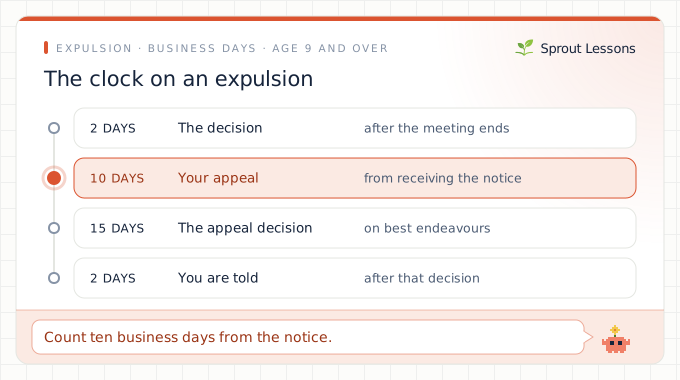
You or your child can appeal by completing the expulsion appeal form and giving it to the principal within 10 business days of receiving the Notice of Expulsion. A late appeal is only considered in extenuating circumstances, though the principal must still pass it on. The four grounds:
- your child has a history of behavioural issues and there is insufficient evidence of earlier interventions designed to address the behaviour and support them
- the grounds on which they were expelled are considered unfair
- the principal did not follow the expulsion process
- other extenuating circumstances
The appeal is not decided by the school. The principal must send it on within 1 business day, and it is decided by the Secretary’s delegate, usually the Department’s executive director for the area. They can convene a review panel of three: a Department representative, an independent member from the Department of Families, Fairness and Housing, and a regional approved support person who was not involved in the original process. The panel must give you and your child the chance to explain your reasons, in person or by phone, and reports within five business days of meeting.
The decision-maker must use their best endeavours to decide within 15 business days of receiving the appeal from the principal, and must contact you within 2 business days of deciding, with a written notice and a copy of the panel’s report.
If the expulsion is overturned, the principal must re-enrol your child (if that is still what you want) under a return to school plan, remove the expulsion from their permanent record, and tell you in writing that the record has been amended. In rare cases a principal with ongoing safety concerns can refer the matter to an expert panel that advises the Secretary.
If the expulsion stands
The guidelines state a principle here: no child is excluded from the government school system. An expulsion removes a student from one school, not from education.
- The expelling school is responsible for the move. Its principal is to arrange a placement in a new setting within a month of the expulsion taking effect, where possible, and write a supported transition plan with the area team and regional office.
- Work continues in the meantime. The principal must set up a student absence learning plan and keep providing meaningful work until your child has started somewhere new.
- Someone checks. A regional engagement coordinator oversees the transition and follows up with the new setting one month and six months after the expulsion.
- A child of compulsory school age must end up enrolled at a registered school or training organisation, or engaged with an employment service. The usual enrolment rules apply to the new school, including the right to a place at the local zoned school.
Some families use this point to consider home education. It is a legal option in Victoria through registration with the VRQA, and how to register for home schooling in Victoria covers the steps. It is a choice, not something a school can require.
Five days at home: a plan that keeps them level
A suspension is not meant to be a holiday, and it should not become a week of arguments either. A short, fixed routine does more than a long vague one. This one is ours, not the Department’s.
- Day one, morning: open the work together and sort it into “can start alone” and “needs explaining”. Email the school that day about anything missing.
- Each day: two blocks of 40 minutes before lunch, maths first. Phone in another room. Stop when the timer stops.
- Each day, 20 minutes: the one idea from the “needs explaining” pile, taught with a drawing or objects before the written method, then three questions on it.
- The afternoon before the return: read the return to school plan with your child, and agree on the first sentence they will say to their teacher.
If the behaviour and the learning are tangled together, which they often are, these help: catching up after falling behind, lessons that hold attention, and re-engaging a reluctant learner. For how absences in general are recorded and followed up, see the school attendance rules.
Sprout Lessons makes that 20-minute lesson for you: one idea, at your child’s Victorian Curriculum level, wrapped in something they actually like, with the curriculum code on the page so the teacher can see exactly what was covered while they were out. Start free.
Checked against the current rules as at 18 November 2026: the Department of Education’s Suspensions policy and its Suspension Guidelines and Procedures (policy last updated 1 July 2025), the Expulsions policy and its guidelines (policy last updated 20 March 2026), both made under Ministerial Order 1125, and the Make a complaint about your school page on vic.gov.au. These apply to Victorian government schools only. The grounds are paraphrased here; the policy has the exact wording. The 7.5% figure and the five-day plan are ours. This is general information, not legal advice, and if an expulsion is under way it is worth getting advice of your own.
FAQ
How long can a student be suspended in Victoria?
In a Victorian government school a student cannot be suspended for more than 5 school days at any one time, unless the principal has suspended immediately, is considering expulsion and the regional director has approved a longer period. A student also cannot be suspended for more than 15 school days in a school year without the written approval of the regional director.
Who can suspend a student in a Victorian government school?
Only the principal or acting principal of the school the student is enrolled at. The Department of Education’s policy says this authority cannot be delegated, although other staff can advise the principal and help communicate with the family.
Does the school have to provide work during a suspension?
Yes. For 3 days or less the school must provide meaningful work. For more than 3 days it must develop a student absence learning plan and a return to school plan, with copies given to the family with the Notice of Suspension. For more than 5 days a teacher should also be named as the point of contact for the student and family.
Can I appeal a school suspension in Victoria?
The Department’s suspension guidelines do not set out an appeal, unlike expulsion. The student must be given the opportunity to be heard before the decision, and anything the family provides must be taken into account. Afterwards you can ask for a Student Support Group meeting, which is strongly recommended whenever a parent or student requests one, and use the government school complaints process: the school, then the regional office, then a Central Office Review.
How do I appeal an expulsion from a Victorian government school?
Complete the expulsion appeal form that comes with the Notice of Expulsion and give it to the principal within 10 business days of receiving the notice. The four grounds are insufficient evidence of earlier interventions for a student with a history of behavioural issues, unfair grounds, the process not being followed, and other extenuating circumstances. The appeal is decided by the Secretary’s delegate, usually the area executive director, who must use best endeavours to decide within 15 business days.