
If you live inside a Victorian government school’s zone, the school must offer your child a place, even when it is full. If you live outside it, only two things can rank your application: a sibling already at the school, and how close you live. Nothing else counts. Not your child’s report, not their NAPLAN results, not a letter from the kinder teacher, and not how early you applied. A school is not even allowed to ask for those before it makes an offer.
That makes the system simpler than the playground version of it, and it changes what is worth your time. This page covers what the zone guarantees, which address counts, how out-of-zone places are really handed out, and how to appeal a no. The Department of Education updated its Enrolment policy on 16 November 2026 with the dates for children starting in 2028, so those are here too.
The short version
| The question | The rule in Victoria |
|---|---|
| Does my zoned school have to take my child? | Yes, at any year level, regardless of capacity, and even if you apply late |
| Where do I check the zone? | Find my School. The Department does not endorse zone advice from real estate agents or other websites |
| Can I apply out of zone? | Yes. The school should enrol your child if it has room, unless it has an enrolment restriction |
| Who gets the spare places? | Siblings first, then everyone else in order of closeness to the school |
| Can the school test or interview my child first? | No. Reports, tests and interviews are banned until after an offer is made |
| Can I appeal? | Yes, in writing to the school, then to the Department’s regional director, on three grounds |
All of this applies to government schools with a zone. Select entry high schools, specialist schools, English language schools and other designated purpose settings do not have zones and set their own entry criteria. Catholic and independent schools run their own enrolment.
What your zone actually guarantees
The right to a place at your local school is in the Education and Training Reform Act, and the Department’s Placement Policy spells out how far it goes. Four details matter more than parents expect.
- It holds when the school is full. The policy says eligible students have the right to be enrolled at their local school “regardless of capacity”. A crowded school can be allocated portable classrooms. It does not get to turn away a child who lives in its zone.
- It holds at every year level, Prep to Year 12, not just at the Prep and Year 7 intakes. A family that moves into the zone in the middle of Year 4 has the same right.
- It holds if you are late. Schools must keep processing applications after the due date, and a child who lives in the zone stays entitled to the place whenever the application arrives.
- It does not depend on your child. The policy says ability, history of behaviour and level of engagement with education are irrelevant to an enrolment decision at a local school. A place there must not hinge on a satisfactory report, test or interview.
The same right covers children with disability, who can enrol at their local school on the same basis as anyone else, and children on dependant or temporary visas. The one exception is a student who holds a student visa in their own name, who can only attend a school accredited for international students.
How the line is drawn, and when it moves
Your local school is usually the nearest government school, but “nearest” is measured in two different ways depending on where you live:
- Metropolitan Melbourne, Ballarat, Bendigo and Geelong: a straight line from your address to the school.
- Everywhere else in Victoria: the shortest practical route by road, which recognises that a school five kilometres away across a river can be a long drive.
Some zones have been adjusted for barriers such as rivers and freeways. The policy notes that a main road is not usually treated as a barrier, so a busy road between you and the school does not put you in a different zone.
Zones are reviewed every year and a small number change, usually because a new school opens, a campus moves or a school is under heavy local demand. Find my School shows the zones for the current year and the following one, and the 2028 zones are due there in late Term 1, 2027. If you are buying or renting for a school, check the address on Find my School for the year your child will start, not this year, and do not rely on a listing that says “in the zone”.
Which address counts
The zone is decided by your child’s permanent address, and the policy defines it in three steps:
- It is the place your child lives at the time you apply.
- If your child lives at more than one address, it is where they spend most of their weekdays.
- If the time is split equally, you can use either address. That gives you a choice of two local schools, not a place at both.
A school can ask you to prove the address, before an offer or as a condition of one. Documents should show the same name and address as the application form. What the policy lets a school do, and what it does not:
| A school may | A school must not |
|---|---|
| Ask for a lease, a contract of sale or other official documents | Keep copies of the documents you show it |
| Ask for a statutory declaration that the address is genuine | Inspect your home or put it under surveillance |
| Check the electoral roll or ask the real estate agent, after telling you it may | Disregard a lease just because it is shorter than 12 months, if it is where you really live |
| Make an offer conditional on a renewed lease before the first day | Decline a family that cannot prove an address because of homelessness, family violence, out-of-home care, Defence postings or recent arrival, without first asking the regional office |
An offer can be withdrawn if you move out of the zone before the first day, or if the address turns out not to be genuine, but only when three things are all true: the new address is outside the zone, there is no place for your child once the priority order is applied to the new address, and the offer letter said in writing that this could happen. The school has to consult the regional office first, and you can appeal.
Applying out of zone: the only two things that rank you
You can apply to any government school. The policy says a school should enrol an out-of-zone child if it has “sufficient accommodation”, which the principal works out with the regional office from the buildings, current and projected enrolments, staffing and, above all, how many in-zone children are coming. In-zone demand, now and in future years, has to be covered first.
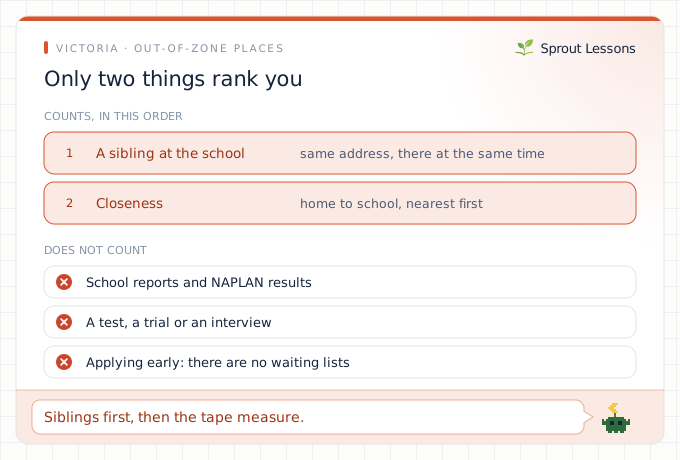
When there are more out-of-zone applicants than places, the school must use the priority order of placement, and it has exactly two rungs:
- Siblings. A child with a sibling who lives at the same permanent address and will be at the school at the same time. Sibling is read broadly: step-siblings count, and so do children living together in foster, kinship or permanent care, or in a shared household. Schools are expected to take all siblings unless the regional director has approved otherwise. A sibling who will have left by the time the younger child starts does not count.
- Closeness. Everyone else, in order of distance from home to school, measured the same way as the zone (straight line in Melbourne, Ballarat, Bendigo and Geelong; by road elsewhere). Find my School lists the five nearest schools to an address with the distance to each, which is the same number the school will use.
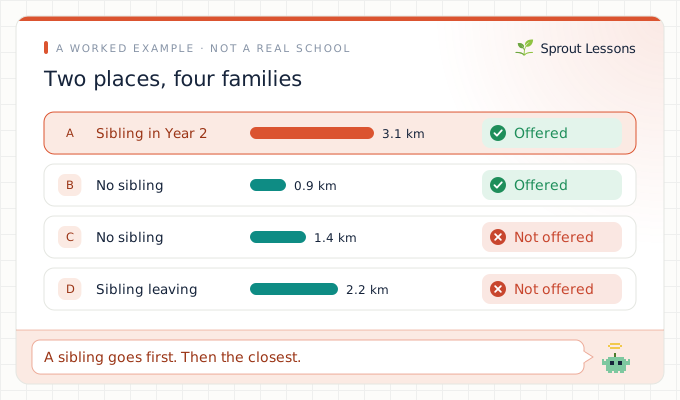
Here is how that plays out, with numbers we have made up. A primary school has two spare Prep places after its in-zone children, and four out-of-zone families apply on time.
| Family | Sibling at the school? | Distance | Result |
|---|---|---|---|
| A | Yes, in Year 2 | 3.1 km | Offered (sibling) |
| B | No | 0.9 km | Offered (closest) |
| C | No | 1.4 km | Not offered |
| D | Sibling in Year 6, leaving | 2.2 km | Not offered |
Family A lives furthest away and still goes first. Family D’s older child will be at secondary school by the time the younger one starts, so D is ranked on distance alone. Family C did nothing wrong and has nothing to appeal on the priority order: they were simply third for two places.
What a school is not allowed to do
The Placement Policy is unusually blunt about selection. Before an offer has been made, a local school must not:
- ask you, or your child’s current school, for school reports, NAPLAN results, teacher judgements, letters of recommendation or evidence of particular skills
- hold a test, an audition, a sporting trial or an interview, formal or informal, with a prospective student or family
- reserve places for children it expects to do well in a later test
- promote a test or interview before offers go out
- hold a waiting list for Prep or Year 7 places
- use its own application form in place of the Department’s
Tests for a scholarship, an accelerated class or a music program can happen, but only after the place has been offered. So a school tour is for you to look at the school. It is not an interview, and a good impression on the day changes nothing.
If the program itself is what you are after, that is a different door. Our pages on the selective entry exam and the Victorian High-Ability Program cover the two routes where ability is the criterion.
Whichever school it turns out to be, every Victorian government school teaches the same Victorian Curriculum. Sprout builds short lessons at your child’s exact level in it, so a change of school does not have to mean a gap. Start free.
When the school has an enrolment restriction
Some schools are not allowed to use their own judgement about spare places. Each year the Department assesses which schools need an enrolment management implementation plan (an EMIP), and regional directors tell those schools in Term 2 for the following school year. Schools near capacity, schools that received a portable classroom for growth in the last year and schools opened in the last five years are the usual candidates. A restriction stays until the school is told otherwise and comes in two types:
- In-zone and siblings only, either for the entry year or for the whole school. An out-of-zone family without a sibling cannot get in on distance at all.
- A cap, such as 300 Year 7 students. The school takes everyone in the zone, then out-of-zone siblings, then the next closest families until the number is reached.
A school with a restriction must say so on its website. Read the enrolment page of the school’s own site before you spend one of your preferences on it: if it says entry is limited to students in the zone, siblings and compassionate grounds, an ordinary out-of-zone application will not succeed however close you live.
Compassionate grounds
In exceptional circumstances a child can be enrolled outside the priority order. Every school has to consider these requests, including schools with a restriction. The policy gives family violence, wellbeing and safety concerns, and children in out-of-home care as examples, and says the list is not complete.
Three things to know before you rely on it:
- The test is that your local school is unsuitable, and you need to show why. The school or region can ask for legal documents, court orders, or reports from medical or allied health professionals, the police or a family violence service.
- It does not win you the school you chose. If the circumstances are accepted, the policy says the child will generally be offered a place at one of the next closest schools to home.
- Disability on its own is not a ground where the concern can be met by reasonable adjustments, because every school is legally required to make those. If your local school is not making them, that is a conversation about adjustments, and our page on Individual Education Plans is the place to start.
How to appeal a no
You can appeal at any year level, for a first enrolment or a transfer, including a move from a non-government school. There are two steps and you cannot skip the first.
- Appeal to the school, in writing. Use the Appeal Form in the Department’s Appeals information pack for parents and carers, which the school must point you to when it tells you the application was unsuccessful. For Prep and Year 7 the due dates are in the statewide timeline. For other year levels and transfers, schools are encouraged to acknowledge an appeal within three working days and typically answer within two weeks, longer over the holidays. Late appeals must still be processed.
- Escalate to the regional director. If the school says no and you still think the policy was applied wrongly or your circumstances were not properly considered, lodge a further written appeal with the Department’s regional office. A panel of senior regional staff advises the regional director, who makes the final decision. That ends the process.
The grounds are limited to three, so write the appeal to one of them:
| Ground | What you are saying | What to attach |
|---|---|---|
| Priority order | The school ranked applications wrongly | The sibling’s enrolment, or your distance from Find my School |
| Permanent address | The school did not follow the process for deciding where your child lives | The lease, the custody arrangement, a statutory declaration |
| Compassionate grounds | Exceptional circumstances make the local school unsuitable | Reports, court orders or letters from the services involved |
What does not work, in our reading of the policy, is an appeal about the school itself: its results, its music program, where your child’s friends are going, or how much you liked the tour. None of those is a ground, and the regional director decides appeals for local schools using the same priority order the school used.
The dates for a 2028 start
Every government primary and secondary school runs to one statewide timeline. These are the dates the Department has published for children starting Prep or Year 7 in 2028.
| Step | Prep 2028 | Year 7 2028 |
|---|---|---|
| Zones for 2028 on Find my School | Late Term 1, 2027 | Late Term 1, 2027 |
| Information pack | Week 1 of Term 2, 2027 | From your primary school by Wednesday 14 April 2027 |
| Applications open | Monday 12 April 2027 | Term 2, 2027 |
| Applications due | Friday 30 July 2027 | Friday 7 May 2027 |
| You hear the outcome | By Friday 13 August 2027 | Wednesday 23 June 2027 |
| Next | Respond to an offer by Friday 27 August 2027 | Orientation Day, Tuesday 7 December 2027 |
A few details that change how you fill in the form:
- Prep applications are online for every local primary school in 2027, through the VicStudents portal, and you can apply to up to three schools. You will need a Service Victoria account.
- A school may make an early Prep offer to a first-preference child who lives in the zone or has a sibling there. Out-of-zone families without a sibling wait for the outcome date.
- Year 7 forms go back to your child’s primary school, and until the placement is confirmed all communication runs through the Year 6 transition coordinator there, not the secondary school. Every Year 6 family at a government primary school returns the form, including those going to a non-government school or registering for home schooling.
- At a P–9 or P–12 school and staying? No application, but an acceptance slip is due by Tuesday 10 August 2027.
- Coming from a Catholic or independent primary school, you apply to the government secondary school directly, on the same form, by the same date.
- Late and out of zone is the weakest position: the application is considered after every one that arrived on time.
Starting in 2027 and not yet enrolled? Those timelines have passed, so contact the school directly. The zone guarantee is unchanged. Our guides to starting Prep and starting Year 7 cover what happens after the offer, and moving to Victoria covers arriving from interstate or overseas mid-year.
A checklist before you apply
- Look up your address on Find my School for the year your child starts. Write down the local school and the distance to each of the five nearest.
- Read the enrolment page of each school you like. A restriction to in-zone and siblings rules it out unless you have one of those.
- Ask the out-of-zone school one question: “How far away did your furthest out-of-zone offer live last year?” The policy says schools can tell you whether they have spare places for children outside the zone.
- Put the local school on the form anyway. It is the guaranteed place, and naming it costs you nothing.
- Have the address documents ready, in the same name as the application, and tell the school early if your lease ends before the first day.
- Apply on time. In the zone, late is fine. Out of the zone, late goes to the back.
What changes for your child, and what does not
It is easy to treat the school’s name as the whole decision. For the learning itself, less changes than the stress suggests. Every government school teaches the Victorian Curriculum, reports against the same levels and sits the same NAPLAN. What differs between two schools is the order topics are taught in during the year, which is why a child who changes school in Term 3 can meet fractions twice and miss area altogether.
If your child is moving, ask the new teacher for the term’s maths topics in order, compare it with what the old class had covered, and teach the one that fell in the gap first. Twenty minutes a night for a week is usually enough, and helping with maths at home without a tutor shows how to run it.
Sprout Lessons makes that lesson for you: one idea, at your child’s Victorian Curriculum level, wrapped in something they like, with the curriculum code on the page so you can show the new teacher exactly what was covered. Start free.
Checked against the current rules as at 18 November 2026: the Department of Education’s Placement Policy and the rest of its Enrolment guidelines, including the chapters on school zones, permanent residence, restricting enrolments and appeals (policy last updated 16 November 2026), and the pages for parents on vic.gov.au: School zones (updated 13 October 2026), Enrolling in school (10 November 2026), Enrolling in Foundation (Prep) and Moving from primary to secondary school (both 16 November 2026), which are the source of the 2027 dates. The worked example and the checklist are ours. Zones and dates can change, so confirm both on Find my School and with the school before you act. This is general information, not legal advice.
FAQ
Does my zoned school have to accept my child in Victoria?
Yes. Under the Education and Training Reform Act and the Department of Education’s Placement Policy, a child who lives in the zone of a Victorian government school must be offered a place when seeking enrolment. The policy says this right applies regardless of the school’s capacity, at every year level from Prep to Year 12, and to late applications.
Can I enrol my child in a Victorian government school outside my zone?
You can apply, and the school should enrol your child if it has sufficient accommodation. Where there are more out-of-zone applicants than places, the school must follow the priority order of placement: first students with a sibling at the same permanent address attending the school at the same time, then all other students in order of closeness from home to the school. Some schools have an enrolment restriction that limits or rules out out-of-zone places.
Can a Victorian government school interview or test my child before offering a place?
No. The Placement Policy says a local school must not ask for school reports, NAPLAN results, teacher judgements or letters of recommendation, and must not hold tests, auditions, trials or interviews, before an enrolment or placement offer has been made. Ability, behaviour history and engagement are irrelevant to enrolment at a local school. Schools with approved entry criteria, such as select entry high schools, are exempt.
Which address counts for a school zone if parents live apart?
The child’s permanent address is where they live at the time of applying. If they live at more than one address, it is where they spend most of their weekdays. If the time is split equally, either address can be used, which gives a choice of two local schools but not a place at both.
How do I appeal a school enrolment decision in Victoria?
Lodge a written appeal with the school using the Department’s Appeal Form. There are three grounds: the priority order of placement was applied incorrectly, the school did not follow the process for determining the permanent address, or compassionate grounds. If the school’s appeal is unsuccessful you can escalate in writing to the regional director, whose decision ends the process. An appeal to the regional director is not considered unless you appealed to the school first.