
A child moving to Victoria from another state usually carries on in the year level they have reached. Victoria’s age rule (turn 5 by 30 April to start Prep) only bites in one case: a child in their first year of school who turned 5 after 30 April, which happens in NSW, Queensland and WA. That child needs an exemption, and a letter from their old school is the evidence the Department prefers. Every child has a right to a place at their zoned government school.
Summer is when most families move, so this page is for the parent who has signed a lease in Geelong or Ballarat or Box Hill and is now wondering whether their child will be the youngest in the class, whether they will have to repeat Prep, and what the school will ask for. It sets out how each state’s starting age compares with Victoria’s, the three situations that matter, what to collect before you leave, and how the Victorian Curriculum differs from what your child has been learning.
How the starting ages compare
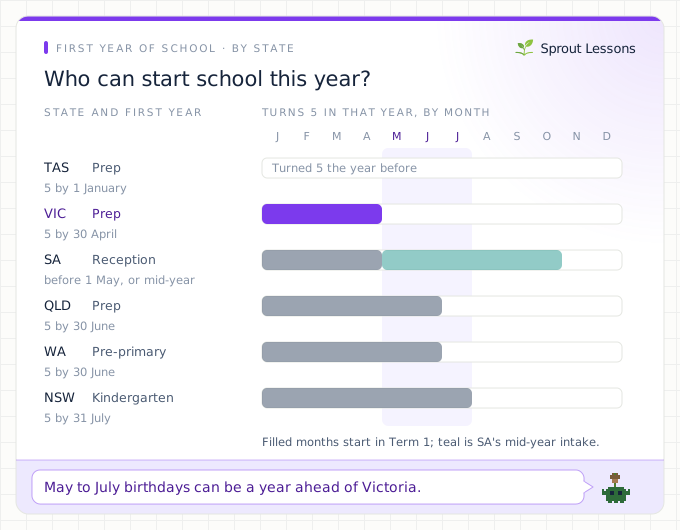
- Victoria: Prep, for children who turn 5 by 30 April of that year. School is compulsory from 6 to 17.
- New South Wales: Kindergarten, for children who turn 5 on or before 31 July. A NSW class can include children three months younger than any Victorian Prep child.
- Queensland: Prep, for children who turn 5 by 30 June. Early entry is possible for July birthdays.
- Western Australia: Pre-primary, the first compulsory year, for children who turn 5 by 30 June. WA Kindergarten is the year before, at 4, and is not the same as Victorian Prep.
- South Australia: Reception from Term 1 for children who turn 5 before 1 May, and a mid-year intake in Term 3 for birthdays from 1 May to 31 October. Mid-year starters do six terms of Reception, which lines them up with Victoria.
- Tasmania: Kindergarten for children who are 4 by 1 January, then Prep the year after. Tasmanian children start Prep older than Victorian ones, and Tasmanian Kindergarten is a part-time program, not the same as Victorian Prep.
We could not open the ACT and Northern Territory education pages when we checked, so they are not in the list; use your own department’s page for those.
The three situations that matter
1. Your child is past their first year: they carry on
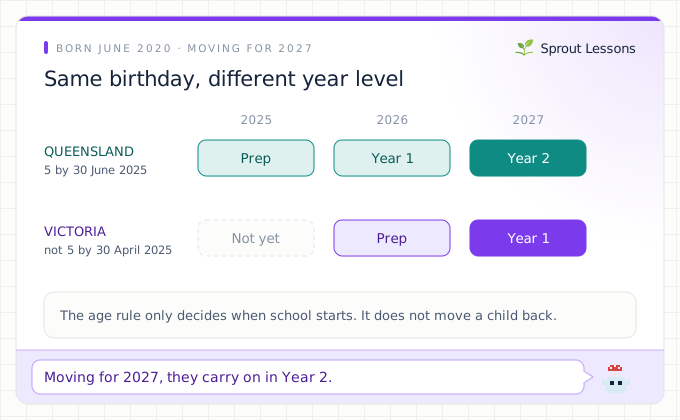
Take a child born in June 2020 who grew up in Brisbane. They turned 5 by 30 June 2025, so they started Prep in 2025, and in 2027 they are going into Year 2. A Victorian child born the same week was not 5 by 30 April 2025, so started Prep in 2026 and goes into Year 1 in 2027. Move the Brisbane child to Melbourne and they go into Year 2: Victoria’s age rule is about whether a child can enrol at all, and at 6 they comfortably can. Nothing in the Department’s enrolment policy sends them back a year. They will simply be among the youngest in their class, as they were in Queensland.
If you think a year down would suit them better, that is a conversation with the principal, and it is the same process as any family asking for a repeat. Our page on repeating a year in Victoria sets out what the principal has to weigh, including the research on children who are young for their year group.
2. Your child is in their first year and turned 5 after 30 April: they need an exemption
This is the one case where the rules get in the way. Say your child was born in July 2021 and started Kindergarten in Sydney in February 2026, aged 4 and a half. You move to Victoria in July. For Victorian enrolment in 2026, your child was not 5 by 30 April 2026, so enrolling them in Prep needs an exemption from the minimum age. It is requested in writing to the school, the principal makes a written recommendation, and the regional director decides.
The child has to show two things: suitable academic ability, and that school is in their best interests. For the first, the Department’s policy names its preferred evidence, and one of the two options is written for exactly this family: for a child transferring from a school in another state or country after more than one term of enrolment and attendance, evidence from that school confirming the child has suitable academic ability. The policy says applications based only on what parents observe will not be accepted. For the second, it says early entry is generally not in a child’s interests unless they were at least 4 years 6 months old on 30 April, which any child born by 31 July comfortably was.
So before you leave, ask the old school for a letter on your child’s progress and readiness, on letterhead. If your child has been at school for less than a term when you move, that route is not open, and the policy’s other preferred evidence is a psychologist’s assessment, which is a much bigger ask. Moving at the end of Term 1 or later avoids that.
If the move is for the start of the next school year instead, the problem disappears: by 30 April of their second year every child is 5, so they enrol in Year 1 like anyone else.
3. Your child has not started school yet: Victoria’s rule applies
A child who has not been enrolled anywhere starts under Victoria’s rule alone. A child born in June 2022 who would have started Prep in Queensland in 2027 is not 5 by 30 April 2027, so in Victoria they start Prep in 2028. Early entry needs the same exemption as above without the old school’s letter to support it, so most of these children start in 2028. Coming from Tasmania works the other way: a child born in February 2021 who is about to start Tasmanian Prep in 2027 could have started Victorian Prep a year earlier, and joins a Victorian Prep class as one of the oldest. Our page on starting Prep in Victoria has the birth-month table.
Which school: zones and what to bring
Every Victorian student has a legislated right to a place at their designated neighbourhood government school, the zoned school for their permanent address. You find it on the Department’s Find my School site by entering the new address. Other schools can take your child if they have room, in the order set by the Placement Policy.
Before you leave, collect:
- Proof of the new address. A rental agreement or an exchanged contract of sale. The Department’s policy says a school may not disregard a lease shorter than 12 months if it genuinely reflects where you live, and if the lease does not yet cover the first day, the school can make the offer conditional on a renewed one.
- The usual enrolment documents. Schools verify name, date of birth, address, residency status, care arrangements and medical needs, and a primary school needs your child’s immunisation certificate.
- The last two school reports, and any learning support plan, assessment or report from a specialist.
- A word with the old school. Tell them where your child is going: interstate transfers go with an interstate student data transfer note from one school to the other.
- For a first-year child born after 30 April, the letter on progress and readiness described above.
If your child is in Year 6, Year 7 placement in Victoria runs on a statewide timeline that finishes mid-year. A late application from a family that lives in the zone keeps its priority; one from out of zone is considered after the on-time applications. Our starting Year 7 in Victoria page covers the year itself.
Arriving mid-year? Sprout builds a short lesson on any Victorian Curriculum code, so you can fill a gap at home without waiting for a school meeting. Try it free.
What changes in the classroom
Victorian government schools teach the Victorian Curriculum F–10 version 2.0, its own version of the Australian Curriculum. Most states teach the Australian Curriculum and NSW has its own syllabuses, so the content is close but the order is not identical. Some differences we have found while writing our by-year pages:
- From NSW, your child may be ahead in places. NSW teaches o’clock in Kindergarten (Victoria waits until Year 2), finds the nearest ten in Stage 1 (Victoria names rounding in Year 4) and starts nouns, verbs and adjectives in Kindergarten. See telling the time by year and rounding by year.
- Written methods in maths. Victoria asks for mental and written strategies from Level 4, and NSW names the vertical algorithm in Stage 2, while the Australian Curriculum names neither. Our addition and subtraction by year page has the detail.
- Victorian extras. Victoria adds cash rounding to the nearest 5 cents in Year 4, and editing writing against agreed criteria in Years 5 and 6.
- The same tests everywhere. NAPLAN is national, so Year 3, 5, 7 and 9 results compare directly across states.
Victorian reports rate your child against the curriculum’s levels, so your first Victorian report may look unfamiliar. Our Victorian school report page explains how to read it, and Victorian Curriculum vs Australian Curriculum covers the two frameworks side by side.
Five questions for the new school
- Which year level will my child go into, and who decides?
- For a first-year child born after 30 April: will you support an age exemption, and what evidence do you want?
- Can my child visit or meet their teacher before the first day?
- How will you find out where they are in reading and maths, and when will you tell me?
- Is there anything taught here in earlier years that my child may have missed?
The short version
- Victoria: Prep if 5 by 30 April. NSW 31 July, Queensland and WA 30 June, SA before 1 May with a mid-year intake, Tasmania later than all of them.
- A child past their first year carries on in the year they have reached.
- A first-year child who turned 5 after 30 April needs a minimum-age exemption; a letter from the old school after more than a term is the preferred evidence.
- Every child has a right to a place at their zoned school. A genuine lease under 12 months counts.
- The Victorian Curriculum is close to the others but not identical; ask what your child may have missed.
Sprout makes a lesson on the exact Victorian code your child is working on, built around what they love. Start free.
How this page was checked
The Victorian rules come from the Department of Education’s Enrolment policy (last updated 25 August 2026): school age requirements and exemptions, determining permanent address, and student transfers between schools. The other states’ starting ages come from the NSW Department of Education’s primary school enrolment page, the Queensland Department of Education’s early entry to Prep fact sheet, the WA Department of Education’s enrolment page, the Tasmanian Department for Education, Children and Young People’s school starting ages page, and, because the South Australian department’s site would not load for us, a South Australian government primary school’s enrolment page quoting the department’s rule. The curriculum comparisons come from our by-year pages, each checked against the Victorian Curriculum and the NSW syllabus. This page is general information; your school and regional office apply the policy to your child. Checked 25 October 2026.
FAQ
Will my child have to repeat a year if we move to Victoria?
Usually not. A child who has finished their first year of school carries on in the year level they have reached. Victoria's age rule, turn 5 by 30 April to start Prep, decides when a child can first enrol, and nothing in the Department's enrolment policy sends an older child back a year. A family that wants a repeat can ask the principal.
My child started Kindergarten in NSW aged 4. Can they continue in Prep in Victoria?
If they turned 5 after 30 April of that year, enrolling them in a Victorian government school that year needs a minimum-age exemption, recommended by the principal and decided by the regional director. The Department's preferred evidence for a child transferring from another state after more than one term of enrolment and attendance is confirmation from that school that the child has suitable academic ability. From the next school year no exemption is needed.
What is the school starting age in Victoria compared with other states?
Victoria: turn 5 by 30 April. NSW: 5 on or before 31 July. Queensland and WA: 5 by 30 June. South Australia: before 1 May for Term 1, with a mid-year intake for birthdays from 1 May to 31 October. Tasmania: children start Prep after a Kindergarten year at 4, so Prep children turned 5 by 1 January.
Do I need a 12-month lease to enrol at my zoned school in Victoria?
No. Every Victorian student has a legislated right to a place at their designated neighbourhood school, and the Department's enrolment policy says a school must not disregard a rental agreement shorter than 12 months if it genuinely reflects where the family lives. If the lease does not cover the first day, the school can make the offer conditional on a renewed one.
What documents do I need to enrol my child in a Victorian school?
Schools verify your child's name, date of birth, address, residency status, care arrangements and medical needs, so bring a birth certificate, proof of address such as a rental agreement or contract of sale, and any health plans. Primary schools also need an immunisation certificate. Recent school reports help the new school place your child.